|  Noise is probably the
most common occupational and environmental hazard. Workplace noise exposes
30 million Americans to potentially harmful levels. Environmental noise
pollution has been doubling every decade. Outdoors, we have become inured
to excessive and potentially damaging noise - power tools, firearms,
recreation vehicles (motorcycles and snowmobiles), amplified sound (the
ubiquitous boom boxes, enclosed and confined automobile music blaring
at rock concert levels) - loud and severe enough to dislodge stubborn
earwax and contribute to more than a third of 28 million Americans with
some degree of hearing impairment. Noise is probably the
most common occupational and environmental hazard. Workplace noise exposes
30 million Americans to potentially harmful levels. Environmental noise
pollution has been doubling every decade. Outdoors, we have become inured
to excessive and potentially damaging noise - power tools, firearms,
recreation vehicles (motorcycles and snowmobiles), amplified sound (the
ubiquitous boom boxes, enclosed and confined automobile music blaring
at rock concert levels) - loud and severe enough to dislodge stubborn
earwax and contribute to more than a third of 28 million Americans with
some degree of hearing impairment.
And to add to the list of hazards,
neither occupational nor environmental, but delivering a concentrate
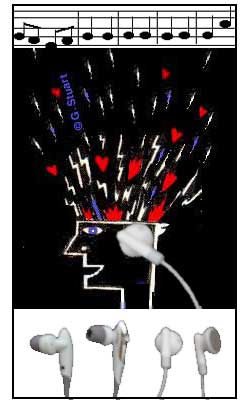
of noise right into the ear canal — music by MP3 or iPod, which
at peak volume can deliver music at 110 to 120 dB, close to live-rock
concert decibel-level.
Loud sound damages the tiny hair cells
in the inner ear which are responsible for converting sound waves into
electrical impulses that are sent to the brain. Hearing loss starts
when 25 to 30% of the hair cells have been destroyed.
| And the past
decade has brought the ear-splitting cochlear-bursting haircell-mowing
MP3 / iPod players, capable of delivering concentrates of music
at concert-level decibels. |
So, it won't hurt to
know your decibels.
Decibels (dB) are measurements of noise. The decibel (dB) is the unit
used for the loudness of a sound, or its sound pressure.
RANGES
|
| Up to 55 dB:
Safe |
| 55 - 75 dB:
Warning |
| 85 dB: Danger zone |
| 132 dB: Noise becomes physically
painful |
| 140 dB: Explosive noise
at this level can cause permanent damage almost immediately. |
|
|
Noise-induced hearing loss is an equation
of volume and duration of sound exposure. Although the ear apparatus
can recover from abuse, constant exposure to excessively loud sounds
can eventually tire out and kill the hair cells with subsequent permanent
hearing loss. The safe limit of noise-exposure has been set at 85 dB
for 8 hours a day. And according to NIOSH (National Institute for Occupational
Safety and Health) an increase of 3 dB cuts safe exposure time in half.
However, the numbers can be
deceiving. For every five decibel increase, the intensity of sound doubles.
A 20 dB sound is ten times louder than a 10 dB sound, and a 30 dB sound,
100 times louder than a 10 dB sound. Permanent damage can occur If your
ears endure 85 dB for eight hours; at 95 dB, it takes only four hours.
Also, a single gunshot, approximately 140 to 170 dB, has the same sound
energy as 40 hours of 90 dB noise.
NIOSH
AND CDC
Prevention Guidelines for Exposure Time for
Continuous Decibels
85 dB - 8 hours
88 dB -- 4 hours
91 dB -- 2 hours
94 dB -- 1 hour
97 dB -- 0 minutes
100 dB -- 15 minutes
103 dB -- 7.5 minutes
106 dB -- less than 4 minutes
109 dB -- less than 2 minutes
112 dB -- less than 1 minutes
115 dB -- about 30 seconds
|
Sound pressure levels are normally
measured in decibels (dB) and this logarithmic scale helps to manage
the method of measuring. But it is not an intuitively easily understood
scale for most people. A 3 dB increase or decrease in sound level equates
to a doubling or halving of the sound level. A 10 dB increase or decrease
represents a tenfold increase or decrease. But this does not readily
translate into what we actually hear. For instance a 3 dB increase or
decrease (doubling or halving) in the sound level of a radio playing
or an aircraft flying overhead, would be virtually imperceptible (this
is the threshold of being able to distinguish between sounds). A tenfold increase in sound level normally equates to a doubling of
loudness and hence it doesn’t directly correspond to changes in
dB sound levels.
Fortunately, decibel levels aren't
additional. Simultaneous house chores with a vacuum cleaner (75 dB),
dishwasher (75 dB), and washing machine (75 dB) do not add up to 225.
A formula adjusts the concurrent exposure to a cumulative level of 81
dB.
Decibel
Levels of Everyday Sounds |
| Human minimum |
0 dB |
| Rustle of leaves |
20 dB |
| Water dripping |
20 dB |
| Soft whisper
(15 feet) |
30 dB |
| Refrigerator humming |
40 dB |
| Quiet office |
40 dB |
| Moderate rainfall |
50 dB |
| Inside an
urban home |
50 dB |
| Light traffic |
50 dB |
| Normal conversation |
50-60
dB |
| Daytime sound
in a quiet suburban neighborhood |
55 dB |
| Noisy restaurant |
70 dB |
| Vacuum cleaner
|
75 dB |
| Dishwasher
|
75
dB |
| Washing machine |
78
dB |
| Busy traffic |
75-80
dB |
| Average factory |
80-90
dB |
| Blow dryer
|
80 -
90 dB |
| Electric razor
|
85 dB |
| Pneumatic
drill (50ft) |
90 dB |
| Lawn mower
|
90 dB |
| Roar of crowd
at sporting event |
90 dB |
| Heavy traffic
(50 ft) |
90 dB |
| Busy Saturday night bar |
95 dB |
| Garbage truck |
100 dB |
| Snowmobile |
100 dB |
| Chain saw |
100 -120 dB |
| Loud shout
(50 ft) |
100 dB |
| Power tools
|
100 dB |
| Leaf blower |
102 dB |
| Stereo headset |
110 dB |
| Live rock music |
108-114 dB |
| MP3 / iPod |
110 - 120
dB |
| Subway train
screech |
115 dB |
| Inside a full-blown
disco |
117 dB |
| Jackhammers |
120 dB |
| Ambulance sirens |
120 dB |
| Rock concert |
120 dB |
| Thunderclap |
120 dB |
| .22 caliber
rifle |
130 dB |
| Low flying
aircraft |
140 - 150 dB |
| Jet take-off
|
140 dB |
| Toy cap gun,
firecracker |
140 dB |
| High-powered
shotgun |
170 dB |
| Rocket launch |
180 dB |
|
 Hearing
loss is inevitable to some due to genetic predisposition or age-related
hearing loss (presbycusis) that can affect a third of the population
by age 65. Presbycusis is a consequence of many years of exposure to
loud noise, smoking, and the ototoxic effect of more than a 130 medications,
some of which are in common use. Hearing
loss is inevitable to some due to genetic predisposition or age-related
hearing loss (presbycusis) that can affect a third of the population
by age 65. Presbycusis is a consequence of many years of exposure to
loud noise, smoking, and the ototoxic effect of more than a 130 medications,
some of which are in common use.
Environmental noise pollution
has been doubling every decade. Hearing loss is increasing in the United
States. The number of Americans ages 3 and older with some form of hearing
disorder has more than doubled since 1971, from 13.2 million to about
30 million today, and of these, a third from noise-induced hearing loss.
Recommendations,
Precautions, Prevention
• Avoid noise that is too loud, too close,
and for long periods of time; those above 85 decibels can cause damage.
• Noise-induced
hearing loss is 100 percent preventable.
•
Ear protection can reduce exposure to unhealthy decibels of sound and
helps prevent noise-induced hearing loss. Earmuffs, custom-fitted plugs,
and disposable earplugs can provide 20 to 40 dB of sound attenuation
and should be used especially by those recurrently exposed to high noise
levels.
• iPod or other personal music player should be used at
60% of the peak volume and for no longer than 60 minutes a day, with
lower volumes for longer listening time.
• Use of noise-canceling headphones or headphones that block competing
background sound will help down-regulate the volume.
• IPod has free software that sets maximum volume on players.
• Earbuds that concentrate and intensify the sound signals have
a greater potential of hearing loss. Because it fits snugly and deeply
in the ear canal, the volume of air and the distance of music source
to eardrum is greatly reduced, doubling the relative level of noise
exposure and reduces the amount of time for safe-listening. Some experts
suggest limiting earbud-delivered music to 30 minutes a day.
• Use earplugs or ear muffs for prolonged exposure to dangerous
levels of noise.
NIHL is 100 percent preventable. All individuals should understand the
hazards of noise and how to practice good hearing health in everyday
life. To protect your hearing:
• Know which noises can cause damage (those at or above 85 decibels).
• Wear earplugs or other hearing protective devices when involved in a
loud activity (special earplugs and earmuffs are available at hardware
and sporting goods stores).
• Be alert to hazardous noise in the environment.
• Protect the ears of children who are too young to protect their own.
• Make family, friends, and colleagues aware of the hazards of noise.
•If you suspect hearing loss, have a medical examination by an otolaryngologist
(a physician who specializes in diseases of the ears, nose, throat,
head, and neck) and a hearing test by an audiologist (a health professional
trained to measure and help individuals deal with hearing loss).
As science wages its war
against deafness, noise is winning the battle. The generation of the pierced
and tattooed has found the ultimate isolationist tool — the iPod/MP3 — cranking out its shattering concentrates of music to the
auditory delight of the zombie'd youth keeping beat and dancing into the
valley of the walking deaf.
|