Gen info
-
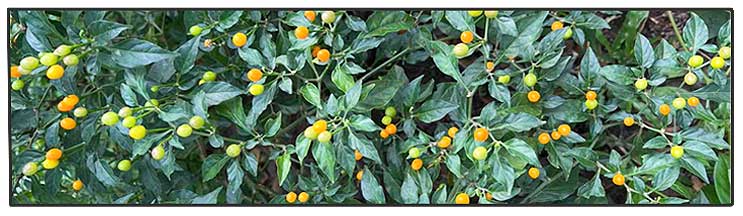
Aji charapita chile pepper is botanically classified as Capsicum chinense. It is a cultivar of Capsicum chinense, native to the Amazon rainforest in Northern Peru.
- Capsicum chinense, commonly known as a "habanero-type pepper, is a species of chili pepper native to the Americas. The hottest peppers in the world are members of this species.
- Taxonomy: The scientific name C. chinensis or C. sinensis (Chinese capsicum) is a misnomer. All Capsicum species originated in the New World. Nikolaus Joseph von Jacquin (1727-1817), a Dutch botanist, erroneously name the species in 1776, believing it originated in China due to its prevalence in Chinese cuisine. It was later found to have been introduced into China by earlier European explorers during the Ming dynasty.
 - Aji charapita is taxonomically distinct from both Capsicum baccatum (Lemon drop) and C. chinense cultivars like Habanero. Genetic analysis by the Universidad Nacional Agraria La Molina (2022) confirmed its status as a unique landrace with high heterozygosity - meaning each plant expresses subtle variations in fruit size, acidity, and heat
profile. - Aji charapita is taxonomically distinct from both Capsicum baccatum (Lemon drop) and C. chinense cultivars like Habanero. Genetic analysis by the Universidad Nacional Agraria La Molina (2022) confirmed its status as a unique landrace with high heterozygosity - meaning each plant expresses subtle variations in fruit size, acidity, and heat
profile.
- Conflict: Some studies on Aji charapita have been confusingly linked with both Capsicum chinense and C. frutescens. This page on Aji charapita links to Capsicum chinense as its scientific name.
- Etymology: Aji charapita derives from aji, the Taino/Spanish term for chili pepper, and charapita, a diminutive referencing of the "charapas" people, a nickname for inhabitants of the Peruvian jungle. (1) Alternatively, the specific epithet derives from the Quechua word charapita, referring to the charapa turtle, whose shell shares the pepper's mottled yellow-green hue and dense knobby texture when immature.
- There are more than 2,500 different chili peppers due to the ease of cross pollination between varieties.
- Hype and Commerce: Aji charapita was touted as the world's most expensive chili pepper, gaining notoriety as a luxury product for its exceptional aromatic profile, miniature size, and complex cultivation, allegedly priced up to up to 25,000 €/kg when dried. But the gold has been squeezed out of these yellow pea-sized nugget of capsaicin. The much hyped and embellished myth has been debunked: Not $25K, but still a Peruvian gem. (4) in the Philippines cybermaket, as low as 10-15 seeds for P90-P150.
- A short-short-too-hot story: An Indian vegetarian guest asked for chili peppers to add zest to his dinner fare: "I want it as hot-hot-as-you-have." My wife served him a few tiny balls of home-grown aji-charapita. He popped one in his mouth, chewed, and immediately starting fanning invisible flaming-hotness spewing from his mouth. The other fireballs remained untouched. No further requests were made for culinary boosting chili.
Botany
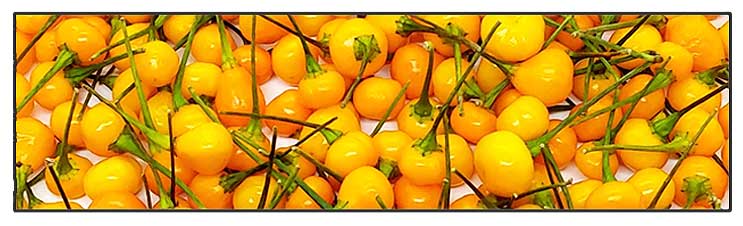
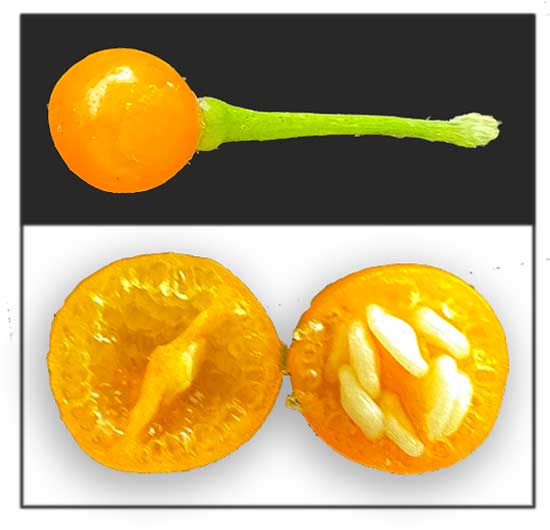
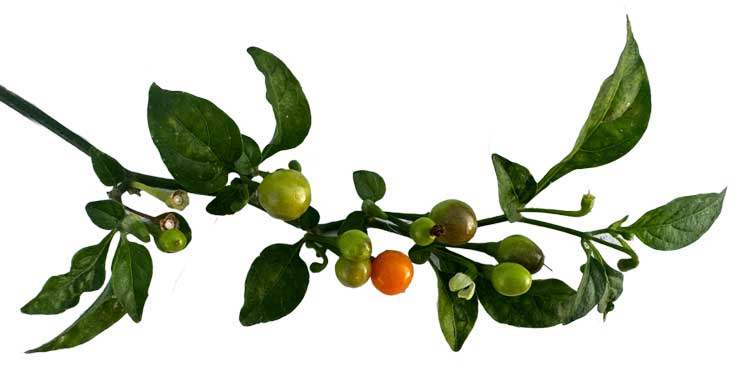
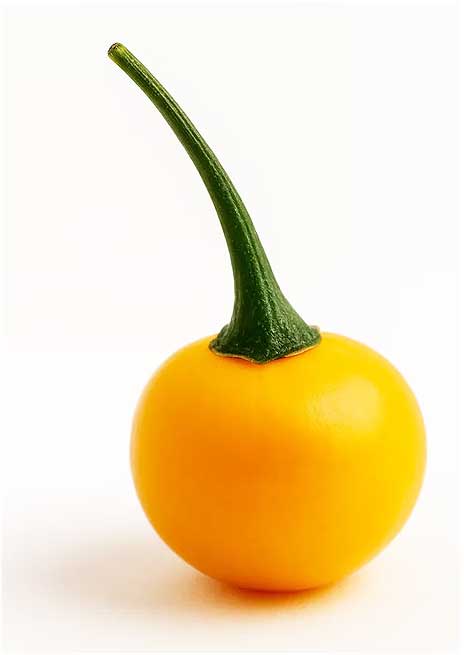
• Ají Charapita is a small varietal, averaging 0.5 to 1 centimeter in diameter, and has a round, slightly tapered, or oblate shape with a slender, straight green stem protruding from the top of the pod. The petite peppers are about the size of a pea and have thin, glossy, firm, taut, and smooth skin, transforming from green to shades of yellow, orange, and yellow-orange when mature. Underneath the surface, the flesh matches its exterior hues and is aqueous, crunchy, and chewy, encasing a cluster of tiny, cream-colored seeds in a central cavity. Ají Charapita has an initially bright, fruity, and citrusy taste followed by a moderate to hot spice level that gradually builds in intensity and has a slow burn. The pepper’s flavor will vary, depending on the coloring, and green pods will showcase grassier, green nuances, while yellow and orange pods have a tangier, sweet, floral, and fruity taste. (1)
Distribution
- Cultivated.
-
Native to the Amazonian jungle regions of Peru.
Constituents
- Antioxidant activity correlated with capsaicinoid content, with C. chinense showed highest FRAP activity of 111.8 µM TE/g. Aji charapita showed phenolics of 1.069 mg/g DW, ABTS 15.074 µM TE/g DW, DPPH 5.723 µM TE/g DW, FRAP 11.658 µM TE/g DW. (see study below) (5)
- Study for capsaicinoid profile revealed capsaicin 3690 µg/g, DHC (dihydrocapsaicin) 466 µg/g, NDHC (nordihydrocapsaicin) 628 µg/g, and pungency of 72,752 Scolville Heat Units (SHU). (see study below) (5)
Properties
- The variety sits in the "super-hot" category, ranging from 50,000-100,000+ SHU (Scoville Heat Units).
- Studies have suggested antioxidant properties.
Parts used
Fruit.
 Uses Uses
Edibility
- The pepper is revered for its fruity flavor with a distinct fruit, citrus aroma like most Capsicum chinense.
- Used in a wide range of savory culinary preparations for added zest; mixed with spice blends. Used as condiments for white meats and grilled vegetables.
- Typically consumed fresh; occasionally dried for extended use. (1)
- In Amazonian cuisine, it is often incorporated as a preventative, in sauces like aji de cocona, or pickled in vinegar or preserved in oil for its medicinal properties.
Folkloric
- No reported folkloric medicinal use in the Philippines.
- In Peru, used in traditional medicine for its high concentration of capsaicin, or pain relief and as digestive aid and to boost metabolism. As medicinal aperitifs, the peppers are infused in alcohol to create medicinal tonics.
- In India, Dried fruits of C. chinense
are widely used for relief of stomach pain. Leaves also used for treatment of headaches. In Cuba, Fiji, and India (Assam), paste from finely powdered leaves applied on boils to facilitate elimination of pus. For arthritis, paste of polyherbal concoction with garlic, ginger, betel nut leaf, sesame and salt applied and massaged with oil. (6)
Others
- Culinary / Cultural: Aji charapita is used in many traditional Peruvian jungle dishes such as Juanes, which is consumed during the June 24th feast of San Juan: a mixture of meat, hard-boiled eggs, spices, and peppers wrapped in bijao leaves. (John the Baptist is the patron saint of the Peruvian Amazon. (1)
Studies
• Note:There are conflicting attributions of studies on Aji charapita to both Capsicum chinense and C. frutescens. From information gathered, Aji charapita is a cultivar of C. chinense.
•
Note: There is a dearth of studies done specifically for Aji charapita (Capsicum chinense Jacq. var charapa). Capsicum chinense (eg., Habanero, Bhut Jolokia) is widely studies for its high capsaicinoid content, with studies suggesting anti-inflammatory, antimicrobial, anticancer, immunomodulatory, analgesic, and antioxidant properties.
•
Capsaicinoid and Antioxidant Profile: Study evaluated the capsaicinoid and phenolic profiles of 47 pepper cultivars, which contribute to their pungency and antioxidant properties. Capsaicinoid profiles revealed species-specific ratios of capsaicin, dihydrocapsaicin, and nordihydrocapsaicin, with C. chinense and C. frutescens showing a capsaicin-dominant 73:25:2 profile. Capsaicinoid profile revealed capsaicin 3690 µg/g, DHC (dihydrocapsaicin) 466 µg/g, NDHC (nordihydrocapsaicin) 628 µg/g, and pungency of 72,752 Scolville Heat Units (SHU). Antioxidant activity correlated with capsaicinoid content, with C. chinense showed highest FRAP activity of 111.8 µM TE/g. Aji charapita showed phenolics of 1.069 mg/g DW, ABTS 15.074 µM TE/g DW, DPPH 5.723 µM TE/g DW, FRAP 11.658 µM TE/g DW. In LPS-activated macrophages, all cultivars suppressed NO production and gene expression levels. Inlelrleukin IL-ß expression was upregulated, with no significant effects on COX-2, IL-6, and MCP-1 mRNA levels. (5)
•
Capsaicinoids: The spiciness or heat of C. chinense is predominantly derived from the substance capsaicin, a phenolic compound primarily found inside the placenta or flesh of the chili fruit. The fruit contains a group of 5 distinct and highly pungent compounds called capsaicinoids: Capsaicin (1), Nordihydrocapsaicin (2), Homocapsaicin (3), Homodihydrocapsaicin (4), and DHC (5). (6)
•
Capsaicin / Vanilloid Receptor / Substance P: Upon consumption, capsaicin diffuses through the lingual epithelium of the oral cavity and specifically binds to a receptor - the transient receptor potential vanilloid 1 (TRPV1 receptor), causing it to open and initiating the influx of calcium that triggers the release of neurotrans-miitters, leading to the sensation of warmth with low capsaicin concentrations and burning pain with higher concentrations. Prolong activation of the receptor results in depletion of substance P, a neuro-transmitter involved in pain transmission, which reduces the responsiveness to capsaicin. (6)
Availability.
- Wild-crafted.
- Seeds, fruits in the
cybermarket |