
HOME      •      SEARCH      •      EMAIL    •     ABOUT


Family Fabaceae
Akle
Sohmaea laxiflora (DC) H.Ohashi & K.Ohashi
LOOSE-FLOWERED DESMODIUM

Da ye na shen cao

Scientific names Common names
Desmodium laxiflorum DC. Akle (Tag.)
Meibomia laxiflora (DC.) Kuntze Loose-flowered desmodium (Engl.)
Sohmaea laxiflora (DC.) H. Ohashi & K.Ohashi  
Accepted infraspecifics (2)  
Sohmaea laxiflora subsp. lacei  
Desmodium lacei Schindl.  
Desmodium laxiflorum subsp. lacei (Schindl.) H. Ohashi  
Sohmaea laxiflora is an accepted species. KEW: Plants of the World Online

Other vernacular names
CHINA: Da ye na shen cao.
INDIA: Porongkhok manbi (Manipuri); Asud, Bhut-sheura, Jangli-ganja (Marathi); Atotti (Tamil); Orila (Malayalam); Antunthalu, Cheppa thatla (Telugu); Otte gida (Kannada); Jangli ganja (Konkani); Kuro jhar (Nepali); Parsniparn (Sanskrit); Chabetban (Mizo); Bionisapota; Lotkani (Bengal).

Gen info
- Sohmaea is a genus of flowering plants in the family Fabaceae, comprising seven species of herbs, shrubs, and subshrubs characterized by linear loments, 1- to 3-foliate leaves, and 4-lobed calyces with nearly equal lobes. (2)
- The genus was circumscribed by Hiroyoshi Ohashi and Kazuaki K. Ohashi in 2018.
- The genus was originally classified under the genus Desmodium. In 2018, the genus Sohmaea was formally established by H. & K.Ohashi through phylogenetic analysis that confirmed the distinct evolutionary lineage of these species from core Desmodium. (2)
- Etymology: The genus name Sohmaea honors Kankichi Sohma (1926-1995), a Japanese botanist professor of Tohoku University, recognized for his pioneering contributions to pollen morphology and Palynology within the Leguminosae family. (2)

Botany
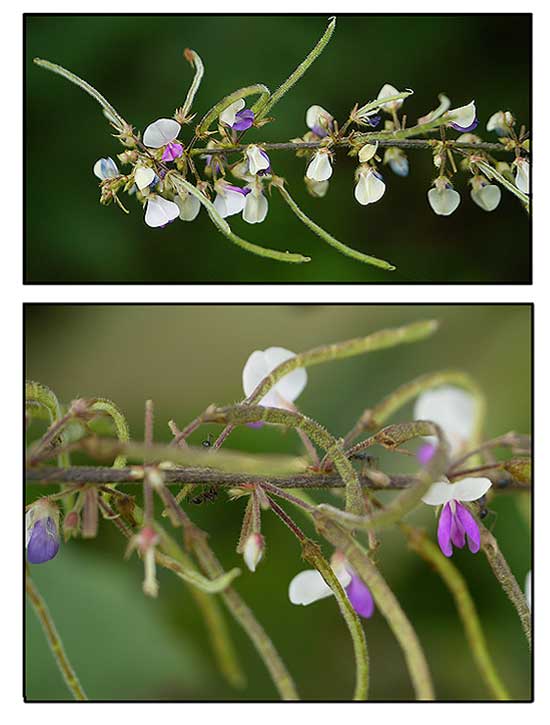
Subshrubs or shrubs, erect, 30-120 cm tall. Young branch­lets with adpressed and minute hooked hairs. Leaves 3-folio­late; petiole 1.5-4 cm; terminal leaflet blade ovate or ovate-elliptic, 9-19 × 3-8 cm, abaxially densely yellow sericeous, adaxially sparsely adpressed hairy, lateral veins 9-12, apex shortly acuminate. Racemes terminal and axillary, often 2 axil­lary, to 28 cm; rachis pubescent intermixed with minute hooked hairs, 2-7-flowered, fascicled. Pedicel 5-10 mm, densely hairy as rachis. Calyx densely villous; upper lobes entire or nearly so at apex. Corolla white to violet, 4-7 mm; standard broadly obo­vate or orbicular; wings auriculate and clawed; keel clawed. Legume linear, 2-6 cm, with dense, minute, hooked hairs, 4-12-jointed, both sutures nearly not constricted between articles; articles oblong. (Flora of China)

• Loose Flowered Desmodium is an undershrub, growing up to 60-150 cm tall. Flowers are born in racemes, 15-25 cm long, at the end of branches and in leaf axils. Bracts and bracteoles are linear, acute. Flower stalks are 5-7.5 mm long. Sepal cup is 2.5-3.0 mm long, bristly, teeth slightly exceeding the tube, can often be reddish. Flowers are 6-7 mm long, varying in color from violet to having white standard and blue wings and keel. Stem is woody, and is velvety when young. Leaves are divided into 3 leaflets. Leaf stalk is 2.0-7.5 cm long, the central leaflet is 7.0-15 cm long, 3.0-7.0 cm broad, other two are smaller. Leaflets are ovate, elliptic or broadly lance-shaped, narrow tipped or nearly blunt. Fruit is 2.5-4.5 cm long, 6-10-jointed. (Flowers of India)

Distribution
- Native to the Philippines. (1) (3)
- In Balabac, Batan, Jolo; in Luzon: Abra, Benguet, Laguna, Pampanga, Rizal.
- In dry wastelands; 500-680 m. (3)
- Also native to Andaman Is., Assam, Bangladesh, Borneo, China South-Central, China Southeast, East Himalaya, Hainan, India, Jawa, Laos, Lesser Sunda Is., Malaya, Maluku, Myanmar, Nepal, New Guinea, Nicobar Is., Pakistan, Sulawesi, Sumatera, Taiwan, Thailand, Vietnam, West Himalaya. (1)

Constituents
- Study of Desmodium laxiflorum aerial parts isolated 3 compounds characterized as apigenin, taxifolin, and pentacosanyl-ßD-glucopyranoside. (6)

Parts used
Leaves, stems, roots.

Uses

Edibility
- Seeds and pods are edible.
- Roots used for making herbal tea.

Folkloric
- No reported medicinal use in the Philippines.
- Plant decoction used for management of irregular menstrual cycles.
- Extracts used for treatment of dysentery and diarrhea.
- Roots have been used in treatment of smallpox, vomiting, unconsciousness, and fever.
- In India, plant roots used as substitute for S. gangeticum (Sharlparni), a prominent ingredient in the Ayurvedic medicine Laghupancamoola. (see study below) (7)
- Among the Mishing community of Northeast India, infusion of leaves drunk for urinary infection. (5)
- The tribes of Santhal pargana region of Bihar, Dhemaki and Golaghat district of Assam use whole plant for treatment of stomachache and fever: Whole plant is pounded, mixed with water and drunk. For gyne-cological disorders, decoctions of leaves and stems taken for menstrual cycle irregularity and for infection of the uterus. For jaundice, roots are crushed and boiled in water, and extract mixed with powder of 3 fruits of Piper longum, taken daily for 10-15 days.
Others

- Agrofrestry: A versatile shrub legume, used as high-quality green manure, forage crop, and soil-cover plant. Reported to fix atmospheric nitrogen, which helps enrich degraded coils, control weeds, and provide for intercropping.

Studies
Ayurvedic Substitute for Desmodium gangeticum:
Shaliparni is one of the Laghupanchamoola indredients. Desmodium gangeticum is an accepted source of Shaliparni as per Ayurvedic pharmacopoea of India. Desmodium laxiflorum has been used as a substitute in the Saurashtra region. Study compared the two species on basis of pharmacognostical profiles using root powders to ascertain its Rasa by dilution method. Both showed the same Rasa and Anurasa i.e., Madhura and Kashaya and almost same morphological and microscopical characters like prismatic crystals, starch grains, etc. Study concludes D. laxiflorum may be considered a substitute for D. gangeticum. (7)

Availability
- Wild-crafted.

June 2026

                                                 PHOTOS / ILLUSTRATIONS
IMAGE SOURCE: Desmodium laxiflorus - Loose-flowered Desmodium / by Jeevan Jose / © 2016 Jee & Rani Nature Photography / CC BY-SA 4.0 / Images modified / Click on image or link to go to source page / Wikimedia Commons
OTHER MAGE SOURCE: Desmodium laxiflorus - Loose-flowered Desmodium / by Dinesh Valke / CC BY-SAR 2.0 Generic / Image modified / Click on image or link to go to source page / Wikimedia Commons
IOTHER MAGE SOURCE: Desmodium laxiflorum DC / by Dinesh Valke / CC BY-SAR 2.0 Generic / Image modified / Click on image or link to go to source page / Wikimedia Commons

Additional Sources and Suggested Readings
(1)
Sohmaea laxiflora / KEW: Plants of the World Online
(2)

Sohmaea / Grokipedia
(3)
Fabaceae: Sohmaea laxiflora / Co's Digital Flora Database
(4)
CHAPTER 5 - Menstrual Wellness and Menstrual Problems / Aviva Romm, Bevin Clare, Jill E Stansbury, Linday Ryan, Ruth Trickey, Laurel Lee, Angela J Hywood / Botanical Medicine for Women's Health, 2010; pp 97-185 / DOI: 10.1016/B978-0-4443-07277-2.00007-6
(5)
Quantitative documentation of traditionally used medicinal plants and their significance to healthcare among the Mishing community of Northeast India / Dipankar Borah et al / Ecological Questions, 2021; 32(4) / DOI: 10.12775/EQ.2021.034
(6)
Chemical constituents of desmodium laxiflorum / YN Shukla, A Pande / Indian Drugs, 2001: 38(1)
(7)
A comparative pharmacognostical profile of Desmodium gangeticum DC. and Desmodium laxiflorum DC. / Bhavesh D Vaghela, Bhupesh R Patel, Preeti N Pandya / AYU, 2012, 33(4): pp 552-556 / PMCID: PMC3665189  PMID: 23723675 / DOI: 10.4103/0974-8520.110522
(8)
A review on Shalparni (Desmodium gangeticum DC.) and Desmodium species (Desmodium triflorum DC. & Desmodium laxiflorum DC.) – Ethnomedicinal perspectives / Suman Singh, Nehar Parmar, Bhupesh Patel / Journal of Medicinal Plant Studies, 2015; 3(4): pp 38-43 / ISSN: 2320-3862
(9)
The biological active compounds and biological activities of Desmodium species from Indian region: a review / Bhoomi R Joshi, Masuma M Hakim, Illa C Patel / Beni-Suef University Journal of Basic and Applied Sciences, 2023; 12(1) / DOI: 10.1186/s43088-022-00339-4

DOI: It is not uncommon for links on studies/sources to change. Copying and pasting the information on the search window or using the DOI (if available) will often redirect to the new link page. (Citing and Using a (DOI) Digital Object Identifier)

                                                            List of Understudied Philippine Medicinal Plants
                                          New plant names needed
The compilation now numbers over 1,750 medicinal plants. While I believe there are hundreds more that can be added to the collection, they are becoming more difficult to find. If you have a plant to suggest for inclusion, native or introduced, please email the info: scientific name (most helpful), local plant name (if known), any known folkloric medicinal use, and, if possible, a photo. Your help will be greatly appreciated.

HOME      •      SEARCH      •      EMAIL    •     ABOUT