
HOME      •      SEARCH      •      EMAIL    •     ABOUT


Family Solanaceae
Bagan-bagan
Lycianthes biflora (Lour.) Bitter
TWIN-FLOWERED NIGHTSHADE

Hong si xian

Scientific names Common names
Lycianthes biflora (Lour.) Bitter Bagan-bagan (Tag.)
Solanum biflorum Lour. Biflorus lycianthes (Engl.)
Accepted infraspecifics (2) Twin-flowered nightshade (Engl.)
Lycianthes biflora var. biflora Two-flowered Lycianthes (Engl.)
Lycianthes biflora var. mollissima (Blume) Bitter Two-flowered red silkyarn (Engl.)
Solanum biflorum var. corynephorum Kuntze  
Solanum calleryanum Dunal  
Solanum decemdentatum Roxb.  
Solanum decemfidum Nees  
Solanum diphyllum Osbeck  
Solanum javanicum Dunal  
Solanum mindanaense Elmer  
Solanum mollissimum Blume  
Solanum multifidum Buch.-Ham. ex D.Don  
Solanum osbeckii Dunal  
Solanum osbeckii var. stauntonii Dunal  
Solanum roxburghii Dunal ex D.Don  
Solanum stauntonii Dunal ex D.Don  
Solanum zollingeri Dunal  
Solanum zollingeri var. multiflorum Dunal  
Lycianthes biflora var. subtusochracea Bitter  
Lycianthes biflora (Lour.) Bitter is an accepted species. KEW: Plants of the World Online

Other vernacular names
CHINA: Hong si xian, Da chi hong si xian, Maoyao.
JAPAN: Mejiro-hozuki.
VIETNAM: Ca hai hoa, Hong tu ngu, Huyet kien sau, Ca ngu.

Gen info
- Lycianthes is a genus of plants from the nightshade family, Solanaceae, found in both Old World and New World, predominant in the latter. It contains over 150 species, mostly from tropical America, with 35-40 species in Asia and the Pacific. (3)

Botany
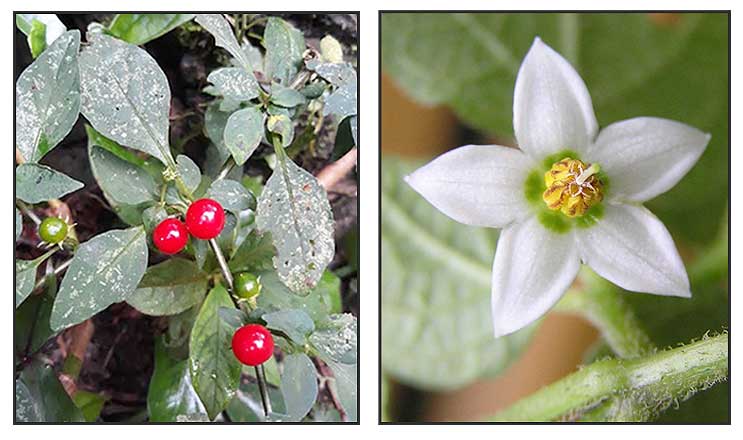
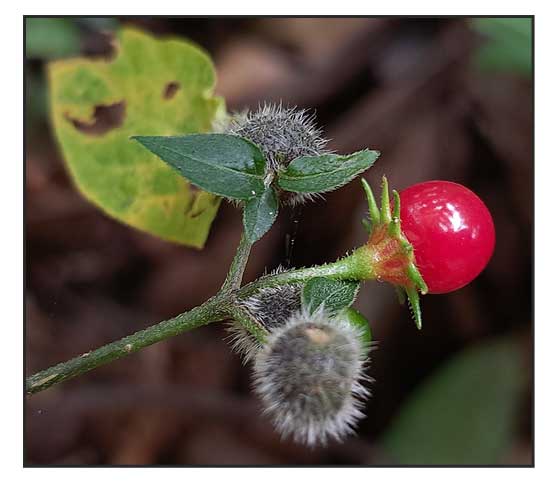
Shrubs or subshrubs 0.5-1.5 m tall; pubescence yellowish, of simple, often moniliform hairs mixed with many-celled ones. Petiole 0.5-4 cm; leaf blade dimorphic; blade of major leaf elliptic-ovate, 9-15 × 3.5-7 cm, sparsely pubescent adaxially, denser abaxially, base cuneate, apex acute or acuminate; blade of minor leaf broadly ovate, 2.5-4 × 2-3 cm, base broadly rounded and decurrent, apex acute. Inflorescences several-flowered fascicles in leaf axils. Pedicel 0.5-2 cm. Calyx cup-shaped, 3-6 × 3-3.5 mm, 10-dentate; teeth linear-subulate, 2-3 mm. Corolla pale purple or white, often drying dark, stellate, 8-12 × 8-10 mm; lobes lanceolate, 6 × 1.8 mm. Filaments ca. 1 mm; anthers ca. 3 mm, sometimes pubescent adaxially. Style 8-9 mm. Fruiting pedicel 1-2 cm. Fruiting calyx densely pubescent with simple and branched hairs; teeth elongate, 3-3.5 mm. Berry red, globose, 6-9 mm in diam. Seeds numerous, pale yellow, ovate to subdeltate, ca. 2 ×1.5 mm, reticulate. (Flora of China)

Distribution
- Native to the Philippines. (1) (2)
- Also native to Andaman Is., Assam, Bangladesh, Bismarck Archipelago, Borneo, Cambodia, China South-Central, China Southeast, Christmas I., East Himalaya, Hainan, Japan, Jawa, Laos, Lesser Sunda Is., Malaya, Maluku, Myanmar, Nansei-shoto, Nepal, New Guinea, Nicobar Is., Taiwan, Thailand, Vietnam. (1)
- In Luzon: Albay, Benguet, Camarines Sur, Catanduanes, Laguna, Rizal, Sorsogon; in Mindanao: Agusan del Norte, Lanao del Sur; Mindoro, Palawan, Panay. (2)

Constituents
- Study for chemical constituents identified: bifloride A (1), N-trans-cinnamoyltyramine (2), liquiritigenin (3), N-trans-p-coumaroyloctopamine (4), 1-O-beta-D-glucopyranosyl-2-N-2'-hydroxypalmitoyl-sphinga-4-trans-8-trans-dienne (5). (see study below) (4)
- Study of roots isolated an alkaloid identified as 2α-hydroxysoladulcidine [(25R)-5α,22αN-spirosolane-2α,3β-diol]. (6)

Properties
- Studies suggest P388 inhibitory, oxalate oxidase properties.

Parts used
Leaves, fruits.

Uses

Edibility
- No information found on edibility.
Folkloric
- No reported folkloric medicinal use in the Philippines.
- In Vietnam, used for treatment of bronchitis; leaves for treatment of pimples. (7)
- In Chinese medicine, used for cough, asthma, dysentery, pyretic stranguria, bites by mad dogs, furunculosis, swelling, traumatic bleeding. (9) For heat furuncles, fresh fruit is pestled and applied to affected lesions
Others

- Polyherbal Invention: Lycianthes biflora is a 6-12% component of a polyherbal mix of 8 traditional Chinese herbs for a preparation for relief of cough and reduction of phlegm.

Studies
NTCT / P-388 Inhibitory Effects:
Column chromatography study isolatd five compounds from the plant. Compound 2, N-trans-cinnamoyltyramine (NTCT), showed inhibitory effects on P-388 (Murine leukemia P388 cells). (see constituents above) (4)
Oxalate Oxidase Activity: Study evaluated 5 Chinese herb species, Lycianthes biflora, B. cusia, A. japonica, K. daigremontiana, C. stauntonii, for oxalate oxidase activity. All five showed high activities, with enzyme stability in range of 35-60°C, and those from L. biflora, Aj, and Kd were not inhibited by NaCl and CaCl2 nor hydrolyzed by pepsin, indicating high application potential. (5) (Oxalate oxidase - OxOx- is a manganese-containing enzyme found in plants, fungi, and bacteria that catalyzes oxidation of oxalate into CO2 and H2O2, playing a key role in plant defense, a diagnostic tool for measuring oxalate in biological fluids, and has potential for treatment of kidney stones. SD).
Inhibitory Effect on Proliferation of HSCs-T6 Cells: Study showed Lycianthes biflora polysaccharide can inhibit the proliferation of mouse hepatic stellate HSCs-T6 cells in rats with a mechanism associated with the inactivationof endogenous TGF-ß pathway for reducing collagen production. (10)

Availability
Wildcrafted.

March 2026

                                                 PHOTOS / ILLUSTRATIONS
IMAGE SOURCE: Lycianthes biflora flower / by 阿橋 HQ / CC BY-SA 2.0 / Click on image or link to go to source page / Wikipedia
OTHER IMAGE SOURCE: Lycianthes biflora - Fruiting leaves / © Tuy Phong Luong / Image modified / Click on image or link to go to source page / ePHARMACOGNOSY
OTHER IMAGE SOURCE: Lycianthes biflora (Mejiro-Hozuki) / © vrxz / Some rights reserved / CC BY SA 4.0 / Image modified / Click on image or link to go to source page / iNaturalist

Additional Sources and Suggested Readings
(1)
Lycianthes biflora / KEW: Plants of the World Online
(2)

Lycianthes biflora / Co's Digital Flora of the Philippines
(3)
Lycianthes / Wikipedia
(4)
Studies on the chemical constituents of Lycianthes biflora / Gungzhong Yang, Songgiao Zhao, Yuan-Chao Li / Yao xue xue bao = Acta Pharmaceutica Sinica
(5)
Activity and characteristics of Oxalate oxidase from five plant species at three harvests. / Wang Yong Feng, Dong Deng Feng / Southwest China Journal of Agricultural Sciences, 2008; 21(3): pp 625-6287
(6)
2α-Hydroxysoladulcidine from Lycianthes biflora / Helmut Ripperger, Andrea Porzel / Phytochemistry, 1992; 31(2): pp 725-726 / DOI: 10.1016/0031-9422(92)90077-4
(7)
Lycianthes biflora Bitter / Pharmacognosy
(8)
Cough relieving and phlegm reducing preparation extracted from Chinese medicinal herbs
/ CN103933192A / GooglePatents
(9)
Lycianthes biflora / Medicinal Plant Images and Database / School of Chinese Medicine
(10)
Inhibitory effect of red thread polysaccharide on proliferation of mouse hepatic stellate HSCs-T6 cells and its mechanism / He Silu, Guo Xiaobao, Xu Lingxuan, Jiao Aijun / China Pharmacy, 2016; 27(4)

DOI: It is not uncommon for links on studies/sources to change. Copying and pasting the information on the search window or using the DOI (if available) will often redirect to the new link page. (Citing and Using a (DOI) Digital Object Identifier)

                                                            List of Understudied Philippine Medicinal Plants
                                          New plant names needed
The compilation now numbers over 1,750 medicinal plants. While I believe there are hundreds more that can be added to the collection, they are becoming more difficult to find. If you have a plant to suggest for inclusion, native or introduced, please email the info: scientific name (most helpful), local plant name (if known), any known folkloric medicinal use, and, if possible, a photo. Your help will be greatly appreciated.

HOME      •      SEARCH      •      EMAIL    •     ABOUT