 Gen info Gen info
- Phyllanthus is the largest genus in the plant family Phyllanthaceae with an estimated and varying number of species from 750 to 1200. It includes a remarkable diversity of growth forms including annual and perennial herbs, shrubs, climbers, floating aquatics, and pachycaulous succulents. (4)
- Phyllanthus was first first described by Carl Linnaeus in 1753, with Phyllanthus niruri designated as type species.
(4)
- Breynia cernua under whose name many studies were published
was transferred to the genus Phyllanthus. A paper by Warren L Wagner and David H Lorence, including Glochidion PhytoKeys (2011), proposed submerging the genera Breynia, Glochidion, Reverchonia, Phyllanthodendron, and Sauropus into a broadened concept of the genus Phyllanthus. While the 2014 proposal has not yet been fully accepted. (5)
- Etymology: The genus name Breynia honors honors the 17th-century Polish-German botanist Jacob Breyne. The specific epithet cernua derives from Latin, meaning "drooping", or "nodding", or "facing downwards", referring to the characteristic weeping branch habit; and, hence, the common name: "Weeping Breynia". The common name Fart Bush derives from the offensive smell produced by the leaves when crushed.
Botany
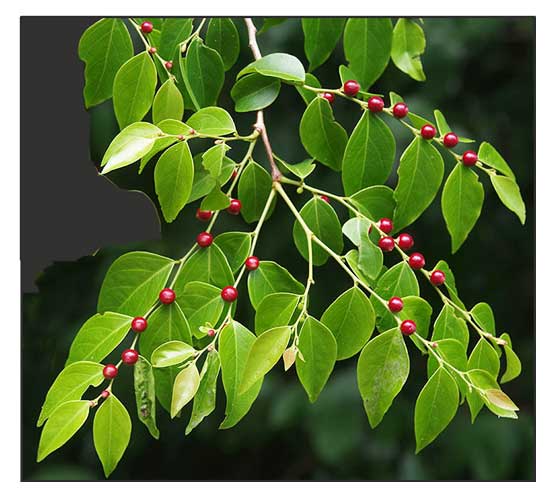
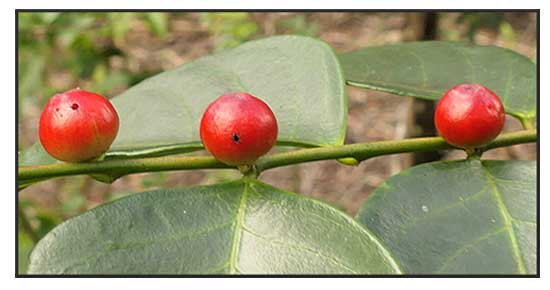
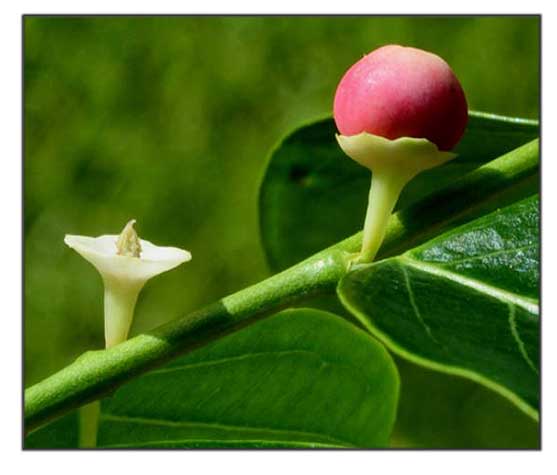
• A shrub or treelet, up to 2(-7) m tall, glabrous. • Leaves: Ovate, 1.7-6.5 cm × 1.2-3.7 cm, length width ratio 1.3-2.1, base attenuate to cuneate, apex obtuse to bluntly acute, margin entire, flat, papery, light green above, tinged glaucous underneath, petiole 1.5-4 mm long, stipules 1.5-2.5 mm long. Flowers: Staminate flowers 1-1.5 mm in diameter, pedicel 2.5-4 mm long, calyx about 1-1.5 mm long, very thick, green, lobes rim-like, androphore 0.7-1 mm high, anthers about 0.7 mm long; pistillate flowers about 3.5 mm in diameter, pedicel about 1.7 mm long, calyx about 2.8 mm long, flat, accrescent in fruit up to 11 mm in diameter, red, lobes about 1.7 mm wide, ovary with stigmas very short, undivided. Fruit: Fruit about 3.5-4 mm × 6-7 mm, red turning black when mature. Seed: Seed 2.5 mm × 3.3 mm × 2 mm.
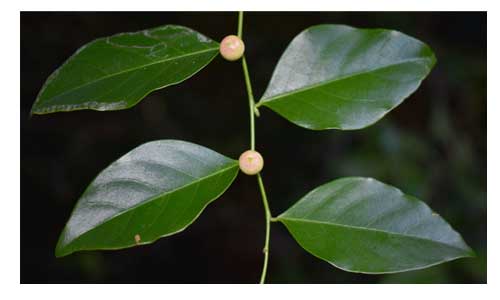 • Shrub or tree to 6 m high, glabrous. Stipules triangular, 0.8–1.5 mm long, green. Branchlet leaves: petiole 3.8–6.3 mm long; lamina ovate, rarely elliptic, 15–100 mm long, 10–47 mm wide, obtuse, sometimes emarginate, discolorous. Male flowers 2–5 per fascicle; perianth obconical; tube c. 2 mm long, truncate; scales exserted, obtuse; androphore exserted. Female flowers 1 or 2 (–3) per cluster; perianth ± obconical, 1–1.3 mm diam.; tube 1.5–2 mm long, truncate or lobes to 1.2 mm long, obtuse or acute; ovary narrowly ovoid or ellipsoid, c. 0.6 mm diam., exserted. Fruit ellipsoid or subglobose, 5.5–9 mm diam., sometimes centrally depressed or beaked, glabrous, white, yellow or pink; fruiting pedicels to 5.5 mm long; fruiting perianth discoid, 5.2–7 mm diam., green. Seeds 3.6–4.6 mm long, grey-brown. • Shrub or tree to 6 m high, glabrous. Stipules triangular, 0.8–1.5 mm long, green. Branchlet leaves: petiole 3.8–6.3 mm long; lamina ovate, rarely elliptic, 15–100 mm long, 10–47 mm wide, obtuse, sometimes emarginate, discolorous. Male flowers 2–5 per fascicle; perianth obconical; tube c. 2 mm long, truncate; scales exserted, obtuse; androphore exserted. Female flowers 1 or 2 (–3) per cluster; perianth ± obconical, 1–1.3 mm diam.; tube 1.5–2 mm long, truncate or lobes to 1.2 mm long, obtuse or acute; ovary narrowly ovoid or ellipsoid, c. 0.6 mm diam., exserted. Fruit ellipsoid or subglobose, 5.5–9 mm diam., sometimes centrally depressed or beaked, glabrous, white, yellow or pink; fruiting pedicels to 5.5 mm long; fruiting perianth discoid, 5.2–7 mm diam., green. Seeds 3.6–4.6 mm long, grey-brown.
(Flora of Australia)
Distribution
- Native to the
Philippines. (2) (3)
- In Batan and Luzon to Palawan and Mindanao. Common in thickets at low and medium elevation; up to 1500 m.
(3)
- Also native to Bismarck Archipelago, Borneo, Jawa, Lesser Sunda Is., New Guinea, New South Wales, Northern Territory, Queensland, Solomon Is., Sulawesi, Sumatera, Western Australia.
 Constituents Constituents
- GC-MS analysis of methanol extract of stem
showed 45 bioactive compounds consisting of cyclic, alkyl halide, organpsulfur, and organoarsenic compounds. Blind docking study to analyze the binding affinity of each metabolite against various target proteins unveiled two compounds, namely N-[ß-hyddroxy-ß-
[4-{1-adamantyl-6,8-dichloro]quinolyl]ethyl]piperidine and 1,3-phenylene, bis(3-phenylpropenoate) with binding affinity varying from -8.3 to -10.8 kcal/mol.
(see study below) (6)
- Phytochemical screening of aerial parts revealed primary phytochemicals of proteins, carbohydrates, and lipids; and secondary metabolites of alkaloids, glycosides, tannins, saponins, terpenoids, and resins. Metals such as Cl, K, Mg, and Ca were in high percentage, while Cr, Fe, Co and Ni were in lower percentage.
(see study below) (7)
Properties
- Studies have suggested antibacterial, antifungal, antioxidant, anti-Plasmodial, anticancer, anti-Parkinson, nickle-hyperaccumulator properties.
Parts used
Leaves, bark, stem.
 Uses Uses
Edibility
- No information found on edibility.
Folkloric
- No reported folkloric medicinal use in the Philippines.
- In Java, pounded leaves are applied to swollen legs. In New Guinea, leaves are heated in salt water and mixed with lime are rubbed on sores and ulcers. (1)
- Decoction of boiled leaves mixed with other herbs used to wash patients with malaria and diarrheal complications. (1)
- Leaf sap drunk to soothe coughs. (5)
- In Indonesia, used for treatment of small pox and wounds. In Papua, used as traditional medicine for cervical and breast cancer. (6)
- Infusion of bark used for treatment of dysentery.
- Used for treatment of wounds, smallpox, cervical cancer and breast cancer.
Studies
• Antioxidant / Antibacterial / Antiplasmodial / Anticancer / Stem: In vitro study of methanol extract of B. cernua stem showed antioxidant activity on DPPH and SOD assays with IC50s of 33 and 8.123 ppm, respectively. Extract exhibited antibacterial activity against Staphylococcus aureus with MBC of 18754 ppm. Extract at concentration of 1-2 ppm protected erythrocytes from the ring formation stage of Plasmodium falciparum. At concentration of 1600 ppm, the extract induced apoptosis in the MCF-7 breast cancer cell line. (see constituents above) (6)
• Antimicrobial / Stem, Root Bark: Ethyl acetate or butanol extract of B. cernua stem hardwood and methanol extract of stem bark exhibited broad-spectrum antibacterial activities against Micrococcus luteus, M. roseus, Bacillus coagulans, B. cerus, B. megaterium, B. subtilis, Citrobacter freundii, Lactobacillus casei, Staphylococcus aureus, S. epidermis, Salmonella typhi, Serratia marcescens among others. Butanol and methanol extra t of root bark demonstrated antifunal activities against Aspergillus niger, A. versicolor, A. vitis, Candida albicans, C. tropicalis, Tricophyton rubrum among others. (6)
• Anti-Parkinsonism / Antioxidant: Study evaluated the anti-Parkinson's (PD) potential of B. cernua against paraquat-induced Parkinsonism symptoms in animal models and mechanisms involved. DPPOH, NO-scavenging, and Ferrous reducing power assays showed 78.02%, 48.05%, and 71.45% inhibitions, respectively. There was significant improvement in motor functions and coordination in a dose dependent manner in the PD rat model. AChE level was significantly reduced (p<0.05) at 500 mg/kg while neurotransmitters were significantly improved (P<0.001) in a dose dependent manner. ELISA results showed significant (p<0.001) down-regulation of IL-6 and TNF-α. Biochemical markers SOD, CAT, GPx and GSH showed significant restoration (p<0.001) while MDA showed significant decrease (p<0.05). Results suggest BCE has potential to reduce PD symptoms. (7)
• Cytotoxicity Testing: Study evaluated the cytotoxic activity of B. cernua extract and its fractions. Cytotoxicity activity testing of breast cancer MCF-7 cell line from 96% ethanolic extract and 3 fractions: n-hexane, ethyl acetate, and water fractions showed 246.841 ppm, 165.65 ppm, 562.57 ppm, and 713.78 ppm respectively. IC50 for doxorubicin as positive control was 6 µM. TLC and phytochemical screening revealed alkaloids, terpenoids, flavonoids, and tannins. (8)
• Phytoremediation of Nickel: Breynia cernua found in Acoje Mine, Zambales, was discovered to be a potential nickel hyperaccumulator. Leaf nickel concentrations of > 1,000 ppm classifies it as a hyper-
accumulator. The leaves accumulated 4,837.6 to9,196.5 ppm, while roots accumulated least at 500.0-1,846.5 ppm. Results indicate a translocation factor of >1, which supports the criterion for a hyper-
accumulator. (9)
Availability
- Wild-crafted.
|