Gen info
- Medicago lupulina, commonly known as black medik, nonesuch, or hop clover, is a plant of dry grassland belonging to the legume or clover family, Fabaceae. It is native to Africa and Eurasia. (3)
- Etymology: The genus name Medicago derives from Latin medica, from Ancient Greek Medike (Median), because alfalfal in the same genus was believed to have been introduced from the region of Media (now in Iran) in antiquity. The specific epithet lupulina means "wolf-like", referring to the hop or willow-wolf. The scientific name is a translation of the common name "hop clover". (3)
Botany
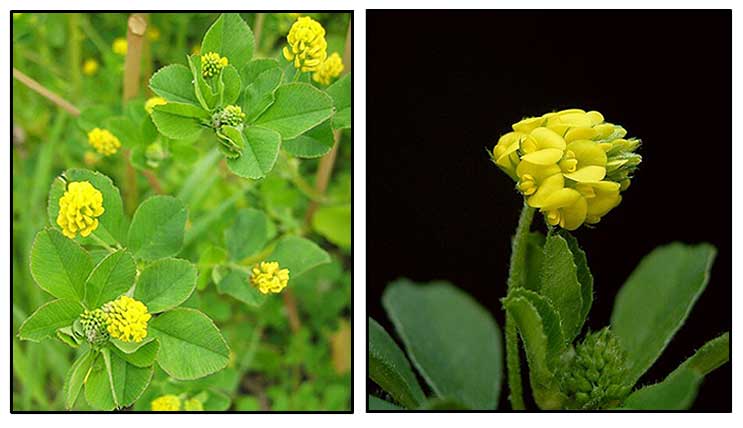
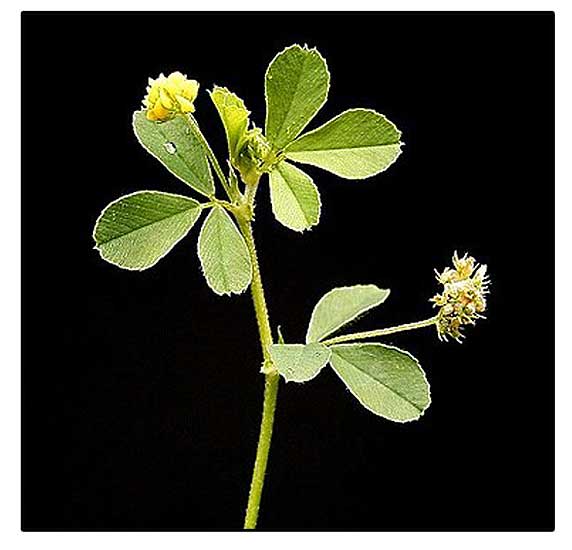
• Medicago lupulina is an annual or short-lived perennial plant, growing each year from adventitious buds on the roots. Mature plants measure from 15 to 80 centimeters (6 to 31 in) in height, with fine stems often lying flat at the beginning of growth and later erecting. Leaves are compound, each with three oval leaflets, carried on a short petiole; the center leaflet usually has a longer petiole. Leaflets are hairy, toothed toward the tip, and differ from those of the similar Trifolium dubium in that they end in a short point. Species has small (2–3 millimeters) yellow flowers grouped in tight bunches (compact recemes). On larger plants the flower heads may reach 8 mm (5⁄16 in) or more. Fruit is a single-seeded pod, 1.5 to 3 mm in diameter, that does not open upon maturation, but hardens and turns black when ripe. Each pod contains a single amber-colored seed.
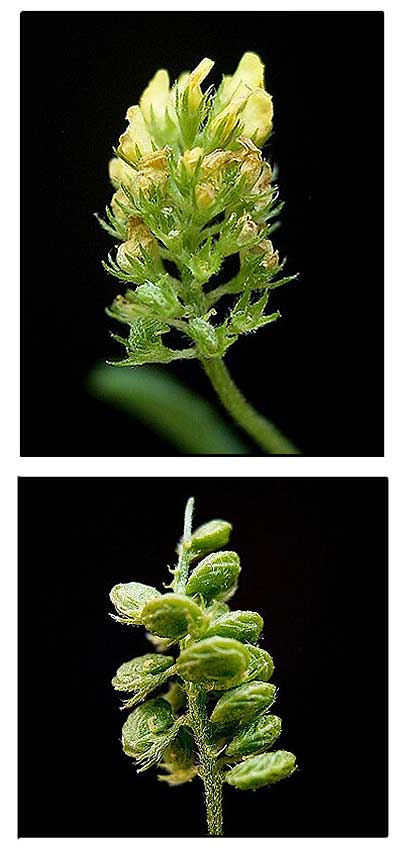 • Black Medic is an annual or bi-annual plant, sometimes long-lived thanks to adventitious buds on the roots. The plant grown up to 15-60 cm tall, with fine stems often lying flat at the beginning of growth and later becoming erect. The nodes bear leaves carried on a long stalk and have 3 oval leaflets, partially toothed towards the tip. Flowers are very small, yellow, and are grouped in tight bunches. The fruit is a pod that does not open upon maturation, of a little arched form and bearing a single seed. • Black Medic is an annual or bi-annual plant, sometimes long-lived thanks to adventitious buds on the roots. The plant grown up to 15-60 cm tall, with fine stems often lying flat at the beginning of growth and later becoming erect. The nodes bear leaves carried on a long stalk and have 3 oval leaflets, partially toothed towards the tip. Flowers are very small, yellow, and are grouped in tight bunches. The fruit is a pod that does not open upon maturation, of a little arched form and bearing a single seed.
(Flowers of India)
Distribution
- Naturalized. (1)
- In Luzon: Benguet.
- Open grassy sites. 1500 m.
- Native to Afghanistan, Albania, Algeria, Austria, Azores, Baleares, Baltic States, Bangladesh, Belarus, Belgium, Bulgaria, Canary Is., Central European Russia, China North-Central, China South-Central, China Southeast, Corse, Cyprus, Czechia-Slovakia, Denmark, East Aegean Is., East European Russia, East Himalaya, Egypt, Eritrea, Ethiopia, Finland, France, Germany, Great Britain, Greece, Hungary, India, Inner Mongolia, Iran, Iraq, Ireland, Italy, Kriti, Krym, Lebanon-Syria, Libya, Madeira, Morocco, Myanmar, Nepal, Netherlands, North Caucasus, North European Russia, Northwest European Russia, Norway, NW. Balkan Pen., Pakistan, Palestine, Poland, Portugal, Romania, Sardegna, Saudi Arabia, Sicilia, Sinai, Somalia, South European Russia, Spain, Sweden, Switzerland, Tibet, Transcaucasus, Tunisia, Türkiye, Türkiye-in-Europe, Ukraine, West Himalaya, Yemen. (2)
- Black medick can be very invasive, sometimes forming large strands.
(14)
Constituents
- Study of crude extracts (CME) of aerial parts yielded flavonoid content of 1.27 mg/g dw. Prevailing flavonoids were luteolin and myricetin, 0.37 and 0..36 mg/g dw, respectively. Total saponins and total phenolic contents were 90.4 mg ESE/g dw and 12.9 mg GAE/g dw, respectively. (see study below) (4)
- LC-MS/MS study
for phenolic composition of M. lupulina revealed salicylic acid as the predominant phenolic compound (78.4 µg/g extract). (see study below) (6)
- In a study for bioactive phenolics, glycerol and polypropylene glycol extracts were found rich in phenolic compounds, mainly derivatives of apigenin, kaempferol, luteolin, quercetin, caffeic and ferulic acid, as well as coumestrol. (see study below)
(8)
- LC-ESI-MS/MS analysis of ME of dried flowers yielded coumarin (23.93), kaempferol )15.79), syringic acid (9.44), isoquercitrin (8.31), salicylic acid (7.59), kaempferol-3-glucoside (6.03), quercetin (4.88) and hesperidin (4.125).
(see study below) (9)
- Phytochemical screening of extracts have yielded flavonoids, alkaloids, phenols, tannins, and diterpenes.
- Study of flowers isolated four dominant flavonoid compounds in crystal form identified as lacicytrin (3-methoxy-3,4',5,5'7-pentahydroxyflavone), and its three glycosides:
5'-O-β-D-glucoside, 3,5'-O-β-D-diglucoside and 3,5',7-0-β-D-triglucoside. (11)
- Nutrient information per 100 g of leaves: 23 g of protein and about 25 g of fiber.
Properties
- Plant considered lenitive (laxative).
- Studies have suggest cytotoxicity, antioxidant, antitumor, antilipoxygenase, α-amylase inhibitory, antidiabetic, anti-leishmanial properties.
- Caution: Since the herb assists blood clotting, caution is advised to people taking blood thinning medications. Also, best for pregnant and breastfeeding women to avoid use of the herb. (12)
Parts used
Aerial parts, flowers.
 Uses Uses
Edibility
- Leaves are edible; cooked. Used as potherb. Also used as green tea.
- Seeds are edible; more nutritious after sprouting, parching, or roasting.
Folkloric
- No reported medicinal use in the Philippines.
- Used for digestive problems and wound care.
- Plant used as laxative.
- Dry leaves used as antiseptic. Stops bleeding from minor cuts and injuries almost immediately. (see caution above)
- For wound healing, cuts and scrapes, fresh leaves applied as poultice. For cough and congestion, brewed leaves used as demulcent tea, the mucilage helping to coat irritated throats. Paste of mashed fresh leaves (infused in oil) applied to rashes and burns. (13)
Others
- Agroforestry: A good green manure plant. Like other legumes, roots contain nodules hosting nitrogen-fixing bacteria and enriching the soil. (3) A good green manure. Makes good ground cover.
- Nectar: A good source of nectar for bees to use making honey.
- Fodder: Its hardiness and ability to grow in poor soils, and tendency to fix nitrogen, makes for a good choice for pasturage, although with limited fodder value. It is grazed by sheep but not very palatable to cattle. (3)
Studies
• Antioxidant Aerial Parts: Study evaluated flavonoid, saponin and phenolic contents and in vitro antioxidant activity of crude (CME) and dry extracts and fractions of M. lupulina aerial parts. In DPPH and FRAP tests, the CME exhibited antioxidant capacity with TEAA and FRAP values of 45.4 µmol Trolox®/g dw and 0.2 mmol Fe2+/g dw, respectively. Diethyl ether dry fraction showed highest antioxidant activity (TEAA 726.1 µmol Trolox/g dw, FRAP 2349.4 µmol Fe2+/g dw, in accordance with high TPC of 162.4 mg/g dw. (see constituents above) (4)
• Cytotoxic Effect on Tumor Cells: Study has showed M. lupulina extract has a direct cytotoxic effect on tumor cells and activates the antitumor activity of natural killers by interleukin-2 upregulation. The mechanism of activation influence on cellular link of antitumor immunity may be related to the ability of biologically active substances isolated from alfalfa hops to stimulate release of regular cytokines from lymphocytes, inter alia, IL-2. (5)
• Antioxidant Aerial Parts: Study evaluated M. lupulina methanolic extract of stem for antioxidant potential using DPPH and ABTS assays. Results showed notable antioxidant activity with IC50s of 14.9 and 8.7 µg/mL, respectively. (see constituents above) (6)
• Enzyme Inhibitory / Antilipoxygenase / Anti-α-Amylase / Antidiabetic: Study reports on two eco-friendly methods of extraction of bioactive phenolics from M. lupulina, using mixtures of water with two non-toxic, skin- and environmentally-friendly polyol solvents: glycerol and polypropylene glycol. Both extracts exhibited notable antioxidant, anti-lipoxygenase and anti-α-amylase activity. The glycerol extract also efficiently inhibited protein coagulation, elastase and α-glucosidase activity. Results suggest the optimized glycerol extract is a potential candidate for direct incorporation in antidiabetic food supplements and cosmeceutical products. (see constituents above) (8)
• Antioxidant / COX-2 Inhibition / Flowers: Study evaluated methanol extracts of dried flowers for total phenolic content and inhibitory properties of main components against cyclo-oxygenase-2 (COX-2). The ME exhibited DPPH radical scavenging of 39.43% and contained 117.2 mg GAE/g extract of total phenolics at 500 ppm. Molecular docking showed isoquercitrin, kaempferol-3-glucoside, and hesperidin exhibited the strongest binding affinities toward COX-2 enzyme. Boiled-Egg model showed coumarin and salicylic acid possess high gastrointestinal absorption and favorable brain permeability. Results suggest promsing potential for applications in the food, pharmaceutical and cosmetic industries. (see constituents above) (9)
• Anti-Leishmanial Effect / Leaves Essential Oil: In vitro study evaluated the anti-leishmania activity of M. lupulina leaf essential oil against L. major promastigotes. Results showed the leaf essential oil had considerable antileishmanial effect compared to glucantime in vitro. Further tests are needed to assess effects on Leishmania parasites in animal models or human volunteers. (10)
Availability
- Wild-crafted.
- Extracts, tinctures in the cybermarket.
|