Gen info
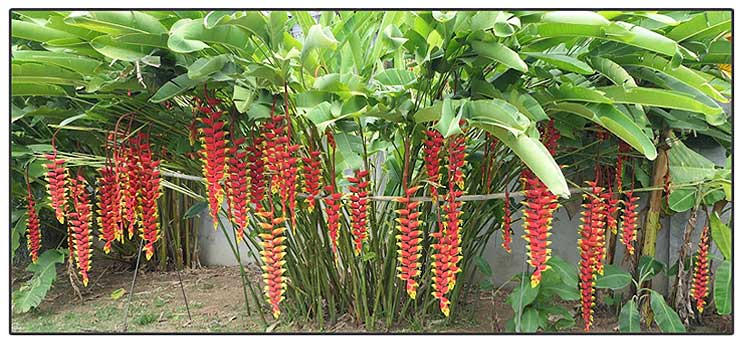
- Heliconia is a genus of flowering plants in the monotypic family Heliconiaceae. Most of the 194 known species are native to the tropical Americas, with a few indigenous to some islands of the western Pacific and Maluku in Indonesia. Collectively, the plants are simply referred to as "heliconias". (3)
- Heliconia originated in the Late Eocene (39 Ma) and are the oldest known clade of hummingbird-pollinatd plants. (3)
- Heliconia is the only genus in the monotypic family Heliconiaceae. The genus was formerly included in the family Musaceae, which includes bananas (Musa, Ensete, etc.)
- Taxonomical journey: Heliconia rostrata has undergone nomenclatural changes, with some 19th-century botanists reclassifying it under the genus Bihai. Later revisions returned it to Heliconia.
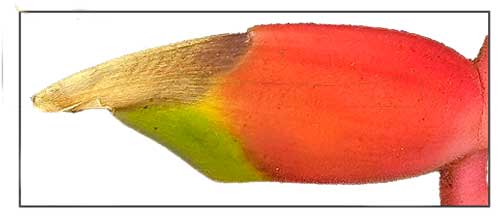
- Etymology: The genus name Heliconia was given by Carl Linnaeus in 1771, derived from the Greek word Helikonios from Helikon after Mount Helicon in Boeotia, central Greece, sacred to Apollo and to the Muses in Greek mythology. The specific epithet rostrata derives from Latin rostratus meaning "beaked" or "snouted", probably referring to the parrot beak-shaped (rostrum) tip of the bracts.
- National flower: Patuju, Heliconia rostrata, is the national flower of Bolivia. (3)
- It is a host flower to many birds, especially hummingbirds.
- False bird of
paradise: The name does not refer to a single plant. It is a shared common name for the entire genus of Heliconia, which contains 200 to 350 tropical perennial species. The name refers to the vibrant bracts that closely resemble the true Strelitzia (bird of paradise) flowers. However, although it is a broadly applied common name, it notably refers to two species: Heliconia rostrata (Hanging lobster claw) and Heliconia psittacorum (Parrot's Beak or Parrot Flower).
 Botany Botany
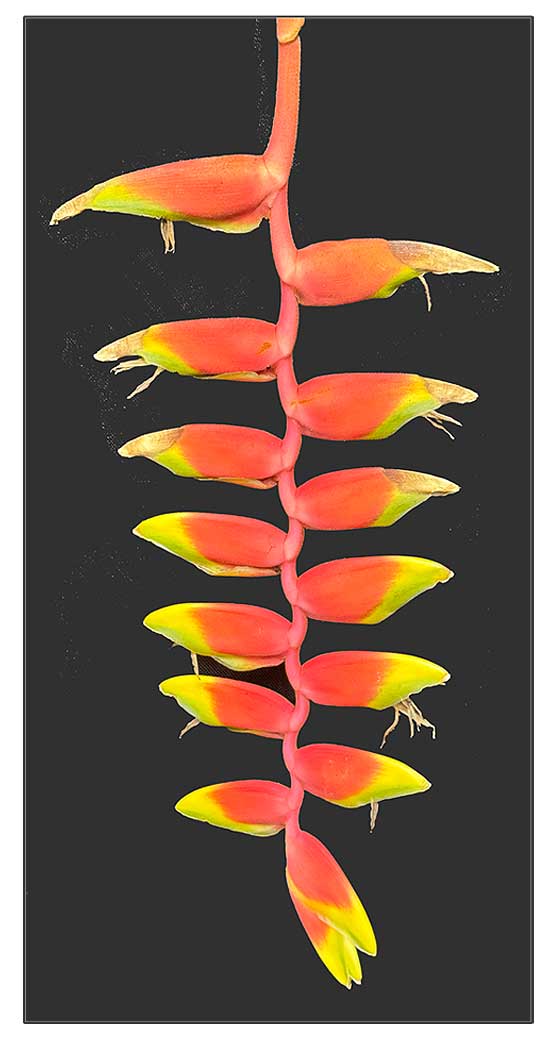
• Stout plants 3-5 m. tall; leaves broadly oblong, 45-150 cm. long, 15-40 cm. broad, broadly obtuse at the base; inflorescences pendulous, the peduncle stout, 30-90 cm. long, rather inconspicuously puberulent, the rachis flexuous; bracts very broadly ovate, obtuse to broadly acute at the tip, broadest and somewhat cordate slightly below the middle, obtusely narrowed to the base, 4-9 cm. long, 4-8 cm. broad, minutely puberulent, deep crimson, strongly reflexed at anthesis; perianth 3-4 cm. long, greenish-yellow; fruits broadly trigonal, 1 cm. long, purplish-blue. (Flora de Panama)
• An evergreen perennial rhizomatous erect herbaceous species quickly forming 1-5 m tall dense tufts. Leaves, on a 20-30 cm long petiole, are basal, alternate, simple, entire, oblong with brusquely pointed apex and prominent central nervation in the lower page, 0,4-1,2 m long and 10-20 cm broad, of intense green color above, paler below, and sheathing tubular foliar bases forming a 50-90 cm long pseudo-stem. Inflorescence, on a robust peduncle, is a 30-80 cm long drooping terminal spike with markedly waved red rachis and 10-40 alternate bracts with the concavity looking downwards, distichous, imbricate, coriaceous, pointed, reminding due to their shape the beak of a parrot, of bright red color with cream or yellow apex and green margins, 6-15 cm long. Bracts enclose up to 18 tubular, 3,5-4,5 cm long flowers, white at the base pale yellow at the apex, rich of nectar. Flowers, with bilateral symmetry, are hermaphroditic, with 3 sepals, two of which merged and one free, and three petals fused together, little differentiated between them, 5 fertile stamina and one staminode opposite to the free sepal; the flowers are pollinated by the humming birds. Fruits are globose drupes initially green, then glossy dark blue when ripe, containing 1-3 seeds. (Monaco Nature Encyclopedia)
Distribution
- Cultivated, not naturalized. (1)
- Native to Bolivia, Colombia, Ecuador, Peru. (2)
- Farmed for ornamental use.
 Constituents Constituents
- Phytochemical analysis of methanolic extract from dried whole plant powder yielded alkaloids, flavonoids, steroids, and saponins. (see study below) (5)
- Phytochemical screening of methanol and ethanol extracts of rhizomes yielded flavonoids, proteins and amino acids, carbohydrates and reducing sugar, tannin, and saponin in both extracts, with absence of alkaloid and steroids and triterpenoids in both. Glycoside was present only the ME. Total phenolic and flavonoid content was higher in the EE, whereas tannin content was higher in the ME. (see study below) (6)
Properties
- Considered antiophidic.
-
Studies suggest hepatoprotective, antioxidant, analgesic, antibacterial, cytotoxicity, antiangiogenic, wound healing, antidiabetic , antiproliferative, apoptotic, antivenom, corrosion inhibitory properties.
P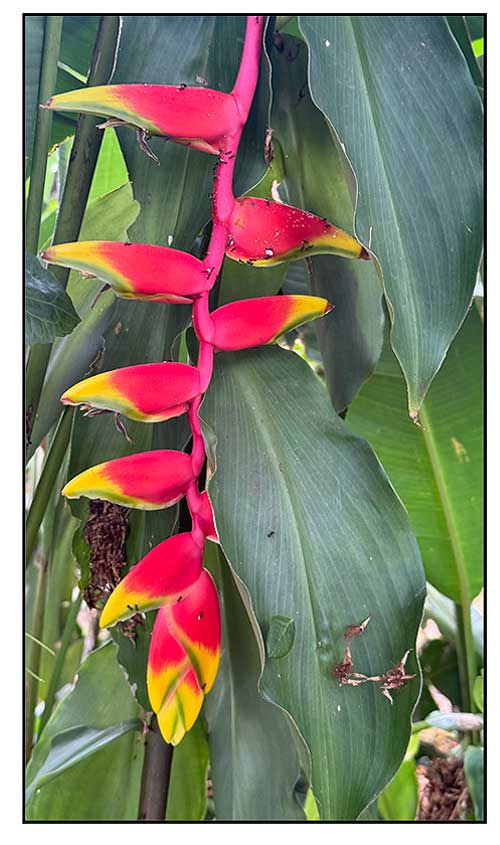 arts used arts used
Whole plant.
Uses
Edibility
- Not a common staple. But rhizomes reportedly edible when cooked.
Folkloric
- No reported medicinal use in the Philippines.
- Traditionally used for treatment of jaundice, intestinal pain, diabetes, and hypertension. (4)
- In Bangladesh, used by folk practitioners for treatment of diabetes and diabetes associated-edema. Leaf and seed used for treatment of headache, sprains, and pain. (5)
- For diabetes, Bangladesh
folk medical practioners' mode of treatment consisted of collecting leaves, crushing the leaves between pieces of stone to obtain the juice, and the juice filtered through a piece of clean cotton cloth. The juice is taken orally with 1 g of kali jeera seeds (Nigella sativa) every evening for 3 months. (7)
- In Malaysia, rhizomes reportedly used for treatment of jaundice, intestinal pain, and high blood pressure. (5)
- In Panama, used for treatment of skin cancer. (8)
Others
- Wrapper: In the Caribbean, leaves used for wrapping food. (3)
Studies
• Hepatoprotective / Antioxidant / Chemical-Induced Liver Injury: Study evaluated the hepatoprotective efficacy of ethanol (REE) and methanol (RME) extracts of H. rostrata rhizomes in HepG2 cell lines in rats. Toxicity studies using OECD guidelines showed no mortality during single and repeated dose toxicity studies. The 50% lethal dose of >2000 mg/kg confirmed category 5 toxicity level of extracts, according to Globally Harmonized System. No-observed-adverse effect level of 200 mg/kg/day was observed for both extracts. The extracts exhibited dose-dependent in vitro hepatoprotective efficacy against ethanol induced hepatotoxicity. At 400µg/ml, the REE and RME showed % protection of 65.53% and 57.98%, respectively. In vivo study with liver function tests and histopath evaluation confirmed dose dependent protection against CCl4-induced hepatotoxicity. Both REE and RME exhibited antioxidant efficacy in ex vivo and in vivo models. Results showed significant hepatoprotective potency. (4)
• Analgesic / Whole Plant: Study evaluated the in-vitro analgesic activity of methanolic extract of H. rostrata (MEHR) in Swiss albino mice by acetic acid-induced model. Whole plant was dried and pulverized into a fine powder. MEHR at doses of 50, 100, 200, and 400 mg/kg significantly lessened the number of writhing by 23.20, 29.0, 46.38, and 58.0%. Standard aspirin decreased the number of writhing by 39.13% and 55.906% at 200 and 400 mg/kg respectively. Doses of 200 and 400 mg of MEHR were more effective in reducing the mean number of abdominal constrictions in acetic acid-induced Swiss mice compared to aspirin. Results suggest a potential natural source for an analgesic drug. (5)
• Antioxidant / Antibacterial / Rhizome: Study evaluated the antioxidant and antimicrobial potency of methanol (RME) and ethanol (REE) extracts of dried and defatted rhizomes. Antibacterial potential was tested against 3 Gram(+) (Bacillus stereothermophillus, Bacillus subtilis, and Staphylococcus aureus) and 6 Gram(-) bacteria (Escherichia coli, Klebsiella pneumoniae, Salmonella enterica, Pseudomonas aeruginosa, Vibrio cholera, and Acinetobacter baumannii) using well diffusion method. Antioxidant activity was measured using DPPH, ABTS, H2O2, Phosphomolybdate, and reducing power assays. Both EE and ME exhibited antioxidant and antibacterial potency. While the antioxidant activity of both extracts were found equal, the EE exhibited significantly higher antibacterial activity than the ME. (see constituents above) (6)
• Cytotoxicity / Antiangiogenic / Rhizomes and Inflorescence: Study evaluated the cytotoxicity and antiagiogenic activity of petroleum ether of rhizomes (RPE) and inflorescence (FPE). using Brine Shrimp Lethality Assay and chick embryo Chorioallantoic Membrane (CAM) assay. The RPE showed potency against brine shrimp compared to FPE with LC50 of 85.04 µg/mL. In the CAM assay, the RPE showed strong antiangiogenic effect compared to FPE. Results suggest the rhizome extract (RPE) has potential as anti-cancer agent. (8)
• As Fiber for Textile Products: Study has shown that fiber extracted from the stem of H. rostrata have microstructural characteristics and thermal properties similar to other commonly used lignocellulosic fibers, such as coir (Cocos nucifera). Study treated the H. rostrata in aqueous medium for 45 days to extract the fiber. Characterizations included measures of fiber length, fiber diameter, bundle strength, moisture content and fiber yield %. TGA analysis showed the fiber to be thermally stable at higher temperature range of 250-300°C. Total of six eco-friendly home textile products were developed from the fibers on handloom using plain weave. Results showed the price of developed eco-friendly home textiles was high compared to commercially available products. However, costs can be brought down by scaling up roduction. Study suggests potential for eco-friendly textile products to cater to requirements of the fashion world. (9)
• Gold Nanoparticles / Antidiabetic / Wound Healing / Leaves: Study reports on use of gold nanoparticles (GNPs) fabricated from H. rostrata leaves by deoxygenation of Tetra-chloroaurat (AuCl-4) ions. Leaf extract acted as potential capping and reducing agents. The IC50s for α-amyllase and
α-glucosidase of AuNPs were 221 and 290 µg/ml. IC50 value for enzymatic assay validat4ed the impact dose-dependently, On wound healing studies, GNPs exhibited a 99% wound closure after 5 days. Per PCR findings, the expression of CD-4 and NANOG was higher in NPs treated wound tissues than in untreated ones. Results showed the GNPs exhibited good antidiabetic and wound healing activity. (10)
• Gold and Silver Nanoparticles / Antiproliferative / Apoptotic / Leaves: Study reports on the rapid, eco-friendly, cost-effective, and one-step process biosynthesis of silver and gold nanoparticles using leaves of H. rostrata as bioreductant. Reduction rate of silver ions was much faster than that for gold. The two types of NPs showed antiproliferative and apoptotic properties in mice model, evidenced by significantly reduced tumor burden in EAT bearing mice. Results suggest potential candidate for various biomedical applications. (12)
• Inhibitory against Bopthrops asper Venom: Study evaluated two species of heliconias: Heliconia rostrata and H. psittacorum against indirect hemolytic, proteolytic, and clotting activities induced by B. asper. The extracts retarded the venom clotting effect with regards positive control up to 45.59 seconds.
Phytochemical screening of extracts showed presence of primary metabolites as glucids and proteins, and secondary metabolites such as phenolic compounds, terpenoids, and coumarins, some of them reported in other vegetal species as responsible for anti-ophidian activity. (13)
• Eco-Friendly Inhibitor for Mild Steel Acid Corrosion / Flower: Study evaluated the inhibitory effect of H. rostrata flower extract (HRFE) on mild steel corrosion in IM HCl. Inhibition efficiency increased with increase concentration of plant extract. Potentiodynamic polarization curves showed the HRFE acted as mixed inhibitor in hydrochloric acid. Results suggest a new ecofriendly material for corrosion inhibition of mild steel in HCl acid medium. (14)
Availability
- Wild-crafted.
- Cultivated. |