Gen info
- Melodinus is a genus of plant in the family Apocynaceae, first described as a genus in 1776.
- Melodinus fusiformis is a species of woody climbing liana in the family Apocynaceae. The species was first described by Champion ex Bentham in 1852. (5)
- Etymology: The genus name Melodinus derives from Greek words melon, meaning "apple" or "fruit" and dinein, meaning "to whirl" or "to turn", referring to the twisting or swirling shape of the spiraling apple-like berries or climbing tendrils. (•) The specific epithet fusiformis derives from Latin, meaning "spindle-shaped", referring to the morphology of the fruit or stems. (5)
 Botany Botany
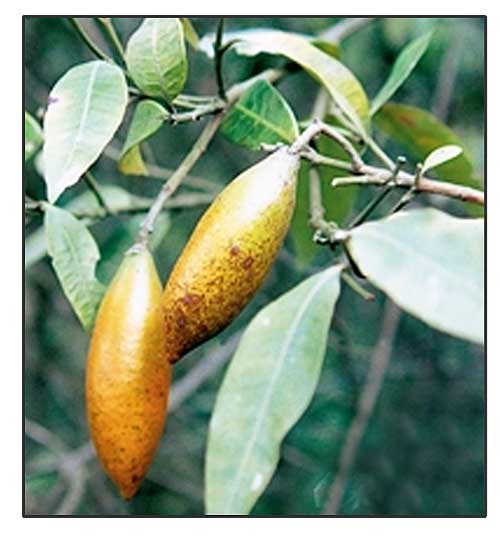
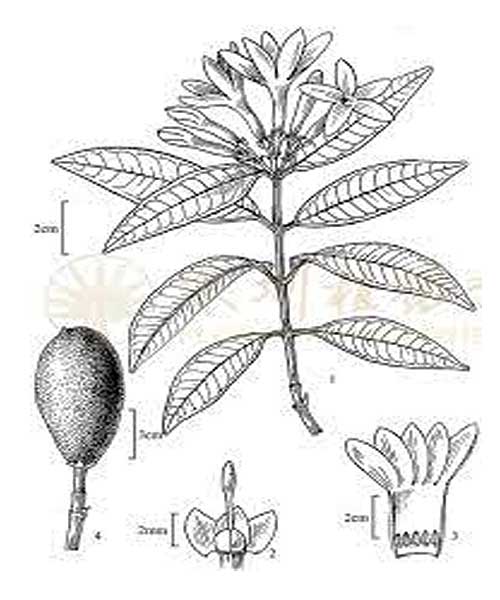
• Melodinus fusiformis is a woody liana that grows as a stout climber, reaching lengths of up to 10 m. Juvenile parts are pubescent, becoming glabrescent with age, and the plant produces milky latex typical of the Apocynaceae family. Bark is gray-brown, and branching is opposite, consistent with the decussate phyllotaxy observed in the leaves. Stems are stout and twining. Leaves are simple and opposite, with petioles measuring 4-6 mm long. Leaf blades are elliptic to oblong (rarely narrowly elliptic), 4.5-12 cm long and 1-5.3 cm wide, somewhat leathery in texture, with a cuneate to rounded base and acuminate apex; they are glabrescent abaxially, bearing prominent lateral veins in about 15 pairs that spread obliquely and form a reticulate pattern toward the margins. Flowers feature a calyx with five ovate sepals, 4–5 mm long, acute at the apex, and lacking glands. Corolla is white, tubular with a tube 1.2–2 cm long, and five-lobed, the lobes obliquely narrow-ovate to obovate, (0.8–)1.1–2 cm long and 3.5–9 mm wide. Five indistinct corona scales are present, exserted and villous with 2- or 3-cleft apices. Five stamens have included filaments inserted near the base of the corolla tube. Superior ovary is 2-loculed with numerous ovules, topped by a short style and a pistil head with dilated, 2-cleft apex serving as the stigma. Fruits are fusiform berries, 3.5–5.3 cm long and 2.2–4 cm wide, containing numerous seeds embedded in pulp. Seeds lack a coma. (5)
• An evergreen climber, M. fusiformis displays a general morphology adapted to montane forest canopies, with the characteristic milky sap aiding in defense and hydration. (5)
• Lianas stout, to 10 m, juvenile parts pubescent, later glabrescent. Bark gray-brown. Petiole 4-6 mm; leaf blade elliptic or oblong, rarely narrowly elliptic, 4.5-12 X 1-5.3 cm, somewhat leathery, base cuneate or rounded, apex acuminate; lateral veins ca. 15 pairs, obliquely spreading and reticulate toward margin. Cymes terminal, 3-5 cm, 6-12-flowered. Pedicel 5-10 mm. Sepals ovate, 4-5 mm, acute. Corolla white, tube 1.2-2 cm; lobes obliquely narrow ovate or obovate, (0.8-)1.1-2 cm X 3.5-9 mm; corona scales 5, indistinct, exserted, villous, apex 2- or 3-cleft. Stamens inserted near base of corolla tube. Berries fusiform, 3.5-5.3 X 2.2-4 cm. (Flora of China)
Distribution
- Native to the
Philippines. (1) (2)
- In Luzon: Cagayan, Rizal, Zambales; Dinagat. 0-2000 m.
- Also native to Cambodia, China South-Central, China Southeast, Laos, Thailand, Vietnam. (1)
Constituents
- Study of leaves and twigs isolated four new alkaloids: Meloformisine A (1), meloformine B (2), meloformine F (3) meloformine G (4) along with five known alkaloids (5-9).
(see study below) (3)
- Study of ethanol extract of aerial parts isolated 6 new melodinus-type alkaloids, melofusines A-E (1-6), along with one known compound, melodinine B. (see study below) (6)
- Study of twigs and leaves isolated two new monoterpenoid indole alkaloids, Fusiformines A (1) and B (2). (8)
 Properties Properties
- Studies have suggested cytotoxic, anti-inflammatory, immunosuppressive, anticancer, apoptotic properties.
Parts used
Leaves, twigs, aerial parts.
Uses
Edibility
- In Guangxi, China, branch and leaf used for making herbal tea. (4)
- Caution: Fruit reported as poisonous. (11)
Folkloric
- No reported folkloric medicinal use in the Philippines.
- In traditional Chinese medicine, Melodinus species, indcluding M. fusiformis, have been used for treatment of a range of ailments including hernia, abdominal pain, indigestion, orchitis, and pediatric malnutrition. Ethnic groups such as the Yao use it for treatments of rheumatism, arthralgias and injuries. (5) Also used for treatment of infantile meningitis and fractures. Also used in Yao traditional medicine for tonifying the lungs and stimulating lactation. (Whole plant is used medicinally for promoting blood circulation and dispelling wind and dampness. The plant is poisonous. (11)
Studies
• Cytotoxic Alkaloids: Study of leaves and twigs isolated four new alkaloids: Meloformisine A (1), meloformine B (2), meloformine F (3) meloformine G (4) along with five known alkaloids (5-9). Compounds were evaluated for inhibition activity against human A-549, MCF-7, and K-562 cell lines. Compounds 1, 2,m 6 and 8 exhibited different levels of cytotoxic activities, weith IC50s ranging from 8.72 to 47.32 µM. (3)
• Melofusine A / Cytotoxic Alkaloid Against Tumor Cell Lines / Aerial Parts: Study of ethanol extract of aerial parts isolated 6 new melodinus-type alkaloids, melofusines A-E (1-6), along with one known compound, melodinine B. Isolated compounds were tested in vitro for cytotoxic potential against six tumor cell lines (Hep-2, SCL-1, CAL-27, UMSCC-1, Detroit-562 and TCA-83. Compound 1, melofusine A, exhibited significant cytotoxic activities against all tested tumor cell lines with IC50s <5µM. (6)
• Bisindole Alkaloids / Immunosuppressive and Anti-Inflammatory: Phytochemical study isolated a new aspidosperma-aspidosperma bisindole alkaloid (BIA) bis-19ß-hydroxyvenalstonidine (1), together with 3 known BIAs (2-4). Compounds were evaluated for cytotoxic, immunosuppressive and anti-inflammatory activities in vitro. BIAs 1, 3, and 4 showed good toxicity against MOLT-4 cell lines with IC50s range of 1.5-17.5 µM. NBIA2 showed strong inhibitory effect against MCF-7 cells lines with IC50 of 7.1 µM. BIA-1 significantly inhibited Con A-stimulated mice splenocytes proliferation equal to positive control DXM in a concentration dependent manner. BIA1 and 2 decreased NO production in LPS-induced RAW 264.7 cells at 30- µM concentration. BIA2 showed similar inhibition of NO release, compared to DXM, and also inhibited levels of IL6 and TNFα. BIA2 inhibitory effect on TNF-α production was similar to dexamethasone at concentration of 20 µM. (7)
• Melognine / Monoterpene Indole Alkaloid / Apoptosis in Human BT549 Breast Cancer Cells / Stems: Study of stems isolated a novel monoterpenoid indole alkaloid, melognine (1). Melognine showed significant cytotoxicity on human breast cancer BT549 cells with IC50 of 1.49 µg by MTT assay. Mechanism of action study indicated melognine demonstrated ability to induce apoptosis by activation of caspase-3 and p53, and downregulation of Bcl-2 in BT549 cells. (9)
Availability
- Wild-crafted.
|