  General info General info
- Ericaceae are a family of flowering plants, commonly known as the heath or heather family, commonly found in acidic and infertile growing conditions. It is a large family with about 4,250 known species spread across 124 genera, making it the 14th most speciose family of flowering plants.
-
Gaultheria is a genus of about 283 species of shrubs in the family Ericaceae.
-
Many species in the genus are used as ethnic drugs for the treatment of rheumatism and pain.
- Etymology: The genus name commemorates Jean Francois Gaultier of Quebec, an honor bestowed by the Scandinavian Pehr Kalm in 1748, and taken up by Carl Linnaeus in his Species Plantarum. The specific epithet honors Hugh Cuming (1791-1865), a prolific 19th-century English naturalist and shell collector, and wildly celebrated for extensive documentation and collection of thousands of botanical and zoological specimens throughout the Philippines and South America.
- Note: Sources suggest that in the Philippines Gaultheria leucocarpa var. yunnanensis is closely related to or considered synonymous with G. cumingiana.
Botany
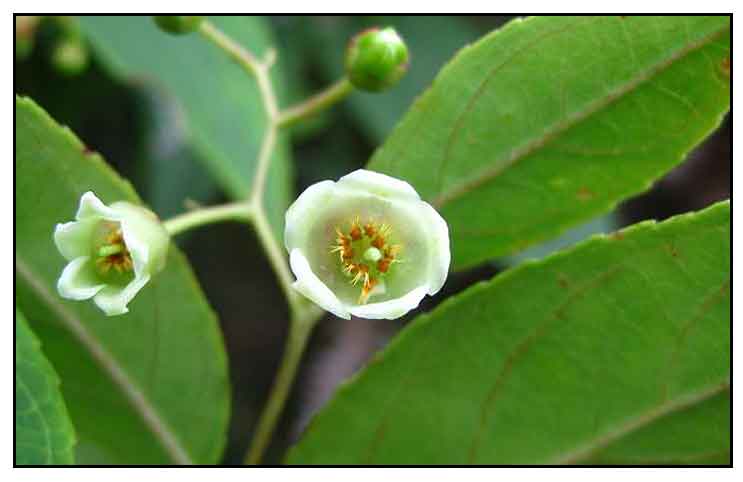
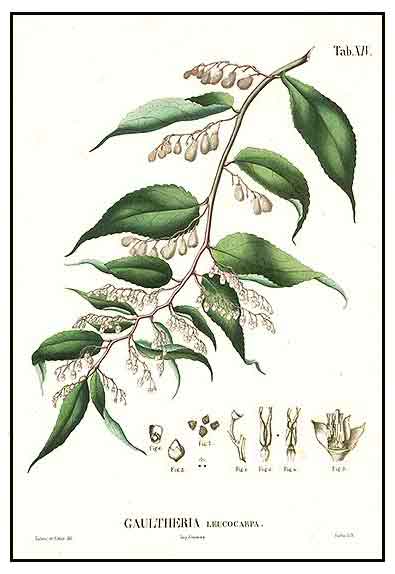
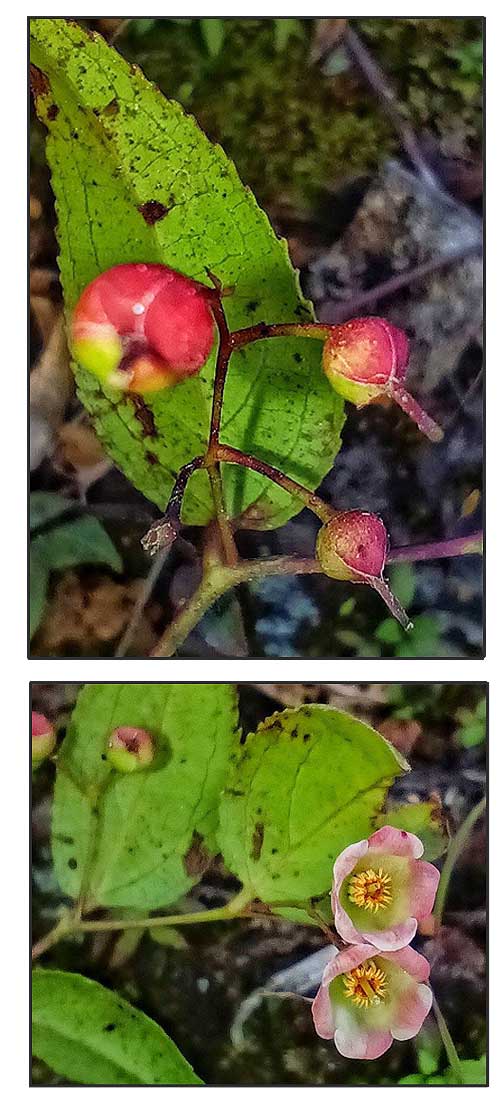
• Idsa is a small shrub growing to a height of 30 cm to 2 meters, prostrate, erect or climbing in habit. Leaves are ovate or lanceolate, 2 to 7 centimeters long, 1 to 2 centimeters wide, pointed at the tip, rounded or somewhat heart-shaped at the base, with toothed margins. Flowers are small, 3 to 5 millimeters across, borne on racemes at the axils of the leaves. Calyx is cup-shaped, the lobes ovate, triangular and ciliate, Corolla is bell-shaped, 3 to 6 millimeters long, with 5 blunt and recurved lobes about 1.5 millimeters long. Fruit is a capsule, rounded, 4 to 7 millimeters in diameter. Edible portion is the dark-blue, fleshy and enlarged calyx. Seeds are numerous.
• The taxon is distinct from G. leucocarpa and its varieties with its smaller leaves, larger calyx and corolla, red to purple or blackish fruit at maturity, distinct pollen structures and distinct matK analysis. (17)
Distribution
- In thickets, ravines, and sometimes on open slopes at altitudes from 1,300 to 2,400 meters in Bontoc, Lepanto, Benguet, Quezon, Laguna; in Mindoro, Negros and Mindanao.
- Also occurs in Taiwan.
 Constituents Constituents
- Leaf contains gaultherin, an essential oil, resembling the odor of wintergreen from the North American species, Gaultheria procumbens.
- Study of G. yunnanensis yielded two methyl salicylter glycosides, viz.,
methyl benzoate-2-O-β-D-xylopyranosyl(1-6)-O-β-D- gluco-pyranoside (J12122) and methyl benzoate-2-O-β-D-xylopyranosyl(1-2)[O-β-D- xylopyranosyl(1-6)]-O-β-D-glucopyranoside (J12123),
- Stem and roots of Gaultheria leucocarpa var. yunnanensis yielded of seven active ingredients in the stems and roots, including (+)-catechin, rutin, gentisic acid, vallinic acid, salicylic acid, quercetin, and protocatechuic acid. (10)
- Roots, stem, and leaf yielded (+)-lyoniresinol-2a-O-ß-L-arabinopyranoside, (+)-lyoniresinol-2a-O-ß-D-glycopyranoside, (-)-isolariciresinol-2a-O-ß-D-xylopyranoside. (12)
- Study of aerial parts of Gaultheria leucocarpa var. yunnanensis isolated six new compounds, including 3 lignans (1a, 1b, and 2), two abietane-type diterpenoids (3 and 4) and a triterpenoid (5), together with 13 known compounds (6a, 6b, and 7-17). (see study below)
(17)
Properties
- Studies have suggested anti-inflammatory, antibacterial, analgesic, antioxidant properties.
Parts used
Roots, leaves, aerial parts, essential oil.
Uses
Edibility
- Edible portion is the enlarged calyx.
Folkloric
- In the Mountain Province, a decoction of leaves taken as tea, is stomachic.
- In traditional Chinese medicine, used for liver cirrhosis and ascites, traumatic injuries, rheumatoid arthritis, back and joint pains.
- In China, G. leucocarpa var. yunnanensis is used to treat rheumatic arthritis, menstrual problems, cold, cough, asthma, eczema, ascites, wounds, amebic dysentery, prostatitis.
(9)
Studies
• Gaultherin: Gaultherin, from which methyl salicylate (oil of wintergreen) is released by mild hydrolysis has been reported from this species.
• Chemical Constituents: Study isolated four compounds: n-dotriacontaine and its homologous compound, ursolic acid, vanillic acid, and quercitrin. (2)
• Anti-Inflammatory / Methyl Salicylate Glycosides: Study Gaultheria yunnanensis isolated two methyl salicylate glycosides. Both dose-dependently inhibited the production of tumor necrosis factor-a, interleukin-1ß, and IL-6. Results show anti-inflammatory properties through inhibition of production of pro-inflammatory cytokines, NO, and ROS. (3)
• Gaultherin / Anti-Inflammatory: Gaultheria yunnanensis has yielded gaultherin, 2-[(6-O-β-d-Xylopyranosyl-β-d-glucopyranosyl)oxy] benzoic acid methyl ester, a natural salicylate derivative , has been shown to have analgesic and anti-inflammatory effects. Study suggested gaultherin did not cause gastric ulcer, releasing salicylate in the intestine slowly, not in the stomach, leaving COX-1 unaffected, the source of cytoprotective prostaglandins in gastric epithelium. (4)
• Antibacterial: Extracts of water, acetic ester and n-butanol showed anti-Staphylococcus aureus action, and the extracts from root and stem showed the same result. Two extracts showed activity against Escherichia coli and Pseudomonas aeruginosa.(6)
• Antibacterial / Anti-inflammatory / Analgesic / Roots: The volatile oil of roots of G. yunnanensis showed bacteriostatic activity. Acetate and butyl alcohol extracts exhibited strong anti-inflammatory activities in mice. (7)
• Anti-Inflammatory / Essential Oil / Methyl Salicylate / Leaves: Study evaluated the phytochemicals and anti-inflammatory action of leaf essential oil (EO) and its mechanisms and therapeutic targets. In xylene-induced mouse ear edema, EO significantly alleviated ear swelling and lowered IL-1ß, TNF-α, and IL-6 expression in ear tissue and serum. Methyl salicylate was the primary constituent of the leaf EO and accounted for 99.50% pf the EO's volatile composition in GC-MS analysis. The key anti-inflammatory target of the EO was TLR4, which directly bound to extracellular domain of the TLR4 membrane to exert its anti-inflammatory activity. EO also significantly inhibited inflammatory cytokine release (IL-1ß,
TNF-α, and IL-6) by suppressing gene expression, and inflammatory mediator secretion (PGE2 and NO) by suppressing transcription and translation of COX-02 and iNOS. The EO prevented NF-kB/MAPK activation triggered by LPS via targeting TLR4, thereby reducing pro inflammatory factor secretion and ultimately alleviating inflammation. Results suggest the leaf EO as a potential anti-inflammatory agent. (15)
• Anti-Inflammatory / Antioxidant / Lignans and Terpenoids / Aerial Parts: Study of aerial parts of Gaultheria leucocarpa var. yunnanensis isolated six new compounds, including 3 lignans (1a, 1b, and 2), two abietane-type diterpenoids (3 and 4) and a triterpenoid (5), together with 13 known compounds (6a, 6b, and 7-17). Compounds 12, 13, and 15 showed inhibitory effects against LPS-induced productonof NO in BV-2 microglial cells with IC50s of 30.50, 23.26, and 13.02 µM. Compounds 2 and 7 showed moderate DPPH radical scavenging activities. (18)
α-amyrin,
y - gamma
γ
δ
Availability
Wild-crafted.
|