Gen info
- Hypodematiaceae is a family of ferns in the order Polypodiales. The family was erected by Ren-Chang Ching in 1975, but was not subsequently accepted by many authors. Hypodematiaceae is a small family of leptosporangiate ferns, which includes two primary genera - Hypodematium (about 29 species) and Leucostegia (3 species), comprising terrestrial or rock-dwelling (rupestral) species characterized by creeping rhizomes.
-
Leucostegia is a genus of ferns in the family Hypodematiaceae in the Pteridophyte Phylogeny Group classification of 2016 (PPG1).
-
Etymology: The scientific name Leucostegia immersa derives from Greek and Latin root words: from Greek, leukos (white) and stege (roof or covering), referring to the pale, whitish indusia or powdery roof of the frond structures, paired with the Latin immersa (sunken or immersed), referring to the sori or structures appearing embedded into the leaf tissue.
Botany
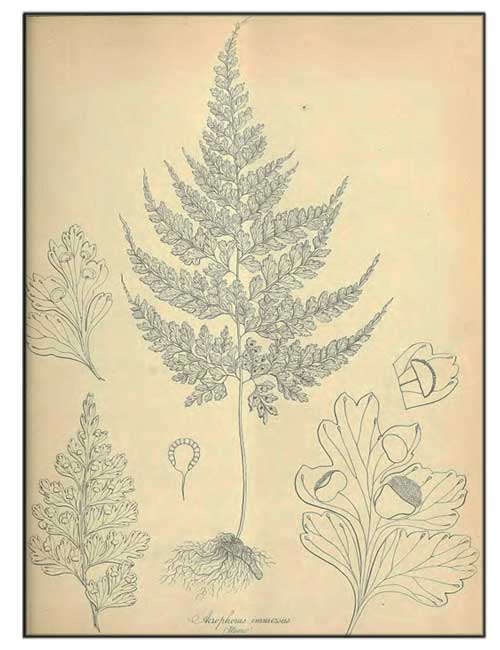
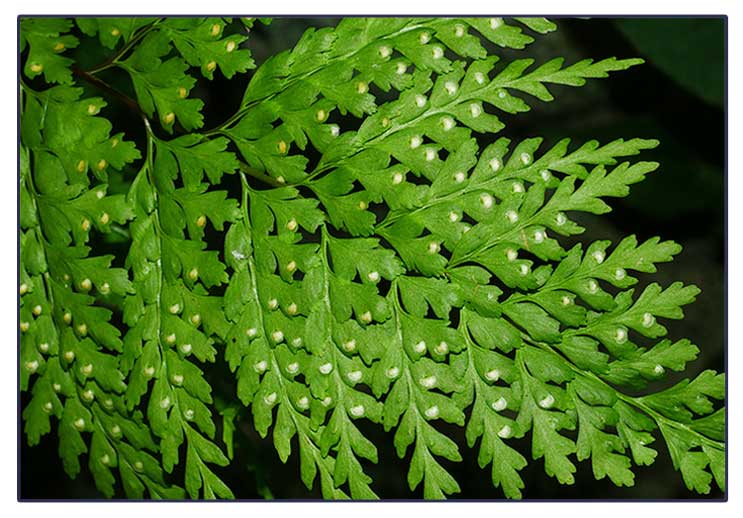
• Rhizome wide-creeping, bearing fronds remotely; hairs rather dense, golden-yellow, multicellular, wooly; scales narrowly lanceolate, up to 4 by 0.4 mm, light brown, membranous, entire at margin. Stipe stramineous or brownish on lower surface, scaly at base, glabrescent upwards, up to 30 cm long. Lamina oblong, acuminate at apex, qauadripinnatifid, up to 40 by 25 cm; pinnae more than 10 pairs, the lowest the largest, with distinct petioles, lower ones asymmetrically oblong-subdeltoid, acuminate at apex, broadly cuneate at base, up to 15 cm long and wide; pinnules oblong to subdeltoid on stalks in larger ones, secondary pinnules oblong or narrower, with 1–6 segments; ultimate segments circular to oblong or terminal ones spathulate, coarsely dentate at margin; thin herbaceous, light green, glabrous. Sori terminal on veinlets, one to each segments; indusia circular, attached only by base, entire, 1.3–2 mm broad, white to pale brown, glabrous. (eFlora of Thailand)
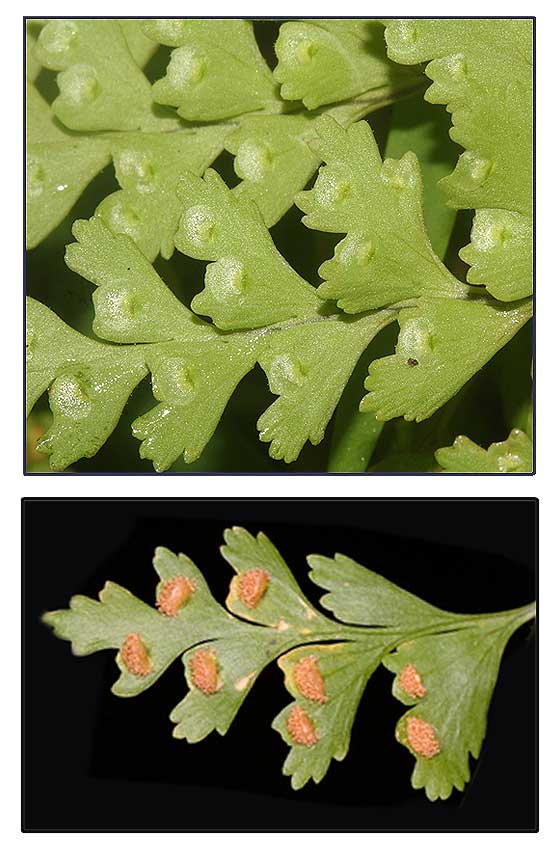 • Rhizome robust, long creeping, 3.5-5 mm in diam., densely covered with scales and yellowish brown hairs. Scales brown, lanceolate or ovate-lanceolate, ca. 3 mm, membranous, margin subentire, apex long acuminate. Fronds remote, 2-5 cm apart; stipe stramineous, 25-35 cm; lamina slightly green when dry, deltoid, 25-35 cm, nearly as wide, anadromous, papery, glabrous, tripinnate, apex acuminate; pinnae 10-12 pairs, basal pair subopposite, 4-6 cm apart, narrowly triangular and broadest toward base, with stalk 5-20 mm, base broadly cuneate, largest pinnae ovate-lanceolate, 12-22 × 6.5-12 cm, apex acuminate; pinnules 8-10 pairs, shortly stalked, alternate, ovate to elliptic, deflexed, basal pinnule 5-8 cm, base asymmetrical; ultimate leaflets rhombic, only shallowly lobed; ultimate segments (lobes) 3-4 mm wide, margin serrate; veins distinct, forking, in ultimate lobes simple, ending in submarginal orbicular hydathodes. Sori separate, 1 or 2 per segment, terminal on acroscopic veinlet; indusium attached by base only, oval or elliptic, 1-1.5 × 1-2 mm, thinly papery. (Flora of China) • Rhizome robust, long creeping, 3.5-5 mm in diam., densely covered with scales and yellowish brown hairs. Scales brown, lanceolate or ovate-lanceolate, ca. 3 mm, membranous, margin subentire, apex long acuminate. Fronds remote, 2-5 cm apart; stipe stramineous, 25-35 cm; lamina slightly green when dry, deltoid, 25-35 cm, nearly as wide, anadromous, papery, glabrous, tripinnate, apex acuminate; pinnae 10-12 pairs, basal pair subopposite, 4-6 cm apart, narrowly triangular and broadest toward base, with stalk 5-20 mm, base broadly cuneate, largest pinnae ovate-lanceolate, 12-22 × 6.5-12 cm, apex acuminate; pinnules 8-10 pairs, shortly stalked, alternate, ovate to elliptic, deflexed, basal pinnule 5-8 cm, base asymmetrical; ultimate leaflets rhombic, only shallowly lobed; ultimate segments (lobes) 3-4 mm wide, margin serrate; veins distinct, forking, in ultimate lobes simple, ending in submarginal orbicular hydathodes. Sori separate, 1 or 2 per segment, terminal on acroscopic veinlet; indusium attached by base only, oval or elliptic, 1-1.5 × 1-2 mm, thinly papery. (Flora of China)
Distribution
- Native to the Philippines.
(1) (2)
- In Luzon: Abra, Apayao, Benguet, Ifugao, Kalinga, Mountain Province, Camarines Norte, Ilocos Norte; in Mindano: Camiguin, Agusan del Norte, Bukidnon, Cotobato, Davao, Lanao del Sur, Misamis Oriental, Sarangani, Cotobato, Zamboanga del Sur; Mindoro, Negros, Panay, Samar. (1)
- Also native to Assam, Borneo, Cambodia, China South-Central, China Southeast, East Himalaya, India, Jawa, Laos, Lesser Sunda Is., Malaya, Maluku, Myanmar, Nepal, New Guinea, Sri Lanka, Sulawesi, Sumatera, Taiwan, Thailand, Tibet, Vietnam, West Himalaya. (2)
Constituents
- LC-MS analysis of hydroalcoholic extract of leaves detected 36 phytochemicals. In-silico study revealed Irinotecan, Cancentrine, and Grossamide as key compounds. (see study below) (3)
Properties
- Considered wound healing.
-
Studies have suggested anticancer, antiproliferative properties.
 Parts used Parts used
Leaves, rhizome.
Uses
Edibility
- No information found on edibility.
- Not considered mainstream edible wild food.
Folkloric
- No reported medicinal use in the Philippines.
- In India, root extract taken orally for treatment of piles.
- Rhizome used for the treatment of swelling, burns, and boils.
- In Nepal, rhizome paste use for treatment of boils and as antibacterial; decoction used for treatment of constipation. (4)
- In India, frond extract used for treatment of wounds, swellings, and constipation.
- Rhizome is mixed with water and tumeric to form a paste, which is applied with a cloth over affected areas to treat swellings. (3)
Others
- Butterfly host plant: It is a larval host plant of blue tiger and dark blue tiger butterflies. (3)
Studies
• Anticancer / Antiproliferative Against Non-Small Cell Lung Ca / Leaves: Study evaluated the cell viability of hydroalcoholic extract of Leucostegia immersa leaf against human lung cancer cell A549. The extract showed anti-proliferative activity with no significant toxicity to normal cell line HEK293. LC-MS analysis of the extract detected 36 phyto-chemicals. In-silico study revealed Irinotecan, Cancentrine, and Grossamide as key compounds. Out of 20 proteins, PTGS2 showed highest affinity with average binding energy value of -8.4 kcal/mol. Isolation of the compound, along with further invivo and invitro studies, present potential for development of new anti-NSCLC drug. (3)
Availability
- Wild-crafted.
|





.jpg)