
HOME      •      SEARCH      •      EMAIL    •     ABOUT


Family Meliaceae
Kuling-babui
Kalimutain

Prasoxylon alliaceum (Blume) M.Roem.
Dysoxylum alliaceum (Blume) Blume ex Juss.
ONION-SCENTED TREE / BUFF MAHOGANY

Scientific names Common names
Alliaria acuminatissima Kuntze Kalimutain (Tagalog)
Alliaria costulata Kuntze Kuling-babui (Tagalog)
Alliaria fraterna (Miq.) Kuntze Malaaduas (Filipino)
Alliaria glabra (C.DC.) Kuntze Miao (Filipino)
Alliaria lampongum Kuntze Paria (Filipino)
Alliaria migueliana (C.DC.) Kuntze Paluahan (Bisaya)
Alliaria nageliana (C.DC.) Kuntze Buff mahogany (Australia)
Alliaria similis (Spreng.) Kuntze Cape York cedar (Australia)
Alliaria thyrsoidea (Hiern) Kuntze Onion-scented tree (Engl.)Buff
Alliaria vrieseana (C.DC.) Kuntze  
Amoora oligosperma Pierre  
Chisocheton dempoensis Baker f.  
Dysoxylum aculeatissimum Steud.  
Dysoxylum acuminatissimum Blume ex M.Roem.  
Dysoxylum alliaceum (Blume) Blume ex Juss.  
Dysoxylum alliaceum var. angustifolium Hochr.  
D. alliaceum var. lanceolatum Koord. & Valeton  
D. alliaceum var. laxiflorum (Blume ex G.Don) C.DC.  
Dysoxylum alliaceum var. pauciflorum Koord & Valeton  
Dysoxylum apoense Elmer  
Dysoxylum archboldianum Merr. & L.M.Perry  
Dysoxylum brachycalycinum Harms  
Dysoxylum brevipes Hiern  
Dysoxylum costulatum (Miq.) Miq.  
Dysoxylum dempoense (Baker.f.) Harms  
Dysoxylum euiphlebium Merr.  
Dysoxylum excelsum var. glabriflorum Miq.  
Dysoxylum fraternum Miq.  
Dysoxylum glabrum C.DC.  
Dysoxylum klemmei Merr.  
Dysoxylum lampongum Miq.  
Dysoxylum lanceolatum Elmer  
Dysoxylum laxiflorum Blume ex G.Don  
Dysoxylum longifolium Blume ex M.Roem.  
Dysoxylum macrothyrsum Miq.  
Dysoxylum miguelianum C.DC.  
Dysoxylum monticola Harms.  
Dysoxylum nagelianum C.DC.  
Dysoxylum platyphyllum Merr.  
Dysoxylum pulchrum Ridll.  
Dysoxylum rostratum C.DC.  
Dysoxylum sattelbergense Merr. & L.M.Perry  
Dysoxylum simile (Spreng.) Blume ex G.Don  
Dysoxylum thyrsoideum Hiern  
Dysoxylum thyrsoideum var. andamanicum King  
Dysoxylum vrieseanum C.DC.  
Guarea alliacea Blume  
Hartighsea costulata Miq.  
Prasoxylon alliaceum (Blume) M.Roem.  
Trichilia similis Spreng.  
Note: For this plant this usual sources for scientific names, synonyms, vernacular names and distribution provide conflicting information. Disagreements have led to revisions, circumscriptions, and exclusions of some species.
Note: Kalimutain is a common name shared with Goiocheton arborescens (Mossman mahogany).
Note: Prosoxylon alliaceum was formerly listed as Dysoxylum alliaceum.
Dysoxylum alliaceum (Blume) Blume ex A.Juss is a synonym of Prosoxylon alliaceum. POWO

Other vernacular names
AUSTRALIA: Cape York cedar, Buff mahogany.
BORNEO: Kambutong, Langsat-langsat, Langsat munyit, Latak manuk, Longkang bawang.
INDONESIA: Ki bawang (Sundanese); Kayu bawang (Moluccas); Pel, Pela (Javanese), Pingku.
MALAYSIA: Beka-beka bukit, Kasai tembaga, Kulim, Kulim burong, Hatap selaya.
MARBURUNG: Sibaumater bau.
SUMATRA: Ki bawang.
THAILAND: Ta suea khao (Peninsular).
VIETNAME: Ch[awj]c kh[ees], Chac khe.
TRADE NAME: Dysox.

Gen info
- Prasoxylon is a genus of flowering plants in the family Meliaceae. It includes seven species.
-The genus was first described by Max Joseph Roemer in 1846. Most the the species currently accepted were until recently included in the genus Dysoxylum. A genetic study published in 2021 found Dysoxylum is polyphyletic, and Prasoxylon was revived and re-circumscribed. (13)
- Prasoxylon alliaceum is a polymorphic evergree tree in the mahogany family Meliaceae, renowned for the strong onion-like odor emitted by all the parts, which inspired its specific epithet alliaceum.
- Etymology: The specific epithet alliaceum derives from Latin meaning "onion-like", alluding to the onion-like scent emitted by crushed leaves and bark.

Botany
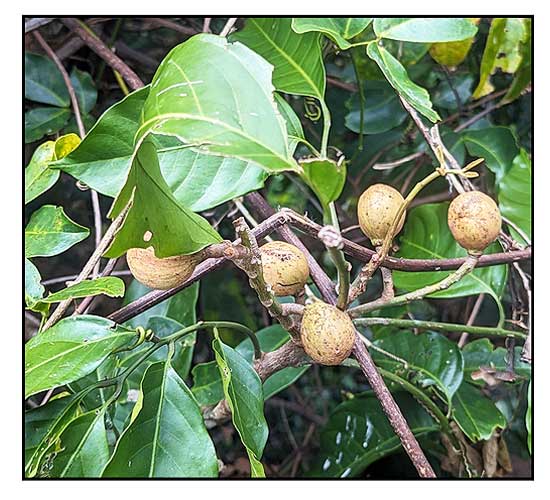
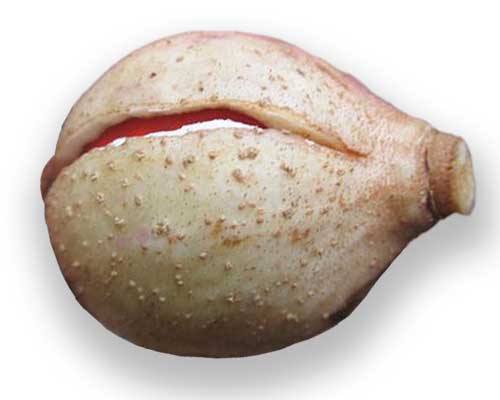
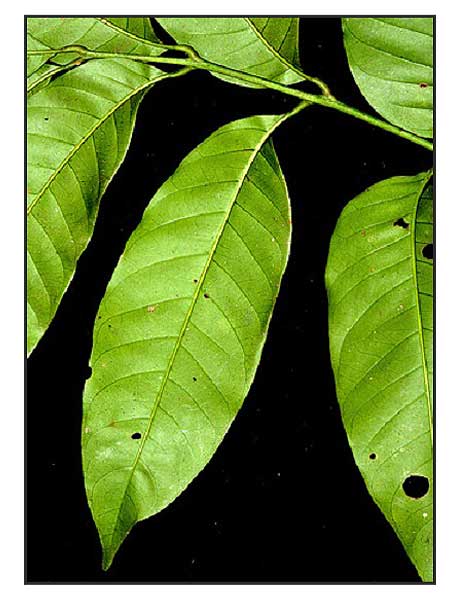
Growth form: Tree to 38m tall. Trunk: Trunk to 80cm in diameter, with buttresses to 60cm tall and reaching outwards by about 1m. Foliage: Leaves 60cm long (occasionally to 120cm),with3-6 or occasionally 8 pairs of leaflets. Leaflets 7.5-25cm long by 2.5-7.5cm wide, opposite or sub-opposite, with an apical pair of leaflets, or appearing to have an apical leaflet, with the leaflet appearing as a small apical scar. Young leaves fist shaped, more or less pubescent. Leaves and bark usually with strong smell of onions.  Flowers: Flowers white or pinkish, 4-5 petaled. Petals 0.5-0.8cm long. Fruit: Fruits  to 7.5cm in diameter, subglobose or lobed, ripening dull reddish orange or reddish brown, with 1-4 seeds per fruit. (Flora & Fauna Web)

Tree up to 38 m tall, all parts smelling strongly of onion; trunk up to 80 cm in diameter, fluted to 4 m at base with buttresses up to 60 cm tall and projecting 1 m from the trunk. Leaves paripinnate, 3-6(-8)-jugate, up to 60(-120) cm long, subcoriaceous; petiole 5-15 cm long; petiolule 0.5-2 cm long; leaflet elliptical, ovate or subfalcate, 7.5-25 cm × 2.5-7.5 cm. Inflorescence a pyramidal thyrse, up to 40 cm long, branchlets bearing cymules of 1-3 sweetly scented flowers.Pedicel up to 4 mm long; flowers 4-5-merous; calyx shallowly cupular, 3 mm in diameter, margin 4-toothed; petals 4-5, linear, 5-8 mm long, white or pinkish; staminal tube glabrous to puberulous, bearing 8 or 10 anthers; pistil with 3-locular ovary and terete style. Infructescence up to 25 cm long; fruit a subglobose capsule, up to 7.5 cm in diameter, sometimes lobed and constricted between the seeds, red. Seeds 1-4 per capsule,
oblong-globose, red. (PROSEA)

Distribution
- Native to the Philippines. (11) (12)
- In Luzon: Cagayan, Camarines, Isabela, Laguna, Rizal; in Mindanao: Davao, Lanao, Surigao; in Negros, Palawan, Panay, Samar, Sibuyan. (11)
- In low and medium elevation primary rainforests, 0-1800m.
- From the Andaman Islands and peninsular Thailand throughout the Malesian Archipelago towards northern Australia and the Solomon Islands. (3)
- Also native to Andaman Is., Bismarck Archipelago, Borneo, Jawa, Lesser Sunda Is., Malaya, Maluku, Myanmar, New Guinea, Queensland, Solomon Is., Sulawesi, Sumatera, Thailand, Vietnam. (12)

Constituents
- HR-ESI-MS, FTIR, and NMR studies of stem bark isolated 8 ttirucallane-type riterpenoid compounds (1-8), including cneorin-NP36 (1), toonapubesin A (2), toonapubesin B (3), chisopanin M (4), 21 α-methylmelianodiol (5), 21 ß-methylmelianodiol (6), hispidone (7), and odoratone (8). (see study below)  (5)
- Study of stem bark isolated two 17-membered macrolides: alliaceumolide A (1), a new macrolide, with known ivorenolide B (2). The compounds were tested against two human cancer cell lines: MCF-7 and HeLa cell lines. (6)
- Study of ethanolic extract of stem bark identified 5 known steroids, 3ß,16ß-dihydroxy-24(S)-methyl cholestenol (1), ergosta-5,22-dien-3ß-ol (2), ergosta-7,24(28)-dien-3ß-ol (3), 22(E)-ergosta-6,22-dien-3ß,5α,8α-triol (4), and 20α-dihydroprogesterone (5). (8)
- Study of stem bark isolated five new mexicanolides (1-5), alliaxylines A-E, together with 2 known limonoids (6, 7). Tested for cytotoxic activity, (see study below) (9)
- Study isolated a new macrolide, Alliaceumolid A, together with known ivorenolide B. (Both compounds were tested for cytotoxicity against two cancer cell lines: MCF-7 and HeLa. (14)
- HR-ESI-MS, FTIR, and NMR study of stem bark isolated 8 tirucallne-type triterpenoid compounds (1-8): cneorin-NP36 (1), toonapubesin A (2), toonapubesin B (3), chisopanin M (4), 21-α methylmelianodiol (5), 21- methylmelianodiol (6), hispidone (7), and odoratone (8). (see study below) (15)

Properties
- Studies have suggested cytotoxicity, anticancer properties.

Parts used
Stem bark, roots..

Uses

Edibility
- Young leaves reportedly edible; boiled. Fresh young leaves used as spice to impart an onion-like flavor. Seeds also reportedly used with ginger and lemon/lime in the preparation of sauce for fish. (Caution: see toxicity below) (3) (7)
Folkloric
- No published info on folkloric medicinal use in the Philippines.
- In Malaysia, the Kensiu tribe of Lubuk Ulu Legong drink root decoction post-partum. (10)
Others

- Wood: Wood is whitish, light in weight, moderately hard, not resistant to insects. Heartwood is red-brown; sapwood, fawnish. Occasionally used for making boards or interior construction, planking, flooring, paneling, wood pallets, furniture making, veneer and plywood. (7)
- Seeds: Seeds are poisonous and contain dysoxylum acid. Used as vertebrate poison. (7)

Studies
Anticancer / Stem Bark:
Study evaluated the cytotoxic activity of D. alliance stem bark against MCF-7, A549, and CV-01 cell lines. HR-ESI-MS, FTIR, and NMR studies isolated 8 neurotically-type enteritides compounds (1-8), including cneorin-NP36 (1), toonapubesin A (2), toonapubesin B (3), chisopanin M (4), 21 α-methylmelianodiol (5), 21 ß-methylmelianodiol (6), hispidone (7), and odoratone (8). Compound 2, toonapubesin A, showed highest selectivity against A549 cancer cell lines with IC50 of 7.81 µM, with no activity towards CV-1 cells (fibroblast-like cells). Results suggest a potential source of natural products with anticancer properties. (5)
Steroids / Stem Bark: Study of ethanolic extract of stem bark identified 5 known steroids, 3ß,16ß-dihydroxy-24(S)-methyl cholestenol (1), ergosta-5,22-dien-3ß-ol (2), ergosta-7,24(28)-dien-3ß-ol (3), 22(E)-ergosta-6,22-dien-3ß,5α,8α-triol (4), and 20α-dihydroprogesterone (5). Compounds showed weak to inactive effect against A549 lung cancer cell lines with IC50s ranging from 68.52 to ≥150 µM. (8)
Cytotoxicity / Stem Bark: Study of stem bark isolated five new mexicanolides (1-5), alliaxylines A-E, together with 2 known limonoids (6, 7). Tested for cytotoxic activity, Compound 2 was most potent against two tested cell lines, MCF-7 and A549, with IC50s of 34.95 and 44.39 µM. (9)
Targeted Triterpenoids / Cytotoxicity in Human Cancer and Normal Cells / Stem Bark: Study evaluated the stem bark of D. alliaceum, which have shown cytotoxic activity against MCF-7, A549, and CV-1 cell lines. HR-ESI-MS, FTIR, and NMR isolated 8 tirucallne-type triterpenoid compounds (1-8). Compound 2, toonapube4sin A, showed highest selectivity against A549 cancer cell lines with IC50 of 7.81 µM, with no activity towards CV-1 cells. (see constituents above) (15)
6-7-dimethoxydihydrocoumarin / Cytotoxic Activity against P-388 / Bark: Study evaluated an ethyl acetate bark extract of D. alliaceum for secondary metabolites. Analysis using spectroscopic methods and guided by TLC isolated the compound 6,,7-dimethoxydyhidrocoumarin. Cytotoxic activity testing against P-388 MTT leukemia cells obtained an IC50 of 39.210 g/mL and was declared inactive. (16)

Availability
- Wild-crafted.

April 2026

                                                 PHOTOS / ILLUSTRATIONS
IMAGE SOURCE: Prosoxylon alliaceum / © Cristopher Mitchell / Some rights reserved / CC BY-NC 4.0 International / Image modified / Click on image or link to go to source page / iNaturalist
OTHER IMAGE SOURCE: Prosoxylon alliaceum fruit / Buff Mahogany / © Atlas of Living Australia / Non-commercial use / Image modified / Click on image or link to go to source page / Atlas of Living Australia
OTHER IMAGE SOURCE: Prosoxylon alliaceum leaves / © earth.com / Non-commercial use / Image modified / Click on image or link to go to source page / earth.com

Additional Sources and Suggested Readings
(1)

Dysoxylum alliaceum / AsianPlantNet
(2)
Dysoxylum alliaceum / National Parks: Flora & Fauna Web
(3)
Dysoxylum alliaceum / PCM Jansen . PROSEA: Plant Resources of South-East Asia
(4)
Dysoxylum / Wikipedia
(5)
Cytotoxic tirucallanes from Dysoxylum alliaceum stem barks in human cancer and normal cells lines /
Sandra Amalia Riyadi, Al Arofatus Naini, Tri Mayanti, Kindi Farabi et al / Journal of Biologically Active Products from Nature, 2024; 14(2): pp 171-186 / DOI: 10.1080/22311866.2024.2347466
(6)
Alliaceumolide A: A rare undescribed 17-membered macrolide from Indonesian Dysoxylum alliaceum / Sandra Amalia Riyade, Al Arofatus Naini, Unang Supratman et al / Phytochemistry Letters, 2024; Vol 62: pp 73-77 / DOI: 10.1016/j.phytol.2024.07.004
(7)
Dysoxylum alliaceum / Ken Fern / Useful Tropical Plants
(8)
The Cytotoxic Evaluation of Steroids Isolated from Dysoxylum alliaceum (Blume) Blume ex A.Juss./ Sandra Amalia Riyadi, Al Arofatus Naini, Tri Mayanti, Unang Supratman et al / Molekul, 2024; 19(3): 471 /
DOI: 10.20884/1.jm.2024.19.3.11439
(9)
Alliaxylines A–E: five new mexicanolides from the stem barks of Dysoxylum alliaceum (Blume) Blume ex A.Juss / Sandra Amalia Riyadi, Al Arofatus Naini, Unang Supratman et al / Journal of Natural Medicines, 2024; Volume 78: pp 558-567 / DOI: 10.1007/s11418-024-01794-2
(10)
Traditional Medicinal Plants Used by the Kensiu Tribe of Lubuk Ulu Legong, Kedah, Malaysia / Nur Shahidah Mohammad, Pozi Milow, Hean Chooi Ong / Ethno Med., 2012; 6(3): pp 149-153 /
DOI: 10.31901/24566772.2012/06.03.02 / eISSN: 2456-6802 / pISSN: 0972-0073
(11)
Meliaceae: Prasoxylon alliaceum / Ed. by Pieter B. Pelser / Co's Digital Flora of the Philippines
(12)
Prasoxylon alliaceum / KEW: Plants of the World Onlline
(13)
Prasoxylon / Wikipedia
(14)
Alliaceumolide A: A rare undescribed 17-membered macrolide from Indonesian Dysoxylum alliaceum / Sandra Amalia Riyadi, Al Arofatus Naini, Tri Mayanti, Kindi Farabi, Unang Supratman et al / Phytochemistry Letters, 2024; Vol 62: pp 73-77 / DOI: 10.1016/j.phytol.2024.07.004
(15)
Targeted triterpenoids from Dysoxylum alliaceum stem barks as cytotoxic agents in human cancer and normal cells / Sandra Amalia Riyadi, Al Naini, Tri Mayanti, Kindi Farabi, Unang Supratman et al /
DOI: 10.21203/rs.3.rs-3851751/v1
(16)
6,7-dimethoxydihydrocoumarin Compound from Ethyl Acetate Extracts from Steambarks Dysoxylum Alliaceum and Cytotoxic Activity Against P-388 / Ois Nurcahyanti, Kartika Rahma / Journal of Tropical Pharmacy and Chemistry, 2022; 6(2) / DOI: 10.25026/jtpc.v6i2.405 / pISSN: 2087-7099 / eISSN: 2407-6090

DOI: It is not uncommon for links on studies/sources to change. Copying and pasting the information on the search window or using the DOI (if available) will often redirect to the new link page. (Citing and Using a (DOI) Digital Object Identifier)

                                                            List of Understudied Philippine Medicinal Plants
                                          New plant names needed
The compilation now numbers over 1,750 medicinal plants. While I believe there are hundreds more that can be added to the collection, they are becoming more difficult to find. If you have a plant to suggest for inclusion, native or introduced, please email the info: scientific name (most helpful), local plant name (if known), any known folkloric medicinal use, and, if possible, a photo. Your help will be greatly appreciated.

HOME      •      SEARCH      •      EMAIL    •     ABOUT