
HOME      •      SEARCH      •      EMAIL    •     ABOUT


Family Apocynaceae
Kwarta-kwarta
Dischidia nummularia R.Br.
STRING OF NICKELS / BUTTON ORCHID
Yuan ye yan shu lian

Scientific names Common names
Collyris minor Vahl Kuarta-kuarta (Tag.)
Dischidia actephila Schltr. Kwarta-kwarta (Tag.)
Dischidia aemula Schltr. Bubble dischidia (Engl.)
Dischidia beiningiana Schltr. Button orchid (Engl.)
Dischidia copelandii Schltr. String of nickels (Engl.)
Dischidia decipiens Schltr.  
Dischidia dirhiza Schltr.  
Dischidia gaudichaudii Decne.  
Dischidia glabra Warb.  
Dischidia horsfieldiana Miq.  
Dischidia microphylla Schltr.  
Dischidia minor (Vahl) Merr.  
Dischidia nummularia R.Br.  
Dischidia nummularia var. gracilis Becc.  
Dischidia nummularia var. minor Kuntze  
Dischidia nummularia var. orbicularis (Decne.) Kuntze  
Dischidia nummularia var. rhombifoliia (Blume) Bakh.f.  
Dischidia orbicularis Decne.  
Dischidia rhombifolia Blume  
Dischidia ridleyana Schltr.  
Dischidia schumanniana Schltr.  
Dischidia sepikana Schltr.  
Leptostemma truncatum Zoll. ex Miq.  
Dischidia nummularia is an accepted species. KEW: Plants of the World Online

Other vernacular names
CHINA : Yuan ye yan shu lian.
INDONESIA: Daun pitis kecil.
MALAYSIA: Pitis-pitis kecil.
THAILAND: Klet khai (general), Bia (central), Top tan ruesi (north-eastern).
VIETNAM: Song ly, Moc tien nho.

Gen info
- Dischidia is a genus of plants in the 'dog-bane' family Apocynaceae, collectively known as "milkweeds". As of February 2025, 128 species have been listed with Plants of the World Online. (4)
- Dischidia nummularia is an epiphytic climbing plant belonging to the genus Dischidia. Dischidia are closely related to the sister-genus Hoya, whose range overlap in some regions. Hoya is the better studies of the two. (4)
- Ecology:
Most Dischidia grow in arboreal ant nests of various species, several have developed a symbiotic relationship with insects. Some have even evolved modified leaves to provide ant housing and/or storage, in exchange for pollination of their blooms. The symbiotic adaptations have resulted into two modification of leaves: bullate and imbricate. (4)
-Etymology: T
he genus name Dischidia derives from Greek words dis, meaning "two", and askidion, ascidium, alluding to the leaves in some species that may develop into pitchers. The specific epithet nummullaria derives from Latin nummus "resembling a coin", referring to the plant's tiny, nearly circular leaves. (3) Alternatively, the genus name derives from Greek word dischides, referring to the 'parted' or 'cleated' crowns; or, to Greek words dis and kichon, 'two' and 'covering coat', referring to the type species' appearance (D. nummularia).

Botany
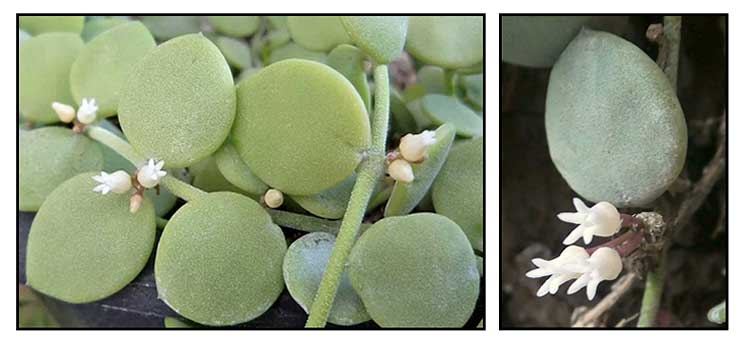
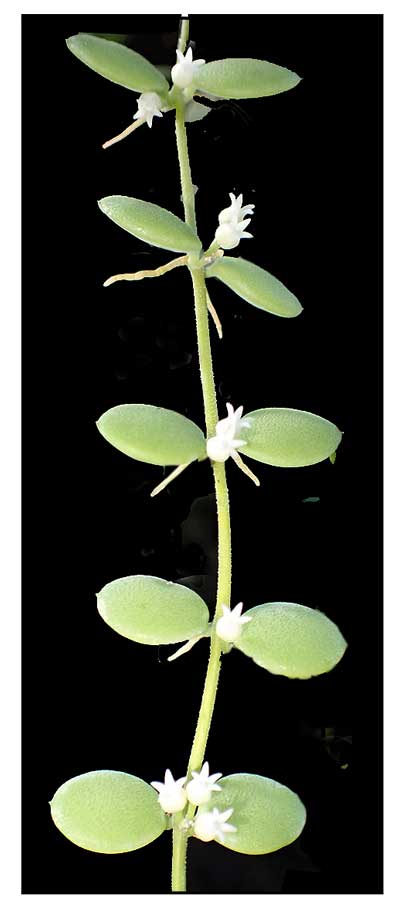
Herbs glabrous except for flowers. Stems slender, twining to 1.5 m; internodes longer than leaves. Petiole 1-2 mm; leaf blade orbicular, 7-10 mm in diam.; lateral veins obsolete. Pseudumbels subsessile. Sepals ovate. Corolla white or yellowish white; lobes ovate-triangular, ca. 1 × 0.5 mm, thickened at middle. Corona lobes anchor-shaped, shorter than gynostegium, stalked, apex 2-cleft, widely divergent, lateral arms oblong, pendulous. Apical membrane of anthers ovate-triangular; pollinia oblong. Stigma head discoid, mucronate at apex. Follicles lanceolate, ca. 4 cm × 5 mm. (Flora of China)

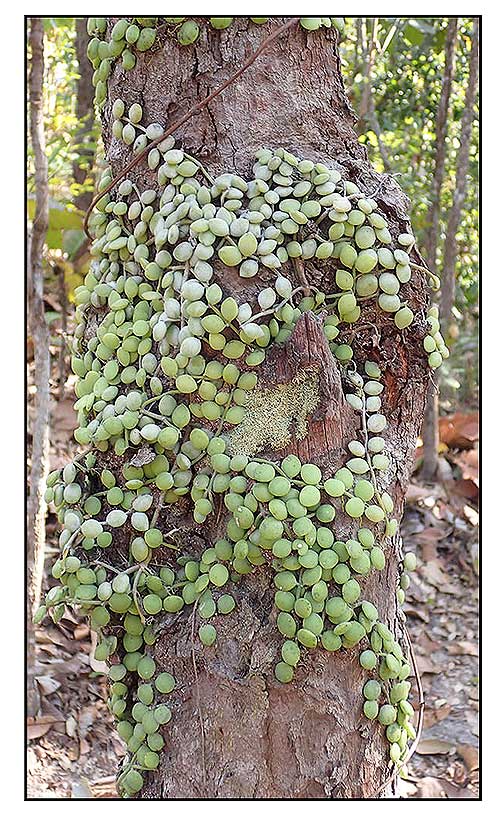
Growth form: Slender creeping epiphyte often forming dense masses on trees on which it occurs. Foliage: Leaves opposite, round, dull greenish-yellow, often thick and succulent, 7 mm – 10 mm in diameter. Young leaves occasionally with powdery bloom. Flowers: Flowers white to yellowish-white, about 1 mm in length, occurring in umbels of 1 – 5 flowers. Fruit: Hairless, pale green or yellow follicles occur singly or in pairs, hanging down from the stem (2 – 4 cm × 0.4 cm). They split open on one side when mature, releasing oblong seeds (1.5 – 2.5 × 0.4 – 0.7 mm). (Flora & Fauna Web)

Distribution
- Native to the Philippines. (1) (2)
- In Luzon: Laguna, Quezon, Rizal,, Sorsogon; in Mindanao: Agusan del Norte, Davao, Davao del Sur, Zamboanga, Zamboanga del Norte; Mindoro: Negros; Palawan. (1)
- In thickets anbd forests at low elevation.
- Also native to Andaman Is., Assam, Bangladesh, Bismarck Archipelago, Borneo, Cambodia, China South-Central, China Southeast, East Himalaya, Hainan, Jawa, Laos, Lesser Sunda Is., Malaya, Maluku, Myanmar, New Guinea, Queensland, Solomon Is., Sulawesi, Sumatera, Thailand, Vietnam. (2)

Constituents
- Study of Dischidia nummularia leaves isolated 5 known compounds, 3 triterpenoid derivatives, glutinol (1), α-amyrin (2) and friedelin (3); along with stigmast-5-ene-3ß-ol, a steroid derivative (4), and α-mangostin, a xanthone derivative (5). (see study below) (6)

Properties
- Caution:
Sap may cause skin irritation in sensitive people and can be toxic to children and pets if ingested. Eating may cause nausea, vomiting, and losee of appetite. Consumption of large amount may necessitate medical attention.
- Studies have suggested cytotoxicity, antiproliferatiive properties.

Parts used
Whole plant, leaves.

Uses

Edibility
- No reports on edibility or culinary use.
- See caution above.
Folkloric
- No reported folkloric medicinal use in the Philippines.
- Leaves used for treatment of gonorrhea and tropical sores (aphthae tropicae). Latex used to treat pain from spiny catfish stings (Ikan sembilang).   (3)
- In Indonesia, boiled water from leaves used for treatment of cysts, cervical cancer, gonorrhea, oral diseases.
- In Thailand, decoction of leaves and whole plants drunk or the same chewed, for musculoskeletal maladies.
- In the Moluccas, latex applied as anodyne to wounds caused by fish spines. Decoction of leaves drunk for treatment of gonorrhea. In Java, latex applied to treat sprue in children. In Thailand, whole plant decoction used for treatment of cirrhosis. (8)


Studies
Cytotoxicity / Antiproliferative:
Study sought to find relevant anticancer constituents from various extracts of Dischidia nummulariia. The n-hexane and dichloromethane extracts showed strong activity against various cancer cell lines viz. MDA-MB-231 and CCRF-CEM. 2H-chromene was isolated from the n-hexane extract for the first time. A large amount of fatty acids were isolated along with glycerol-mono-stearate, which was found moderately toxic against the cancer cell lines. (5)
Weak Cytotoxicity Against Murine Leukemia / Leaves:
Study of Dischidia nummularia leaves isolated 5 known compounds, 3 triterpenoid derivatives, glutinol (1), α-amyrin (2) and friedelin (3); along with stigmast-5-ene-3ß-ol, a steroid derivative (4), and α-mangostin, a xanthone derivative (5). The acetone crude extract and compounds 1-3 showed weak cytotoxicity against murine leukemia P-388 cells. (6)

Availability
- Wild-crafted.
- Plants in the cybermakert.

February 2026

                                                 PHOTOS / ILLUSTRATIONS
IMAGE SOURCE: Dischidia nummularia / Krzysztof Ziarnek, Kenraiz / CC BY-SA 4.0 / Image modified / Click on image or link to go to source page / Wikimedia Commons
OTHER IMAGE SOURCE: Dischidia nummularia flowering / Steve Fitzgeral / CC BY-SA 4.0 / Image modified / Click on image or link to go to source page / Wikimedia Commons
OTHER IMAGE SOURCE: Dischidia nummularia flowers / Engeser / CC BY-SA 3.0 / Image modified / Click on image or link to go to source page / Wikipedia
OTHER IMAGE SOURCE: Dischidia nummularia flowers / Raffa C Garcia / Non-commercial use / Image modified / Click on image or link to go to source page / LLIFLE - Encyclopedia of Living Forms

Additional Sources and Suggested Readings
(1)

Apocynaceae: Dischidia nummularia / Co's Digital Flora of the Philippines
(2)
Dischidia nummularia / KEW: Plants of the World Online
(3)
Dischidia nummularia / National Parks: FLORA & FAUNA WEB
(4)
Dischidia / Wikipedia
(5)
Dischidia nummularia – a potential plant for cytotoxicity and anti-proliferative activity / M Khalil-ur-Rehman, EM Pferschy Wenzig, N Kretschmer, O Kunert, F HOfer, R Bauer / Planta Med, 2019; 85(18): pp 1525-1526 / DOI: 10.1055/s-0039-3400026
(6)
Chemical Constituents from the Leaves of Dischidia nummularia (Asclepiadaceae) / Sonni Maurit Benu, Riga Riga, Lia Dewi Juliawaty / Natural Product Sciences, 2023; 29(4): pp 263-267 /
DOI: 10.20307/nps.2023.29.4.263
(7)
Ethnobotany and phytochemistry of plants used to treat musculoskeletal disorders among Skaw Karen, Thailand / Rapeeporn Kantasrila, Hataichanok Pandith, Angkhana Inta et al / Phar Biol, 2023; 62(1): pp 62-104 / DOI: 10.1080/13880209.2023.2292261
(8)
Dischidia nummularia / Wongsatit Chuakul, Noppamas Soonthornchaereonnon, Orawan Ruangsomboon / PROSEA

DOI: It is not uncommon for links on studies/sources to change. Copying and pasting the information on the search window or using the DOI (if available) will often redirect to the new link page. (Citing and Using a (DOI) Digital Object Identifier)

                                                            List of Understudied Philippine Medicinal Plants
                                          New plant names needed
The compilation now numbers over 1,750 medicinal plants. While I believe there are hundreds more that can be added to the collection, they are becoming more difficult to find. If you have a plant to suggest for inclusion, native or introduced, please email the info: scientific name (most helpful), local plant name (if known), any known folkloric medicinal use, and, if possible, a photo. Your help will be greatly appreciated.

HOME      •      SEARCH      •      EMAIL    •     ABOUT