|
 Gen info Gen info
• Hibiscus is a genus of flowering plants in the mallow family, Malvaceae; a large genus with several hundred species native to warm temperate, subtropical and tropical regions throughout the world. The genus includes both annual and perennial herbaceous plants, as well as woody shrubs and small trees. Species are renown for their large, showy flowers. (26)
- Etymology: The genus name Hibiscus derives from Greek name ibiskos, which the Greek botanist Pedanius Discorides gave to the plant now known as Althaea officinalis. (26) The specific epithet surattensis refers to the city of Surat in India, suggesting an early place of collection or identification.
Botany
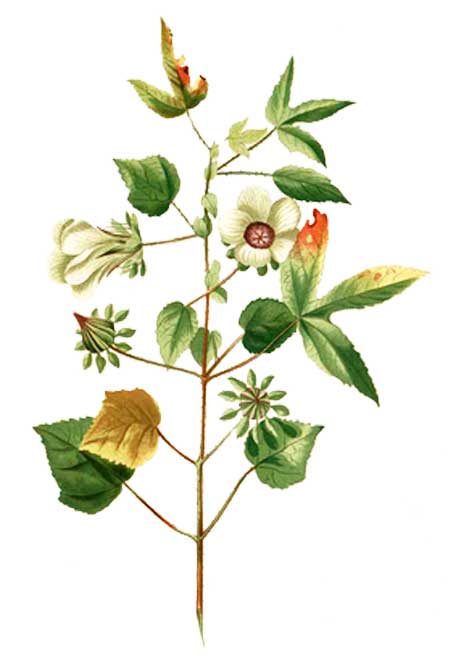
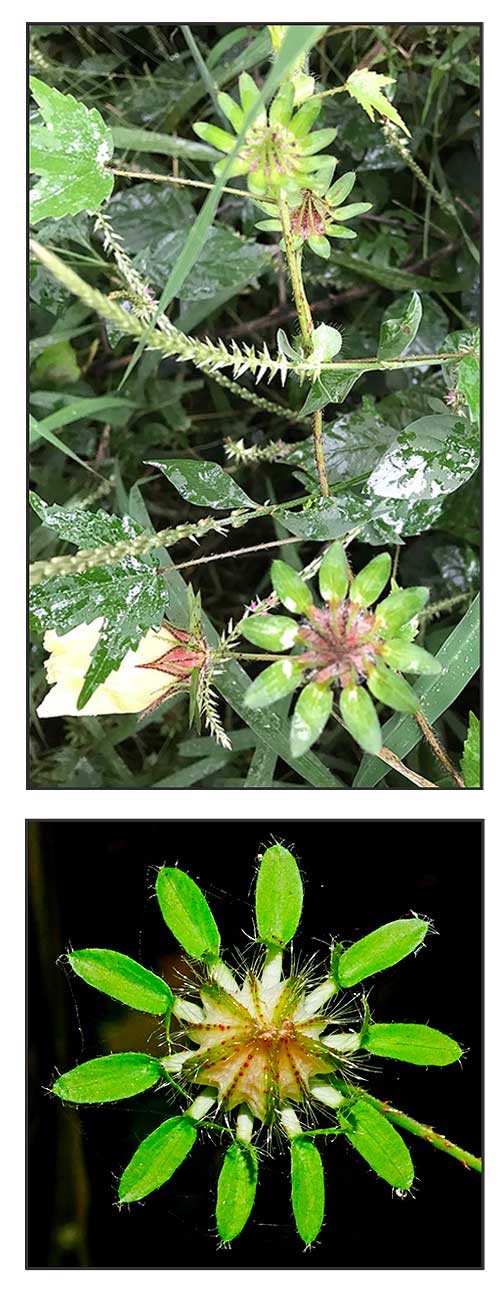
• Labuag is a weak-stemmed trailing plant covered with soft hairs and scattered prickles. Leaves are rounded, toothed, and deeply and palmately 3- or 5-lobed. Flowers are yellow with a dark red center. Capsules are hairy and ovoid. Seeds are downy.
• Bush Sorrel is a weak-stemmed, prostrate or climbing plant covered with soft hairs and scattered prickles. The leaves are rounded, up to 10 X 10 cm, and deeply and palmately 3- to 5-lobed, the lobes being toothed. The flowers are yellow, with a dark center, and occur singly in leaf axils. Petals are obovate, up to 6 cm long and 4 cm wide. This flower can be easily identified by its unique false sepals, which are 8-10 in number. The false sepals (actually bracts) are forked into a spoon-shaped outer part, and a narrow linear inner part. But for this feature, the plant can be confused with Deccan Hemp. The capsules are hairy and ovoid. The seeds are downy. (Flowers of India)
Distribution
- Native to the Philippines. (8) (7)
-
Most islands and provinces throughout the Philippines in open grasslands, at low and medium altitudes.
- In early secondary growths and waste places near human settlements in the lowlands.
- In Luzon: Albay, Bataan, Bulacan, La Union, Laguna, NCR, Nueva Viscaya, Pangasinan, Quezon, Rizal; in Mindanao: Zamboanga, Zamboanga del Norte; Mindoro, Palawan, Panay.
(7)
- Also native to Angola, Assam, Bangladesh, Benin, Borneo, Burundi, Cambodia, Cameroon, Cape Verde, Central African Republic, China South-Central, China Southeast, Congo, DR Congo, East Himalaya, Ethiopia, Gabon, Gambia, Ghana, Guinea, Guinea-Bissau, Gulf of Guinea Is., Hainan, India, Ivory Coast, Kenya, Laos, Liberia, Malawi, Malaya, Mozambique, Myanmar, Nigeria, Northern Provinces, Senegal, Sierra Leone, Sri Lanka, Sudan-South Sudan, Tanzania, Thailand, Togo, Uganda, Vietnam, Zambia, Zimbabwe. (8)
 Constituents Constituents
- Seeds yield: oil, 13-17%, with a predominance of linoleic acid in the fatty acid component of the oil, followed by palmitic and oleic acids, and small concentrations of malvalic acid, sterculic, dihydrosterculic and epoxy acids.
- Essential oil from leaves
was dominated by monoterpenes (34.1%) and sesquiterpene compounds (41.2%). Major oil constituents were ß-caryophyllene (12.9%), menthol (10.6%), methyl salicylate (9.7%), and camphor (9.2%), with significant amounts of germacrene D (5.5%), hexadecanoic acid (4.3%),
α-humulene (4.0%), 1,8-cineole (3.0%) and methone (3.0%). (10)
- Ethanol and aqueous plant extracts yielded flavonoids, anthraquinones, coumarins, and triterpenes, with tannins also present in the ethanolic extract.
(see study below) (17)
- LC-MS/MS analysis of ethanol extract of leaves showed presence of major compounds, including kaempferol, morin, quercetin, and trifoliin.
(see study below) (19)
- GC-MS analysis of calyces EO obtained by hydro-distillation revealed main compounds of ß-caryophyllene (11.68%), menthol (9.44%), methyl salicylate (8.32%), camphor (8.47%), and germacrene D (5.13%).
(see study below) (20)
- GC-FID and GC-MS studies of H. surattensis leaf EO
revealed a dominance of monoterpenes (34.1%) and sesquiterpene compounds (41.l2%). Major oil constituents were ß-caryophyllene (12.9%), menthol (10.6%), methyl salicylate (9.7%), camphor (9.2%), with significant amounts of germacrene D (5.5%), hexadecanoic acid (4.3%), α-humulene (4.0%), 1,8-cineole (3.0%), and menthone (3.0%). (21)
Properties
- Rich in mucilage.
- Considered emollient,
febrifuge, laxative, abortifacient, pectoral, cardiotonic.
- Studies have suggested biodiesel potential, antioxidant, analgesic, antidiarrheal,
anti-inflammatory, antidiabetic, DPP-IV inhibitory, antimalarial, antibacterial properties.
Parts used
Leaves, stems, fruit, flowers, and roots.
 Uses Uses
Edibility
- Acid leaves used for salads or as a pot-herb.
- In India, fruit and tender leaves used in curries.
- In Africa, leaves used as spinach.
- See study on effects of cooking methods below (24)
Folkloric
- In Senegal, plant used as an emollient.
- Leaves used for cough.
- Zulus use a lotion or ointment of the stem and leaf as treatment for penile irritation; including venereal sores and urethritis. Infusion used as injection into the urethra and vagina for gonorrhea and other urethral inflammations.
- Decoction of leaves or roots used for skin complaints.
- In other traditional systems, used for paralysis, epilepsy, convulsions, pregnancy; as abortifacient.
- Leaf, root and fruit juice used for cutaneous parasitic infections.
- Roots used as febrifuge, laxative; for tumors and cancers.
- In Nigeria, leaf and fruit juice given to children for cough.
- In India, among the folklore herbalists and Tripuri medical practitioners, curry is made from its tender leaves and given to patients with jaundice. (3)
- In Bangladesh, leaves are used for intestinal disorders. Mucilaginous flowers used as emollient and pectoral. (9)
- In Africa, stems used for skin ulcers; leaves for anemia; decoction of leaves for adult dyspepsia; poultice of leaves for ulcers and boils; decoction of stems with leaves used for cough; paste of pounded roots applied to burns; leaves applied as dressing on wounds; infusion of leaves used as mouth wash for oral sores in children; heated leaves applied to boils and abscesses. (11)
- In Sierra Leone, infusion of leaves with Zingiber officinale or Ocimum gratissimum drunk for cough. (12)
- In Ayurveda, leaves, roots and fruits used for epilepsy, paralysis, pulmonary diseases, venereal diseases, parasitic infections, fever, edema, abscesses, snake bites. (13)
- In Indonesia, used by ethnic Sumari as antidiabetic herbal. (14)
- In Nigeria, infusion of leaves used internally for gonorrhea. (15)
- In West Africa, leaf decoction ingested for treatment of malaria. In Nigeria, flowers used for treatment of hypertension. In India, lotion made from stems and leaves used for treatment of venereal diseases and urethritis.
(16)
Others
- Fiber: Plant yields a fiber of good quality. In Brazil, used as a substitute for jute.
- Rural housing material: Provides material for roof thatching.
Studies
• Fatty Acid Composition: In a study of the fatty acid composition of seed oils of seven Hibiscus species of malvaceae, all contained 13-17% oil. Linoleic acid predominated in the component fatty acids of all oils, followed by palmitic acid and oleic acid. (1)
• Biodiesel Source: Study investigated the viability of using locally available vegetable seed oils to produce biodiesel. Two indigenous seeds - Hibiscus surattensis and Hibiscus sabdariffa were used in the study. Results suggest H. sabdariffa blend of 40:60 and H. surattensis blend of 30:70 can be recommended for use in diesel engines without any engine modifications. (6)
• Antidiabetic / Leaves: Study investigated the antidiabetic activity of ethanolic extract and fractions of leaves and fractions in invitro and in vivo models. Results showed the extract and fraction of HS leaves in vitro had no effect on α-glucosidase inhibition but in vivo exhibited hypoglycemic effect on ethyl acetate and water fractions. (14)
• Anti-Inflammatory / Antioxidant / Analgesic / Anti-Diarrheal / Leaves: Study evaluated the effect of fractional extracts (ethanol, chloroform, and n-hexane) of H. surattensis in treating inflammation, oxidant, pain and diarrhea in vitro and in vivo experimental models using protein denaturation of egg albumin, DPPH free radical inhibition, acetic-acid induced writhing, and castor-oil induced diarrheal models. All extracts showed significant (p<0.05, p<0.005) mild to moderate inhibition of protein denaturation; significant (p<0.05) DPPH free radical scavenging inhibition, significant (p<0.05) reduction of writhing and increased mean latent period of defecation in castor oil-induced diarrheal model in mice at dose of 500 mg/kbw. Identification of more active chemical entities were suggested. (16)
• Antiplasmodial / Antimalarial: Extracts and fractions by bioassay-guided isolation were tested in vitro against Chloroquine-sensitive and field isolate strains of Plasmodium falciparum by immune-dosage of Plasmodium lactate dehydrogenase. The ethanolic extract showed best antiplasmodial activity against field isolate with IC50 of 5.03 µg/mL and Chloroquine-sensitive with IC50 7.55 µg/mL while the aqueous extract showed moderate activity. Both extracts exhibited strong antioxidant activity, hemolytic power less than 1%. No mortality was observed in rats with ethanol extract at 2000 mg/kbw. Activity was attributed to the synergetic action of secondary metabolites. (see constituents above) (17)
• Antidiabetic: Study evaluated the in vitro antidiabetic potential of solvent extracts of H. surattensis with emphasis on glucose absorption, enzyme inhibition, and antioxidant activities. Phytochemical screening revealed appreciable amounts of flavonoids, tannins, phenolic compounds, saponins, and glycosides. Among tested solvents, ethanol (EE) and aqueous (AqE) outperformed others. In glucose absorption test, the EE showed highest glucose-binding/uptake capacity with 77.3% uptake at 800 µg/mL with EC50 of 189.4 µg/mL, closely comparable to reference drug acarbose. The aqueous extract showed a similar trend Both extract showed potent
α-amylase and α-glucosidase inhibition, along with strong free radical scavenging activity in DPPH, hydroxyl, and superoxide assays.
The multiple mechanisms of antidiabetic action involves direct suppression of digestive enzymes associated with postprandial hyperglycemia, reduction of intestinal adsorption of glucose, mitigation of oxidative stress implicated in ß-cell dysfunction, insulin resistance, and downstream diabetic complications. Results suggest potential for a safe, effective, and plant-based therapy for management of diabetes mellitus. (18)
• Antidiabetic / Antioxidant / Dipeptidyl Peptidase-IV Inhibitory / Antioxidant / Leaves: Study evaluated ethanolic extracts of leaf and active subfractions for antioxidant potential. The ethyl acetate fraction showed potential inhibitory activity against dipeptidyl peptidase IV with IC50 17.947 µg/mL and high free radical scavenging capacity with IC50 of 44.10 µg/mL, ferric reducing ability and cupric reducing antioxidant capacity of 639.70 mg ascorbic acid Eq/g and 174.89 mg ascorbic acid Eq/100g respectively. Results suggest a new mechanism for the control of diabetes. (see constituents above) (19)
• Antibacterial on Food Borne Pathogens / Essential Oil of Calyces: Study
evaluated the essential oil composition of HS calyces and its antibacterial effect on some important food-borne pathogens. By disc diffusion method, the most highest antibacterial effect was on Listeria monocytogenes with diameter zone of 25.26 mm, followed by 23.42 mm for Staphylococcus aureus, 22.93 mm for E. coli. The EO also showed bactericidal effect on E. coli, S. aureus, and L. monocytogenes, and a bacteriostatic effect on Enterococcus aerogenes, Salmonella typhimurium, and Shigella flexneri -- foodborne pathogens used in the study. (see constituents above ) (20)
• Angiotensin Converting Enzyme Inhibitory / Antioxidant / Leaves: Study evaluated the herbonanoceutical effects of tamoenju 96% ethanol extract of leaf formulated into nanoemulsions on Angiotensin Converting Enzyme (ACE) inhibition, antioxidant activity, phenolic and flavonoid content.
Antioxidant activity for F1, F2, and F3 were 95.12, 61.27 and 160.40 µg/mL for DPPH and 51.92, 135.60 and 52.26 µg/mL for FRAP. Ace inhibition IC50s for F1, F2, and F3 were 24.44, 63.33, and 52.28 µg/mL. Phenolic content was highest in F3 (449.5 mg GAE/g). and flavonoid highest in F1 (328.77 mg QE/g). Fraction 1 showed superior potential as antioxidant and ACE inhibitor. (22)
• Antidiabetic / Reduction of HbA1c and AGEs / Leaves: Study evaluated the efficacy of HS leaves active fraction in reducing levels of HbA1c, AGEs (advanced glycation end products), and GLUT-4 expression in muscle tissue of rat model with T2 DM using a high-fat and fructose diet for 8 weeks. HFD/HF induction significantly increased HbA1c and Ages. Results showed significant
. Treatment significantly reduced (p<0.05) HbA1c and AGEs levels by 56.4% and 54.7% respectively. Results showed antidiabetic effect via reduction of HbA1c and AGEs probably via mechanism of targeting GLUT4 glucose transporter by increasing its translocation and expression. (23)
• Effect of Cooking on Nutritional Composition and Antioxidant Properties / Leaf Vegetable: Study evaluated the effect of various cooking ways on nutritional, anti-nutritional, total phenolics content, and antioxidant activity of leaves. Fresh leaves were cooked by boiling, microwave, and stir-fry9ing methods for 3, 5, and 10 min. Boiling enhanced the total carbohydrates and total proteins, whereas trypsin inhibitor activity was significantly reduced at 10 min. Boiling for 10 minutes also improved total phenolics, antioxidant activity (DPPH, ABTS, FRAP assays) of leaves. Recommended time of boiled leaves may contribute to good stability of dietary compounds.
(24)
• Antibacterial Gel Formulations / Leaves: Study evaluated the effect of gelling agent in tamoenju leaves extract gel and their antibacterial potential. Formulations of 1, 1.5, and 2% concentration of gelling agents were evaluated for physical characteristics i.e., organoleptic, pH, viscosity, spreadability, adhesiveness, and antibacterial potential against Staphylococcus aureus. Results showed antibacterial gel formulations can be made using the leaf extract. Physical stability parameters of all gel preparations showed good results on day 1, but changed after 36 d of storage. F2 (1.5% of HPMC) showed best physical stability and strongest inhibitory effect against growth of S. aureus. (25)
Availability
Wild-crafted. |