Gen info
- Malvaceae, or the mallows, is a family of flowering plants containing about 244 genera with 4225 known species. Well known members of economic importance include cacao, cola, cotton, okra, roselle, and durian. (5)
-
Malachra is a genus of flowering plants in the family Malvaceae, native to the Americas and Africa, and introduced in some places in Asia. They lack an epicalyx, a derived trait (autapomorphy) within their tribe Hibisceae, which is known to have epicalyces. (23)
Botany
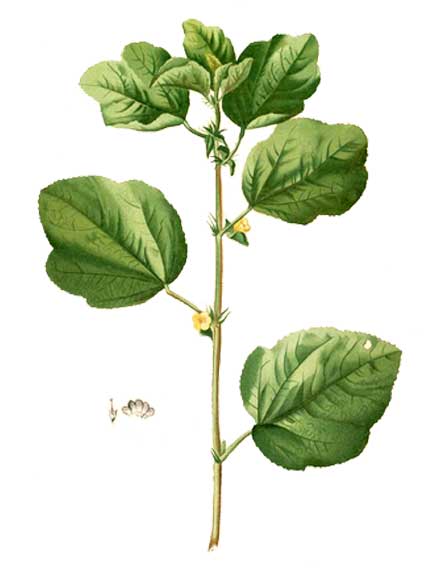
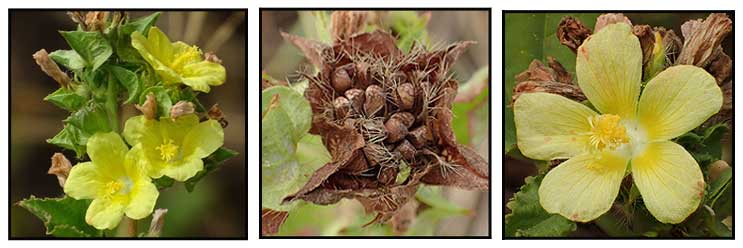
• Lapnis is a coarse, erect, simple or branched, annual herb, 0.5 to 2 meters high, covered with hairs. Leaves are orbicular, 5 to 15 centimeters in diameter, obscurely and shallowly lobed, finely toothed and somewhat heart-shaped at the base. Flowers are borne in axillary and terminal heads. The calyx-lobes are short, and slenderly pointed at the tip. The petals are yellow, imbricate, about 1 centimeter long.
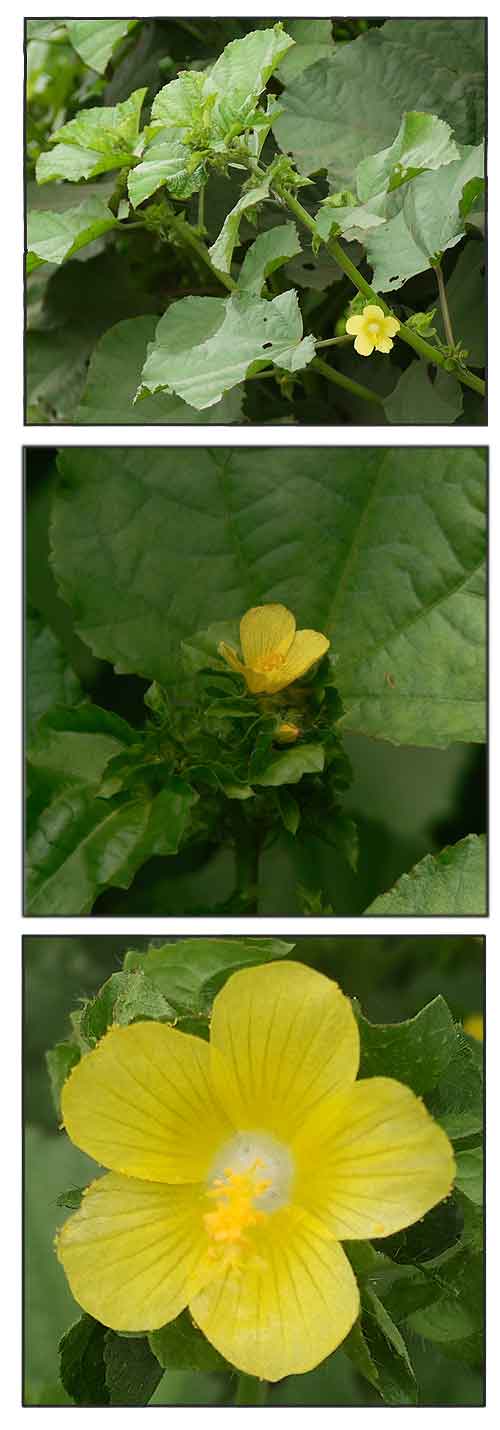 • An erect annual or perennial woody herb, up to 2 m tall, green parts with scattered, stiff, simple hairs and stiff, 2-armed, stellate hairs, prickly, about 2 mm long, for the rest densely covered with small many-armed stellate hairs. Leaves with petiole up to 9 cm long; stipules filiform, up to 1.5 cm long, hispid; blade orbicular to ovate, angular or slightly lobed, 2—9 cm in diameter, base cordate and 5-veined, margin crenate to serrate, apex obtuse to rounded, both sides densely clothed with gray, stellate hairs, glabrescent. Inflorescence a 2—10-flowered head; peduncle 1—5 cm long,; bracts 3—4, ovate to circular, 0.5—2 cm in diameter, folded along the midrib; calyx cup 3.5 mm long, segments oblong, 3 mm x 1.5 mm, obtuse, not aristate; corolla 1—1.5 cm in diameter, bright yellow, petals obovate; staminal column 3 mm long. Fruit 5—6 mm in diameter, mericarps 3 mm x 2 mm. Seed triangular-obovoid, 2.5 mm long, gray, densely stellate-hairy.
Distribution
- Naturalized.
-
Common weed in open, waste places in Nueva Viscaya, La Union, Pampanga, Rizal, Cavite, Laguna Provinces and Manila in Luzon.
- Native to Bahamas, Belize, Bolivia, Brazil Northeast, Brazil Southeast, Colombia, Costa Rica, Cuba, Dominican Republic, Florida, Guatemala, Haiti, Honduras, Jamaica, Leeward Is., Mexico Central, Mexico Gulf, Mexico Northeast, Mexico Southeast, Mexico Southwest, Nicaragua, Panamá, Puerto Rico, Texas, Venezuela, Windward Is. (11)
- Planted as a fiber plant in India.
- Now pantropic.
Constituents
- Phytochemical screening yielded alkaloids, flavonoids, tannins, phlobatanin, terpenoid, saponin, and glycosides. (6)
- Fat obtained from shade dried plant was saponified; the unsaponifiable matter was isolated and identified as ß-sitosterol. (8)
- Roots yield phenols, tannins, carbohydrates, saponins, and flavonoids.
- HPLC analysis of roots for flavonoid
contents detected (mg/g concentration): gallic aid 20.0, caffeic acid 1.0, rutin 0.1, quercetin 10.0, ferulic acid 1.0. Stem yielded gallic acid 30.0, with others below detection limit. Leaves yielded rutin 10.0 and ferulic acid 10.0, with the three other flavonoids below detectable limit. (14)
- Various solvent extracts of root, stem, and leaf dry powder yielded alkaloids, anthocyanoides, coumarin, flavonoids, phenol, protein, saponins, tannins, and terpenoids. (see study below) (16)
- Phytochemical screening of hydroethanolic extract of whole plant
revealed presence of tannins, flavonoids phenolic compounds, reducing sugars, and alkaloids, with absence of saponins, terpenoids, steroids, and carbonyl compounds. (25)
Properties
- Emollient.
- Studies suggest anti-viral, antioxidant, hepatoprotective, anti-ulcer, anti-epileptic, corrosion inhibition, antioxidant, anti-diarrheal, erythrocyte protective, hepatoprotective, antimicrobial, anti-inflammatory, analgesic, corrosion inhibitory, allelopathic properties.
Parts
used
Flowers, leaves and roots.
 Uses Uses
Folkloric
• In the Philippines, decoction of roots and leaves considered emollient in enemas and for bathing purposes. (22)
• Roots used as traditional remedy for many diseases: diarrhea, convulsion, inflammation, fever, wound healing.
• In Antilles, used as an emollient.
• In West Bengal, India, used for infertility -- raw fruits given daily during the menstrual period, for 3 months.
• In Indian traditional medicine, used for treatment of epilepsy and inflammation.
• In the Krishna district of India, leaf paste is used as an external ointment for treating skin eruptions.
• In India's Akola district, plant used for gastric disorders and jaundice.
Others
• Fiber: Bast is strong and used in rope making. Fiber is excellent, 8 to 9 feet long, considered as strong and just slightly inferior to jute. (•) In the Philippines, used for making strong rope, suitable for clotheslines and general purposes. Fiber also suitable for use in coarse textiles, e.g. sacks. Used as substitute for jute or in admixture with jute. (27)
Studies
• Antiviral Activity / Stems and Leaves: In a study of forty-seven ethanol crude extracts of 42 plants for antiviral activity against Foot and Mouth Disease type O, the leaves and stems of Malachra capitata showed low antiviral activity. (1)
• Anti-Ulcer Activity / Roots: Study evaluated the anti-ulcer activity of aqueous extract of roots of Malachra capitata against pylorus ligation and ethanol induced gastric ulcer in rats. Results showed significant anti-ulcer activity in both models, with gastric anti-secretory effect in pylorus-ligated rats and gastric cytoprotective effect in ethanol induced gastric ulcers. Ranitidine and misoprostol were used as standard drugs. (4)
• Corrosion Inhibition / Leaves: Study evaluated an extract of leaves for corrosion inhibit on of mild steel in 1N H2So4. Weight loss results showed the extract of M. capitata leaves is an excellent corrosion inhibitor. Adsorption of active molecules led to the formation of a protective layer on the surface of the mild steel. (5)
• Anti-Epileptic Activity: Study evaluated and aqueous extract of M. capitata showed anti-convulsant activity on MES (Maximum Electroshock) and PTZ (Pentylenetetrazole) induced seizure models in albino Wistar rats. Anticonvulsant activity may be due to potentiation of GABA activity. (10)
• Corrosion Inhibition / Leaves: Extract of M. capitata leaves was investigated as corrosion inhibitor of mild steel in 1N H2SO4. Results showed the leaves of MC to be an excellent corrosion inhibitor, with a mixed mode of inhibition, with adsorption of active molecules providing formation of a protective layer on the surface of mild steel. (9)
• Toxicity Study / Roots: Acute toxicity study of roots in rats showed the extract to be safe at doses of 2000 mg/kg body weight orally per OECD guidelines. In chronic study, no significant changes were observed with hematological, hepatic, and renal parameters. (12)
• Antidiarrheal / Roots: Study evaluated an aqueous extract of roots for antidiarrheal activity using castor oil-induced diarrhea, enteropooling and small intestinal transit model in rats. Results showed significant (p<0.001) reduction of castor oil-induced frequency and enteropooling. At 200 and 400 mg/kg, there was significant inhibition (p<0.001) in castor oil-induced charcoal meal transit. (12) (19)
• Erythrocyte Protective Activity / Antioxidant: Study evaluated the antioxidant activity of aqueous extract of M. capitata in rats with carbon tetrachloride (CCl4)-induced erythrocyte damage. Results showed the extract protected against the loss of functional integrity and membrane lipid alteration in RBCs induced by oxidative stress, together with inhibition of accumulation of lipid peroxidation products. (13)
• Flavonoids / Antioxidant: HPLC studies of methanol extracts of root, stem and leaf samples yielded appreciable amounts of flavonoid gallic acids (root and stem), quercetin (root), rutin and ferulic acid (leaf). (see constituents above) (14)
• Hepatoprotective: Study evaluated an aqueous extract of M. capitata showed significant protection against CCl4 induced toxicity model in male Wistar albino rats. (12)
• Antibacterial
/ Stem and Roots: Study evaluated ethanol extracts of leaf, stem, and root of Malachra capitata for antimicrobial activity against Micrococcus sp, Bacillus subtilis, Escherichia coli, Pseudomonas aeruginosa and Salmonella typhimurium. Stem and root extracts were active against all test organisms. Leaf extract was effective against Micrococcus and E. coli only. (15)
• Antimicrobial: Study of ethanol extracts of leaf root, stem, and leaf showed potential activity against bacteria (E. coli, P. aeruginosa, B. subtilis) and fungi (C. albicans, C. paraapsolisis, and A. niger). (see constituents above) (16) Study screened methanolic, chloroform and benzene extracts of leaves of M. capitata for antimicrobial properties. The methanolic extracts at different concentrations inhibited the growth of E. coli and L. monocytogenes. Concentration of 50 mg/ml showed highest diameters zone of inhibition ranging from 1mm to 11mm. Phytochemical screening of leaf extracts yielded alkaloids, carbohydrates, flavonoids, and saponin. (21)
• Antioxidant / Roots: Study evaluated an aqueous extract of roots for antioxidant activity using DPPH scavenging and reducing power assays. Results showed significant dose dependent inhibition of DPPH activity. (17)
• Silver Nanoparticles / Antibacterial / Leaf: Study reports on the green, eco-friendly and convenient method of silver nanoparticles synthesis using n-hexane extract of leaf as reducing agent. The green synthesized AgNPs showed excellent antibacterial activity against all tested bacterial strains viz. B. subtilis, M. luteus, S. aureus, and P. aeruginosa. (18)
• Bionic Amines Post-Seizure / Anticonvulsant Activity: Study evaluated the relationship between seizure activities and altered monoamines such as noradrenaline (NA), dopamine (DA), serotonin (5-HT) and gamma amino butyric acid (GABA) in forebrain of rats in MES and PTZ models. Results showed significant reduction (p<0.01) in SOD, glutathione peroxidase, glutathione reductase and catalase in rat brain due to epilepsy, which was significantly restored (p<0.01) by the aqueous extract of M. capitata. Similar dose dependent results were obtained in the PTZ model. The anticonvulsant activity may be due to antioxidant properties, which delays generation of free radicals in MES and PTZ induced epilepsy. (20)
• Anti-Arthritic / Anti-Denaturing Property: Study evaluated the anti-arthritic activity of ethanolic extract of M. capitata using protein denaturation techniques including egg albumin and bovine serum albumin (BSA). The extracts of MC exhibited dependent suppression of denaturation of protein (albumin). Methotrexate showed less impact compared to the extracts. (24)
• Analgesic / Anti-Inflammatory / Leaves: Study evaluated the analgesic and anti-inflammatory activity of alcoholic extracts of leaves of M. capitata in male Wistar rats. Analgesic testing by acetic acid-induced writhing and tail immersion methods showed significant dose-dependent inhibition of writhing and significant increase in time taken for removal of tail from hot water. In anti-inflammatory testing by carrageenan induced paw edema, there was 41.38% reduction of edema volume and dose-dependent decrease in both dry and wet cotton pellet weights. Results showed significant analgesic and anti-inflammatory properties. (26)
• Herbicidal Activity of the Invasive Weed / Allelopathic Potential for Weed Control: The invasive weed Malachra capitata is unsuitable for human or animal consumption but has recently attracted attention for its potential alternative use i.e., its allelopathic potential for weed control. Leaves extract collected 35 days after planting exhibited the strongest inhibitory activity. Bioassay-guided fractionation indicated the ethyl acetate-soluble acidic fraction contain active allelochemicals. Inhibition was associated with reduced water intake and suppression of α-amylase activity during seed germination. Most abundant GC-MS detectable components of the acidic fraction were octadecane (12.45%), eicosane (9.74%), and hexadecane (9.60%). Results highlights the allelopathic potential of the invasive weed M. capitata, which is influenced by plant growth stage resulting in different phytotoxic effects. (28)
• Herbal Antidiabetic Tablet: Study reports on the formulation of a herbal antidiabetic tablet using a novel, cost-effective, non-toxic and green granulation method. Results highlight the antidiabetic and hypoglycemic potential of M. capitata seeds against diabetes. (29)
• Inhibitive Effect on Sulphuric Acid Corrosion of Mild Steel / Leaves: Study evaluated M. capitata extract of leaves as corrosion inhibitor of mild steel in 1 N H2SO4. Weight loss results showed the leaf extract an excellent corrosion inhibitor. Electrochemical polarization data revealed mixed mode of inhibition. Change in concentration of extract is due to adsorption of active molecules leading to formation of a protective layer on the surface of mild steel. (30)
Availability
- Wild-crafted.
- Cultivated. |






.jpg)
.jpg)

