
HOME      •      SEARCH      •      EMAIL    •     ABOUT


Family • Euphorbiaceae
Malasapsap
Acalypha caturus Blume
MIGTANONG
Jian wei tie xian cai

Scientific names Common names
Acalypha caturus Blume            Ambugtunong (Bisaya)
Acalypha caturus f. angustifolia J.J.Sm.            Malasapsap (Tagalog)
Acalypha cinnamomifolia Pax & K.Hoffm.            Migtanong (Bikol)
Acalypha cinnamomifolia var. induta Airy Shaw             
Acalypha minahassae Koord.             
Acalypha similis Koord.             
Ricinocarpus caturus (Blume) Kuntze             
Acalypha caturus Blume is an accepted species. KEW: Plants of the World Online

Other vernacular names
CHINA: Jian wei tie xian cai.
INDONESIA: Bunga halaman, Hanjawan, Goprak, Kalangkongan, Kayu in cios, Ki lauk.
MALAYSIA: Sepang.

Gen info
- Acalypha is a genus of flowering plants in the family Euphorbiaceae. I(t is the sole genus of the subtribe Acalyphinae. It is the largest euphorbia genera, with about 450-462 species.
- The genus was first described in the Species Plantarum by Linne in 1753.
- Etymology: The genus name Acalypha derived from Greek akaluphe,
"nettle".

Botany
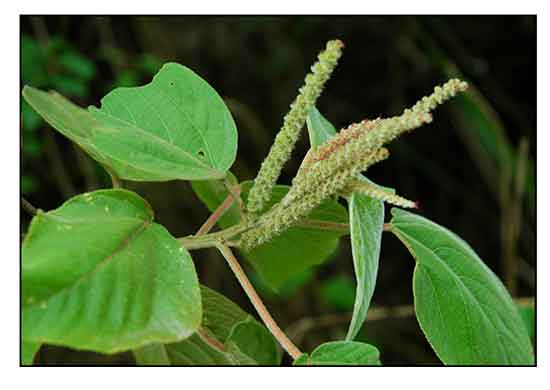
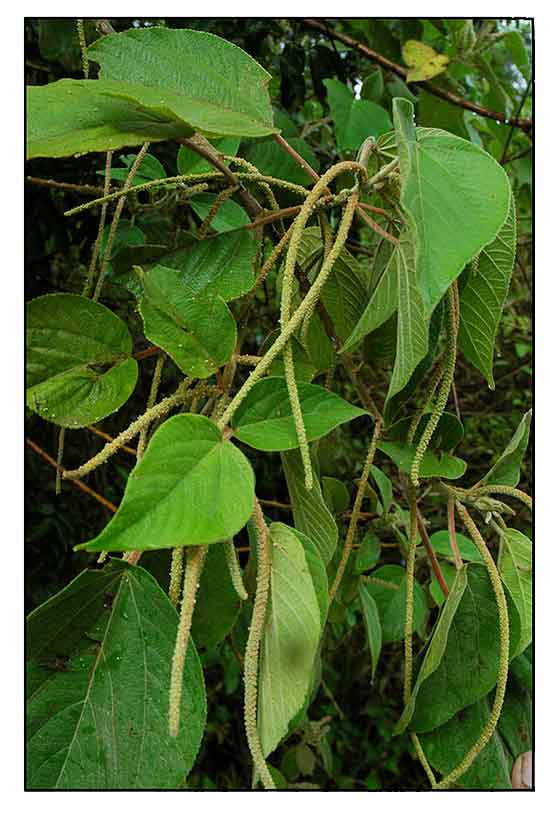
• Small trees, ca. 4 m tall. Young branchlets grayish tomentulose. Stipules narrowly lanceolate, 4-12 mm, pilose; petiole 5-10 cm, pilose; leaf blade broadly ovate or ovate, 8-20 × 5.5-12 cm, papyraceous, abaxially tomentulose along veins, and vein axils bearded, base obtuse or subtruncate, sometimes slightly cordate, margin crenate, apex acuminate or long acuminate; basal veins 3-5. Plants dioecious, rarely monoecious. Inflorescences axillary. Male flowers glomerate; spikes 10-20 cm, pilosulose; bracts lax, ovate, ca. 0.5 mm; pedicel ca. 1 mm; sepals 4, ca. 0.3 mm; stamens 8. Female flowers 1 in each bract; spikes 10-30 cm, slender; bracts lax, ovate, ca. 1 mm, acute, pilose; sepals 3, ovate, ca. 1 mm, pilose; ovary pubescent, often bilocular; styles 2(or 3), 2-3 mm, 15-20-laciniate. Capsule 2(or 3)-locular, 3-4 mm in diam. Seeds ovoid, ca. 2 mm. (Flora of China)

Distribution
- Native to the Philippines.
- Also native to Bismarck Archipelago, Borneo, Jawa, Lesser Sunda Is., Malaya, Maluku, New Guinea, Sulawesi, Sumatera, Vanuatu. (2)
- In open places in forests or in secondary forests or open land, below 100-200 m. Often along rivers or on dry riverbeds or along roads. also on limestone. (2)

Constituents
- Nutrient composition of the grass yielded 24.71% DM, 16.51% crude protein, 4.62% ether extract, 28.68% crude fiber, 18.28% ash. (4)

Properties
Study has suggested antioxidant, antibacterial properties.

Parts used
Leaves.

Uses

Edibility
- Fruits, leaves and young shoots eaten as vegetable after cooking.
- In rural households in Indonesia, used as emergency food.
- In Malaysia, leaves are fried with anchovies.
Folkloric
- In the Mountain Province, leaves rubbed on wounds to hasten healing.
Others
- Wood: Used for native fencing.

- Fodder: In Indonesia, use as forage for goats. (see constituents above) (4)

Studies
• Antioxidant / Antibacterial / Endophytc Fungi:
Endophytic fungi are a group of fungi that grow inside plant tissues without causing negative symptoms to the host plant and can produce biologically active substances. In a study of 40 endophytic fungi isolated from 10 species of medicinal plants,  Acalypha caturus PAL-14D3 was one of six that exhibited very strong antioxidant activity with IC50 14.06 and AAI (final concentration of DPPH in the reaction/IC50)value of 2.187.PAL-14D3 showed an MIC of 64 µg/ml against E. coli and MIC of 256 µg/ml against S. aureus. (5)

Availability
Wild-crafted.

October 2023

                                                 PHOTOS / ILLUSTRATIONS
IMAGE SOURCE: Euphorbiaceae : Acalypha caturus / Flowering twig / Copyright © 2011 by Leonardo L Co [ref. DOL32623] / Non-Commercial Use / click on image or link to go to source pagre / Phytoimages.siu.edu
OTHER IMAGE SOURCE: Euphorbiaceae : Acalypha caturus / Flowering plant / Copyright © 2011 by Leonardo L Co [ref. DOL32622] / Non-Commercial Use / click on image or link to go to source pagre / Phytoimages.siu.edu

Additional Sources and Suggested Readings
(1)
Acalypha caturus / KEW: Plants of the World Online
(2)
Acalypha caturus Blume / AsianPlantNet
(3)

Acalypha / Wikipedia
(4)
Forages commonly available to goats under farm conditions on Lombok Island, Indonesia / Dahlanuddin /  Livestock Research for Rural Development, 2001; 13(1)
(5)
Antibacterial and antioxidant activities of endophytic fungi extracts of medicinal plants from Central Sulawesi / Praptiwi, Marlin Raunsai, Dewi Wulansari, Ahmad Fathoni, Andria Agusta /  Journal of Applied Pharmaceutical Science, 2018; 8(8): pp 69-74 / DOI: 10.7324/JAPS.2018.8811 /  ISSN: 2231-3354

•

DOI: It is not uncommon for links on studies/sources to change. Copying and pasting the information on the search window or using the DOI (if available) will often redirect to the new link page. (Citing and Using a (DOI) Digital Object Identifier)

                                                            List of Understudied Philippine Medicinal Plants
                                          New plant names needed
The compilation now numbers over 1,300 medicinal plants. While I believe there are hundreds more that can be added to the collection, they are becoming increasingly difficult to find. If you have a plant to suggest for inclusion, please email the info: local plant name (if known), any known folkloric medicinal use, scientific name (most helpful), and, if available, a photo. Suggestions are greatly appreciated. (G.Stuart)
•

•
HOME      •      SEARCH      •      EMAIL    •     ABOUT