
HOME      •      SEARCH      •      EMAIL    •     ABOUT


Family Apocynaceae
Malayan urn vine
Dischidia major (Vahl) Merr.
ANT PLANT / RATTLE SKULL
Ye he bao

Scientific names Common names
Collyris major Vahl Ant plant (Engl.)
Dischidia baeuerlenii Schltr. Malayan urn vine (Engl.)
Dischidia clavata Wall. Rattle sculls (Engl.)
Dischidia merguiensis Becc. Rattle skulls (Engl.)
Dischidia pubiflora Schltr.  
Dischidia rafflesiana Wall.  
Dischidia singaporensis Ridl.  
Dischidia timorensis Decne.  
Dischidia viridescens Griff.  
Dischidia major is an accepted species. KEW: Plants of the World Online

Other vernacular names
CHINA: Ye he bao.
DUTCH: Mierenplant.
MALAYSIA: Akar kul, Akar banok, Akar bani, Buah jantung.
THAILAND: Chuk rohini (central), Kluai mai (northern), Thao phunh pla (eastern).
VIETNAM: Song ly to, D[aa]y m[or] qu[aj].

Gen info
- Dischidia is a genus of plants in the "dog-bane" family Apocynaceae, collective known as the "milkweeds." The genus comprises 128 accepted epiphytic species.
- Phylogenetically, Dischidia is the sister genus to Hoya, sharing a common ancestor in the tribe Marsdenieae.
- Dischidia major was first described by Martin Vahl as Collyris major in 1810, based on material from Malaya. It was later transferred to the genus Dischidia by Elmer Drew Merrill in 1917, in his Interpretation of Rumphius' Herbarium Amboinense. (10)
- Etymology: The genus name Dischidia derives from Greek words dis, two; and askidion, ascidium, alluding to the leaves which may or may not develop into pouches. The specific epithet major, derives from Latin, meaning "larger".
- Ecological snippet: The plant's modified leaves offer accommodation to ants, especially Philidris
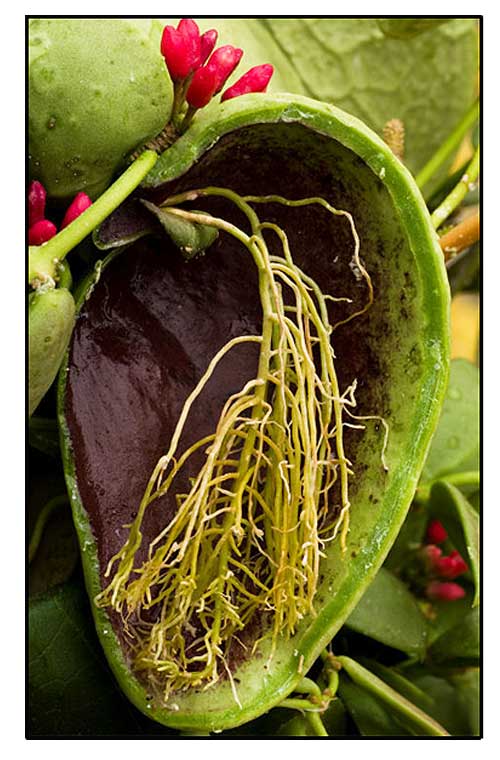
of the family Dolichoderinae - most commonly, Iridomyrmex myrmecodiae, but also Cataulacus and Crematogaster (Myrmicinae). In return, depending on the intimate contact between the branching adventitious roots within the inhabited pitchers and organic debris brought in by the ants, the plants gain some sustenance from increase carbon dioxide and nitrogen levels, and a degree of protection from noxious animals and plants.
(3) (11)
- Ant-Plant Symbiosis: Myrmecophytes are plants that live in a mutualistic association with a colony of ants. As a myrmecophyte, D. major exemplifies ant-plant symbiosis, with its milky latex-containing sap offering chemical defense against herbivores. However, the latex can cause skin irritation and toxicity. (10) Some nests were found away from D. major, indicating that the ant-plant mutualism is not obligate. (11)

Botany
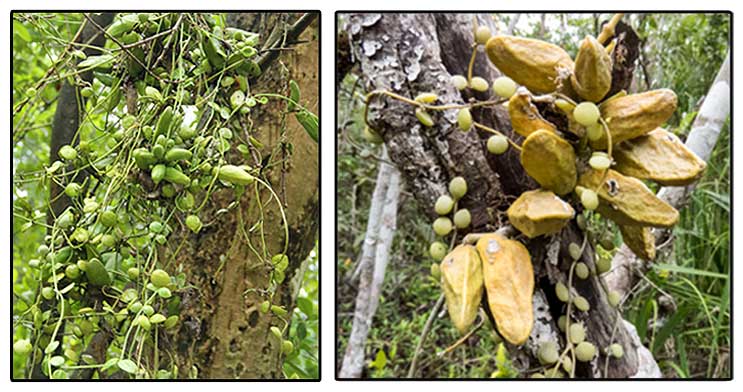
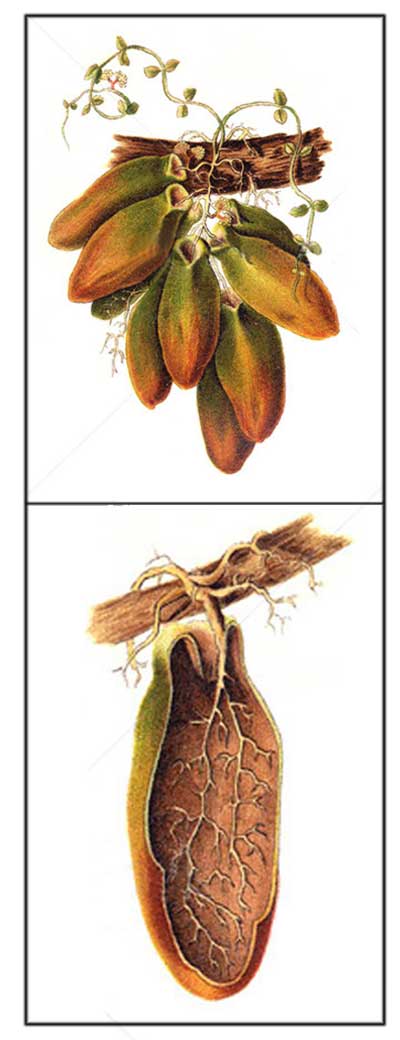
Growth form: Twining epiphyte, associated with ants. Foliage: Its latex-containing, opposite leaves have two forms of leaf blades. The smaller leaf blades are flat, rounded, and 2–3 by 1.5–2 cm, adpressed to the host tree or supporting structure. The other form is oblong, pouch-like, yellowish-green outside, purple inside, and 6–12 by 2–4 cm. This is often inhabited by ants. Flowers: Flowers are yellow-green, or striped yellow and green, have tubes 6–8 by 3–4 mm, and develop in clusters of 1–6 flowers. Fruit: Yellow-green fruits are follicles that split open at one side when mature and about 5 by 0.5cm. (Flora & Fauna Web)

• An epiphytic, climbing herb with glabrescent stem; leaves of 2 types: flat-orbicular, 2—3 cm in diameter, and pitcher-form ones 6—12 cm long, appressed to the host surface; inflorescence with 0.5—5 cm long peduncle, simple or bifid; corolla 8—10 mm long, yellow-green, lobes inside with short white hairs. Dischidia major is locally common in sunny and slightly shaded localities in open forest up to 1000 m altitude, also in secondary forest and mangrove forest, and on roadside trees, often hanging down in long garlands. (PROSEA)

Dischidia major flowers are yellow striped with green, and arranged in few or many-flowered umbels. The fruit of D. major consists of the usual horn-shaped pair of follicles while the seed has a tuft of silky hairs at one end and includes an edible portion or elaisome as incentive for ants to move the seed (myrmecochory) into nests inside the tree with an improved chance of germination and growth. (3)

Distribution
- Native to the Philippines. (1)
- In Cebu; Dinagat; Palawan; in Luzon: Camarines Norte, Zambales; In Mindanao: Agusan del Sur, Davao Oriental, Surigao del Norte. (2)
- Locally common on trees along the coase and on coastal mountains, forming large clusters on the branches. 0-100 m. (2)
- Also native to
Andaman Is., Assam, Bangladesh, Borneo, Cambodia, Jawa, Laos, Lesser Sunda Is., Malaya, Myanmar, New Guinea, Queensland, Solomon Is., Sulawesi, Sumatera, Thailand, Vietnam. (1)

Constituents
- Quantittive analysis of methanol extract yielded polyphenols (191.18 mg GAE/g), flavonoids (32.09 mg QE/g), alkaloids (189.79 mg AE/g), and saponins (215.33 mg OAE/g). (see study below) (6)

Properties
- Latex toxicity: Reported to secrete a milkly latex, which may cause itching or irritation upon contact., or toxicity if ingested.
- Leaves used as nesting sites by arboreal ants.
- Studies have suggested antihypertensive, antigout, anticancer, xanthine oxidase inhibitory properties.


Parts used
Roots, leaves.

Uses

Edibility
- Caution / Conflicting info: Fruit reportedly consumed for medicinal use and anecdotally as vegetable. However, it is generally not considered a conventional food source, with reports on potential toxicity. Milky latex reported to cause itching or irritation on contact.
Folkloric
- In the Philippines, leaves of a Dischidia species, possibly D. major, crushed with salt and applied externally to treat goiter. (8)
- Roots are chewed with betel to treat cough.
- In Thailand, decoction of whole plant used for treatment of peptic ulcer. Leaves mixed with Hoya kerrii leaves and Vanilla aphylla stems used for treatment of liver dysfunction. Roots use for treatment of fever. (8)
- In Sabah, fruit used for treatment of cancer and skin problems. (7)
Others

- Cultural belief: Purse-like leaves believed to bring wealth and prosperity among growers. (3)

Studies
Role of Surfactants in the Extraction of ß-amyrin:
Study reports on the green method ultrasound-assisted extraction of ß-amyrin from Dischidia major, using surfactants to improve absorption of ß-amyrin into the4 air/liquid interface during flotation. With the aid of surfactants, the foam later collected from flotation showed high selectivity toward ß-amyrin, and the product content notably increased after removal of surfactant from the solution. (4)
Antihypertensive / Anti-Angiotensin-Converting Enzyme: In a study of 29 herbal ingredients in two Thai traditional remedies - Prasachandaeng (PSCD) and Chantaharuethai (CHRT), Dischidia major showed strong properties as an anti-angiotensin-converting enzyme for control of hypertension. (5)
Anticancer / Xanthine Oxidase Inhibitory: Study evaluated methanol extract of D. major for xanthine oxidase inhibitory activity, biocompatibility on HEK293 cells, and anticancer effects on HepG2 and MCF7 cell lines. Extract exhibited xanthine oxidase inhibitory activity with IC50 of 46.4 µg/mL, biocompatibility on HEK293 cells, and inhibition of proliferation of HepG2 and MCF7 cancer cell lines with IC50s of 84.50 µg/mL and 73.74 µg/mL, respectively. Results highlight therapeutic potential for treatment of gout and cancer. (see constituents above) (6)

Availability
- Wild-crafted.

May 2026

                                                 PHOTOS / ILLUSTRATIONS
IMAGE SOURCE: Dischidia major / © URBAN FOREST / Non-commercial use / Image modified / Click on image or link to go to source page / UrbanForest
OTHER IMAGE SOURCE: Malayan Urn Vine / Dischidia major / © Gerard Chartier / Some rights reserved / CC BY 4.0 International / Click on image or link to go to source page / iNaturalist
OTHER IMAGE SOURCE: Illustration: Dischidia major / Meyers Konversations-Lexikon 1897 / PUBLIC DOMAIN / Click on image or link to go to source page / picryl
OTHER IMAGE SOURCE: Dischidia major: Cross section of "flower-pot" leaf / Sarracenia.com / eol.org / Non-commercial use / Image modified / Click on image or link to go to source page / AwkwardBotany

Additional Sources and Suggested Readings
(1)
Dischidia major (Vahl) Merr. / KEW: Plants of the World Online
(2)
Apocynaceae: Dischidia major / Co's Digital Flora of the Philippines
(3)
Dischidia major / Wikipedia
(4)
Crucial Role of Surfactants in Improving the Extraction Efficiency of β-Amyrin from Dischidia major Using Ultrasound-Assisted Extraction Coupled with Gas Bubble Flotation / Phuc Van Hoang, Thy Dang Uyen Phan, Nam Van Ho Phan et al / Labgmuir, 2022; 38(30)
(5)
Phenolic profiles and in vitro biochemical properties of Thai herb ingredients for chronic diseases prevention / Nattira On-Nom, Sirinapa Thangsiri, Uthaiwan Suttisansanee et al / Scientific Reports 2023; 13: Article No 21690 / DOI: 10.1038/s41598-023-49074-5
(6)
XANTHINE OXIDASE INHIBITORY AND ANTICANCER ACTIVITIES OF Dischidia major (Vahl) Merr. EXTRACT FROM PHU QUOC / Nguyen Duc Hien, Truong Quoc Hung, Nguyen Quoc Trung et al / Ho Chi Minh University of Education: Journal of Science, 2025; 22(6) / ISSN" 2734-9918
(7)
Ethnobotanical Survey of Medicinal Plants Traded at Tamu in Sabah Urban Area / Jurry Foo, Abdul Latiff Mohamad, Mustafa Omar, Ahmad Aldrie Amir / International Journal of the Malay World and Civilisation, 2016; 4(SI1): pp 79-87 / DOI: 10.17576/IMAN-2016-04SI1-09
(8)
Dischidia major / Wongsatit Chuakul, Noppamas Soothornchareonnon, Orawan Ruangsomboon / PROSEA: Plant Resources of South-East Asia
(9)
Additional reading: The symbiosis between Philidris ants and the ant-plant Dischidia major includes fungal and algal associates / Rumsaïs Biatrix, Aroonrat Kidyoo et al / Symbiosis, 2021; Vol 83: pp 306-315 / DOI: 10.1007/s13199-021-00751-x
(10)
Dischidia major / Grokipedia
(11)
Philidris ants living inside Dischidia epiphytes from Thailand / Christian Peeters and Deecha Wiwtwitaya / ASIAN MYRMECOLOGY, 2014; Volume 6: pp 49-61 / ISSN: 1985-1944

DOI: It is not uncommon for links on studies/sources to change. Copying and pasting the information on the search window or using the DOI (if available) will often redirect to the new link page. (Citing and Using a (DOI) Digital Object Identifier)

                                                            List of Understudied Philippine Medicinal Plants
                                          New plant names needed
The compilation now numbers over 1,750 medicinal plants. While I believe there are hundreds more that can be added to the collection, they are becoming more difficult to find. If you have a plant to suggest for inclusion, native or introduced, please email the info: scientific name (most helpful), local plant name (if known), any known folkloric medicinal use, and, if possible, a photo. Your help will be greatly appreciated.

HOME      •      SEARCH      •      EMAIL    •     ABOUT