 |

Family • Malvaceae
Modiola
Modiola caroliniana (L.) G.Don
CAROLINA BRISTLE MALLOW / CREEPING MALLOW
| Scientific names | Common names |
| Abutilodes carolinianum (L.) Kuntze | Modiola |
| Anoda strictiflora Steud. | Bristly-fruited mallow (Engl.) |
| Malva caroliniana L. | Bristly mallow (Engl.) |
| Malva caroliniana L. | Carolina bristle mallow (Engl.) |
| Malva caroliniana var. decumbens (Willd.) Trevir. | Creeping mallow (Engl.) |
| Malva caroliniana var.neglecta Regel | Mellow mallow (Engl.) |
| Malva decumbens Willd. | Red-flowered mallow (Engl.) |
| Malva eriocarpa DC. | Wheel mallow (Engl.) |
| Malva hawaiensis H.Lév. | |
| Malva juvenalis Lesp. | |
| Malva prostata Cav. | |
| Malva radicans Larrañaga | |
| Malva urticifolia Kunth | |
| Modanthos caroliniana (L.) Alef. | |
| Modanthos decumbens (Willd.) Alef. | |
| Modanthos eriocarpa (DC.) Alef. | |
| Modanthos prostata (Cav.) Alef. | |
| Modanthos reptans (A.St.-Hil.) Alef. | |
| Modanthos urticifolia (Kunth) Alef. | |
| Modiola caroliniana (L.) G.Don | |
| Modiola caroliniana var. brevipes Griiseb. | |
| Modiola caroliniana var. cumingiana C.A.Mey. | |
| Modiola caroliniana var. ereceta Thell. | |
| Modiola caroliniana f. parvula R.E.Fr. | |
| Modiola decumbens (Willd.) G.Don | |
| Modiola erecta Lesp. | |
| Modiola eriocarpa (DC.) G.Don | |
| Modiola fissistipula C.Presl | |
| Modiola multifida Moench | |
| Modiola prostata (Cav.) A.St.-Hil. | |
| Modiola reptans A.St.-Hil. | |
| Modiola urticifolia (Kunth) G.Don | |
| Modiolastrum jaeggianum K.Schum. | |
| Sphaeralcea caroliniana (L.) Paxton | |
| Sphaeralcea decumbens (Willd.) Paxton | |
| Sphaeralcea prostata (Cav.) Paxton | |
| Modiola caroliniana is an accepted species. KEW: Plants of the World Online | |
| Other vernacular names |
| ESTONIAN : Ujeöis. |
| JAPANESE: Kikunohaaoi. |
| KOREAN: Guk-hwa-ip-a-uk. |
| SPANISH / MEXICO: Pata de chula, Mercurio, Babosilla, Escobillo, Hiedra, Sanalo todo. |
| SWEDISH: Sprötmalva. |
 |
Gen info
Distribution Constituents Properties Studies Availability |
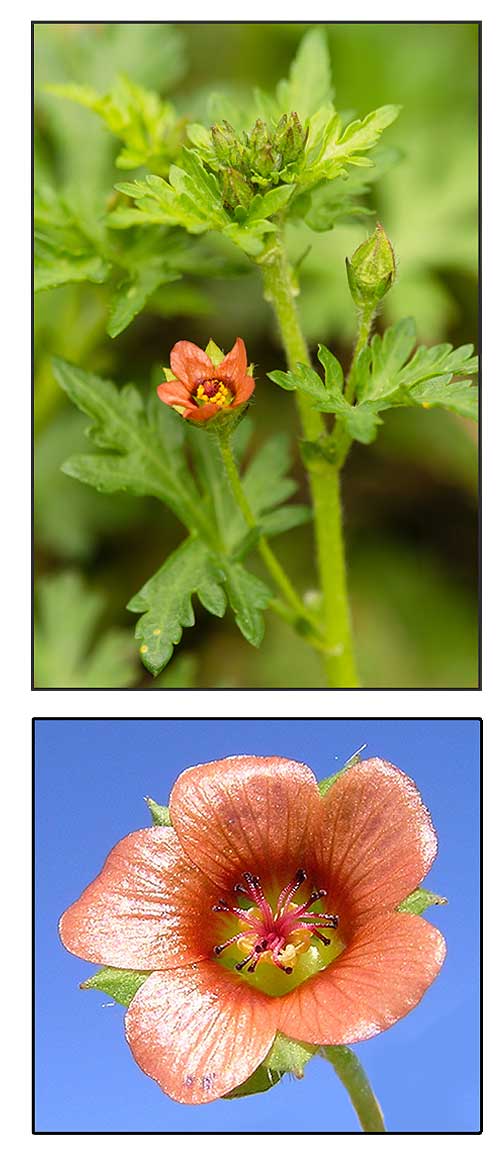 • Carolina Bristle Mallow is an annual or perennial herb native to tropical America and warm temperate eastern North America, and widely naturalized throughout the tropical world. It has prostrate, hairy stems, rooting at the nodes, from which arise upright flowering stems. Leaves are variable, being 5-8 cm long, 2-5 cm wide, triangular to circular, kidney-shaped in overall outline, varying from shallowly toothed, to deeply 3- to 7-palmately lobed, such lobes often themselves pinnately lobed. The 4-5 mm long, ciliate, persistent, stipules are leafy. Orange-red flowers are borne solitarily or rarely in pairs in the leaf axils, on stalks 2-4 cm long. Flowers have 3 free, narrowly lanceshaped false-sepals, borne about 1 mm below the 5 broadly triangular-ovate sepals. Flowers have 5 orange-red obovate petals, often red at the base, each 3-8 mm in length, unnotched and adnate to the base of the stamen column. The stamen column is shorter than the petals, and yellowish in color. The filaments, numbering 10-20, are borne solely at the tip of the column. The stigmas, borne on filiform style-branches, are head-like. The fruit is a schizocarp composed of roughly 20 black, 2-seeded, kidney-shaped mericarps, borne in a single whorl. (
.jpg)
May 2026

 |
| PHOTOS / ILLUSTRATIONS |
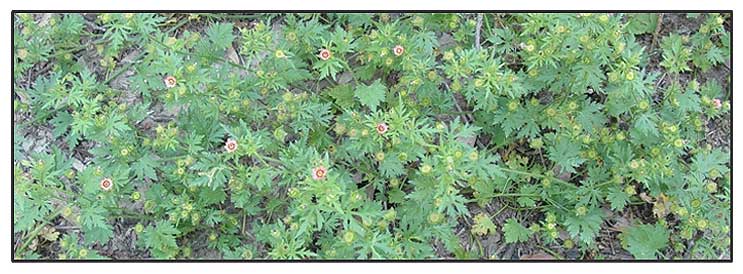
| IMAGE SOURCE: Modiola caroliniana flower and leaves / © Keith Bradley / Non-commercial use / Click on image or link to go to source page / North Carolina Botanical Garden |
| OTHER IMAGE SOURCE: Modiola caroliniana flower close-up / © Harry Rose / CC BY 2.0 use / Click on image or link to go to source page / Wikimedia Commons |
| OTHER IMAGE SOURCE: Modiola caroliniana leaf / by Harry Rose / CC BY 2.0 / Image modified / Click on image or link to go to source page / Wikimedia Commons |
| OTHER IMAGE SOURCE: Bristly mallow - Modiola caroliniana / by Charles T Bryson / CC BY 3.0 US / Image modified / Click on image or link to go to source page / INVASIVE.ORG |
Additional
Sources and Suggested Readings |
• |
DOI: It is not uncommon for links on studies/sources to change. Copying and pasting the information on the search window or using the DOI (if available) will often redirect to the new link page. (Citing and Using a (DOI) Digital Object Identifier) |
| List of Understudied Philippine Medicinal Plants |
| New plant names needed The compilation now numbers over 1,750 medicinal plants. While I believe there are hundreds more that can be added to the collection, they are becoming more difficult to find. If you have a plant to suggest for inclusion, native or introduced, please email the info: scientific name (most helpful), local plant name (if known), any known folkloric medicinal use, and, if possible, a photo. Your help will be greatly appreciated. |
• |
 |
|

.jpg)
.jpg)