 Gen info Gen info
- Dipteris is a genus of about seven species of ferns. It is one of two genera in the family Dipteridaceae.
- Taxonomical journey: The genus was first published in 1825 by Caspar Georg Carl Reinwardt. In 1901, Konrad Christ published and included the genus Dipteris in the family Polypodiaceae. In 1928, it was placed into a separate genus into the family Dipteridaceae, then comprising only one genus, Dipteris. (6)
-
Dipteris conjugata is a species of fern in the family Dipteridaceae.
-
Etymology: The Latin genus name Dipteris refers to an amalgamation of two terms: di meaning two, and the Greek word pteris, generally used for ferns, meaning "wing-like". The specific epithet conjugata derives from Latin, referring to the leaf structure having one distinct matching pair of main leaflets or divided halves. (6)
 Botany Botany
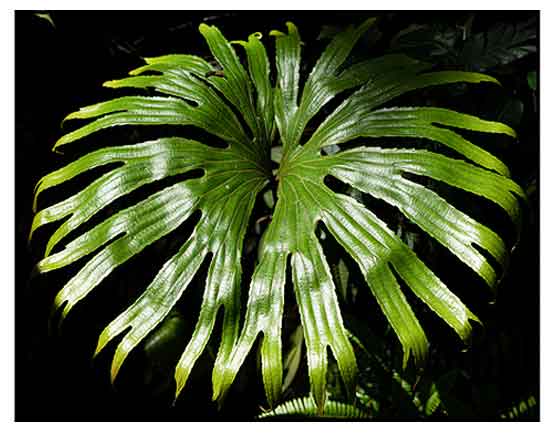
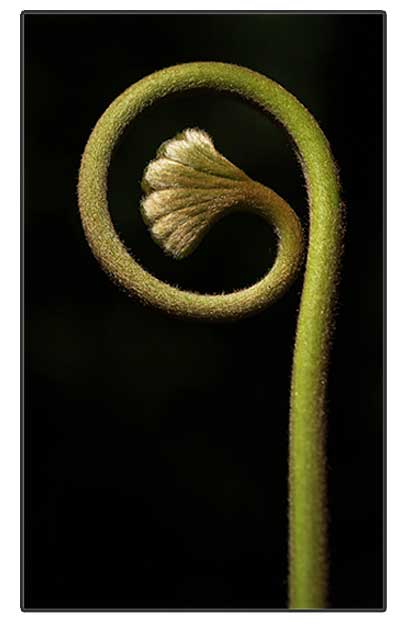
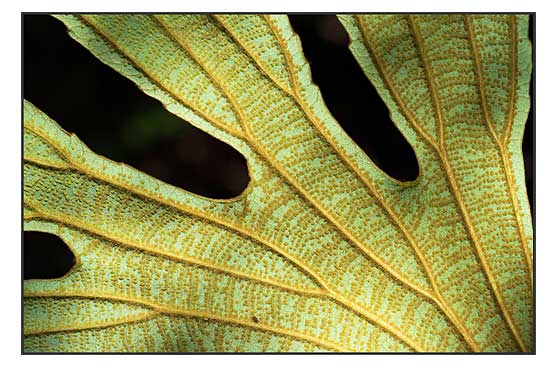
Dipteris conjugata is a terrestrial, umbrella-shaped fern, 0.5-2 m tall. Rhizome wide- or long-creeping, up to 1.5 cm in diameter, densely setose; setae 0.2 mm × 4-5 mm, lustrous reddish-brown to black, the base sometimes widened. Leaves monomorphous, repeatedly bifid; petiole stout, up to over 2.5 m long, yellow-brown, basally setose; lamina reniform, up to 25-50 cm × 70 cm, divided to the base into two spreading flabellate halves, the base cordate to hastate, apex rounded, coriaceous, glabrous, dark green adaxially, paler or glaucous abaxially, young leaves yellow-green with reddish tinge; segments broadly obovate, up to over 60 cm long, usually twisted through 90 degrees, spreading more or less horizontally, 3 or more times dichotomously divided; ultimate lobes narrowly subtriangular, the margins irregularly and broadly dentate, gradually narrowing into a caudate-acuminate apex; main veins repeatedly dichotomous, intermediate veins forming a dense network with free included veinlets in the areoles. Sori small, numerous, irregular in shape and size, scattered over the undersurface and borne on the minor veins, without indusium, paraphyses capitate. Spores monolete, ellipsoid, 29-38 μm, smooth. (2)
• Growth Form: A terrestrial fern with spreading rhizomes which forms thickets of up to 2 m tall. FoliageYoung fronds are reddish brown with silk brown hairs beneath. When mature, fronds become almost smooth (glabrescent), a bluish grey or sea-green layer (glaucous) on the underside. The fronds are held horizontally, comprised of 2 equal halves. Each half is spilt irregularly for 2 - 3 times. The final division tapers to a narrow pointed tip with distinct toothed margins and yellowish brown forked veins on the underside. The fronds are variably-sized, usually measuring 30 - 80 cm long and may reach up to 1 m wide held on an erect, reddish-brown stalk of 2 m or more. Others - Plant Morphology: Spore bearing structures known as sori are scattered all over on the underside. Rhizomes are up to 14 mm thick covered in dense, stiff, glossy hairs which are purplish brown or black. (Flora & Fauna Web)
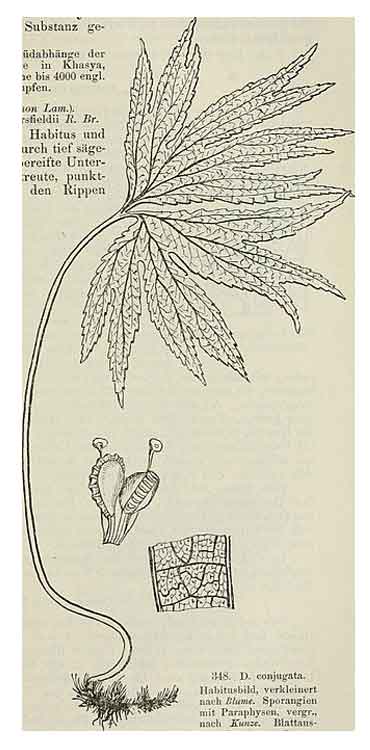 • The unique palmate frond morphology — a suborbicular lamina deeply divided into radiating lobes and supported on a single erect stipe — is unlike anything else in the fern world; it resembles the leaf of a palm or the spokes of an umbrella, hence the common name. (8) • The unique palmate frond morphology — a suborbicular lamina deeply divided into radiating lobes and supported on a single erect stipe — is unlike anything else in the fern world; it resembles the leaf of a palm or the spokes of an umbrella, hence the common name. (8)
Distribution
- Native to the Philippines.
- Also native to Borneo, Cambodia, Fiji, Hainan, Jawa, Lesser Sunda Is., Malaya, Maluku, Nansei-shoto, New Caledonia, New Guinea, Queensland, Samoa, Solomon Is., Sulawesi, Sumatera, Taiwan, Thailand, Vanuatu, Vietnam, Wallis-Futuna Is.
(1)
- In forest clearings at mid to high altitudes, 300-1,500 m.
Constituents
- Study of fronds isolated three new ent-kaurane-type diterpenes, elucidated as16β, 17-dihydroxy-ent-kauran-19-oic acid, 16β, 17-dihydroxy-19-nor-ent-kauran-18-oic acid and 16β, 17, 18-trihydroxy-ent-kauran-19-oic acid, respectively. (5)
- Phytochemical screening revealed alkaloid, terpenoid, steroid, saponin, glycosides and tannins in both leaf and shoot ethanolic extract. Quinone was present only in the leaf extract. Flavonoid was absent in both fern parts extracts. (see study below) (7)
Properties
- Studies have suggested antibacterial and anti-lipolytic properties.
Parts used
Roots, leaves
 Uses Uses
Edibility
- While not a mainstream vegetable, there are occasional reports of use in traditional local diets by indigenous groups, like use of fronds or leaves in soups.
-
Caution is advised as many wild ferns contain tannins, toxins, or oxalates. Never forage or consume wild plants unless positively identified by a local botanical expert.
Folkloric
- In Benguet, roots used in traditional medicine.
- In Fiji, roots used by for male-reproductive ailments.
- In Malaysia, used for treatment of rheumatic pains.
Others
- Rainy-day use: In Benguet and the Mindanao highlands, large fronds used as umbrella.
Studies
• Antibacterial / Anti-Lipolytic / Leaves: Study evaluated the biologic properties and identified the functional components of methanolic leaf extract of D. conjugata. By agar diffusion method, the MLE at concentration of 25 µg/ml showed marked activity against all bacterial strains with 11-25 mm zone of inhibition. Best MICs of 2.25 and 9.0 mg/ml were reported against Staphylococcus aureus and Enterobacter sp., respectively. The MLE also exhibited good antilipolytic activity (55%) against porcine pancreatic lipase (PPL) and cholesterol oxidase inhibition (69%). Results suggest antibacterial activity and efficient cholesterol degradation and anti-lipolytic activities that may be beneficial in body weight management. (4)
• Antibacterial / Leaves and shoots: Study evaluated the antibacterial activity of ethanol extracts of leaf and shoot against Gram(+) S. aureus and P. aeruginosa and two Gram(-) B. subtilis and E. coli using well diffusion method. Only the leaf extracts showed resistance to all tested organisms. Zones of inhibition were 12.0 mm and 12.5 mm against S. aureus and E. coli. (see constituents above) (7)
Availability
- Wild-crafted.
- Ornamental cultivation.
- Seeds in the cybermarket.
|





_(20725847540).jpg)