
HOME      •      SEARCH      •      EMAIL    •     ABOUT


Family Haemodoraceae
Palmita
Xiphidium caeruleum Aubl.
ANGEL FAN FLOWER / ANGEL'S WINGS\

Scientific names Common names
Excremis scabra Kuntze Palmita (Tag.)
Ornithogalum rubrum Kuntze Angel fan flower (Engl.)
Xiphidium albidum Lam. Angel hands (Engl.)
Xiphidium album Willd. Angel's wings (Engl.)
Xiphidium caeruleum Aubl. Caribbean lily (Engl.)
Xiphidium caeruleum var. albidum Backer Caribbean swordleaf (Engl.)
Xiphidium floribundum Sw. Dove tail (Engl.)
Xiphidium floribundum var. albiflorum Hook.f. Mountain grass (Guyana)
Xiphidium floribundum var. caeruleum (Aubl.) Hook.f. Tiger plant (Guyana)
Xiphidium fockeanum Miq. Walk fast (Engl.)
Xiphidium giganteum Lindl.  
Xiphidium loeflingii Mutis  
Xiphidium rubrum D.Don  
Ixia xiphidium Loefl.  
Xiphidium caeruleum is an accepted species. KEW: Plants of the World Online

Other vernacular names
FINNISH: Kiiltoenkelinviuhka.
FRENCH: Coumarti feulli, Muguet peyi, Muguet de Tahiti.
GERMAN: Dreimasterblume, Taubenschwanzlilie.
GUIANAS: Coumarti feuilli, Glaivane bleue, Koupi koupi (FRENCH GUIANA); Yarui balli (GUYANA); Ebesere-bina, Salalang (SURINAME).
INDONESIA: Cendena semut (Javanese), Kamoneng alas (Kangean), Blaping (Timor), Apit-apit.
PORTUGUESE: Capim-de-semente, Lirio, Mentrasto, Palma do Norte.
SPANISH: Cola de Paloma, Cola de gallo, Hierba de la Virgen, Mano de Dios, Mano ponderosa, Palmita, Soskia, Zabililla.

Gen info
- Haemodoraceae is a family of perennial herbaceous angiosperms (flowering plants) containing 15 genera and 102 known species, sometimes referred to as "bloodroots", found throughout the Southern Hemisphere, from Australia and New Guinea to South Africa, as well as the Americas (from extreme southeastern USA through tropical South America. Haemodoraceae was first described by Robert Brown in 1810. (11)
- Xiphidium is a genus of herbs in the family Haemodoraceae, which was first described as a genus in 1775. Two species are accepted: Xiphidium caeruleum and X. pontederiiflorum. (3)

Botany
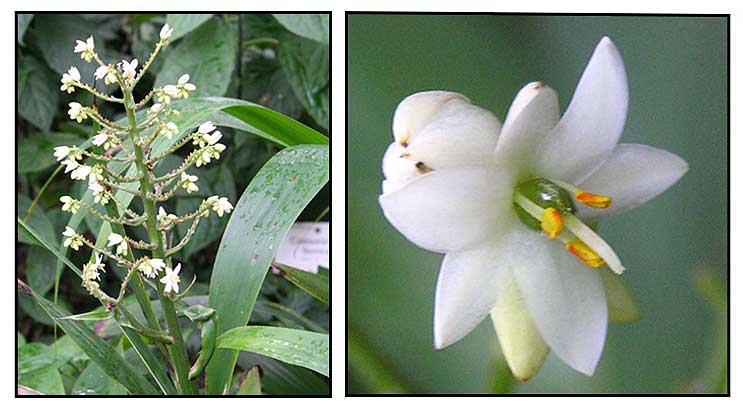
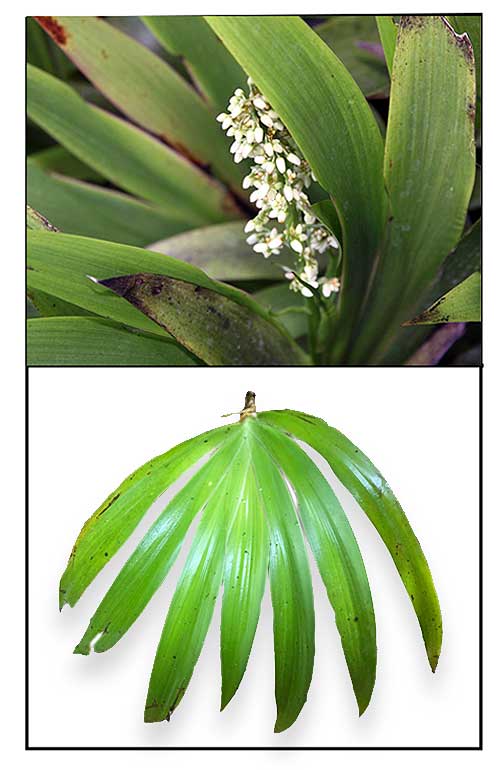
Growth form: A rhizomatous herbaceous plant Foliage: Narrow, linear leaves are arranged in a fan shape that gracefully bends to form a fountain-like structure. Glossy, hairless leaf surface has a rippled texture, because of the parallel venation.  Flowers: Small, egg-shaped flower buds give rise to white, tubular flowers that hang down and open slightly at the tip. Plants produce a spike-like inflorescence under full sun, but a branched inflorescence under semi-shade. (Flora & Fauna Web)

• Herbs 15-200 cm tall; rhizomes horizontally creeping, white to brownish red inside, 4-20 cm long, to 10 mm in diam., roots fibrous; stolons 5-55 cm long, rooting at the nodes, each node with a membranous, brownish, ovate bract, basally sheathing, apex acuminate, 8-10(-22) mm long. Leaves scattered to mainly radical, somewhat succulent, 20-65 x (1-)1.5-6(-6.5) cm, mostly exceeding the inflorescence, glabrous. Inflorescence a thyrse, 2-44 cm long and 2-15 cm wide, the cincinni 5-25-flowered, simple, sometimes once branched, sometimes young plants sprouting from the axil of the cataphylls and/or primary bracts; number of cataphylls 2-6, 0.5-14 x 0.2-1.2 cm; primary bracts narrowly triangular, 0.1-3 cm long; floral bracts narrowly triangular, 0.1-0.2 cm long; pedicels 2-10 mm long; cataphylls, rachis, bracts, pedicels, and ovary sparsely to densely villose, hairs white (0.3-2 mm long), tepals and fruit almost glabrous. Flower buds pale yellow to orange, flowers white to yellowish white, sometimes with yellow honey-guide on the 3 adaxial tepals; tepals narrowly ovate-elliptic to ovate-elliptic, 4-13 x 1-6 mm, the 3 adaxial ones basally connate; stamens with white to pale green filaments and bright yellow to orange anthers, abaxial stamen 4-11 mm long, the 2 adaxial ones 3-6 mm long, dehiscence starting apically; ovary green, subglobose, style white to pale green, 3-5 mm long. Capsule green when young, maturing shiny orange, red, and finally black, (sub)globose, 5-10 mm in diam.; seeds black, subglobose, tuberculate, 0.5-1 mm in diam. (Flora of the Guianas)

Distribution
- Naturazlized. (1)
- Widely cultivated in the Philippines. Naturalized in a Rizal subdivision. (1)
- Native to Belize, Bolivia, Brazil North, Brazil Northeast, Brazil West-Central, Colombia, Costa Rica, Cuba, Dominican Republic, Ecuador, El Salvador, French Guiana, Guatemala, Guyana, Haiti, Honduras, Jamaica, Leeward Is., Mexico Central, Mexico Gulf, Mexico Southeast, Mexico Southwest, Nicaragua, Panamá, Peru, Suriname, Trinidad-Tobago, Venezuela, Windward Is. (2)
- Cultivated in some neotropical countries as an ornamental.

Constituents
- LC-SPE-NMR study of phytohemical profile of X. caeruleum flowers revealed metabolites that differ to other plant parts. Fractions from flower extracts identified 22 phenolic compounds (three flavonoids, two phenylphenalenones and 17 phenyl-phenalenone-related compounds, including five new natural products.
- Phytochemical screening revealed phenolic compounds as main metabolites, including phenolic acids (gallic, caffeic, ferulic, and cinnamic acids) and flavonoids (catechin, kaempfero9l-3-O-glucoside and quercetin). (see study below) (4)

Properties
- Studies have suggested diuretic properties.

Parts used
Leaves, roots, stems.

Uses

Edibility
- No reports found on edibility.
Folkloric
- No reported folkloric medicinal use in the Philippines.
- In Cuba, used as anti-inflammatory, analgesic, antilithiatic, and diuretic remedy.
- In Guyana, plant used use for treatment of worm infection that causes a curved foot. In Suriname, used as remedy against torn foot soles. (6)
- In Trinidad and Tobago, leaves are rubbed on feet and knees of children learning to walk. In Panama and Columbia, ground stem infusion or decoction drunk as antiemetic; leaf infusion used externally for skin disorders. (7)
- The Semende tribe community of Komering Ulu in South Sumatra, Indonesia, eat roots soaked in hot water for fever, cough, and canker sores. (8)
Others
- Veterinary: In Trinidad, used to "brighten up" hunting dogs and help them run faster. (6)

Studies
Diuretic / Toxicity Study / Leaves:
Study in Wistar rats evaluated the diuretic activity and oral toxicity of aqueous extracts from leaves of plants in vegetative (VE) and flowering (FE) stages. Phytochemical screening revealed phenolic compounds as main metabolites, including phenolic acids (gallic, caffeic, ferulic, and cinnamic acids) and flavonoids (catechin, kaempfero9l-3-O-glucoside and quercetin). VE and FE showed diuretic activity. VE activity was similar to furosemide; FE resembled spironolactone. No oral toxicity was observed. (4)

Availability
- Wild-crafted.
- Seeds, seedlings, live plants in the cybermarket.


<B><U><FONT COLOR="#ff0000" SIZE="+1" FACE="Arial Black">Studies </FONT></U></B><br>
<img src="AbanikoPD2.jpg" width="321" height="554" align="right" />&#8226; <font color="#0000FF"><strong>Phenolic Content / Rhizomes / Anticancer:

December 2025

                                                 PHOTOS / ILLUSTRATIONS
IMAGE SOURCE: Xiphidium caeruleum / by Michael Wolf / CC BY-SA 2.0 / Image modified / Click on image or link to go to source page / Wikipedia
OTHER IMAGE SOURCE: Xiphidium caeruleum / Franz Xaver / CC BY-SA 4.0 / Image modified / Click on image or link to go to source page / Wikimedia Species
OTHER IMAGE SOURCE: Xiphidium caeruleum - flower close-up / 阿橋 HQ : Royal Flora Ratchaphruek / CC BY-SA 2.0 / Image modified / Click on image or link to go to source page / fr.Wikipedia
OTHER IMAGE SOURCE: Xiphidium caeruleum / David Stang / CC BY-SA 4.0 International / Image modified / Click on image or link to go to source page / Creative Commons
OTHER IMAGE SOURCE: Xiphidium caeruleum / © keesgroenendijk / Some rights reserved / CC BY 4.0 International / Click on image or link to go to source page / iNaturalist

Additional Sources and Suggested Readings
(1)

Haemodoraceae: Xiphidium caeruleum / Co's Digital Flora of the Philippines
(2)
Xiphidium caeruleum Aubl. / KEW: Plants of the World Onlline
(3)
Xiphidium / Wikipedia
(4)
Pharmacognostic Study, Diuretic Activity and Acute Oral Toxicity of the Leaves of Xiphidium caeruleumAubl. Collected in Two Different Phenological Stages / Yamilet I Gutiérrez Gaiten, Alejandro Felipe Gonzalez, Ramon Scull Lizama et al / Plants (Basel), 2023; 12(6): 1268 / DOI: 10.3390.plants12061268
(5)
Co-occurrence of phenylphenalenones and flavonoids in Xiphidium caeruleum Aubl. flowers / Jingjing Fang, Dirk Hölscher, Bernd Schneider / Phytochemistry, 2012, Vol 82: pp 143-148
(6)
Xiphidium caeruleum / Flora of the Guianas
(7)
Medicinal and ethnoveterinary remedies of hunters in Trinidad / C Lans, T Harper, K Georges et al / Medicinal and Ethnoveterinary Remedies of Hunters in Trinidad / BMC Complement Altern Med., 2001; 1(10) / DOI: 10.1186/1472-6882-1-10
(8)
Exploration of Medicinal Plant Potential in the Semende Tribe Community in South Ogan Komering Ulu /Aulia Ulmillah,, Dwijowati Asih Saputri, Yuni Satitiningrum et al / E3S Web of Conferences, 2024; 482, 01001 / DOI: 10.1051/e3sconf/202448201001
(9)
Preliminary Anthecological Observations on Xiphidium caeruleum Aubl. (Monocotyledoneae: Haemodoraceae) in Panama / Stephen L Buchmann / Journal of the Kansas Entomological Society, 1980;p 53(4): pp 685-699
(10)
Xiphidium caeruleum / Common names / Pl@ntNet
(11)
Haemodoraceae / Wikipedia

DOI: It is not uncommon for links on studies/sources to change. Copying and pasting the information on the search window or using the DOI (if available) will often redirect to the new link page. (Citing and Using a (DOI) Digital Object Identifier)

                                                            List of Understudied Philippine Medicinal Plants
                                          New plant names needed
The compilation now numbers over 1,730 medicinal plants. While I believe there are hundreds more that can be added to the collection, they are becoming more difficult to find. If you have a plant to suggest for inclusion, native or introduced, please email the info: scientific name (most helpful), local plant name (if known), any known folkloric medicinal use, and, if possible, a photo. Your help will be greatly appreciated.

HOME      •      SEARCH      •      EMAIL    •     ABOUT