Gen info
- Selaginella, also known as spikemosses or lesser clubmosses is a genus of leucophyte. It is the only genus in the family Selaginellaceae, with over 750 known species. (3)
- The family is distinguished from Lycopodiaceae (clubmosses) by having scale-leaves bearing a ligule and by having spores of two types. They are sometimes included in an informal paraphyletic group called the "fern allies". (3)
- Selaginella willdenowii is a species of spikemoss, a lycophyte in the family Selaginellaceae.
- Etymology: The genus name Selaginella derives from Latin selago, meaning "clubmoss". The specific epithet willdenowii honors Carl Ludwig von Willdenow (1765-1812), a German naturalist and physician, Director of Berlin Botanical Garden and author of Flora Berolinensis prodromus (1787).
- The species was initially described as Lycopodium willdenowii by Nicaise Augustin Desvaux in 1814, and later transferred to the genus Selaginella by John Gilbert Baker in 1867. (9)
 Botany Botany
• Plants terrestrial, evergreen, scandent, 100-200 cm or more. Rhizophores restricted to lower part of main stem or up to upper part, with some spinelike protuberances at base (as well as at axes of stems). Main stems branched from near base upward, stramineous or reddish, 2.4-3.5 mm in diam. in lower part, angulate, sulcate, glabrous; primary leafy branches 5-15 pairs, 3 times pinnately branched, ultimate branches simple or forked, branchlets sparse and regular, adjacent primary branches on main stem 6-13 cm apart, ultimate branches 3-7 mm wide including leaves. Axillary leaves on main stems obviously larger than those on branches, oblong, biauriculate (auricles larger than those of Selaginella helferi); axillary leaves on branches symmetrical, oblong or oblong-elliptic, 1.5-2.4 × 1-1.6 mm, base biauriculate, margin entire. Dorsal leaves asymmetrical, those on main stems obviously larger than those on branches; dorsal leaves on branches approximate to imbricate, overlapping at leaf apex, falcate, 0.9-1.4 × 0.4-0.6 mm, not carinate, base obliquely subcordate, margin entire, apex obtusely cuspidate. Ventral leaves asymmetrical, those on main stem obviously larger than those on branches; ventral leaves on branches slightly ascending or spreading, distant or approximate, oblong-falcate, 2.8-4 × 1-1.5 mm, margin entire, apex obtuse; acroscopic base with rounded auricle, not overlapping stem and branches. Strobili solitary, terminal, compact, tetragonal, 5-35 × 1.8-3.8 mm; sporophylls unlike sterile leaves, uniform, white-margined, suborbicular, margin entire, apex acute or cuspidate; megasporophylls in middle on lower side of strobilus; microsporangia orbicular, rather thin, cells regular; microspores pale yellow, megaspores whitish. (Flora of China)
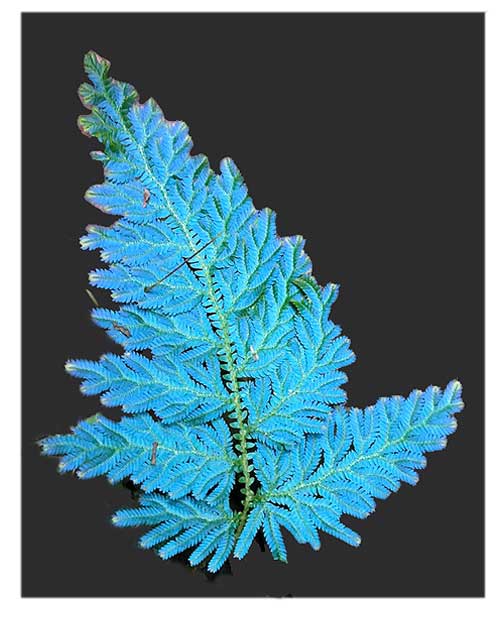
• Growth form: Herbaceous, fern-like species with a scrambling growth habit. Foliage: Iridescent fronds are mostly blue-green with pinkish hues depending on the angle at which they are viewed. They are composed of two leaf types, lateral and median leaves, which are both arranged in 2 rows along the stem. Lateral leaves are ovate to oblong (3-4 mm long and 1.5-2 mm wide), while median leaves are even smaller and vary in shape. Reproductive Parts-Non-flowering Plant: Cone-like strobili composed of sporophylls (spore-producing structures) are produced at the branch tips. The sporophylls are heart-shaped or egg-shaped to triangular. (Flora & Fauna Web)
Distribution
- Native to the Philippines. (1)
- In Luzon: Laguna, NCR.
- Also native to Andaman Is., Bangladesh, Cambodia, China South-Central, China Southeast, Jawa, Laos, Malaya, Myanmar, Sulawesi, Sumatera, Thailand, Vietnam. (1)
- Per Leonardo Co's database: Cultivated, not naturalized. (2)
- Introduced worldwide as an ornamental for its iridescent bluish-green color.
Constituents
- Study of aqueous extracts of leaves and stems (fresh and dried, with or without heat treatment) for total phenolic contents yielded a range of 6.22-7.774 and 1.77- 2.56 GAE/g dry matter, and 3.16-6.93 and 0.65-1.32 mg QE/g dry matter for leaves and stems, respectively, with fresh+heat showing higher yields. (4)
- Bioactivity-guided fractionation of leaves isolated three known biflavones: 4′,7″-di-O-methylamento-flavone, isocryptomerin and 7″-O-methylrobustaflavone. Other non-cytotoxic isolates included amentoflavone, bilobetin, robustaflavone and 2″,3″-dihydroisocryptomerin, a new dihydrobiflavone. (see study below) (5)
- GC-MS analysis of ethanol extracts of fresh plant parts of leaves, stems, and roots identified 69 metabolites in 16 categories of compound classes. Four compounds were consistently present in each part: 2,6,10-Trimethyl, 14-Ethylene-14-Pentadecne, Stigmasterol, Hexadecanoic, and acid methyl ester. (6)
Properties
-
Noted ornamentally due to its striking iridescence.
-
Studies have suggested antioxidant, anti-inflammatory, cytotoxicity, anticancer properties. Parts used
Stems, leaves.
Uses
Edibility
- In Indonesia, consumed as vegetable.
- Plant parts used in herbal preparations.
Folkloric
- No reported medicinal use in the Philippines.
- In Malaysia, leaf decoction used for treatment of wounds, high fever, and backache, and as tonic medicine. In Brunei, used for treatment of gastric pains and urinary tract infections. In Indonesia, used for treatment of wounds, menstrual pains, and skin diseases. In India, infusion used for high fever; liniment prepared from ashes used for backache. (4)
Others
- Ecology: A bioindicator of environmental change by reflecting microclimate shifts in temperature, humidity, and light intensity.
- Crafts: Used as raw material for crafts, decorative displays and woven accents. Striking foliage are sometimes pressed and dried for terranium and botanical art crafts.
Studies
• Antioxidant / Leaves and Stems: Study evaluated the antioxidant propertie of aqueous extracts of leaves and stems, fresh and dried prepared with or without heat treatment. Leaf extracts consistently showed higher total phenolic and flavonoid contents than stem extracts. Hot water extracts of fresh leaves were 4.4-fold and 10.7-fold higher that other extracts. Leaf extracts showed consistently higher radical scavenging and ferric reducing activities than stem extracts. TEAC and FRAP of hot water extracts of fresh leaves were 5.5- to 5.3-fold higher than other extracts. (4)
• Cytotoxic Biflavonoids / Leaves: Bioactivity-guided fractionation of leaves isolated three known biflavones: 4′,7″-di-O-methylamentoflavone, isocryptomerin and 7″-O-methylrobustaflavone that showed significant cytotoxicity against a panel of human cancer cell lines. (5)
• Bioactive Biflavonoids / Anti-Inflammatory / Cytotoxicity / Leaves: Multivariate analysis examined S. willdenowii fractions having anti-inflammatory activity combined with LC-MS-based metabolomic profiles. Findings suggested tetrahydro-bilobetin and 2′′,3′′-dihydrobilobetin were potential anti-inflammatory agents. Robustaflavone-7"-methyl ether (9c) showed strongest cytotoxicity against three cancer cell lines (A549, HepG2, and T47D) with high selectivity for A549 cells. Compound 9c induced apoptotic cell death through elevation of reactive oxygen species (ROS) level in A549 cells. The work highlights the potential for metabolomic strategy coupled with bioassy-guided isolation for accelerating research in drug discovery and providing source of ingredients for value-added food products. (7)
• Iridescent Blue Color: - The iridescent blue color of several Selaginella species is caused by a physical effect, thin-film interference. (8)
Availability
- Wild-crafted. |