
HOME      •      SEARCH      •      EMAIL    •     ABOUT


Family Annonaceae
Pisang-pisang
Meiogyne virgata (Blume) Miq.
SEMUKAN

Scientific names Common names
Ararocarpus velutinus Scheff. No Philippine name available.
Ararocarpus velutinus var. tenuifolius Boerl. Pisang-pisang (Borneo)
Cananga virgata (Blume) Hook.f. & Thomson Semukan (Borneo)
Cyathocalyx virgatus (Blume) King  
Desmos monogynus Merr.  
Enicosanthum erianthum (Ridl.) Airy Shaw  
Hopia gracilis Miq.  
Meiogyne eriantha (Ridl.) J.Sinclair  
Meiogyne lucida Elmer  
Meiogyne monogyna (Merr.) Ban  
Meiogyne montana (Blume) Backer  
Meiogyne paucinervia Merr.  
Meiogyne philippinensis Elmer  
Meiogyne stipitata Koord. & Valeton  
Meiogyne virgata (Blume) Miq.  
Polyalthia eriantha Ridl.  
Stelechocarpus montanus (Blume) Miq.  
Unona virgata Blume  
Uvaria montana Blume  
Uvaria montana Noronha  
Uvaria virgata (Blume) Blume  
Meiogyne virgata (Blume) Miq. is an accepted species. KEW: Plants of the World Online
Note: No Philippine name found for the plant. For now, adopting Pisang-pisang as plant page title.

Other vernacular names
BORNEO: Mepisang, Pisang-pisang, Semukan.
MALAYSIA: Cha ngut.
THAILAND: Sang yu khao.
VIETNAM: Thieu nhuy nhan.
OTHERS: Karrai, Banitan gading.

Gen info
- Meiogyne is a genus of flowering plants in the family Annonaceae. It contains 38 species, native from southwestern India and Indochina to Australia, including Fiji and New Caledonia. The type species is Meiogyne virgata. (2)
- Etymology: The specific epithet virgata derives from Latin virgatus , meaning "twiggy, striped, wand-like".

Botany
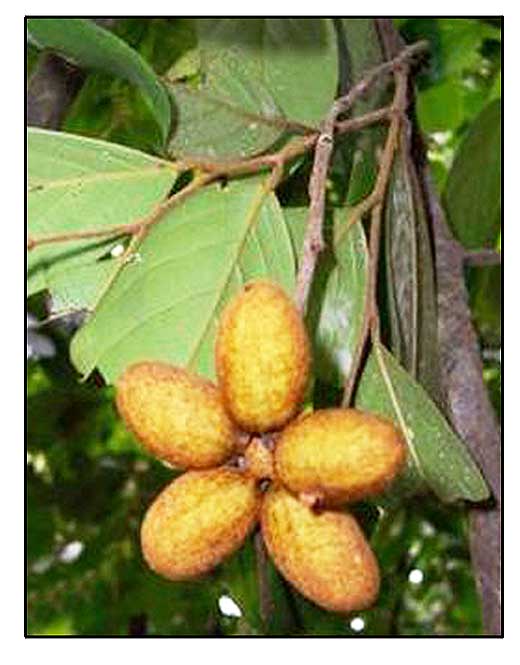
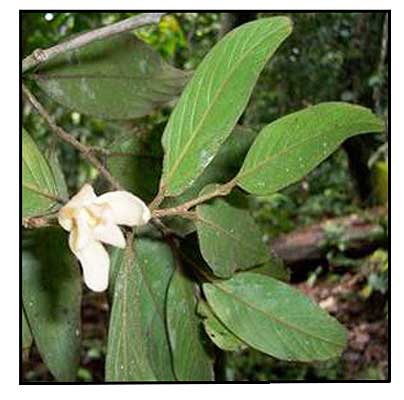
Shrub or tree up to 12.5(–15 m) tall; bark gray to brown-gray, smooth. Twigs puberulent, soon glabrate. Leaves chartaceous, elliptic, ovate, or sometimes oblong-elliptic, 9.8–22 by 4.5–9 cm, base broadly cuneate to rounded, apex acuminate, the acumen 7–15 mm long, pubescent along midrib on both surfaces but otherwise glabrate, secondary veins slightly arcuate, 7–15 per side, tertiary venation distinctly percurrent; petioles 5–9 mm long. Inflorescences axillary, 1-flowered, extended rachis absent, pedicels ca 3 mm long, with 2 small bracts; petals separating early in bud. Sepalsfree to minutely connate, broadly ovate, ca 5 mm long, acute to attenuate. Petals cream-coloured to pale brownish yellow, acute to obtuse; outer petals linear to linear-lanceolate, 13–17 by 2.5–3.5 mm, finely pubescent on outer surface; inner petals lanceolate, 9–10 by 3–3.5 mm, with a pink-red, purple, or brown corrugated patch on proximal 1/2 of inner surface. Stamens clavate, ca 1 mm long, anther connective apex truncate. Carpels 3–5, stigmas globose, ca 0.5 mm long. Fruit of up to 4 monocarps borne on a pedicel 3–5 mm long. Monocarps green, purplish, brown, or blackish yellow, oblongoid to ellipsoid, not torulose, 2.2–5.4 by 2.2–2.8 cm, gray- or brown-tomentose (hairs matted), apex rounded, sessile or rarely base contracted into a stipe up to 3 mm long; pericarp ca 3.5 mm thick, woody when dried. Seeds in two rows, 11–15 per monocarp, semicircular in lateral view, flattened, 15–20 by 10–11 mm, ring encircling seed raised as a ridge. (eFlora of Thailand)

Distribution
- Native to the Philippines. (1) (3)
- In Bohol, Leyte, Luzon (Laguna, Sorsogon), Mindanao (Agusan del Norte, Davao del Sur, Surigao, Surigao del Norte), Palawan, Samar. In primary or secondary forests, 0-1300 m. (3)
- Also native to Borneo, Jawa, Malaya, Thailand, Vietnam. (1)

Constituents
- Phytochemical study on bark of M. virgata yielded nine known alkaloids: liriodenine 1, lanuginosine 2, asimilobine 3 and lysicamine 4; four aporphines, anonaine 5, N-methylanonaine 6, nornuciferine 7 and norushinsunine 8; and one azaanthracene alkaloid, cleistopholine 9. (4)
- Hydrodistillation and GC-FID/MS of leaves for EO yielded major compound of germacrene D (42.48%) for M. virgata. (see study below) (5)
- GC-FID and GC-MS study of EO from stems yielded α-humulene, bicyclogermacrene, ß-caryo-phyllene, and bicycloelemene. Aromatic esters were also prominent in the stem oil (10.3%). Main sesquiterpene compounds common to leaf and stem oils were bicycloelemene (13.9 and 1.0%),
ß-caryophyllene (14.6 and 6.2%), α-humulene (20.4 and 13.3%) , and bicyclogermacrene (15.4 and 9.2%), respectively.

Properties
- Studies have suggested antimicrobial properties.

Parts used
Leaves, bark.

Uses

Edibility
- No info found on edibility.
Folkloric
- No reported medicinal use in the Philippines.
- Used for treatment of cough and fever.

Studies
Antimicrobial / Essential Oil / Germacrene D / Leaves:
Study evaluated the EO of three Vietnamese Annonaceae species, Meiogyne virgata, M. vietnamica, and Orophea polycarpa. Hydrodistillation and GC-FID/MS of EO yielded major compound of germacrene D (42.48%) for M. virgata. The EO of Mv leaves exhibited strong antimicrobial activity against Gm(+) Bacillus subtils ATCC 5230, Gram(-) Escherichia coli ATCC 8739, and fungus Aspergillus niger ATCC 9587 with same MIC of 16.µg/ml. Germacrene D showed binding affinity values of -66.68, -5.265, and -5.602 kcal/mol with proteins E. coli DNA gyrase, B. subtilis TasA, and A. niger PhyA. Germacrene D is predicted to have low toxicity and is not active against any of the considered target organs. (5)

Availability
- Wild-crafted.

December 2025

                                                 PHOTOS / ILLUSTRATIONS
IMAGE SOURCE: Meiogyne virgata / © AsianPlantNet / Fruits / Non-commercial use / Image modified / Click on image or link to go to source page / asianplant.net
OTHER IMAGE SOURCE: Meiogyne virgata - flowers and leaves / © AsianPlantNet / Non-commercial use / Image modified / Click on image or link to go to source page / asianplant.net

Additional Sources and Suggested Readings
(1)

Meiogyne virgata / KEW: Plants of the World Online
(2)
Meiogyne / Wikipedia
(3)
Annonaceae: Meiogyne virgata / Co's Digital Flora of the Philippines
(4)
ESSENTIAL OIL AND BIOACTIVE COMPOUNDS FROM MIOGYNE SP. / Nor Hadiani Ismail / 2012
(5)
The leaf essential oils of Meiogyne virgata (Blume) Miq., M. vietnamica Jaikhamseub, T.A.Le & Chaowasku, and Orophea polycarpa A.DC.: Chemical composition, antimicrobial activity, molecular docking, and toxicity profiling / DN Dai, L Huong, Ninh The Son et al / Journal of Essential Oil, 2024 /
DOI : 10.1080/0972060X.2024.2398675 / Corpus ID: 273579240
(6)
Chemical Compositions of Essential Oilsof Selected Medicinal Plants from Thùa Thiên-Huế Province, Vietnam / SN Dai, Le T Thuong, Nguyen H Hung, Tran D Thang, Isiaka A Ogunwande / Journal of Herbs, Spices& Medicinal Plants, 2014; 20(3): pp 269-281 / DOI: 10.1080/10496475.2013.865007

DOI: It is not uncommon for links on studies/sources to change. Copying and pasting the information on the search window or using the DOI (if available) will often redirect to the new link page. (Citing and Using a (DOI) Digital Object Identifier)

                                                            List of Understudied Philippine Medicinal Plants
                                          New plant names needed
The compilation now numbers over 1,730 medicinal plants. While I believe there are hundreds more that can be added to the collection, they are becoming more difficult to find. If you have a plant to suggest for inclusion, native or introduced, please email the info: scientific name (most helpful), local plant name (if known), any known folkloric medicinal use, and, if possible, a photo. Your help will be greatly appreciated.

HOME      •      SEARCH      •      EMAIL    •     ABOUT