 Gen info Gen info
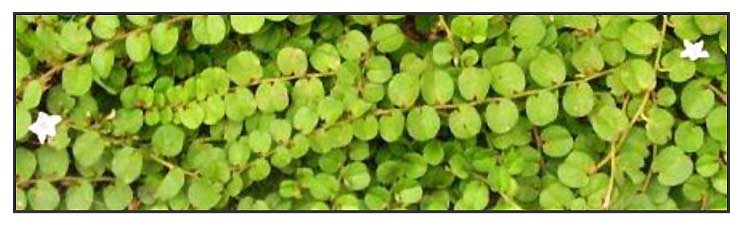
- Evolvulus is a genus of flowering plants in Convolvulaceae, the morning glory family. They are generally known as "dwarf morning glories". There are about 100 species.
- Evolvulus nummularius is a species of flower plant in the morning-glory family
. It is an annual or perennial plant.
- Etymology: The genus name Evolvulus derives from Latin, meaning "to unroll", referring to its non-vining form.
 Botany Botany
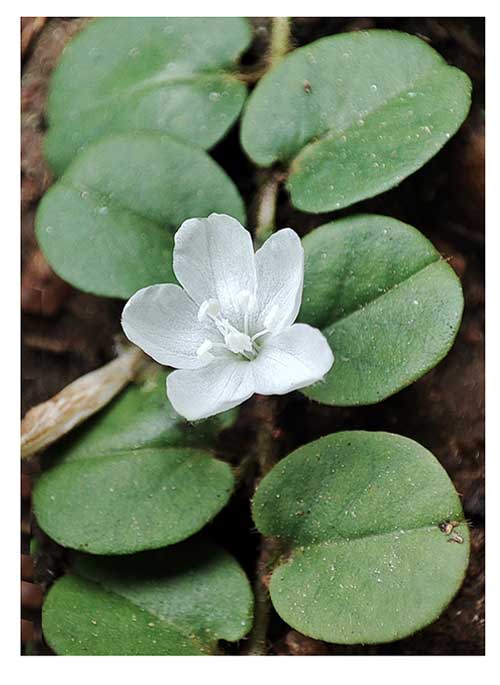
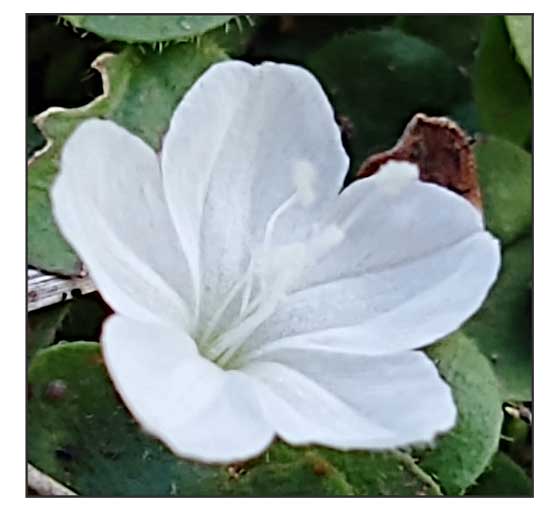
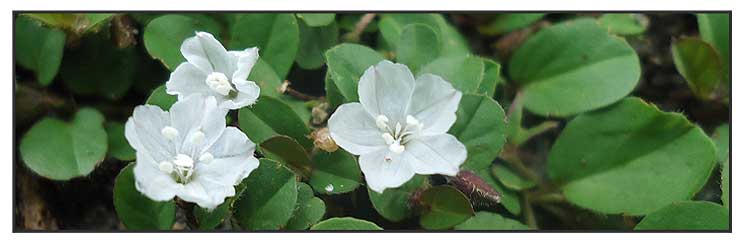
• Herbs perennial. Stems several, rooting at nodes, prostrate, 20-40 cm, slender, ± villous or scabrous. Leaves distichous; petiole 2-4 mm; leaf blade nearly circular, 1.3-1.7 X 1.2-1.4 cm, glabrous or appressed pilose abaxially, base cordate to rounded, apex rounded or emarginate; lateral veins 2 or 3 pairs. Peduncle absent or very short. Pedicel 2.5-3 mm, densely villous. Flowers 1 or 2 per leaf axil. Sepals persistent, oblong-ovate to oblong, 3-4 2-3 mm, outer 2 slightly longer than inner ones, pilose abaxially, margin ciliate. Corolla broadly campanulate or subrotate, ca. 6 mm; limb ca. 7-8 mm in diam., 5-lobed. Stamens inserted at middle of corolla tube; filaments ca. 1.5 mm, glabrous basally; anthers oblong. Ovary globose. Style lobes linear, ca. 3 mm; stigmas minutely capitate. Capsule ovoid, 2-3 mm in diam. Seeds 2-4, brown, ovoid-trigonous, ca. 1 0.5 mm, minutely tuberculate. (Flora of China)
• Slender prostrate perennial herbs. Leaves 5-15 x 4-10 mm, broadly ovate to orbicular, base subcordate, apex obtuse to emarginate, glabrous or sparsely hairy below; petiole to 5 mm long. Flowers 1-2, in leaf-axils; pedicels slender 2-5 mm long. Calyx lobes 5, free, 2-3.5 mm long, ovate-lanceolate, acute, ciliate on margins. Corolla white, 6-8 mm across, rotate. Stamens sub-exserted. Capsule 3-4 mm across, globose. Seeds brown to black. (India Biodiversity Portal) (6)
Distribution
- Naturalized. (2)
- In Mindanao: Davao del Sur.
- Native range is Tropical and Subtropical America.
- Also known as a weed of lawns, grasslands, and agricultural lands.
In India, a weed of groundnut, sugarcane, rice, and lentil crops; in Bangladesh, of wheat and mulberry. (8)
Constituents
- Phytochemical analysis of methanol extract of whole plant yielded alkaloids, triterpenoids, tannins, cardiac glycosides and flavonoids. (see study below) (7)
- Phytochemical analysis of aerial parts have yielded a wide range of bioactive compounds, including
ß-sitosterol, glucoside, stigmasterol, d-mannitol, ursolic acid and oleanolic acid. Spectroscopic studies have isolated stigmastane, coumaroyl, and ursane derivatives. (8)
- Phytochemical screening of methanolic extracts of aerial parts showed presence of ß-sitosterol, stigmasterol, ursolic acid, oleanolic acid, nummularic acid, and palmitic acid. (see study below) (12)
- Study of aerial parts yielded 28 essential and trace elements. In notable amounts (ppm) are: Calcium 107.87, potassium 210.57, sulfur 136.68 ppm. (16)
- GC-MS study
of methanolic extract of whole plant revealed t-)-deoxyephedrine, methamphetamine, 1-(5-methoxy-2-methylphenyl)-N-methylpropan-2-amine, ethyl vanillin, 3,4-dihydroxypropiophenone, and 1-(1,4-cyclohexadienyl)-2-methylaminopropane. (see study below) (17)
Properties
- Considered to have febrifuge and vermifuge properties.
- Toxicity concern: See study below (20)
-
Studies have suggested antioxidant, antibacterial, hepatoprotective, wound healing, antipyretic , anticestodal, CNS depressant properties.
Parts used
Leaves, aerial parts.
 Uses Uses
Edibility
- Whole plant reportedly edible, including flowers, stems, and leaves.
- Leaves and stems used as green leafy vegetable.
Folkloric
- No reported folkloric medicinal use in the Philippines.
- Used for treatment of anxiety, insomnia, hysteria, convulsions.
- In Kerala, where the herb is called "Shankhapushpi", interchangeably with other Evolvulus species, decoction of aerial parts is drunk to soothe fraught nerves.
- In Unani medicine, leaf juice combined with rose water and honey is drunk to calm palpitation (rapid heart beats triggered by anxiety).
- Records exist in Ancient Sanskrit compendia around 12th century CE
of its use for treating "manah-kshaya" (mental fatigue).
- In Ayurveda, used for mood balancing, stress and anxiety relief, memory enhancement. (5)
- In Indian traditional medicine, used for treating burns, cuts, wounds, scorpion stings. and as anthelmintic.
- In Nepal, plant paste used for treatment of scabies.
- In Bangladesh, the Garo tribe tie whole plant parts to the legs to reduce edema during pregnancy. (13)
- In Idisha, India,
whole plant ash with oil rubbed on skin infections, especially chicken pox. (14)
- The Mandais of Bangladesh use pills prepared from macerated roots of E. nummularius, rhizomes of Zingiber officinale, and roots of Alternathera sessilis for treatment of dysentery, vomiting, and nose bleeds. (15)
Others
- Agroforestry: A creeping ground-cover plant. Planted as a cover crop to prevent soil erosion and to reduce mud formation in garden pathways.
- Ornamental: Prized for use in ornamental settings and landscaping.
Studies
• Antibacterial / Antioxidant / Whole Plant: Study evaluated a methanold extract of whole plant of E. nummularius for antioxidant and antibacterial activity. Antibacterial activity by disc diffusion assay showed MICs of 12.5 and 3.125 mg/ml against E. coli and B. subtilis, and MBC of 25 mg/ml and 50 mg/ml, respectively. The ME extract showed scavenging activity by DPPH assay with IC50 =350 µg/ml, with activity increasing with extract concentration. The activity was less in comparision to ascorbic acid. (see constituents above) (7) Study evaluated the antibacterial activity of crude methanol extract of whole plant against 3 standard gram(-) and 2 gram(+) strains of bacteria (ATCC strains). Results showed both bacteriostatic and batericidal activity against all strains. Further evaluation for mechanism of action, the reactive oxygen species (ROS) was estimated and showed the ROS increased (40-55%) in the presence of IC50 dose of E. nummularius.
• Hepatoprotective / Antioxidant / Whole Plant: Study evaluated the protective effects of a methanolic leaf extract of E. nummularius (MEEN) against NAFLD brought on by a high fat diet. Acute and subacute toxicological studies on doses up to 2000 mg/kg were found safe. Wistar albino rats were given a high fat diet for 10 weeks to cause fatty liver. Parameters measured included hematological, antioxidant, serum biomarkers, and histopathology.
MEEN supplementation. MEEN effectively inhibited lipid buildup and subsequent development of steatosis, further evidenced by histological examination of the liver. Results suggest MEEN as a viable treatment option for NAFKLD caused by a diet heavy in fat. (10)
• Wound Healing / Antipyretic / Leaves: Study evaluated the antipyretic and wound healing activity of hydroalcoholic extracts of E. nummularius leaves in albino wistar rats using yeast-induced pyrexia and excision wound models. Results showed significant antipyretic effect, The extract and leaf juices showed significant wound healing activity comparable to standard drug used. (11)
• Wound Healing / Antibacterial / Leaf Juice: Study compared the wound healing activity of aqueous-alocoholic extract of E. nummularius leaf juice (10% w/w in simple ointment Indian Pharmacopeia) and juice from fresh leaves with control and 0.2% nitrofurazone as standard in rats. Results showed animals treated with leaf juice had 94.4% wound healing, while the extract showed 87.12% wound healing. Disc diffusion assay showed E. nummularius with MBC of 25 and 50 mg/mL against E. coli and B. subtilis, respectively. (see constituents above) (12)
• Anthelmintic / Anticestodial / Whole Plant: In Assam, India, whole plant of E. nummularius is traditionally used to treat helminth infections. Study evaluated the efficacy of a methanolic extract in in vitro and in vivo models. In vitro study showed significant efficacy, while in vivo study revealed 76.93% and 71% reduction in eggs and worm counts respectively against juvenile H. diminuta worms, and 80% and 79.25% reduction in parameters of Hd adult worms. Extract also showed 55.73% reduction in AChE activity. Results showed antihelmintic activity and potential for use in traditional medicine. (see constituents above) (17)
• CNS Depressant Activity / Aerial Parts: Study evaluated the central nervous system (CNS) and behavioral activity of ethanolic extract (EE) of E. nummularius aerial parts using phenobarbitone sodium-induced sleeping time to evaluate sedative activity, Y-maze to evaluate exploratory behavior, Rotarod to evaluate muscle relaxant activity, and Actophotometer for locomotor activity in experimental animal models. Acute toxicity study revealed no toxicity or mortality and LD50 > 2000 mg/kg extract. Results showed significant increase in sleeping latency and duration of sleep in rats, significant reduction in exploratory behavior in y-maze, marked reduction in muscle relaxant and locomotor activity in Rotarod and Actophotometer testing. Results suggest the 200 and 400 mg/kg dose of EE aerial parts possess CNS depressant activity. Phytochemical screening revealed alkaloids, ergoline alkaloids, flavonoids, saponins, glycosides, anthraquinones, among others, which may be responsible for the psychopharma-cological action. (19)
• Toxicity Concerns with Vaginal Microbicidal Use: Study evaluated the safety of methanolic extract of E. nummularius use as vaginal microbicide using various safety tests such as cell viability by MTT assay on 3 female genital tract epithelial cell lines: vaginal (VK2/E6E7), endocervical (End1/E6E7) and endometrial (HEC-1-A). Results revealed the ME appeared to be toxic towards human RBCs and female genital tract epithelial cells. Due to its toxic nature, caution is advised on its direct applications to human vaginal tissue in vivo. (20)
Availability
- Wild-crafted.
- Live plants, capsules, dried leaf powder in the cybermarket and traditional medicine shops.
|





_L._-_Flickr_-_Alex_Popovkin,_Bahia,_Brazil_(7).jpg)