 |

Family • Commelinaceae
Salibangon
Pollia secundiflora (Blume) Bakh.f
THREE-STAMEN POLLIA
Chang hua zhi du ruo
| Scientific names | Common names |
| Aclisia cumingiana Hassk. | Salibangon (Tagalog) |
| Aclisia elegans (HJassk.) Hassk. | Three-stamen pollia (Engl.) |
| Aclisia gigantea Hassk. | African pollia (Engl.) |
| Aclisia indica Wight | |
| Aclisia secundiflora (Blume) Bakh.f. | |
| Aclisia sorzogonensis E.Mey. ex C.Presl | |
| Aneilema didynum Seem. | |
| Aneilema imbricatum Warb. | |
| Aneilema secundiflora (Blume) Kunth | |
| Aneilema siamense Craib | |
| Commelina didyma Steud. | |
| Commelina secundiflora Blume | |
| Pollia aclisia Hassk. | |
| Pollia didyma C.B.Clarke | |
| Pollia elegans Hassk. | |
| Pollia indica (Wight) Thwaites | |
| Pollia secundiflora (Blume) Bakh.f. | |
| Pollia secundiflora var. gigantea (Hassk.) Sanjappa | |
| Pollia secundiflora var. indica (Wight) Sanjappa | |
| Pollia siamensis (Craib) Faden ex D.Y.Hong | |
| Pollia secundiflora (Blume) Bakh.f. | |
| Pollia secundiflora var. gigantea (Hassk.) Sanjappa | |
| Pollia secundiflora var. indica (Wight) Sanjappa | |
| Pollia siamensis (Craib) Faden ex D.Y.Hong | |
| Pollia sorzogonensis (E.Mey. ex C.Presl) Steud. | |
| Pollia sorzogonensis var. gigantea (Hassk.) C.B.Clarke | |
| Pollia sorzogonensis var. indica (Wight) C.B.Clarke | |
| Pollia umbellata H.Lév. | |
| Pollia secundiflora is an accepted species. KEW: Plants of the World Online | |
| Other vernacular names |
| CHINA: Chang hua zhi du ruo. |
| BANGLADESH: Kansipili. |
| INDONESIA: Lekosa. |
| LAOS: Tohng tao noy, Kap pee nyai, Kap pee huai. |
| xxxx |
| xxxx |
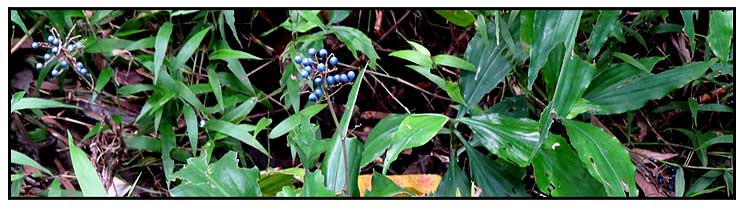
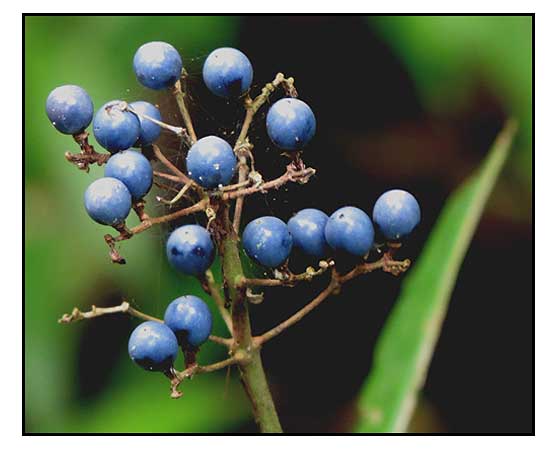
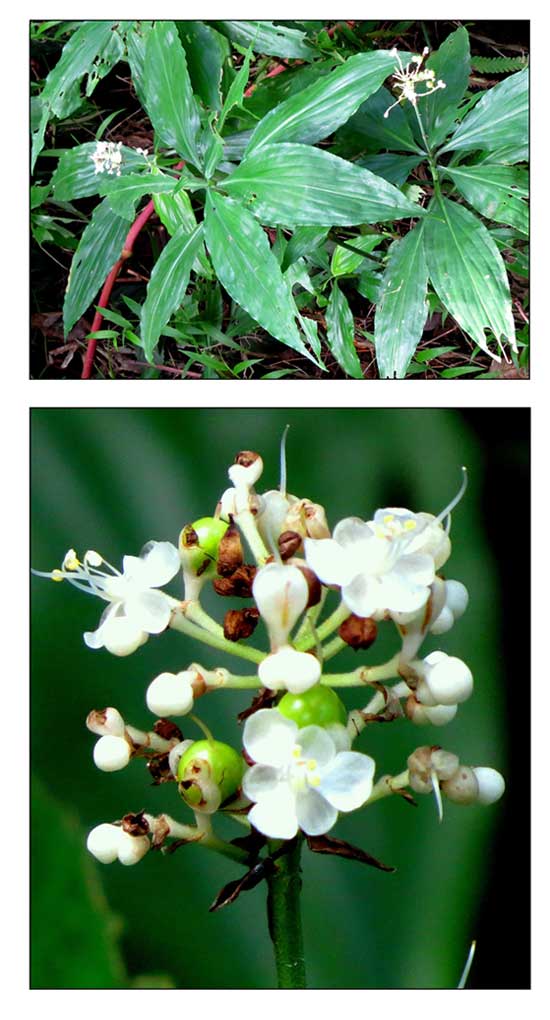
• Herbs perennial. Stems erect, to 20 cm × 7 mm, sparsely white-pubescent. Leaves sessile; leaf sheath ca. 2.5 cm, rather densely pubescent; leaf blade elliptic, ca. 20 × 5 cm, verrucose adaxially, densely puberulent abaxially. Inflorescence longer than distal leaves; proximal inflorescence branches with peduncle to more than 20 cm, densely brown-yellow hooked hirsute; cincinni numerous, ca. 2 cm, in whorls or not, densely brown-yellow hooked hirsute; proximal involucral bracts leaflike, nearly as large as leaves, distal ones much smaller, to 5 mm, densely brown-yellow hirsute; bracts membranous. Sepals ovate-orbicular, boat-shaped, ca. 3 mm, glabrous, persistent. Petals white, obovate, shallowly boat-shaped, ca. 5 mm. Stamens 6; fertile stamens 3, anterior; staminodes 3, with shorter filaments. Fruit globose, ca. 6 mm in diam. (Flora of China)
Properties Studies Availability |
 Distribution
December 2025

 |
| PHOTOS / ILLUSTRATIONS |
| IMAGE SOURCE: Pllia secundiflora (3 images) / © Agnes Adique Talavera / 2015 / agnessa@flowerpots / Non-commercial use / Click on image or link to go to source page / Project Noah |
Additional
Sources and Suggested Readings |
• |
DOI: It is not uncommon for links on studies/sources to change. Copying and pasting the information on the search window or using the DOI (if available) will often redirect to the new link page. (Citing and Using a (DOI) Digital Object Identifier) |
| List of Understudied Philippine Medicinal Plants |
| New plant names needed The compilation now numbers over 1,720 medicinal plants. While I believe there are hundreds more that can be added to the collection, they are becoming more difficult to find. If you have a plant to suggest for inclusion, native or introduced, please email the info: scientific name (most helpful), local plant name (if known), any known folkloric medicinal use, and, if possible, a photo. Your help will be greatly appreciated. |
• |
 |
|
