
HOME      •      SEARCH      •      EMAIL    •     ABOUT


Family Apocynaceae
Starla
Hoya diversifolia Blume
MANGROVE WAX FLOWER
Yi ye qiu lan

Scientific names Common names
Eriostemma zollingerianum (Miq.) Kloppenb. Andaman wax flower (Engl.)
Hoya alba Kostel. Mangrove wax plant (Engl.)
Hoya bulusanensis Elmer Starla (Engl.)
Hoya coriacea Zoll. ex Miq.  
Hoya crassipes Turcz.  
Hoya diversifolia Blume  
Hoya diversifolia subsp. elnidicus (Koppenb.) Kloppenb.  
Hoya elnidicus Kloppenb.  
Hoya esculenta Tsiang  
Hoya liangii Tsiang  
Hoya orbiculata Wall. ex Wight  
Hoya panchoi Kloppenb.  
Hoya persicinicoronaria Shao Y.He & P.T.Li  
Hoya zollingeriana Miq.  
Hoya diversifolia Blume is an accepted species. KEW: Plants of the World Online

Other vernacular names
CHINA : Yi ye qiu lan..
INDONESIA / MALAYSIA: Akar susudu bukit (Sumatra), Akar sesudu bukit, Akar Serapat, Akar chaping kera (Peninsular Malaysia)/
PORTUGUESE: Flor-de-cera.
THAILAND: Lin Khwaai (Songkhla), Hoya kluay ping.
VIETNAM: Hoa sao khac la.

Gen info
- Hoya is a genus of over 500 species of plants in the dogbane family, Apocynaceae, commonly known as wax flowers. Plants in the genus are mostly epiphytic or lithophytic vines, rarely subshrubs. (9)
- Taxonomy: The genus was first formally described in 1810 by botanist Robert Brown in his book Prodromus Florae Novae Hollandiae et Insulae Van Diemen, and honors Thomas Hoy, the gardener for the Duke of Northumberland. The first species of Hoya that Brown described, the type species, was Hoya carnosa. (9)
- Hoya diversifolia is a widespread species of flowering plant in the family Apocynaceae.
- Study reports on the presence of 39 species and six subspecies of Hoyas in the Quezon province. Among the species, 37 are reported as endemic and two as indigenous. It is suggested, Quezon province houses a higher number of Hoya species than other places in the Philippines. Most of the Hoyas listed are epiphytic, thriving in forests ranging from low to 650 m above sea level. (8)

Botany
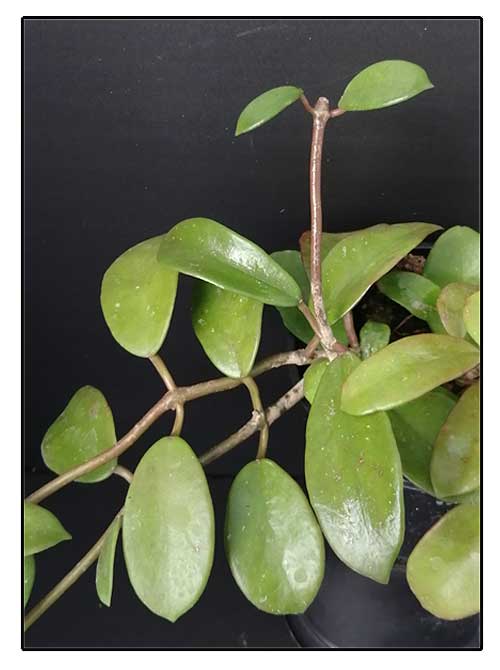
A climber with branches up to 4 m long; leaves broadly ovate to obovate-oblong, up to 14 cm × 5 cm, fleshy, petiole up to 1.5 cm long; flowers 9-14 mm in diameter, corolla pale outside, tinged with violet and densely appressed white-hairy inside, shallowly lobed, lobes with recurved top; follicle lanceolate, c. 13 cm long. (PROSEA)

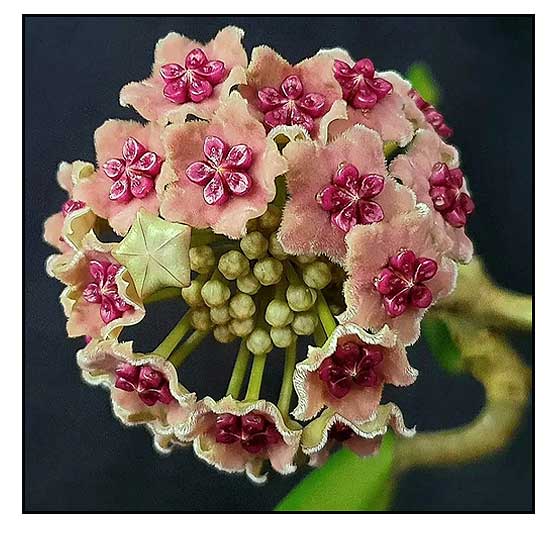
• Mangrove Wax Plant is a climbing shrub with milky latex on plant parts. Plants are often found hanging down from branches of trees. Leaves are fleshy, very thick, round, broadly elliptic or obovate, blunt or apiculate at tip, rounded at base. Flowers are borne in many-flowered umbels, on stout thick, flower-cluster-stalk, 2.6 cm long. Flowers are white or rose-colored with pink corona. Calyx is membranous; sepals elliptic-blunt, usually fringed with hairs at the tips. Flowers are finely velvet-hairy within; petals heart-shaped-tapering. Corona of 5 processes attached to the bases both of the staminal column and of the flower tube. Seedpods are single nearly linear, sickle shaped, 4-5 x 3-5 mm; pericarp thick. (Flowers of India)

Distribution
- Native to the Philippines. (1)
- Also native to
Andaman Is., Borneo, Cambodia, Hainan, Jawa, Laos, Lesser Sunda Is., Malaya, Myanmar, Sulawesi, Sumatera, Thailand, Vietnam. (1)
- Occurs an epiphyte or terrestrial in open forest, but also on wayside trees, up to 400 m altitude.
- Usually found climbing on and even covering trees in shoreline mangrove forests, and further inland.  (4)

Constituents
- Study of dichloromethane extracts isolated ß-amyrin cinnamate (1), squalene (2), ß-sitosterol (3), a mixture of ß-amyrin (4a) and α-amyrin (4b) and lupeol (4c) in a 4:2:1 ration and saturated hydrocarbons from leaves, taraxerol (5), lupeol cinnamate (6), and a mixture of 3 and stigmasterol (7) in a 2:1 ratio from stems. (7)

Properties
- Study suggested antibacterial properties.

Parts used
- Leaves, flowers, latex.

Uses

Edibility
- Conflicting information on edibility: Latex reportedly used to stimulate digestion. There are some reports that the sap is mildly toxic, and caution is advised on ingestion of other plant parts, especially leaves and stems.
- While the flowers are not typically consumed, the nectar is reportedly edible: thick, orange, with a sugary, honey-like flavor. If tempted to taste the nectar, make sure the plant has not been treated with pesticides.
Folkloric
- In Peninsular Malaysia and Vietnam, decoction of leaves used as bath for treatment of rheumatism. (3)
- Latex reportedly poisonous. In
Malaysia, used to ease painful catfish stings. for treatment of cough, and in hot baths, for rheumatism.
- Flowers applied to relieve pain of rheumatism. Also used as anti-nematodal against Bursaphelenchus xylophilus. Plant also used for treatment of skin diseases such as eczema, abscess, acne, boils, scabies, itching, sores, rashes, scars, and warts. (6)


Studies
Antibacterial / Leaves:
Study of evaluated the antibacterial properties of ethanolic extract of H. diversifolia leaves extract using disc diffusion assay against several Gram negative and Gram positive bacteria. The extract exhibited inhibition of growth of methicillin-resistant Staphylococcus aureus, Escherichia coli, and Bacillus cereus, with MICs of 25mg, 25 mg, and 100 mg/ML respectively at 24 and 48 hours incubation period. (6)

Availability
- Wild-crafted.
- Plants in the cybermarket.

May 2026

                                                 PHOTOS / ILLUSTRATIONS
IMAGE SOURCE: Hoya diversifolia / NatureAtYourBackyard / CC BY 2.0 / Image modified / Click on image or link to go to source page / Wikipedia
OTHER IMAGE SOURCE:Hoya diversifolia leaves / © Ortofiorito / Non-commercial use / Image modified / Click on image or link to go to source page / Ortofiorito
OTHER IMAGE SOURCE:Hoya diversifolia / © Le Jardin / Non-commercial use / Click on image or link to go to source page / LeJardin

Additional Sources and Suggested Readings
(1)
Hoya diversifolia / KEW: Plants of the World Online
(2)
Apocynaceae: Hoya diversifolia / Co's Digital Flora of the Philippines
(3)
Hoya diversifolia / Muhammad Mansur / PROSEA: Plant Resources of South-East Asia
(4)
Hoya diversifolia / Wikipedia
(5)
Mangrove was plant / WILD Fact Sheets
(6)
Antibacterial Activity of Hoya Diversifolia Ethanolic Leaves Extract / Nurhidayah Ab-Rahim, Wan Ismahanisa Ismail, Muhammad Nabil Fikri Roslan et al / Biomedical and Pharmacology Journal, 2019; 12(2): pp 857-862 / DOI: 10.13005/bpj/1710 / ISSN: 0974-6242
(7)
Triterpenes and sterols from Hoya diversifolia Blume / Nelson M Panajon, Fernando B Aurique, Chien-Chang Shen, Consolacion Y Ragasa / Journal of Applied Pharmaceutical Science, 2016; 6(6): pp 79-82 / ISSN: 2231-3354 / DOI: 10.7324/JAPS.2016.60614
(8)
An Enumeration of Hoyas in Quezon Province, Luzon Island, Philippines / Elaine Loreen C Villanueva, Inocencio E Buot Jr / The Thailand Natural History Museum Journal, 2017; 11(1): pp 23-33
(9)
Hoya / Wikipedia

DOI: It is not uncommon for links on studies/sources to change. Copying and pasting the information on the search window or using the DOI (if available) will often redirect to the new link page. (Citing and Using a (DOI) Digital Object Identifier)

                                                            List of Understudied Philippine Medicinal Plants
                                          New plant names needed
The compilation now numbers over 1,750 medicinal plants. While I believe there are hundreds more that can be added to the collection, they are becoming more difficult to find. If you have a plant to suggest for inclusion, native or introduced, please email the info: scientific name (most helpful), local plant name (if known), any known folkloric medicinal use, and, if possible, a photo. Your help will be greatly appreciated.

HOME      •      SEARCH      •      EMAIL    •     ABOUT