
HOME      •      SEARCH      •      EMAIL    •     ABOUT


Family Fabaceae
Wild lablab bean
Dolichos trilobus subsp. trilobus
WILD BUTTER BEAN / SICKLE BEAN
Lian bian dou

Scientific names Common names
Dolichos trilobus L. Japanese arrowroot (Engl.)
Accepted infraspecifics (4) Three-lobe leaf bean (Engl.)
Dolichos trilobus subsp. occidentalis Verdc. Sickle bean (Engl.)
Dolichos trilobus var. richardsiae Mackinder Wild butter bean (Engl.)
Dolichos trilobus subsp. transvaalicus Verdc. Wild lablab bean (Engl.)
Dolichos trilobus var. trilobus  
Dolichos andorgensis Welw. ex Baker  
Dolichos debilis Hochst. ex A. Rich.  
Dolichos falcatus J.G.Klein ex Willd.  
Dolichos formosoides Harms  
Dolichos kosyunensis Hosok.  
Dolichos schliebenii Harms  
Dolichos trilobus var. kosyunensis (Hosok.) H.Ohashi & Tateishi  
Dolichos trilobus subsp. trilobus  
Dolichos trilobus var. stenophyllus Verdc.  
Vigna tenuis Franch.  
Dolichos trilobus subsp. trilobus is an accepted subspecies. KEW: Plants of the World Online

Other vernacular names
INDIA: Kattuparayu, Lattupayaru, Pampu-moccai, Minnikishangu (Tamil); Kaadavare, Kaduhuruli (Kannada); Kattamara, Kattumtira (Malayalam); Raan pavata (Marathi); Adavi chikkudu, Inti-mungatiga, Verriulavu, Pilli pesara (Telugu); Tung (Maharashtra); Nispavah (Sanskrit); Kattabare (Tulu).
SRI LANKA: Wal dambala (Sinhala).

Gen info
- Dolichos is a genus of flowering plants in the legume family, Fabaceae and the subfamily Faboideae. The genus contains about 60 species.
- Etymology: The genus name Dolichos derives from Greek meaning "long", likely used by Dioscorides for long-podded plants. The specific epithet trilobus derives from Latin, meaning "three-lobed", referring to the leaves.

Botany
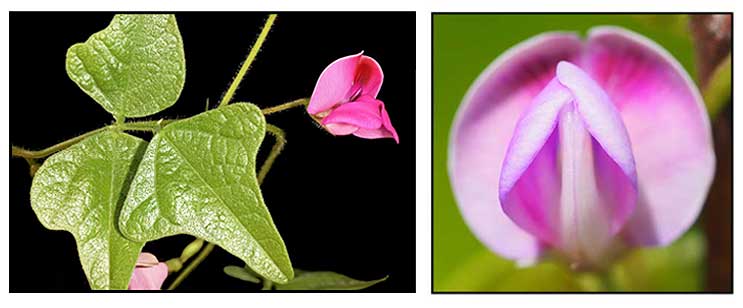
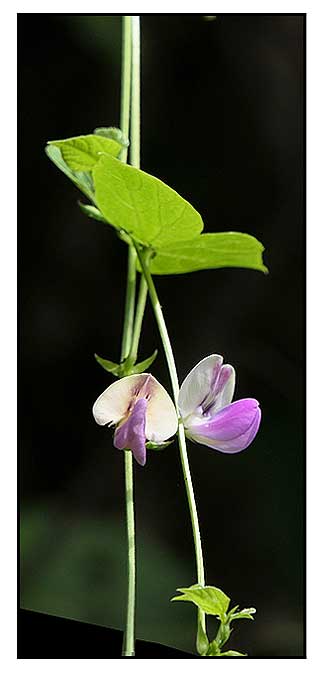
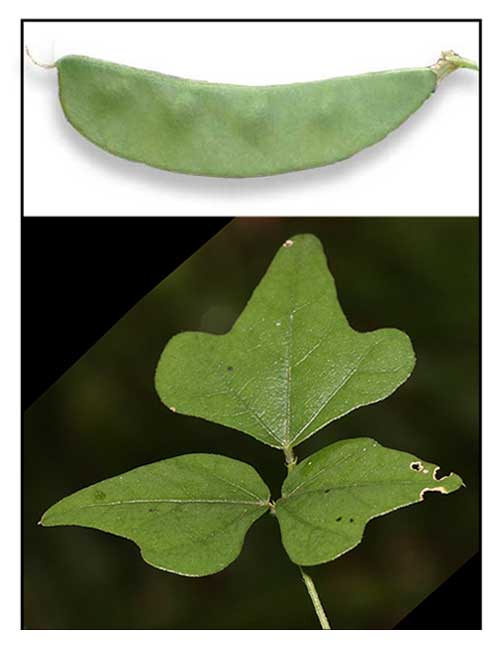
Perennial, climbing herb, up to 1 m long, with a woody rhizome. Leaves trifoliolate; petiole up to 7 cm long; stipules lanceolate, reflexed, up to 4 mm long; leaflets thin, suborbicular, ovate to oblong-ovate or rhomboid, up to 9 cm × 9 cm, glabrous to variously hairy. Inflorescence an axillary, 2-3-flowered, raceme. Calyx tubular, with 5 short teeth; corolla white or pink, about 1 cm in diameter. Pod cylindrical, somewhat curved, 5-9 cm × 6-12 mm, 6-8-seeded. (PROSEA)

•Twining herbs. Stems slender, glabrous or subglabrous. Leaves pinnately 3-foliolate; stipules ovate, ca. 3 mm, veins conspicuous; petiole 2-3 cm; stipels linear; leaflets rhombic or ovate-rhombic, 2-6 × 2-4.5 cm, glabrous or almost so on both surfaces, base broad and obtuse, apex acute or acuminate. Ra­cemes axillary, slender, 1-4-flowered; peduncles equal to or longer than petiole. Bracts and bracteoles with conspicuous veins. Calyx broadly campanulate, ca. 3 mm, glabrous; teeth triangular. Corolla white, 10-20 mm; standard orbicular, base with 2 triangular appendages, without auricles; wings obovate, slightly longer than standard; keel base truncate, clawed. Ovary sessile. Legumes linear-oblong, ca. 6 × 0.8 cm, (Flora of China)

Distribution
- Native to the Philippines. (1) (2)
- In Luzon from Ilocos Norte to Batangas. Lowland thickets. (2)
- Also native to Angola, Assam, Bangladesh, Cameroon, China South-Central, China Southeast, East Himalaya, Ethiopia, Hainan, India, Jawa, Kenya, KwaZulu-Natal, Laos, Lesser Sunda Is., Malawi, Mozambique, Myanmar, Namibia, Nepal, Rwanda, Somalia, Sri Lanka, Sudan-South Sudan, Taiwan, Tanzania, Uganda, Vietnam, West Himalaya, Yemen, Zambia, Zimbabwe. (1)

D. trilobus is found along roads, in grassland and at the margins of thickets and bamboo forest. In Indo-China it occurs on volcanic or limestone-derived soil up to 1100 m altitude.

Constituents
- Nutrient analysis per 100 g of edible root portion: Moisture 72.4%, energy 1794 kJ, protein 7.1g, iron 0.2 mg, zinc 4.4 mg. (4)
- Phytochemical screening of 80% methanol extract of root revealed presence of alkaloids, terpenes, flavonoids, carbohydrates, anthraquinones, cardiac glycosides, steroids, tannins, and saponins. GC-MS analysis of methanol fraction detected 4-(3,4-dimethoxyphenyl)-6-phenylpyrimidin-2-ol, 3-benzylamino-5,6-diphenyl-1,2,4-triazine and 5-(7-hydroxycoumarin-8-yl)-7-methoxycoumarins. (see study below) (6)
- Study of ethyl acetate root extracts isolated Falcatane A and B (1,2), 4-oxo-3,24-dinor-2,4-secooleanane- and 3-oxo-24-norolea-nane-type triterpenoids, together with seven known triterpenoids, including 2-hydroxy-3-oxo-24-noroleana-1,4,12-trien-28-oic acid (3) and oleanolic acid (4). (see study below) (7)
- Study of roots isolated four new coumestans, dolichosins A-D (1-4), together with four known compounds, isoso0jagol (5), phaseol (6), psoralidin (7) and 4",5"-dehydroisopsoralidin (8). (see study below) (8)

Properties
- Studies suggest antinociceptive, antivenom, anti-inflammatory, α-glucosidase inhibitory properties.

Parts used
Leaves, bark, tubers.

Uses

Edibility
- Seeds are edible; cooked while fresh or after sun-drying. Coconut milk or pounded groundnuts can be added while cooking, making it more palatable. Dried seeds can be stored for months. (3)
Folkloric
- No reported folkloric medicinal use in the Philippines.
- Pounded tubers used for treatment of chickenpox. (3)
- Use in Yi ethnic medicine for treatment of pain, rheumatism, fractures, and snake bites.
- Used as abortifacient by Mannan tribes of Idukki district, Kerala: Whole plant juice used to induce abortion in the first three months. (9)
- Tribal use in Tamil Nadu for skin diseases like scabies, eruptions and urticaria: roots boiled and taken internally or fresh roots consumed as such.
- In India, bark extract used as antidote against snake bite, treatment of tumors, asthma, and chickenpox.
Others

- Agroforestry: Sometimes used as green manure. (3)

Studies
Antinociceptive / Doliroside B / Roots:
Study evaluated the therapeutic potential of doliroside B (DB) from D. trilobus and its disodium salt (DBDS) for antinociceptive effect and its underlying mechanism using acetic acid-induced writhing test, Eddy's hot plate test, and Formalin test in mice. DBDS (5 mg/kg) inhibited the writhing number by 80.2%, which exhibited the highest antinociceptive activity in pain models. DBDS could selectively inhibit COX-1 activity, and also reduce production of NO, iNOS, and
IL-6 with 55.8%, 69.0%, and 49.9% inhibition, respectively. DBDS also positively modulated the function of GABA(A1) receptor. Results suggest both peripheral and central antinociceptive activity, which may act on multiple targets. Study suggest potential for developing DBDS as analgesic drug. (5)
Antivenom Potential / Roots: Study evaluated the anti-venom potential of air-dried, pulverized-powdered 80% D. trilobus methanol root extract and using a computational and cheminformatics approach. Results demonstrated significant antivenin activity against Naja nigricollis venom. (see constituents above) (6)
Anti-α-glucosidase Activity / Noroleanane-type Triterpenoids / Roots: Study of ethyl acetate root extracts isolated Falcatane A and B (1,2), 4-oxo-3,24-dinor-2,4-secooleanane- and 3-oxo-24-norolea-nane-type triterpenoids, together with seven known triterpenoids. All isolates showed varying degrees of α-glucosidase inhibitory activity except compound 2. (7)
α-Glucosidase Inhibitory / Anti-Inflammatory / Coumestans / Roots: Study of roots isolated four new coumestans, dolichosins A-D (1-4), together with four known compounds, isoso0jagol (5), phaseol (6), psoralidin (7) and 4",5"-dehydroisopsoralidin (8). Compounds were evaluated for anti-inflammatory activity by inhibition of nitric oxide production in LPS-activated murine macrophage RAW 264.7 cells. Compounds 1 and 6 exhibited moderate inhibitory activity with no cytotoxic effects. Compounds 1 and 5-8 exhibited appreciable α-glucosidase inhibition. Compounds 1, 7 and 8 showed IC50s lower than 20.0 µM. (8)

Availability
Wildcrafted.

April 2026

                                                 PHOTOS / ILLUSTRATIONS
IMAGE SOURCE: Dolichos trilobus pod. / © eziam / CC BY-NC 4.0 International / Image modified / Click onn image or link to go to source page / iNaturalist
IMAGE SOURCE: Dolichos trilobus flower close-up. / by 葉子 / No rights reserved / PUBLIC DOMAIN / Click on image or link to go to source page / iNaturalist
IMAGE SOURCE: Dolichos trilobus trifoliate leaves / © PMR: Pathumi Dinithya / Non-commercial use / Click on image or link to go to source page / FloraOfSriLanka
IMAGE SOURCE: Dolichos trilobus . / by dineshvalke / Some rights reserved / CC BY-SA 4.0 International / Image modified / Click on image or link to go to source page / iNaturalist
IMAGE SOURCE: Dolichos trilobus subsp. transvaalicus flower. / by SAplants / CC BY-SA 4.0 International / Image modified / Click onn image or link to go to source page / Wikimedia Commons

Additional Sources and Suggested Readings
(1)
Dolichos trilobus / KEW: Plants of the World Online
(2)
Fabaceae: Dolichos trilobus / Co's Digital Flora of the Philippines
(3)

Dolichos trilobus / Ken Fern: Tropical Plants Database / Useful Tropical Plants
(4)
Dolichos trilobus / Food Plants International
(5)
Antinociceptive activity of doliroside B / Xishan Bai, Yanhong Li, Yuxiao Li, Min Li, Xiangxhong Huang et al / Pharmaceutical Biology, 2023; 61(1): pp 201-212 /  DOI: 10.1080/13880209.2022.2163407 / PMCID: PMC9848282  PMID: 36628487
(6)
Investigating the Anti-Venom Potential of Dolichos Trilobus Root Extract: A Computational and Cheminformatics Approach / Lokta Solomon, IY Chindo, UF Hussan / IJART: International Journal of Applied Research and Technology, 2020; 5(2) / ISSN: 2519-5115 / DOI: 10.24163/ijart/2017/5(2):32-58
(7)
Noroleanane-type triterpenoids from Dolichos trilobus L. and their anti-α-glucosidase activities / Ming Luo, Yan-Hong Li, Ya Lu, Yan Yuan, Rong-Sheng Ruan et al / Natural Product Research, 2021; 35(4): pp 600-606 / DOI: 10.1080/14786419.2019.1590713
(8)
α-Glucosidase Inhibitory and Anti-Inflammatory Coumestans from the Roots of Dolichos trilobus /
Meng-Yuang, Jiang Ming, Luo Kai et al / Planta Med, 2019; 85(2): pp 112-117 / DOI: 10.1055/a-0746-8622
(9)
Herbal abortifacients used by Mannan tribes of Kerala, India. /
TP Ajesh, MV Krishnaraj et al / International Journal of Pharm Tech Research, 2012, 4(3): pp 1015-1017 / pISSN: 0974-4304

DOI: It is not uncommon for links on studies/sources to change. Copying and pasting the information on the search window or using the DOI (if available) will often redirect to the new link page. (Citing and Using a (DOI) Digital Object Identifier)

                                                            List of Understudied Philippine Medicinal Plants
                                          New plant names needed
The compilation now numbers over 1,750 medicinal plants. While I believe there are hundreds more that can be added to the collection, they are becoming more difficult to find. If you have a plant to suggest for inclusion, native or introduced, please email the info: scientific name (most helpful), local plant name (if known), any known folkloric medicinal use, and, if possible, a photo. Your help will be greatly appreciated.

HOME      •      SEARCH      •      EMAIL    •     ABOUT