
HOME      •      SEARCH      •      EMAIL    •     ABOUT


Family Apocynaceae

Yellow allamanda
Allamanda schottii Pohl
BUSH ALLAMANDA / YELLOW BELL

Huang ying

Scientific names Common names
Allamanda brasiliensis Schott ex Pohl Bush allamanda (Engl.)
Allamanda cathartica Schrad. Buttercup flower (Engl.)
Allamanda cathartica var. schottii (Pohl.) Bailey & Raffill Dwarf golden trumpet (Engl.)
Allamanda magnifica B.S.Williams Golden trumpet bush (Engl.)
Allamanda neriifolia Hook. Golden trumpet vine (Engl.)
Allamanda schottii Pohl Yellow allamanda (Engl.)
  Yellow allamanda (Engl.)
  Yellow bell (Engl.)
Allamanda schottii Pohl is an accepted species. KEW: Plants of the World Online
In the Philippines, the "yellow flower" is source of great confusion, especially when it refers to the "yellow bell." and "kampanilya." Kampanilya is a shared common between two species of plant: (1) Thevetia peruviana, campanilla, campanero and (2) Allamanda cathartica, campanilla, kampanero, goldfen trumpet.
"Yellow bell" is a shared common name with (1) Allamanda cathartica (2) Allamanda neriifolia, and (3) Tecoma stans.
Some compilations list Allamanda cathartica and Allamanda nerifolia as synonyms; others as separate species, but sharing in many of the common names.

Other vernacular names
CHINA: Huang ying.
MALAYSIA: Akar chempaka hutan, Bunga akar kuning.
THAI: Ban phara.
VIETNAMESE: D[aa]y hu[yf]nh l[as] h[ej]p (Day huynh la hep).

Gen info
- Apocynaceae is a family of flowering plants that includes trees, shrubs, herbs, stem succulents, and vines, usually known as the dogbane family, because some taxa were used as dog poison. Notable members include oleander, dogbanes, milkweeds, wax plants, and periwinkles. As of 2012, the family comprised some 5,100 species, in five sub-families: Apocynoideae, Asclepiadoideae, Periplocoideae, Rauvolfioideae, and Secamonoideae. (17)
- Etymology: The scientific name Allamanda schottii honors two 18th- and 19th-century naturalists: Swiss botanist Frederik Allamand and Dutch botanical collector Heinrich Wilhelm Schott.

Botany
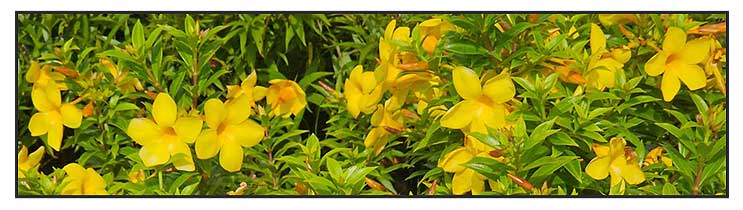
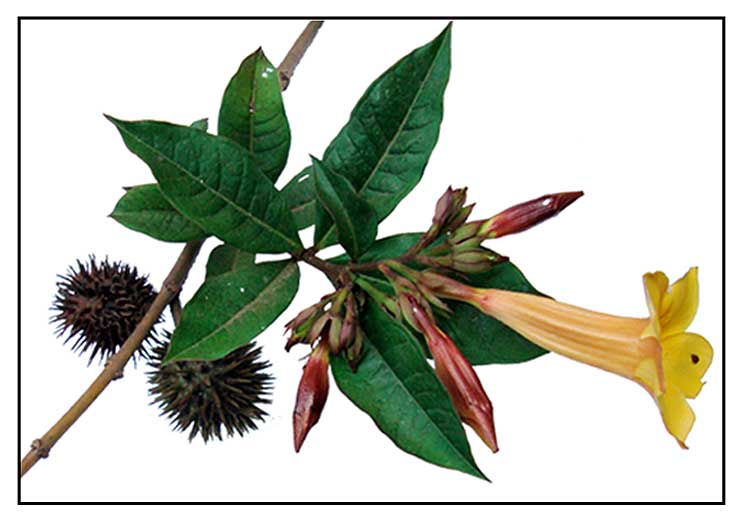
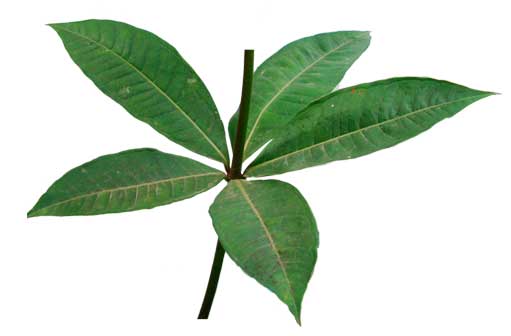
• Yellow allamanda is a glabrous perennial shrub growing to a height of 1.5 meters, with a milky sap and sometimes scandent branches. Leaves are narrow, opposite or whorled, 2 to 5 at each node, 8 to 10 centimeters long, 2 to 3 centimeters wide. Inflorescence is paniculate. Flowers are bell-shaped with a golden yellow corolla, striped orange at the throat, up to 6 centimeters across, with a short and swollen tube, angular at the base. Fruit is a globose and prickly capsule.

• Unlike many members of the genus, A. schottii is a shrub rather than a vine, growing to 1.5 to 3 m (5–10 ft) tall and around 2 m (6–8 ft) wide. Elliptic to obovate leaves are arranged in whorls of 3–5 or are subopposite along the stem, and measure 2–14 cm long and 1.1–4 cm wide. Large yellow flowers are terminal (i.e. appearing at the ends of branches),  and can appear year-round but predominantly in spring.

Distribution
- Naturalized. (10)
- In forest edges.
- In Mindanao: Bukidnon.
- Ornamental cultivation.
- Native to Argentina Northeast, Brazil South, Brazil Southeast, French Guiana.

Constituents
- Study of ethanol extract from aerial parts (leaves and stems) of A. schottii yielded a mixture of ß-sitosterol and stigmasterol. Elution of fraction 80-106 yielded plumericin (56.3 mg), scopoletin (14.5 mg), ursolic acid (267.8 mg) and plumierede (74.3 mg). A dichlormethane fraction from roots yielded plumericin (22.1 mg), isoplumericin (18.0 mg), 1-(3,4-dimethoxyphenyl)-ethano-1,2-diol (8.3 mg) and scoparone (15.2 mg). (see study below) (3)
- In a study of flavonoids in flowers of different Allamanda species, A. schottii ethyl acetate fraction yielded a rutin concentration of 24.85 ±0.08 mg/100 g fresh flowers. Flowers also yielded kaempferol and quercetin. (7)

Properties
Concerns: Stem and leaves contain a milky and irritant sap. Skin contact may cause dermatitis. Reports of diarrhea or vomiting with ingestion of plant parts, which is attributed to plumericin content.

• Purgative.
• Studies have shown antiproliferative, cytotoxic, anti-leishmanial, antioxidant, antimitotic, anti-rabies, anticoagulant properties.

Uses
Edibility
• No plant part considered edible.
• Reports of diarrhea, vomiting, and excessive drooling with ingestion of plant parts.
Folkloric
• Used as purgative and vermifuge.
Others
Pollination: Flowers are pollinated by the butterflies of the genus Phoebis; while bees and wasps also visit the flowers.
Decorative: Prickly fruits are used in floral arrangements.

Studies
Protoplumericin / Iridoid Bis-glucoside: Study isolated protoplumericin, 13-O-(ß-D-glucopyranosyl-p-coumaroyl)-plumieride, from the methanolic extract of A neriifolia. (1)
Anti-Proliferative / Cytostatic / Cytotoxic: Study evaluated the anti-proliferative effect of A schottii and A blanchetti ethanolic extracts on K562 leukemic cells. The root extract of A schottii showed to be the most active, showing dose-dependent cytostatic and cytotoxic effect. (3)
Anti-Rabies Virus / Leaves: In a study of South American plant extracts and fractions for antiherpetic and antirabies activities, only a methanol extract of leaves of Allamanda schottii showed anti-rabies virus activity, with a selectivity index (SI=CC50/EC50) of 5.6. (4)
Antileishmanial / Roots, Stems and Leaves: Study evaluated extracts, fractions, and isolated compounds from selected Brazilian medicinal plants against strains of promastigotes of Leishmania amazonensis and L. brasiliensis in vitro. Dichlormethanes fractions of roots, stems, and leaves of Allamanda schottii showed IC50 values between 14.0 and 2.0 µg/mL. Plumericin was the main active compound, with IC50 of 0.3 and 0.04 µg/mL against the two Leishmania species. (6)
Antimitotic Activity: Study evaluated the effects of dichlormethane fraction obtained from Allamanda schottii on sea urchin Echinometra lucunter eggs, as a multicellular model for evaluating anti-tumor activity. Results showed dose-dependent inhibition of sea urchin development with IC50 for first and third cleavage and blastulae stage of 103.7 µg/mL, 33.1 µg/mL, and 10.2 µg/mL, respectively. The expressive anti-mitotic activity on sea urchin eggs reinforces the anti-tumor potential of A. schottii. (8)
• Cytotoxicity / Plumericin / Seasonal Influence: Study evaluated fractions obtained from leaf, stem, and roots of Allamanda schottii for cytotoxicity using several cell lines (human erythromyelobastoid leukemia cell line: K562). Ethanol and DCM fractions were evaluated in L929, HeLa, Nalm6 and K562 cell lines. Ethanol extract of stems yielded the compounds plumericin, plumieride and ursolic acid from the ethanol extracts of stems. Results showed the season of A. schottii collection and the part of the plant analyzed influenced the cytotoxicity on K562 cells. The DCM fractions from the stems and roots were responsible for the cytotoxicity on the cells tested. The cytotoxic activity may be due to the presence of plumericin or minor compounds yet unidentified. (9)
• Anticoagulant / Antioxidant / Leaves: Study evaluated leaves of Allamanda schottii for antioxidant activity using DPPH and FRAP methods, and in-vitro anticoagulant activity using clot lysis, prothrombin time (PT), and activated partial thromboplastin time (APTT) and in-vivo anticoagulant activity using clotting time and Tail Bleeding Assay. Results showed significant anticoagulant potential evidenced by significant prolongation of clotting times (PT, aPTT and clotting time) at higher concentrations. Methanolic extracts also showed antioxidant potential with favorable IC50 values. (11)

Availability
Wild-crafted.


Updated July 2026 / November 2018 / September 2016

PHOTOS / ILLUSTRATIONS
Photos ©Godofredo Stuart / StuartXchange
OTHER IMAGE SOURCE: Allamanda schottii / by Md T Mahtab / CC BY-SA 4.0 / Image modified / Click on image or link to go to source page / Wikimedia Commons
OTHER IMAGE SOURCE: Bush allamanda /Allamanda schottii compacta / © Jagtap Nursery Wholesale / Image modified / Click on image or link to go to source page / Jagtap Nursery

Additional Sources and Suggested Readings
(1)
Protoplumericin, an Iridoid Bis-glucoside in Allamanda neriifolia / Yamauchi Tatsuo et al / Chemical & pharmaceutical bulletin, 29(10) pp.3051-3055 19811025
(2)
Bioactive components of Allamanda schottii. / Anderson JE, Chang CJ, Mclaughlein JL (1988) / J Nat Prod 51: 307
(3)
Evaluation of the anti-proliferative effect the extracts of Allamanda blanchetti and A. schottii on the growth of leukemic and endothelial cells / Dionezine de F Navarro Schmidt et al / J Pharm Pharmaceut Sci., 2006; 9(2): pp 200-208 /
(4)
Evaluation of Antiviral Activity of South American Plant Extracts Against Herpes Simplex Virus Type 1 and Rabies Virus / Vanessa Müller, Juliana H. Chávez, Flávio H. Reginatto, Silvana M. Zucolotto, Rivaldo Niero, Dionezine Navarro, Rosendo A. Yunes, Eloir P. Schenkel, Célia R. M. Barardi, Carlos R. Zanetti and Cláudia M. O. Simões / PHYTOTHERAPY RESEARCH / DOI: 10.1002/ptr.2198
(5)
Allamanda schottii / KEW: Plants of the World Online
(6)
Evaluation of Antileishmanial Activity of Selected Brazilian Plants and Identification of the Active Principles / Valdir Cechinel Filho, Christiane Meyre-Silva, Rivaldo Niero, Luisa Nathália Bolda Mariano, Fabiana Gomes do Nascimento, Ingrid Vicente Farias, Vanessa Fátima Gazoni, Bruna dos Santos Silva, Alberto Giménez, David Gutierrez-Yapu, Efrain Salamanca, and Angela Malheiros* / Evid Based Complement Alternat Med. 2013; 2013 / doi: 10.1155/2013/265025
(7)
Development and validation of an HPLC-PDA method for the determination of flavonoids in Allamanda species flowers / Tiago J. Bonomini, Carolina Wittkowski, Folvi D. Tomczak, Marcelo M. Mafra, Pedro A. de Mattos, Rosendo A. Yunes, Valdir Cechinel Filho, Marina da S. Machado, Ruth M. Lucinda and Angela Malheiros / Journal of Chemical and Pharmaceutical Research, 2015, 7(2):409-415
(8)
Anti-mitotic activity towards sea urchin eggs of dichloromethane fraction obtained from Allamanda schottii Pohl (Apocynaceae) / Louisa M. A. Sousa; Rubens L. Monte Neto; Dionezine F. Navarro Schmidt, Márcia R. OliveiraI / Rev. bras. farmacogn. vol.19 no.2a João Pessoa Apr./June 2009
(9)
Seasonal influence and cytotoxicity of extracts, fractions and major compounds from Allamanda schottii / Fabiana G. Nascimento, Amanda Faqueti, Jessica F. Wilhelm, Carolina Wittkowski, Folvi D. Tomczak, Sheila L. Borges et al / Rev. bras. farmacogn, Vol 24, No 5, Curitiba Sept.-Oct. 2014 / http://dx.doi.org/10.1016/j.bjp.2014.08.005
(10)
Apocynaceae: Allamanda schottii / Co's Digital Flora Database
(11)
Antioxidant and Anticoagulant Screening of Allamanda schottii Leaf Extract in Rats / Achla K Vyas, Revathi A Gupta, Rakesh K Jatav / Cardiovasc Hematol Disord Drug Targets, 2026; 26(2): pp 139-155 /
DOI: 210.2174/011971529X382502250924095327 / PMID: 41084251
(12)
Allamanda schottii / Wikipedia

DOI: It is not uncommon for links on studies/sources to change. Copying and pasting the information on the search window or using the DOI (if available) will often redirect to the new link page. (Citing and Using a (DOI) Digital Object Identifier)

                                                            List of Understudied Philippine Medicinal Plants
                                          New plant names needed
The compilation now numbers over 1,750 medicinal plants. While I believe there are hundreds more that can be added to the collection, they are becoming more difficult to find. If you have a plant to suggest for inclusion, native or introduced, please email the info: scientific name (most helpful), local plant name (if known), any known folkloric medicinal use, and, if possible, a photo. Your help will be greatly appreciated.

HOME      •      SEARCH      •      EMAIL