|  Gen info Gen info
- Leea is a genus of plants in the family Vitaceae, subfamily Leeoideae, native to parts of Central Africa, tropical Asia, Australia and Melanesia. Previously placed in its own family, Leeaceae, but differences in ovule and carpel numbers, staminoidal tube presence in Leeaceae and floral disc in vitaceae, and pollen structure, have led to its separation from Leaceae, and inclusion into Vitaceae. As of 2023, Plants of the World Online lists 45 species in the genus. (15)
- Etymology: The genus Leea was named by Linnaeus after James Lee, the Scottish nurseryman based in Hammersmith, London, who introduced many new plants discoveries to England at the end of the 18th century. (15) The species epithet guineensis is Latin, referring to Guinea Coast of West Africa, one of the countries within natural distribution range. (16)
 Botany Botany
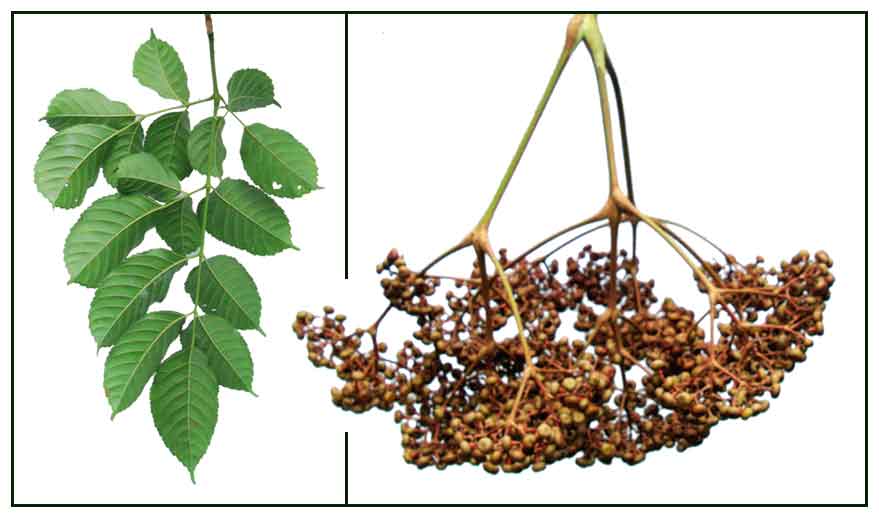
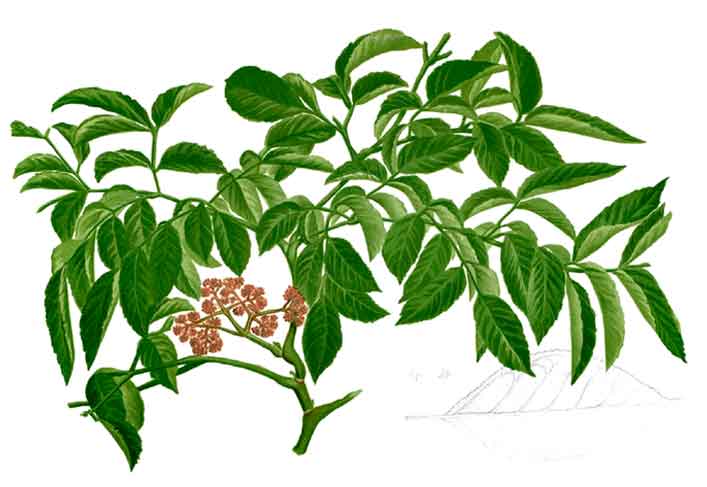
• Abang-abang is a smooth or nearly smooth shrub or small
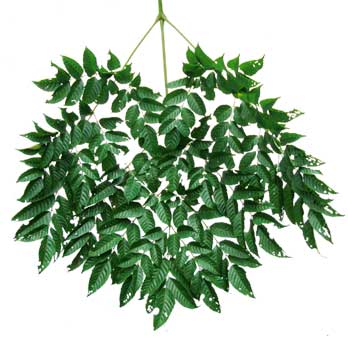
tree, 3 to 5 meters in height. Leaves are three or four times pinnately
compound, 50 to 80 centimeters long. Leaflets are elliptic-ovate to oblong lanceolate,
6 to 15 centimeters long, toothed at the margins, pointed at the tip and rounded
or somewhat pointed at the base. Flowers are borne on large cymes,
up to 50 centimeters in diameter, five-parted and about 3 millimeters long, a few opening
at a time, the stalks and calyx are red, the petals, pale yellow. Fruit
is dark red, depressed-globose and about 8 millimeters in diameter.
• Growth form: A tree, it can grow up to 10m in height and can be cultivated as a shrub. Foliage: Leaves are pinnately compound and have obovate stipules. The young leaves are reddish-green in colour and turn to green as the leaves mature. Leaflets are elliptic to lance shaped and have a rounded base with a caudate apex and a dentate margin. Flowers: Flowers are borne on a cyme and are red to reddish-orange in colour. Fruit: Fruits are red berries when mature. (16)
Distribution
- Native to the Philippines.
-
Common in thickets and secondary
forests at low and medium altitudes throughout the Philippines.
- Also native to Andaman Is., Angola, Assam, Bangladesh, Benin, Burkina, Burundi, Cambodia, Cameroon, Central African Republic, Comoros, Congo, East Himalaya, Gabon, Ghana, Guinea, Guinea-Bissau, Gulf of Guinea Is., India, Ivory Coast, Jawa, Kenya, Laos, Lesser Sunda Is., Liberia, Madagascar, Malawi, Malaya, Mali, Mauritius, Myanmar, Nepal, New Guinea, Nigeria, Réunion, Senegal, Sierra Leone, Solomon Is., Sudan, Sulawesi, Sumatera, Tanzania, Thailand, Togo, Uganda, Vietnam, Zambia, Zaïre. (4)
 Constituents Constituents
- Leaves of Leea guineense (Leeaceae) yielded three hydrophilic flavonoids, viz., quercetin-3'-sulphate-3-O-alpha-L-rhamnopyranoside, quercetin-3,3'-disulphate, and a new flavonoid sulphate, together with kaempferol, quercetin, quercitrin, mearnsitrin, gallic acid and ethyl gallate. (See study below) (5)
- Leaves have yielded quercetin, kaempferol, mearnsitrin, gallic acid and ethyl gallate.
- Proximate analysis of seeds showed crude protein of 22.30 ±0.45%, crude fiber of 14.38 ±1.20% and ash of 6.96 ±0.16%.
Study also showed it to be a good source of dietary minerals especially potassium, phosphorus, magnesium, manganese and copper. (see study below) (11)
- Proximate analysis of leaves yielded (% of dry samples) 7.43% ash content, 5.69% moisture content, 19.3% crude protein, 7.28% fat, 9.61% crude fiber, 50.7% carbohydrate.
(14)
- Mineral analysis of leaves (mg/100g) yielded 31.51 mg sodium, 31.21 mg potassium, 36.29 mg calcium, 28..68 mg magnesium, 30.18 mg zinc, 5.08 mg iron,
1.22 mg manganese, 35.53 mg phosphorus.
(14)
- Phytochemical analysis of leaves yielded alkaloid, tannins, saponins, steroid, phlobatannin/terpenoid, flavonoid cardiac glycoside, together with antinutrients phytin phosphorus, oxalate, phytic acid and polyphenol.
(14)
- Anti-nutrient content of fruits (mg/100g) yielded phytates (29530), oxalates (510), saponins (10333), alkaloids (30533), and tannins (53.3). Analysis for essential minerals (mg/100g) yielded potassium (493), calcium (200), magnesium (103.3), phosphorus (9.9), zinc (8.5), manganese (5.5), and iron (5.0). Heavy metals were in the order of lead>chromium>nickel>cobalt> cadmium. (see study below) (18)
Properties
- Considered vulnerary, antidiarrheal, antihypertensive.
- Studies have shown antioxidant, antitumor, antihypertensive, anticonvulsant, analgesic, anti-inflammatory, anxiolytic, antimicrobial, antifungal properties.
Parts used
Roots, branches, leaves.
Uses
Folkloric
- The indigenous Ati tribe in Tobias Fornier, Antique, Philippines apply leaves on the forehead for headache or dizziness. (19)
-
Decoction of roots, branches
and leaves used for wound healing.
- In Thailand, root used for diarrhea and
hallucination.
- In southern Western Ghats, leaf juice of the plant is mixed with coconut milk, given three times daily for treatment of dysentery with blood discharge.
- Leea guineense popularly used for treating hypertension.
- In West Africa and Guinea-Bissau, plant used for epilepsy.
- Used for treatment of enlarged spleen in children, pregnancy detection, toothache, gonorrhea, diarrhea, dysentery. Also used as diuretic.
(11)
- In Nigeria,
leaves, roots, and seeds used for pregnancy detection, toothache, gonorrhea, general weakness, and as purgative. (20) Used for treatment of enlarged spleen in children, skin rashes, ulcer, herpes, and boils. Cold water infusion of leaves used to wash ulcers.
Others
- Amulet (Karmen-karmen): Sliced dried roots with Uncaria sp., A. calamus, M. pruriens, and Alocasia cv are placed in a pouch and pinned on child's clothes for protection.(Also: see Unton) (19)
Studies
• Anti-Hypertensive:
In a study of the potential antihypertensive activity of Brazilian plants,
Leea rubra was one of five plants (C brasiliense, C fruticosum, P roebelinii
and T catappa) that showed significant angiotensin-converting enzyme
(ACE) inhibition.
(1)
• Antioxidant Flavonoids / Phenolic Acids / Leaves: Leaves of Leea guineense (Leeaceae) yielded three hydrophilic flavonoids, viz., quercetin-3'-sulphate-3-O-alpha-L-rhamnopyranoside, quercetin-3,3'-disulphate, and a new flavonoid sulphate, quercetin-3,3',4'-trisulphate, together with kaempferol, quercetin, quercitrin, mearnsitrin, gallic acid and ethyl gallate. The free radical scavenging effect was evaluated in the DPPH assay.
(5)
• Anticonvulsant / Neurobehavioral Effects: Study of an aqueous extract of leaves of Leea guineensis showed anticonvulsant, anxiolytic, antinociceptive effects through central mechanisms. The extract also caused concentration-dependent contractions on isolated toad rectus abdominis muscle similar to ACh and did not impair motor coordination and balance. (6)
• Antitumor / Antioxidant: Study evaluated the subacute toxicity, in vivo antioxidant and antitumor activity of an aqueous methanol extract of Leea guineensis on rats bearing carcinomatous cells. Results showed the extract is non toxic and exhibits significant antioxidant and antitumor effects. (7)
• Anti-Edematogenic / Anti-Inflammatory: Using the carrageenan-induced paw edema method, study of an aqueous extract showed significant (p<0.001) dose-depended anti-edematogenic activity. Phytochemical analysis revealed presence of saponins and glycosides as secondary metabolites. Results support its use in the treatment of inflammatory conditions.
(9)
• Anti-Nociceptive / Anxiolytic / Anticonvulsant: Study of aqueous extract of L. guineensis showed anti-nociceptive, anti-anxiety, and anticonvulsant effects in murine models of pain (formalin test), anxiety (elevated plus-mazes and light/dark box tests) and convulsion (pentylenetetrazole- picrotoxin- and MES-induced seizure tests).
(10)
• Proximate Analysis / Seeds: Proximate analysis of seeds showed crude protein of 22.30 ±0.45%, crude fiber of 14.38 ±1.20% and ash of 6.96 ±0.16%.
Study also showed it to be a good source of dietary minerals especially potassium, phosphorus, magnesium, manganese and copper. Fatty acid profile showed essential amino acids threonine, valine, isoleucine, leucine, tyrosine, phenylalanine, and histidine. (see constituents above) (11)
• Antioxidant / Anti-Tyrosinase / Leaves: In a study of 21 species of plants, fresh leaves of Leea guinensis showed most effective antioxidant activity (IC50=0.281 g/L) while dried leaves showed the best anti-tyrosinase activity
(IC50=0.374 g/L). (13)
• Antimicrobial / Leaves: Study evaluated the antimicrobial properties of leaf extracts of L. guineensis. Phytochemical screening revealed alkaloids, flavonoids, tannins, saponins, and cardiac glycosides in ethanol and hexane/acetone/methanol mixture extracts. The extracts showed efficacy against E. coli, S. aureus, B. subtilis, S. pneumonia, P. aeruginosa and Candida albicans. (17)
• Anti-Nutritional Composition, Heavy Metal Content, Mineral Content / Fruits: Study evaluated the essential minerals, heavy metals, and anti-nutritional compositions of whole fruits of L. guineensis. Results suggest L. guineensis fruits are a good source of phytominerals for nutritional purpose. The antinutrient contents in whole fruits should be reduced to safe level through processing methods (soaking, de-pulping or fermentation) to achieve optimum nutritional or medicinal use. (see constituents above) (18)
• Antifungal / Leaves: Study evaluated methanolic crude extracts of fresh leaves of Leea guineensis, O. gratissimum, and M. scandens for ability to inhibit growth of phytopathogenic fungi i.e., Botryodiplodia theobromae, Phytophthora palmivora, Aspergillus flavus, Aspergillus niger and Aspergillus glaucus. Plant Using extract concentrations of 50, 100, 150, 200 mg/mL, Leea guineensis exhibited strong antifungal activities. (21)
Availability
- Wildcrafted. |