Botany
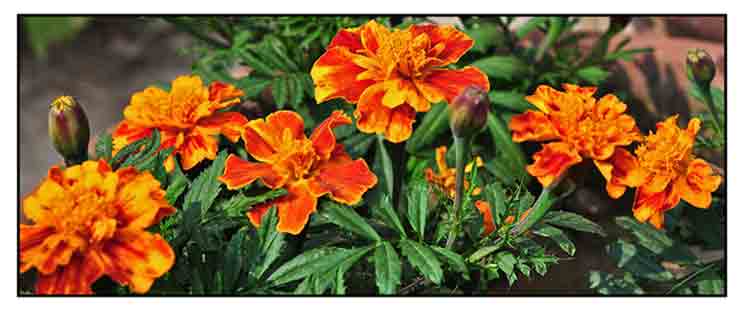
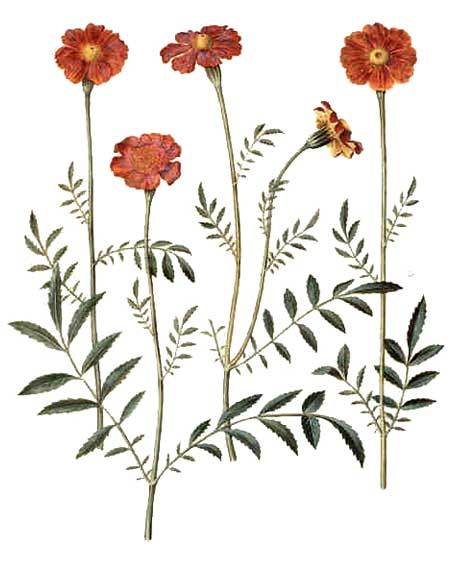
Amarillo is an erect, smooth, branched, rank-smelling herb, 0.3 to 0.8 meters high. Leaves are 4 to 7 centimeters long, deeply pinnatifid with linear-lanceolate segments. Heads are solitary, 1.5 to 2 centimeters long, 2 to 4 centimeters in diameter, borne on long peduncles which are thickened upward. Flowers are pale to deep yellow, sometimes red. Achenes are 6 to 7 millimeters long.
• Species is similar to Ahito (Tagetes erecta) except that it is smaller, with finer leaves and smaller heads.
 Distribution Distribution
- Cultivated for ornamental purposes in the Philippines.
- Thoroughly naturalized in Lepanto and the Benguet Subprovinces, along gravel banks and streams, at altitudes of 1,200 to 1,500 meters.
- Native of Mexico.
- Now widely distributed in cultivation.
Constituents
- Flowers yield a yellow crystalline substance, quercetagetine. The dye was found several shades browner than quercetin.
- Flowers contain volatile oil, 0.57%.
- Fruit contains phytomelan, 3.2%.
- Study of roots, leaves and flowers yielded thiophenes, steroidal and terpenoidal type constituents.
- Screening of phytochemical profiles of T. patula and T. erecta leaf and flower extract showed the presence of alkaloids, flavonoids, steroids, tannins, and phenolic compounds as major secondary metabolites. (21)
- Study of essential oil of flowers yielded eight major constituents of volatile oil viz., β-ocimene, α-terpinolene, trans-caryophyllene, Z-ocimenone, dl-limonene, piperitenone, β-pinene and car-3-en-2-one.
(see study below) (20)
- Study of T. patula flowers for lutein esters isolated and identified lutein, lutein dimyristate (ca25%), lutein myristate palmitate (ca 33%), lutein dipalmitate (ca 26%) and lutein palmitate stearate (ca 10%).
(see study below) (28)
Properties
- Flowers considered carminative.
- Considered aromatic, digestive, diuretic and sedative.
- Studies have suggested nematicidal, larvicidal, hypotensive, antibacterial, antifungal, anti-inflammatory, membrane stabilizing properties.
Parts utilized
Flower.
Uses
Edibility
- Flowers used in refreshing drinks.
- Leaves and essential oil used as food flavoring.
Folkloric
- Flowers considered carminative and refreshing.
-
Decoction of flowers used to relieve flatulence.
- Used for treatment of indigestion, colic, severe constipation, coughs, dysentery.
- Externally, used for sore eyes and rheumatism.
- In Bangladesh, used for treatment of pain, inflammation, wounds and cuts, and for lowering blood sugar.
(13) Paste of leaves applied to cuts and wounds as soon as possible after preparation. Leaves also applied to external bleeding. (19)
Others
- Dye: Dried flowers used as adulterant of saffron, used for coloring foods yellow. Also used for coloring textiles.
- Insecticidal: Secretion from roots have an insecticidal effect on the soil, against nematodes and keeled slugs.
- Repellent: Repels insects (whiteflies).
Studies
• Larvicidal: Study of T patula essential oil on fourth instar larvae of mosquito species showed greatest activity against A aegypti, followed by An. stephansi and C quinquefasciatus. Results were compared to synthetic insecticide, malathion. (1)
• Nematicidal: Extract of yellow flowers was studied to identify phytochemicals lethal to economically important cyst nematode Heterodera zeae. Phytochemical analysis yielded phenolic compounds (flavonoids and phenolic acids). Results showed crude extracts to have promising nematicidal activity. Commercially obtained α-terthienyl and gallic and linoleic acids showed 100% mortality at concentrations of 0.125% after 24 h. (9)
• Antibacterial / Patuletin / Flower: Study showed the methanol extract of the flower to possess antimicrobial activity against a number of bacteria. Study isolated a flavonoid patuletin as the active antibacterial principle. (4)
• Antimicrobial: Study of various extracts evaluated the antimicrobial activity of T. erecta and T. pistula flowers. Results showed the extracts of both species possess potential broad spectrum antibacterial activity.
• Hypotensive / Hypertensive Effects: Study of methanolic extract of roots of Tagetes patula isolated well known citric and malic acid as hypotensive, and pyridine hydrochloride as a hypertensive constituent. (5)
• Sesquiterpene Rich Volatile Seed Oil: Study of hydrodistilled volatile seed oil yielded forty constituents, comprising 94% of the total oil. The constituents of the volatile oil were (E)-caryophyllene, caryophyllene oxide, germacrene D, (Z)-ß-ocimene and limonene. The chemical composition was characterized as sesquiterpene and a-terthienyl rich with appreciable biocidal (insecticidal and nematicidal) and pharmacological potential. (10)
• Essential Oil / Aerial Parts / Antibacterial: Essential oil of aerial parts yielded major constituents of piperitone (33.77 %), trans-β-ocymene (14.83 %), terpinolene (13.87 %) and β-caryophyllene (9.56 %). The essential oil showed strong antibacterial activity against important human pathogenic Gram positive and Gram negative bacteria. (11)
• Antifungal: Methanol extracts from 10 cultivars of T. patula were assayed on two phytopathogenic fungi: Botrytis cinerea and Fusarium moniliforme. B. cinerea showed high dose-dependent inhibition. Results suggest Tagetes patula could be a potential source of antifungal substances and that thiophene activity is strongly increased by UV-A radiation. (12)
• Antihyperglycemic / Antinociceptive / Stems: Study of methanol extract of stems in glucose-loaded Swiss albino mice showed significant and dose-dependent reduction of blood sugar, comparable to glibenclamide. In antinociceptive testing with intraperitoneal acetic acid-induced gastric pain model in mice, there was dose-dependent reduction in number of writhing in mice. (13)
• Flavonoids / Anti-Inflammatory: Patuletin and patulitrin, major components isolated from florets of Tagetes patula, were found to inhibit acute inflammation in mice. Oral administration suppressed hind-paw edema induced by carrageenin and histamine, while topical administration inhibited ear edema induced by 12-O-tetradecanoylphorbol-13-acetate and arachidonic acid. (14)
• Membrane Stabilizing Activity / Cytotoxicity / Antioxidant / Antimicrobial: Extractives of T. patula significantly protected lysis of mice erythrocyte membrane induced by hypotonic solution and heat. A hexane soluble fraction and crude methanolic extract exhibited moderate antioxidant activity. In brine shrimp lethality assay, crude methanolic extract showed strong cytotoxic activity. Extractives also showed moderate antimicrobial activity against test organisms. (15)
• Fibrous Corns and Callus: Study reports on the local use of T. patula for reduction of pain, permitting a deeper callus reduction and more complete enucleation of the corn. (16)
• Anti-Candida Activity: Study evaluated T. patula extracts against strains of Candida glabrata, C. krusei, C. parapsilosis, and C. tropicalis. Results showed excellent activity of ethanolic and methanolic extracts against C. glabrata. All samples were ineffective against the other three strains of Candida. (17)
• Essential Oil / Antioxidant: Study of essential oil of cultivated Tagetes patula flowers identified eight major constituents of the volatile oil. The essential oil showed significant antioxidant activity with an IC50 of 28 µg/ml compared to ascorbic acid 15.0 µg/ml. (see constituents above) (20)
• Comparative Antifungal Activity: Study made a comparative analysis of the mycostatic activity of leaf and flower extracts of T. erecta and T. patula in ethanol. All extracts showed inhibitory effect on the growth of of C. albicans, A. niger, S. cerevisiae and A. flavus. T erecta leaf extract showed the highest antifungal activity among all four extracts tested. (21)
• Antibacterial / Aerial Parts: Study
evaluated the antibacterial potential of methanolic and ethanolic extracts of aerial parts against clinical bacterial isolates including three gram-positive (B. cereus, S. aureus, S. epidermis) and five gram negative bacteria (S. typhi, K. pneumonia, E. coli, P. aeruginosa, and P. mirabilis). Both extracts showed activity against B. cereus, S. aureus, S. epidermis, and S. typhi. (23)
• Antioxidant / Cytoprotective / Protection o Jurkat T- Cells against Oxidative Stress / Flowers: Study evaluated the potential of T. patula compounds to alleviate the oxidative strezs in H2O2-challenged human lymphoblastoid Jurkat T-cells. Crude extracts of marigold flowers and purified fractions containing flavonoids patuletin, quercetagetin, and quercetin and derivatives, as well as lutein, were brought into contact with Jurkat cells challenged with H2O2. Oxidative stress was alleviated by marigold ingredients that demonstrated high radical scavenging capacity and enhanced the activity antioxidant enzymes. Flavonoid fraction rich in quercetin and quercetagetin showed highest cytoprotective activity, while patulein in high dose exerted a cytotoxic effect associated with its anticancer potential. (24)
• Acaricidal /
Ovicidal / Repellent / Leaves: Study evaluated the acaricidal, ovicidal, and repellent effects of T. patula leaf extracts against both adult female and egg stages of Tetranychus urticae under laboratory conditions. Five bioactive compounds were identified in the ethanol leaf extract and the major compound was phytol (62.72%). The extract exhibited toxicant, ovicidal, repellent and oviposition-deterrent activities. Study suggests a combination of multiple modes of action of different plant components, alone or in synergism, which may delay the development of mite resistance. (25)
• Hypertensive / Toxicological Study / Roots: Study on the effects of methanolic extract of T. patula roots on blood pressure led to the isolated of citric acid (1) and malic acid (7) as hypotensive constituents, and pyridine hydrochloride (4) as hypertensive constituents of the plant, along with a new constituent, 2--hydroxy, 5-hydroxymethyl furan (9). Compounds 1 and 7 caused 71% and 43% fall in mean arterial blood pressure (MABP) at doses of 15 mg/kg and 30 mg/kg, respectively, while pyridine hydrochloride produced a 34% rise in MABP at dos4 of 30 mg/kg. LD50 and LD100 of citric acid in mice
were 545 mg/kg and 1000 mg/kg, respectively. (26)
• Extraction of Flavonoids / Larvicidal Against Ae. aegypti / Flowers: Study reports on an optimized extraction process through the biomonitoring of flavonoids using simple0centroid design, evaluating various solvents by total flavonoid content. The acetone extract yielded the highest total flavonoid content, 25.13 ± 1.02% (4.07%), and the best radical scavenging activity with IC50 of 15.74 µg/ml ± 1.09 (6.92%). A correlation between TFC and radical scavenging activity showed flavonoids contribute significantly to antioxidant capacity. Preliminary study on biological activity of optimized extracts showed a larvicidal effect of the acetone extract on Aedes aegypti mosquitoes. (27)
• Lutein Esters / Yellow Food Color: Study of flowers for lutein esters yielded lutein myristate palmitate (ca 33% of total carotenoids) as major lutein, followed by lutein dipalmitate (ca 26%), lutein dimyristate (ca 25%), and palmitate stearate (ca 10%). A yellow food color additive prepared from T. patula carotenoids showed high stability towards daylight and room temperature, and can be safely used as substitute for synthetic dyestuffs like sunset yellow or other imported natural color additive like Annato. (28)
• Anti-Chronic Nonbacterial Prostatitis Mechanism: Study evaluated the anti-chronic nonbacteril prostatitis (CNP) mechanism of T. patula by metabolomics and network pharmacology. Study showed that flavonoifds and polysaccharides of T. patula could alleviate prostatitis by improving the level of DHT, reducing secretion of PSA and TNF-α.
Up to 28 potential biomarkers and 8 key metabolic pathways related to CNP were elucidated by metabolomics analysis. The anti-CNP mechanism of flavonoids and polysaccharides may be through reduction of expression of inflammatory factors, adjusting hormone level, and regulating amino acid metabolism, energy metabolism, and glucose and lipid metabolism. (29)
• Effect and Benefits of Packaging on Shelf-Life and Lutein Content of Flowers: Study evaluated the effect of packaging design configurations on preservation of marigold cut flowers. LDPE pack was the best design among the ten package designs in preserving lutein content of flowers and extending shelf-life. The economically viable packaging can also boost export potential of the ornamental flower and also allow utilization of the nutraceutical potency of lutein. (30)
Availability
- Ornamental cultivation.
- Wild-crafted.
- Extracts and other products in the cybermarket. |





.jpg)
