 Gen info Gen info
- Avicennia is a genus of flowering plants currently in the bear's breeches family, Acanthaceae. They are commonly known as api api, which in Malay means "fires", referring to the fireflies that often congregate on these trees. They are characterized by "pencil roots", which are aerial roots.
(24)
- The taxonomic placement is controversial. Some classifications have placed it in the Verbenaceae family, and more recently in Avicenniaceae. Recent studies have suggest Avicennia is derived from within Acanthaceae. (24)
- The genus name honors Persian physician Avicenna (Ibn Sina), 980-1037.
(24) A
 Botany Botany
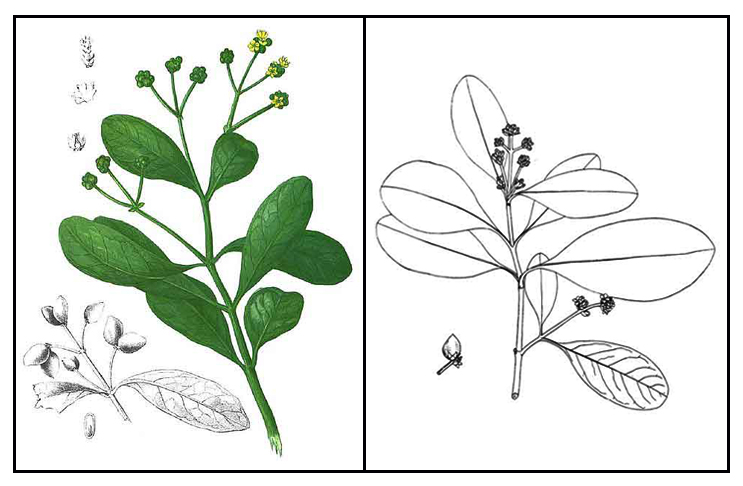
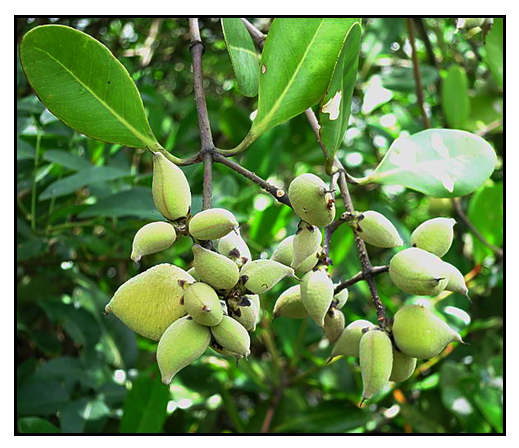
Api-api is a shrub or small tree reaching a height of 8 meters, often flowering when less than 1 meter high. Bark is light gray to brown, smooth but with small cracks. Leaves are leathery, opposite, dark green above and pale and hairy below, oblong-ovate to elliptic, 5 to 10 centimeters long, 2.5 to 5 centimeters broad, usually rounded at the apex and narrow at the base. Flowers are small, without individual stalks, appearing in small heads on stiff, angular and flowering stalks, occurring two together in the axils of the upper leaves, or several at the end of the branch. There are 3 to 7 flowers in each head. Corolla is orange-yellow, about 5 millimeters long, corolla tube being very short and cylindrical, with four lobes, 5 millimeters in length, hairy without and nearly smooth within. Calyx has five lobes, 2 to 8 millimeters long, hairy on the margins; and the lower part of the back is hairy and the rest, smooth. Fruit is an ovoid capsule, 2.5 to 4 centimeters long and contains a single seed which completely fills the capsule. Like other mangroves, the tree has numerous, leafless, blind, erect, conical root-suckers or air-roots, about 8 to 20 centimeters high.
Distribution
- Native to the Philippines.
-
In Quezon and Camarines Provinces in Luzon; and in Mindoro, Palawan, Samar, Negros and Mindanao, Along muddy seashores and tidal streams.
- Also native to Andaman Is., Bangladesh, Borneo, Cambodia, India, Jawa, Lesser Sunda Is., Malaya, Malukiu, Myanmar, New Guinea, New South Wales, Northern Territory, Queensland, Sri Lanka, Sulawesi, Sumatera, Thailand, Vietnam. (9)
Constituents
- Wood cortex yields a crystalline substance, lapachol.
- Phytochemical screening yielded alkaloids, triterpenes and tannins. Test yielded a triterpene, betulinic acid.
- Ethyl acetate extract of stem bark of A. officinalis yielded triterpenoids, betulinic acid, lupeol, and betulinaldehyde.
(10)
- Phytochemical screening of ethanol extract of leaves yielded
carbohydrates, reducing sugar, combined reducing sugar, glycosides, tannins, alkaloids, proteins, terpenoids, and flavonoids. (see study below) (14)
- Qualitative analysis of methanol leaf extract yielded protein, resin, steroids, tannins, glycosides, reducing sugar, carbohydrates, saponins, sterols, terpenoids, acidic compounds, phenol, cardioglycosides, catachol. GC-MS analysis of methanol extract of leaves yielded 3a,6-methano-3ah-inden-5-ol, octahydro and 26,26-Di(nor)-cholest-5,7,23-trien-22-ol, 3 methoxy.
(19)
- Study of leaves yielded compounds elucidated by NMR spectroscopy analysis: areaviridoid (1), (1S,5R,8S, 9R)-2'(E-coumaroyl)mussaenosidic acid (2), velutin (3),
α-tocopherol (4), and a mixture of 6-methoxynaphtho [2,3-b]-furan-4,9-quinone (6). (23)
Properties
- Bark is astringent and diuretic.
- Considered an aphrodisiac, cicatrizant.
- Studies have suggested anti-inflammatory, gastroprotective, antibacterial, antioxidant, anticancer, phytoremediative, antioxidant, antiarthritic, diuretic, immunomodulatory properties.
Parts used
Resin, seeds, bark.
Uses
Edibility
- In the Celebes, seeds, soaked in water overnight and boiled, used as famine food.
- In Celebes and Java, fruit sometimes eaten by fishermen.
- Bitter fruits and seeds sometimes used as food. Eater after baking or steaming.
Folkloric
- Resin from the sapwood used locally for snake bites.
- Seeds boiled in water used as maturative poultices and cicatrizant of ulcers.
- Fruits plastered on boils and tumors.
- Used for leprosy and hepatitis.
- In Arabia, roots used as aphrodisiac.
- Unripe seeds used as poultice to hasten suppuration of boils and abscesses.
- In Madras, used for small pox.
- In Java, resin oozing from the bark used as contraceptive.
- Bark used as diuretic.
- In Indo-China, bark used for skin afflictions, especially scabies.
- In India, used for rheumatism, paralysis, asthma, snake-bites, skin disease and ulcers. Fruits are used as plaster for tumors.
- In Sundarban, India, warm juice extracted from the screen fruits of the Jat Baine tree used in the treatment of sores or blisters.
- Plant decoction with sugar and cumin used in dyspepsia with acid eructations.
Others
- Fuel: Used for fuel in smoking fish, and as firewood.
- Wood: Used for cabinetry work and making rice mortars; used in building boats and houses.
-
Tar: Yields a wood-tar.
- Dye: In India, bark used as dyeing agent. Bark and roots used for tanning.
- Washing: In Madras, the ashes from the wood used for washing clothes.
- Fodder: Branches are lopped and given to cattle as fodder. (15)
Studies
• Anti-Ulcer / Gastroprotective / Leaves: Study of the plant extract of leaves of AO showed it was able to decrease the acidity and increase the mucosal defense in the gastric areas, justifying its use as an antiulcerogenic agent. (1) Study evaluated the anti-ulcer potential of methanol leaf extracts of Avicennia officinalis by two different models: ethanol hydrochloric acid induced and modified pyloric ligation in Wistar albino rats. Results showed significant (p<0.01) antiulcer activity by ulcer inhibition and decrease of the ulcer score in both models. (11)
• Antibacterial / Stems and Roots: Various extracts of stem and root of Avicennia officinalis were evaluated for antibacterial activity against E coli, Enterobacter aerogenes, K pneumonia, B subtilis, S aureus among others. Acetone extracts showed the best antibacterial activity. (2)
•Anti-Inflammatory / Leaves: Study investigated the anti-inflammatory activity of crude methanolic extract of A. officinalis leaves on acute, subacute, and chronic rat paw edema models. Results showed dose-dependent anti-inflammatory activity. Extract yielded a triterpene - betulinic acid - which may be responsible for the anti-inflammatory activity. (3)
• Anticancer / Leaves: Study investigated the anticancer activity of methanolic leaves extract on Ehrlich ascites carcinoma cell lines in rodents. The extract reversed the hematological changes induced by cell lines. Results showed highly significant dose-dependent cytotoxic effect. (4)
• Antioxidant / Radical Scavenging Effect / Leaves: Study of leaves extracts using in vitro assay systems showed antioxidative and free radical scavenging effect. (5)
• Phytoremediation Potential: Study evaluated the absorption, accumulation, and partitioning of Zn, Cu, Pb, Cr and Cd in Avicennia officinalis. Metal accumulation in roots was comparable to adjacent sediments. Metal concentration was lower in the bark, and lowest in the leaves. Results showed A. officinalis tend to exclude non-essential metals and regulate the uptake of essential metals. (6)
• Anti-Arthritic Activity / Free Radical Scavenging Effects: Study evaluated an aqueous extract of A. officinalis for lipid peroxidation inhibitory and anti-arthritic activities. Results showed free radical scavenging activity towards lipid peroxidation and DPPH radicals. AO also exhibited moderate anti-arthritic activity. The activities may be due to the total phenolic content. (7)
• Diuretic / Neuropharmacologic Activities / Leaves: Study evaluated crude methanolic extract of leaves for diuretic and neuropharmacologic activities. Neuropharmacologic effects were evidenced by potentiation of pentobarbital induced sleeping time in mice and findings in open field test, hole cross test, and hole board test. Diuretic activity was evidenced by electrolyte loss ratio with Na+/K+ excretion ration of 1.52 and 1.33 at doses of 200 and 400 mg/kg, respectively. (13)
• Antioxidant / Antibacterial / Analgesic
/ Leaves: Study evaluated the antioxidant and antibacterial activity of ethanol extract of Avicennia officinalis leaves. DPPH showed an IC50 of 160.92 µg/ml and total phenolic content of 208.57 mg GAE/100 g of dry powder. There was 18.75% and 51.88% (p<0.01) writhing inhibition at doses of 250 and 500 mg/kbw, respectively, in acetic-acid induced writhing model in Swiss albino mice. There was antibacterial activity against E. coli and S. typhi with MIC of 62.5 µg/ml and 125 µg/ml, respectively. (see constituents above) (14)
• Antidiabetic / Antioxidant / Leaves: Study of PE and aqueous extracts of leaves evaluated the antidiabetic activity activity by inhibition of carbohydrate metabolizing enzymes α-amylase and
α-glucosidase and antioxidant capacity by DPPH, superoxide and H2O2 scavenging activity. Results confirmed antidiabetic and radical scavenging effects of A. officinalis leaves extracts. (16)
• In-Vitro Immunomodulatory Effect / Leaves: Study evaluated the immunomodulatory activity of various extracts of powdered leaves Avicennia officinalis against autoimmune disease. Results showed the ethanolic extract and ethyl acetate extracts to have effective immunomodulatory effect via suppression of leukocytes and neutrophils. (17)
• Antibacterial / Leaves: Study evaluated leaf extracts of A. officinalis for antibacterial potential using five different solvents against strains of human pathogenic bacteria. The crude ethyl acetate extracts showed remarkable antibacterial activity with zones of inhibition of 13 mm against E. coli, 11 mm against S. aureus. Fraction 13 (EA:methanol= 8/2) showed most potent activity with MIC of 30 mm against E. coli and 25 mm against S. aureus. GC-MS analysis of active column fraction (F13) showed the active principals were a mixture of hydroxy-4 methoxybenzoic acid, diethyl phthlate, and oleic acid. (18)
• Potential against Main Protease of SARS-CoV-2: Study evaluated the potential effects of phytochemicals extracted from Avicennia officinalis against the main protease of SARS-CoV-2. The antioxidant activities of leaf and fruit extracts at 150 µg/mL were 95.97% and 92.48%, respectively. Both extracts displayed low cytotoxicity against Artemia salina. GC-MS analysis yielded 75 phytochemicals from both extracts, four potent compounds, triacontane, hexaconsane, methyl linoleate, and methyl palminoleate, with binding free energy values of -6.75, -6.7, -6.3, and -6.3 Kcal/mol, respectively, in complexes with SARS-CoV-2 main protease. The findings require in vitro and in vivo validation to ensure possible inhibitory effects and pharmacologic efficacy. (20)
• Carbohydrate Metabolizing Enzyme Inhibition / Antioxidant / Antimicrobial / Cytotoxic / Leaf and Bark: Study evaluated the carbohydrate metabolizing enzyme inhibitory, antioxidant, antimicrobial, and cytotoxic potentials of ethanol leaf and bark of extracts of A. officinalis. The extracts inhibited the activity of α-amylase and α-glucosidase in a dose dependent manner with IC50s of 0.66 and 0.71 mg/ml for bark extract and 0.29 and 1.19 mg/ml for the leaf extract. The ethanol bark extract showed scavenging potential against DPPH, ABTS, and superoxide radicals in a dose dependent manner. Both leaf and bark extracts exhibited dose dependent antiproliferative activity on TC1 murine cell lines. Both extracts also exhibited antimicrobial activity against B. subtilis, E. coli, P. aeruginosa and fungi C. albicans. (21)
• Antinociceptive / Leaves: Study evaluated a crude ethanol extract of leaves of Avicennia officinalis for antinociceptive activity in mice. The extract produced significant writhing inhibition in acetic acid-induced writhing in mice at oral doses of 250 and 500 mg/kbw (p<0.001) comparable to standard drug diclofenac sodium 25 mg/kbw. Results suggest antinociceptive activity of the extract. (22)
Availability
Wild-crafted.
|