|  Gen info Gen info
- Malvastrum is a genus of flowering plants in the Malvaceae family. The native range is the New World.
Botany
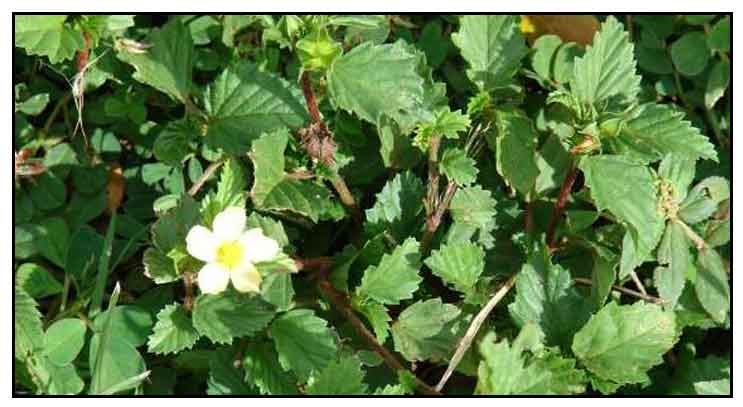
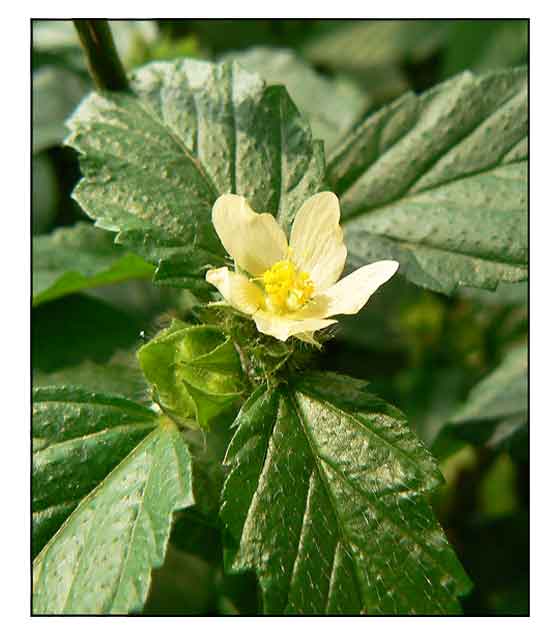
Babara is an erect, somewhat hairy, branched, half-woody perennial, about 1 meter high. Leaves are oblong to ovate-lanceolate, 2 to 5 centimeters long, with blunt tip, rounded base and irregularly toothed margins. Flowers are axillary and terminal. Calyx is green, about 7 millimeters long, with lanceolate and pointed lobes. Petals are yellow, about 8 millimeters long. Fruit has 8 to 12 reniform, compressed, hirsute carpels, 2 to 3 millimeters long, each carpel having 3 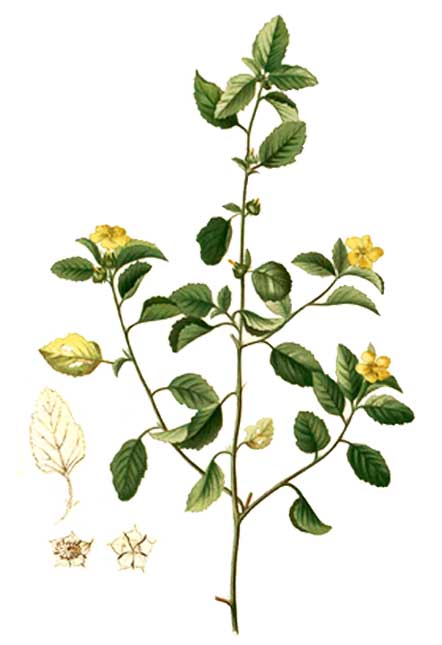 short, straight projections. short, straight projections.
Distribution
- Introduced.
-
A common weed in and about towns throughout the Philippines.
- Probably of American origin.
- Now pantropic.
- An invasive weed in many places.
Constituents
- Studies on whole plant have yielded bioactive compounds such as stigmasterol, lutein, phenylethylamine, indole alkaloids, fatty acids (palmitic, oleic, linoleic, and sterulic), etc.
-
Seed oil of MC contained palmitic acid (22.7%), palmitoleic acid (2.4%), stearic acid (2.7%), oleic acid (14.6%), linoleic acid (37%), malvalic acid (10.5%) and sterculic acid (10.1%).
- Phytochemical screening of leaves yielded
alkaloids, tannins, amino acid proteins, and carbohydrates, with appreciable amounts of phenolic and flavonoid contents. Petroleum ether extract yielded ß-sitosterol. (16)
- Study of leaves showed appreciable amounts of phenolic and flavonoid content, while HPTLC analysis showed the presence of ß-sitosterol in petroleum ether extract.
(24)
- Study of aerial parts for essential oil yielded 50 compounds representing 98.5% of the oil. Major constituents were palmitic acid (19.2%), hexahydrofarnesyl acetone (5.2%), linoleic acid (4.8%), ß-caryophyllene (3.5%), and cedren-8-en-15-ol (3.1%). (see study below)
(25)
Properties
- Studies have shown anti-inflammatory, antipyretic, analgesic, antibacterial, hypoglycemic, hypolipidemic, antiulcer, antimycobacterial antioxidant, wound healing, immunomodulatory, antifungal, antidiarrheal, anthelmintic properties.
Parts utilized
Leaves.
 Uses Uses
Folkloric
- Leaves used for carbuncles.
- In Mexico, decoction of leaves used to clean wounds; also used for dysentery.
- In Tanzania, used for wounds and sores; also used as diaphoretic.
- In the West Indies, plant is considered resolvent and emollient.
- In India, flowers used in cough and lung diseases. Leaves used for jaundice.
- Irulas of Tamil Nadu use the leaves and roots together with leaves of Sida acuta, ground into a paste and applied externally to blisters. (22)
-
In Thailand, used for diabetes.
- In Pakistan, decoction of dried rhizomes are used as tonic and for relief of muscular pain. Powdered rhizome used to for fever and diarrhea. (12) Decoction of flowers used to reduce fever; decoction of whole plant used to treat dysentery; poultice of leaves used to heal wounds. (36)
- In Jamaica, used for stomach pains. (17)
- In Western Ghats, Tamil Nadu, India, decoction of flowers and leaves used for dysentery and sores and as antidote.
(32)
Others
- Fiber: Bast can be twisted into rope or woven into handicrafts. Bast fiber can be extracted from the stem by retting for a week or more in stagnant water. It is lustrous, strong, and durable, creamy white; grayish-white in older stems. (37)
- Crafts: Stems used in making brooms.
Studies
• Antinociceptive / Aerial Parts:
Aerial parts of Malvastrum coramandelianum showed antinociceptive activity in acid-induced writhing test in mice. Effects are comparable with acetylsalicylic acid. (1) Study evaluated the antinociceptive property of hydroalcoholic extract of M. coromandelianum by tail-flick, hot-plate, and acetic acid induced writhing method in a rat model. The HEMC showed central analgesic action probably via inhibition of central pain receptors and peripheral analgesic effect probably mediated by prostaglandin inhibition. (20)
• Anti-Inflammatory / Analgesic: Study showed M coromandelianum water extract inhibited hind-paw edema induced by carrageenan and exhibited analgesic activity in the formalin test. (2)
• Anti-Staphylococcal / Aerial Parts: Study evaluated crude water extract of MC aerial parts for anti-Staphylococcus aureus activity against S. aureus ATCC 25923, SA ATCC29213 and clinical ioslat3s of MSSA and MRSA. Results suggest potential benefits as alternative remedy for Methicillin resistant Staphylococcus aureus. Although it did not show bactericidal activity to all tested strains of MSRA, the crude water extract showed inhibitory effect at considerable low concentration against most of the tested MSRA. (3)
• Antioxidant / Leaves: Various extracts of the leaf of three plants, M. coromandelianum, T. purpurea, and Clitorea ternatea, were tested for antioxidant potential. Screening suggested flavonoids. Leaves of all three plants exhibited antioxidant properties and can serve as free radical inhibitors or scavengers. M. coromandelianum was not as potent as the other two plants. (5)
• Antidiabetic / Antihyperlipidemic / Leaves: Study evaluated aqueous extracts of leaves of Malvastrum coromandelianum on alloxan-induced diabetic rats. Results showed antidiabetic activity with significant reduction in fasting blood glucose levels and antihyperlipidemic activity with normalization of lipid profile. (7)
• Chronic Toxicity Study: A chronic toxicity study of a water extract in Wistar rats at doses of 0.2 to 20 g/kbw per day for 60 days did not produce toxicity in the test animals. (8)
• Wound Healing / Ointment Formulation
: Study evaluated the effects of topical administration of an ethanolic extract of Malvastrum tricuspidatum ointment on two types of wound models in wistar rats. Results showed wound healing properties with faster epithelization and higher wound contraction in the incision model, and increase tensile strength in the incision model. (9)
• Antibacterial / Antifungal / Irritant: Study evaluated various extracts of Malva parviflora and Malvastrum coromandelianum for antibacterial, antifungal, and irritant activities. Results showed similar patterns of antibacterial activities against E. coli, and slight variations against Proteus vulgaris, Bacillus subtils, and Staphylococcus aureus, and the same activities against Aspergillus niger and A. oryzae. Application of hexane, chloroform and aqueous extracts on the inner surface of ear of male albino rabbits caused an irritant response. (10)
• Immunomodulatory: Study evaluated an ethanolic extract of whole plant in experimental models of immunity in Swiss albino mice. Results showed the extract to possess potential for augmenting immune activity by cellular and humoral mediated mechanisms. (11)
• Hypoglycemic: Study evaluated extracts and fractions of dried powder of M. coromandelianum for hypoglycemic activity in normal and alloxan-induced diabetic rats. At doses of 4 g/kbw, an MC-1 extract showed significant hypoglycemic activity in alloxan-induced diabetic rats. Other fractions failed to show hypoglycemic activity. (13)
• Antipyretic / Analgesic / Anti-Inflammatory: Study of an aqueous extract of whole plant and root of M. coromandelianum showed lowering of rabbit fever in fever induced by typhoid-paratyphoid vaccine, decreased mice writhing, inhibition of ear edema and decrease in permeability of blood capillary in abdominal cavity of mice. Results suggest antipyretic, analgesic, and anti-inflammatory effects. (14)
• Study of Glucose-Lowering Effect / No Efficacy / Clinical Trial: A double blind, randomized controlled trial evaluated the glucose-lowering efficacy of a water extract of M. coromandelianum in type 2 Diabetes patients. In this study, MC in dosage of 1,200 mg/day dose showed no glucose lowering efficacy in type 2 diabetes. (18)
• Antidiarrheal / Leaves: Study evaluated the in vivo antidiarrheal effect of ethanolic extract of leaves of M. tricuspidatum in rats, evaluated by castor oil, magnesium sulfate and charcoal. Results showed significant (p<0.05) activity against castor oil-induced diarrhea. It also inhibited magnesium sulfate induced enteropooling and significant reduction in gastrointestinal motility in charcoal meal test. (19)
• Anthelmintic
/ Leaves: Study evaluated a methanolic leaf extract for anthelmintic activity against Indian earthworm Pheretima posthuma and compared with standard drug Albendazole. Results showed significant anthelmintic effect with higher activity at higher concentrations. (21)
• Antibacterial / Cytotoxicity / Antioxidant
/ Essential Oil of Aerial Parts: Study evaluated the chemical composition, antibacterial, cytotoxic, and antioxidant activities of essential oil from aerial parts. GC/FID and GC/MS analysis identified 50 compounds, representing 98.5% of the oil. The essential oil exhibited significant antibacterial activity against S. aureus, B. subtilis, and E. coli with MICs of 0.156 mg/mL, 0.156 mg/mL, and 0.078 mg/mL, respectively. MTT assay showed moderate cytotoxic effect against HepG2 and MCF-7 cell lines with IC50s of 116.40 µg/mL and 120.27 µg/mL. The EO showed weak antioxidant effects by DPPH, ABTS, and FRAP assays. (see constituents above) (25)
• Arabinoxylan / Antioxidant / Leaves: Study isolated an alkali-soluble polysaccharide (MAP) from the leaves of M. coromandelianum. The MAP was found to be an arabinoxylan which also exhibited ferric ion reducing activity, with a reducing power of 0.914 ± 0.01 at 1 mg/mL concentration which showed dose dependent behavior. Results suggest the MAP may be utilized as a potential antioxidant. (26)
• Quercetrin and Trans-Tiliroside / Antioxidant: Study of methanol extract isolated two compounds characterized as tiliroside and quercetrin. The invitro IC50 values against DPPH for tiliroside, quercetrin, and extract were 60.40 ± 0.24, 68.05 — 0.36, and 71.98 ± 0.29 µg/mL, respectively.. Results suggest significant antioxidant activity. (27)
• Anti-Mycobacterial / Anti-Inflammatory: Study of crude leaf extracts isolated bioactive secondary metabolites. The ethyl acetate fraction showed the highest anti-mycobacterial and anti-inflammatory activities. Fractionation yielded apigenin-7-O-β-6″(p-coumaroyl)-glucopyranoside (1) and apigenin-8-C-glucopyranoside, vitexin (2). Both compounds showed interesting anti-mycobacterial activity against at least one Mycobacterium strain with MIC range of 0.03-0.25 mg/ml. Compounds showed anti-inflammatory activity with IC50s of 6.67 and 8.02 µg/ml, respectively. Results suggest possible lead compounds for anti-mycobacterial and anti-inflammatory products. (28)
• Antiulcer: Study investigated the antiulcer effect of various extracts of whole plant of Malvastrum tricuspidatum on ethanol-, aspirin-, cold-restraint stress-, and pylorus-ligation-induced gastric ulcer models in rats. The ethanol extract showed better ulcer protection in ethanol-induced ulcer model. The EE also showed concomitant attenuation of gastric secretory volume, free acidity, total acidity, and peptic activity in ulcerated rat. (29)
• Formulation of Film-Coated Tablets: Study reports on the preparation of film-coated tablets of high dose MCS by direct compression and pan coating techniques, with varying amounts of lactose cellulose, sodium starch glycolate, and fixed amounts of lubricants with 300 mg of MCS. The tablets had good appearance and met the requirement of compendia. (31)
• Anticancer: Study evaluated the possible anticancer mechanism of Malvastrum coromandelianum by tryphan blue exclusion method and ADME analysis on MCF-7 cell line. 5-fluorouracil was used as standard anticancer drug. In vitro results confirmed the anticancer activity of M. coromandelianum. Anticancer activity was attributed to possible anticancer activities of phytoconstituents i.e., palmitoleic acid, stearic acid, palmitic acid, linoleic acid, malvalic acid etc. All molecules demonstrated significant bioavailability and were BBB non-permeant (blood brain barrier). (33)
• Anthelmintic / Antibacterial / Leaves: Study evaluated M. coromandelianum leaves extract for anthelmintic activity against Indian earthworm Pheretima posthuma and antibacterial activity against gram-positive S. aureus, B. subtilis and gram-negative E. coli, P. aeruginosa, and P. putiida. Anthelmintic activity was seen at 100 mg/ml compared to standard albendazole at 10 mg. Maximum antibacterial activity was seen against S. aureus with 17 mm zone of inhibition, and 15 mm ZOI against P. aeruginosa and P. putida, compared to standard Gentamycin 25µg/ml. (34)
• Antibacterial Herbal Mouthwash: Study reports on an liquid herbal mouthwash found to reduce oral pathogens when combined with daily brushing and flossing. Ingredients consisted of 1g of Malvastrum coromadelianum, 0.5g of neem extract, 1g fennel extract, and clove powder were dissolved in 4 ml of water, filtered and made up to 10 ml. 0.5 ml of glycerin was added by continuous shaking, followed by the addition of 1gm of methyl paraben for preservation. The formulated mouthway was inoculated on plates of agar media and antibacterial potency tested against S. aureus and E. coli. (35)
Availability
- Cultivated.
- Dried whole plants in the cybermarket.
|


.jpg)