 Gen info Gen info
- Rhizophora is a genus of tropical mangrove trees, sometimes collectively called true mangroves.
- Etymology: The genus name Rhizophora derives from Greek words rhiza, meaning "root", and phoros, meaning "bearing", referring to the stilt-roots.
- There are eight bakauan species in the genus Rhizophora. Three are found in the Philippines: R. mucronata (bakauan babae), R. stylosa
(bakauan bato or bangkao), and
R. apiculata (bakauan lalaki). There may be a fourth, bakauan hybrid pula, first sighted by C. E, Yao in the Visayas in 1984.
Further sightings in Bohol confirmed a report by mangrove expert Fred Vande Vusse who believes the species could be Rhizophora x lamarckii, a sterile hybrid between bakauan lalaki and bakauan bato. (37)
Botany
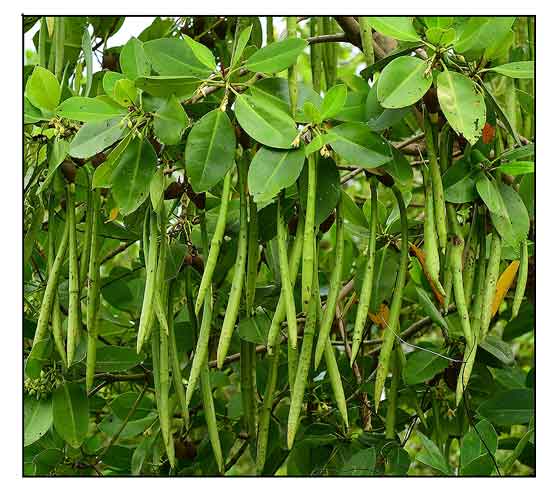
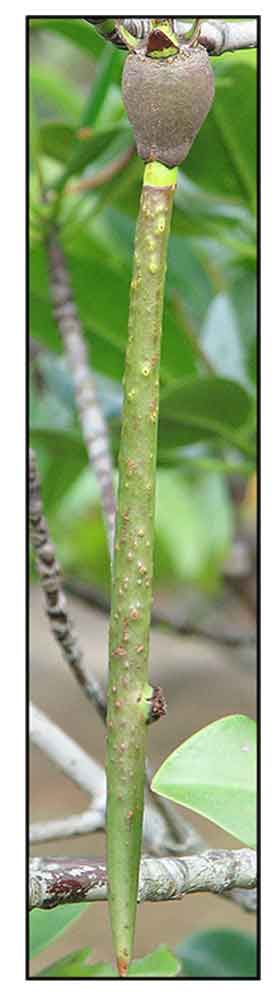
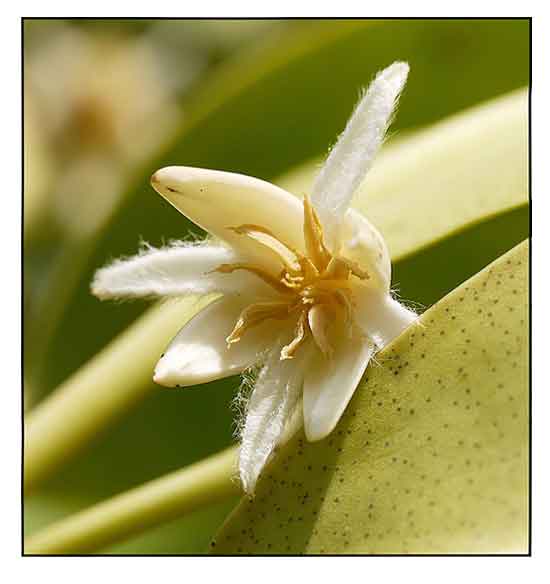
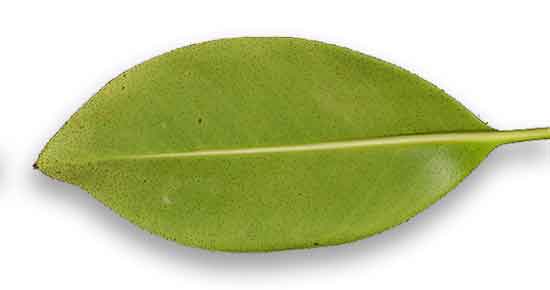
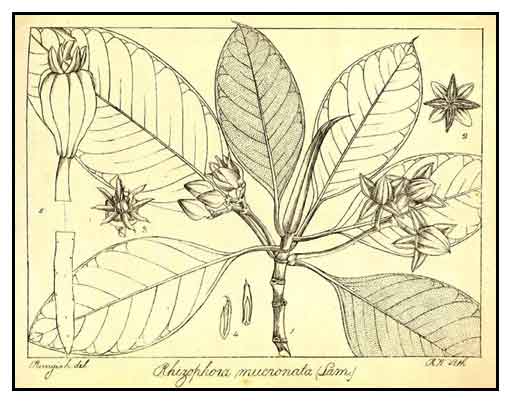
Bakauan-babae is a tree of the mangrove swamps growing up to 12 meters high, with numerous prop roots. Leaves are shining, oblong-elliptic, 8 to 16 centimeters long, 3.5 to 8 centimeters wide, and pointed at both ends. Cymes are axillary, 2.5 to 4 centimeters long, and bear 3 to 7 stalkless, white or cream-colored flowers. Fruit is ovoid, 3.5 to 5 centimeters long, pendulous, brown or olive colored, the persistent calyx-lobes are reflexed. Protruded radicle is green and cylindric, growing up 20 to 40 centimeters long before falling off the tree. Seeds often germinate while on the tree and crop as young plants into the mud below.
 Distribution Distribution
- Native to the Philippines.
-
In mangrove swamps throughout the Philippines.
- Also native to Andaman Is., Bangladesh, Borneo, Cambodia, India, Jawa, Lesser Sunda Is., Malaya, Maldives, Maluku, Myanmar, Nansei-shoto, New Guinea, Northern Territory, Pakistan, Queensland, Sri Lanka, Sulawesi, Sumatera, Taiwan, Thailand, Vietnam, etc.
- Natural habitat is estuaries, tidal creeks, and flat coastal areas subject to daily tidal flooding.
Constituents
- Bark yields tannin in variable amounts, 12.3 to 33.8 per cent.
- Leaves contain 9.13 % tannin; unripe fruit, 12 per cent; ripe fruit, 4.21 percent.
- Methanolic extract of leaves yielded flavonoids, together with gallic acid, quercetin, and coumarin. (see study below)
(7)
- Ethanol extract yielded saponins, tannins, flavonoids, phenols, and volatile oils, whereas the aqueous extract yielded tannin and phenols. (see study below) (9)
- GC-MS study of leaves yielded
alkaloids+. coumarins++, flavonoids++, saponins++, sterols and terpenes+, tannins+, and glycosides and carbohydrates+. with absence of anthraquinones. (12)
- In proximate analysis of plant parts, the leaf showed the highest moisture content (34%), followed by root (19.71%). Maximum amount of carbohydrate and chlorophyll was found in the leaf and minimum amount in the bark. Total phenolic content was 21.25, 16.10 and 26.02 mg equivalent to standard drug for leaf, root, and bark, respectively. Total flavonoid content showed 8.02, 3.62, and 14.07 for leaf, root, and bark, respectively. (13)
- The alkaloid-rich extracts yielded ajmalicine, vindoline, catharanthine, and serpentine as bioactive components. (see study below) (14)
- Study evaluated the pigment profiles of R. mucronata leaves by HPLC method and to computationally evaluated the antioxidant mechanisms of the pigments. HPLC yielded chlorophyll a (68.61%), chlorophyll b (27.69%). beta-carotene (14.05%), pheophytin a (8.72%), violaxanthin (5.19%), and neoxanthin (3.65%). (see study below) (25)
-
Phytochemical screening of leaves yielded: alkaloid ++++, tannin +, saponin +, phenolic ++++, flavonoid ++++, terpenoid ++++, steroid ++, glycosides ++++; root: alkaloid ++++. tannin +, saponin +, phenolic (-), flavonoid (-), terpenoid (-), steroid +, glycosides +; bark: alkaloid ++++. tannin ++++. saponin +++, phenolic ++++, flavonoid ++++. terpenoid ++++, steroid (-), glycosides +++; fruit: alkaloid +++, tannin ++, saponin ++, phenolic ++, flavonoid +, terpenoid+, steroid (-), glycosides ++; flower: alkaloid ++++, tannin +++, saponin +++, phenolic ++, flavonoid ++, terpenoid +, steroid (-), glycosdes +++. (35)
Properties
- Considered astringent, antiseptic, febrifuge.
- In Queensland, the honey which the native bees collect from the flowers is reported to be poisonous, probably endowed with some deleterious principle.
- Studies suggest antidiarrheal, antidiabetic, radical scavenging, antimicrobial, hepatoprotective, nephroprotective, anti-inflammatory, antiviral, anthelmintic, anticholinesterase, anticancer, anti-arthritic, antibacterial properties.
Parts used
Bark, leaves.
 Uses Uses
Edibility
- Fruit is bitter, occasionally eaten. Fruit is boiled, wood ashes added to neutralize the bitterness, and then baked. (8)
- In Indonesia, ripe fruit consumed by mangrove society.
- Juice can be extracted to make wine. Young shoots can be consumed as vegetable. (13)
Folkloric
- Bark used for hematuria.
- Bark also used for diabetes, angina, boils, fungal infections.
- Leaves and bark used as antiseptic; used for diarrhea, dysentery, fever, malaria and leprosy.
- Old leaves used as decoction at childbirth.
- Leaves also prescribed for fever.
- In India, bark used for diabetes.
- In Thailand, bark decoction used as astringent for diarrhea, nausea, and vomiting; also as antiseptic.
- In Indonesia, used for elephantiasis, fever, hematomas (bark), hepatitis (bark, flowers, fruit, leaves, roots), and ulcers (bark). (10)
 Others Others
- Timber: Used for construction, poles, pilings, and making fish traps. (13)
-
Fuel: Wood used as fuel; makes an excellent charcoal.
- Tar: Tar can be made from the wood.
- Tannin: Bark used for tanning and dyeing. The tannin yields a deep brown or black dye. Used by fishermen to toughen and dye lines, nets, and ropes. (9)
- Ash: Ash yields lime 18% and calcium carbonate 70%, and can be used as fertilizer. (9)
Studies
• Anti-Diarrheal: Bark extracts showed inhibition of castor oil-induced diarrhea and a very significant percentage inhibition of charcoal meal in mice. Results support the anti-diarrheal activity of Rhizophora mucronata bark. (1)
• Anti-HIV / Polysaccharide: Study extracted a polysaccharide from the bark of R. mucronata. Assessment in an in vitro culture system suggested the RM polysaccharide inhibited early steps of the virus life cycle especially virus adsorption to the cell. (2)
• Antidiabetic / Antiradical / Leaves: Study evaluated an 80% methanolic extract of leaves for antiradical and antidiabetic activities. Screening yielded flavonoids and gallic acid, quercetin, and coumarin. Results showed antiradical activities, reduction of blood glucose in type 2 diabetic rats and reduced formation of lipid peroxidation in the liver with enhancement of glutathione level in the liver. Findings suggest a source of natural antioxidants and potentialities for an antidiabetic agent by its hypoglycemic activity through antiradical action. (7)
 • Antibacterial / Leaves: In a study of mangrove leaf extracts for antibacterial activity, the ethanol extract of R. mucronata showed maximum zone of inhibition against S. aureus (16 mm) followed by Streptococcus sp. (12.3mm) and P. mirabilis (11mm). The activity of the ethanol extract of leaves may be attributed to the presence of saponins, tannins, flavonoids, phenols, and volatile oils. (9) • Antibacterial / Leaves: In a study of mangrove leaf extracts for antibacterial activity, the ethanol extract of R. mucronata showed maximum zone of inhibition against S. aureus (16 mm) followed by Streptococcus sp. (12.3mm) and P. mirabilis (11mm). The activity of the ethanol extract of leaves may be attributed to the presence of saponins, tannins, flavonoids, phenols, and volatile oils. (9)
• Fruit Flour as Functional Food and Antidiabetic: Study evaluated the potency of ripe R. mucronata fruit flour for reducing blood glucose level inn alloxan-induced diabetic rats. Results showed significant decline in blood glucose in positive control and experimental groups. At doses of 1000, 1500, and 2000 mg/kbw per day, the effect was similar to glibenclamide in reducing blood glucose level. Fruit flour potency may be related to phytoconstituents such as tannins, saponins, flavonoids, and steroid. Ripe fruit flour contained 7.50% soluble dietary fiber, 38.60% insoluble dietary fiber. Results suggest the fruit flour has potential as a functional food source, especially for diabetics. (10)
• Protective Role in STZ-Induced Diabetic Nephropathy / Leaves: Study evaluated the effects of R. mucronata leaves on streptozotocin generated oxidative stress induced diabetic nephropathy in Wistar rats. STZ treated rats showed increased LPO with decreased levels of SOD, CAT, and GSH. The leaf extract significantly improved all biochemical parameters and dose dependently acted as antioxidant to prevent oxidative damage in the diabetic kidney. (11)
• Antioxidant: R. mucronata plant parts demonstrated significant antioxidant properties by scavenging assay, reducing power assay, and total antioxidant capacity. The methanol extract of plant parts exhibited the highest phenolic and antioxidant potential. Results suggest potential as source of natural antioxidants. (13)
• Toxicological Evaluation of Hypocotyls Syrup: Rhizophora mucronata hypocotyls extract is known to be an antioxidant and hepatoprotector supplement syrup. This study evaluated its subacute toxicological profile with a 28-day repeated dose evaluation using Sprague Dawley rats. Results showed the hypocotyls ethanolic extract was safe in the 28-day repeated toxicity study. There were no significant differences in body weight, with no significant changes in blood chemistry parameters. (14)
• Anti-HIV Activity / GP120 Binding Inhibition: Study screened medicinal plants viz., Ocimum sanctum, Withania somnifera, Tinospora cordifolia, Avicennia officinalis, and Rhizophora mucronata for anti-
HIV activity. On Gp120 binding inhibition, R. mucronata petroleum ether, ethanol, and aqueous extracts showed 69.33 ± 0.22, 81.679 ± 0.13, and 60.11 ± 0.69 % inhibition, respectively. Heparin control (12.5 units) showed 75.96 ± 0.23% inhibition. Inhibition >50% is considered significant. (15)
• Antimicrobial / Radical Scavenging Effects / Alkaloid Rich Extract: Study focused on the isolation and quantification of alkaloid-rich extracts of R. mucronata and in vitro estimation of free radical scavenging potential and antimicrobial activity. The alkaloid-rich extracts yielded ajmalicine, vindoline, catharanthine, and serpentine as bioactive components. Antimicrobial study showed maximum zone of inhibition (19.56 ± 0.19) in Staphylococcus aureus isolated from a diabetic foot ulcer. (16)
• Anti-Inflammatory / Antioxidant / Leaves: Study evaluated the in vitro and in vivo anti-inflammatory activity of ethanolic extract of leaves of R. mucronata. Results showed the extract significantly scavenged free radicals and significantly inhibited nitrite accumulation in LPS stimulated RAW 264.7 macrophage cell line. The extract reduced rodent paw edema in acute and chronic inflammation models using Carrageenan acute and chronic induced and Freund's adjuvant induced chronic inflammatory animal models. (17)
• Hepatoprotective / CCl4 Toxicity: Study evaluated the hepatoprotective effect of bark, collar, hypocotyl and stilt root extracts of R. mucronata in a rat mode with carbon tetrachloride induced toxicity.. Of all extracts, the stilt root extract showed better hepatoprotective activity. Activity was dose-dependent, with significant reduction of enzyme and other biochemical parameters. Other than mild fatty changes in the liver, no histopathological alterations were noted. Phytochemical screening yielded flavonoids, alkaloids, coumarins, and polyphenols. DPPH, HR, NO, FRAP, LPO, and SOD radical scavenging assays showed IC50s of 58.33±2.87 µg/ml, 72.14±0.94 µg/ml, 25.79±0.93 µg/ml, 163.38±0.81 µg/ml, and 22.80±0.93 µg/ml, respectively. (18)
• Anthelmintic / Leaves: Study evaluated the in vitro anthelmintic activity of R. mucronata against Indian earthworm Pheretima posthuma. Fractions showed dose dependent anthelmintic activity
with efficacy similar to that of piperazine citrate. (19)
• Positive Regulation of Blood Glucose and Lipid Profile: Study assessed the effect of ethanolic leaf extract and dichlormethane and aqueous fractions in diabetic rats.
Phytochemical screening yielded alkaloids, flavonoids, and terpenoids. The dichlormethane fraction showed higher amounts of alkaloids than the ethanolic extract and aqueous fraction. DCM-F treated rats showed significant (p<0.01) reduction in blood glucose, serum cholesterol (p<0.05), and triglycerides (p<0.05), with increase (p<0.05) in HDL level. Results suggest the DCM-F has potential as an anti-hyperglycemic and antihyperlipidemic agent in diabetic rats. (20)
• Methoxycoumarin / Antidiabetic / Bark: Study isolated a coumarin from the bark of R. mucronata. The isolated compounds were identified as 7-methoxycoumarin, which was found to have antidiabetic activity. (21)
• Cytotoxic / Polyisoprenoids / WiDr Colon Cancer Cell Lines / Leaves: Study evaluated the cytotoxic effects of polyisoprenoids from Rhizophora mucronata and Ceriops tagal leaves in WiDr colon cancer cells. The polyisoprenoids from Rc and Ct leaves significantly induced apoptosis and caused cell cycle arrest in G0/G1 phase, while decreasing expression of Bcl-2 and cyclin D1. Results suggest potential for Rhizophora mucronata and Ceriops tagal leaves to be developed as anticancer agents for colon cancer. (22)
• Anticholinesterase / Antioxidant: Study evaluated the cholinesterase inhibitory potential and antioxidant activities of various extracts and fractions of R. mucronata leaves. The methanolic leaf extract (500 µg/ml) exhibited highest inhibitory activity against AChE (92.73±0.54%) BuChE (98.98±0.17%), with IC50s of 59.31±0.35 and 51.72±0.33 µg/ml, respectively. The methanol extract also exhibited highest antioxidant activity for DPPY, OH, NO radical, and hydrogen perioxide. Total polyphenolic and flavonoid contents in the methanol extract were 598.13±1.85 µg of gallic acid equivalent and 48.85 ±0.70 µg of rutin equivalent/mg of extract. The presence of high flavonoids, in particular catechin, may be responsible for its cholinesterase inhibitory and antioxidant activities. (23)
• Quinizarin / Antioxidant / Antibacterial / Anticancer: Study of methanolic crude extract yielded a bioactive compound, 1,4-dihydroanthraquinone, also termed Quinizarin. The compounds exhibited antibacterial, antioxidant, and cytotoxic activity. Quinizarin inhibited the growth of Bacillus cereus and Klebsiella aerogenes with MICs of 0.78 and 1.5 mg/ml. DPPH radical scavenging assay showed maximum activity of 99.8% at 200 µg/ml with IC50 of 12.67 µg/ml. Cytotoxicity assay against HeLa (cervical) and MDA-MB231 (breast) cancer cell lines showed IC50s of 4.60 and 3.89 µg/ml. Molecuular docking and dynamics simulation studies showed stronger binding affinity and significant structural stability towards anti-apoptotic Bcl-2 protein. Results suggest a promising role for Quinizarin in the formulation of therapeutic drugs against bacterial infections and cancer. (24)
• Pigment Profile / Antioxidant / Leaves: Study evaluated the pigment profiles of R. mucronata leaves by HPLC method and to computationally evaluated the antioxidant mechanisms of the pigments. HPLC yielded chlorophyll a (68.61%), chlorophyll b (27.69%). beta-carotene (14.05%), pheophytin a (8.72%), violaxanthin (5.19%), and neoxanthin (3.65%). Beta-carotene, lutein, neoxanthine and violaxanthin were predicted to have potential antioxidant properties. Neoxanthine and violaxanthin were predicted as free radical scavengers; beta-carotene as Nrf-2 stimulant. The leaf pigments interacted synergistically by activating antioxidant enzymes and inhibiting expression of oxidative stress proteins. The ethanol extract of leaves may be a potent antioxidant with IC50 20.99 µg/ml. (25)
• Dipeptidyl Peptidase IV (DPP IV) Inhibitors / Antidiabetic: DPP IV is responsible for the conversion of glucagon-like peptide-1 into inactive form, which would be beneficial in the treatment of diabetes. Study isolated and evaluated cystine, phenyl acetic acid, acrylamide, caprylone and oleic acid from R. mucronata inhibitory action on DPP IV inhibitors using in silico approach. Among the five compounds, cysteine showed inhibition with binding energy -5.89 kcal/mol, seven hydrogen bond interactions at residues VAL459, VAL 459, GLU408, GLU206, ARG358, GLU205 and SER209 to suppress the action of DPP IV protein. (26)
• Anti-Inflammatory / Anti-Arthritic / Leaves: Study evaluated the anti-arthritic property of Rhizophora mucronata using three methods viz., membrane stabilization, protein denaturation, and albumin denaturation assays. A methanolic extract showed strong anti-arthrtic activity at different concentration when compared to standard drug diclofenac sodium. Activity was attributed to phytoconstituents saponins, flavanoids, tannins, anthracene, phenols, amino acids and sugars. Further studies with in vivo models were suggested. (27)
• Diuretic / Antibacterial / Cytotoxic / Analgesic / Bark: Study evaluated ethanolic bark extracts for antibacterial, cytotoxic, analgesic, and diuretic activities. The extract showed moderate antibacterial activity against both Gram-positive and Gram-negative strains, with marked inhibitory effects against E. coli and S. epidermis at concentration of 500 µg/disc. Extract showed very high level of general toxicity in brine shrimp lethality bioassay with LC50 of 0.5 µg/mL. The bark extract at concentrations of 250 and 500 mg/kg exhibited significant (p<0.01) inhibition of writhing reflex by 36.96% and 50%, respectively, compared to diclofenac at 65/21% at 50 mg/kbw. The extract also showed dose dependent high diuretic response. (28)
• Hematological Effects / Leaves: Study evaluated the effects of fresh and dried leaves extracts of R. mucronata in experimental animal models. Results showed remarkable improvement in counts of RBC, WBC, platelet count, differential count, Hb, PCV, and levels of total protein, albumin, globulin, cholesterol and urea. There was a transient rise in liver enzymes with dried leaves. Fresh leaves yielded important phytoconstituents, such as carboxylic acids, flavonoids, proteins and amino acids, steroids, and tannins, which were more predominant in fresh than dried leaf extract. Fresh leaves also showed to be safe and non-toxic at dose of 500 mg/kg. (29)
• Silver Nanoparticles / Antibacterial and Antioxidant / Leaves: Study reports on the simple, safe, clean, and environmentally friendly biosynthesis of silver nanoparticles using a leaf extract as a bioreductor and capping agent. The AgNPs showed good antibacterial and antioxidant activity compared to the pure plant extract. (30)
• Analgesic / Leaves: An ethanolic extract of leaves at dose of 200 mg/kbw orally showed significant inhibition in acetic acid writhing response in mice. In hot plate method, there was increase in latency period. There was not significant result in tail immersion test. The leave extract was found safe up to 2 gm/kbw orally. The leaves extract was rich in tannin, flavonoids, polyphenols and possessed potential peripheral analgesic and mild central analgesic action. (31)
• Alpha-Ketoglutarate Dependent Dioxygenase FTO Inhibitors / Phenyl Acetic Acid / Anti-Obesity: Alpha-ketoglutarate dependent dioxygenase (AKDD) is an enzyme encoded by FTO gene correlated with obesity in humans. Study isolated and evaluated R. mucronata derived phytocompounds viz., cystine, phenyl acetic acid, acrylamide, caprylone and oleic acid from inhibitory action on AKDD using insilico method. Among the five compounds, phenyl acetic acid as as inhibitor with binding energy -5.42 kcal/mol, and suppress the action of obesity protein. (32)
• Anti-Neuro-Inflammatory / Alkaloids / Serpentine and Ajmalicine: Study evaluated the inhibitory effect of R. mucronata derived alkaloids such as ajmalicine, vindoline, catharanthine, serpentine, and tabersonin on COX2. Molecular docking studies showed serpentine and ajmalicine expressed higher binding energy, length of hydrogen bond, amino acid residues on COX2 receptor than other derivatives. Results suggest serpentine and ajmalicine may be a potent source of anti-neuro-infammatory agents. (33)
• Anticancer / Leaves and Stems: Study evaluated the anticancer effects of methanol extracts of leaves and stems. Major components from both leaves and stems were inositol (relative abundance of 33.67% and 27.59%. respectively) and 3-O-methyl-d-glucose ( RA 6.45% and 2.63%, respectively). The active constituents exhibited anticancer effects against colon cancer (CaCo-2) with IC50 158 and 107 µg/mL, respectively. No cytotoxicity was shown against normal cells (WI-38). (34)
Availability
Wild-crafted.
|




.jpg)