|
 Gen info Gen info
• Callistemon is a genus of shrubs in the family Myrtaceae, first described as a genus in 1814.
• Callistemon species have been commonly referred to as bottlebrushes due to their cylindrical, brush-like flowers that resemble a traditional bottle brush. (34)
• Melaleuca viminalis was first formally described in 1788 by Joseph Gaertner, who gave it the name Metrosideros viminalis in De Fructibus et Seminibus Plantarum. In 1984, Norman Brice Byrnes transfered the species to Melaleuca as M. viminalis in the journal Austrobaileya. (45)
• Etymology: The genus name Callistemon derives from two Greek words: 'callis" meaning beauty and 'stemon" meaning stamen, referring to the flowers of the plant. The genus was first formally described in 1814 by Robert Brown. (34) The genus name Melaleuca derives from Greek words melas (black) and leukos (white), referring to the dark bark and white stems. The specific epithet viminalis means "having long, slender twigs and branches". (45)
•
The genus Callistemon belongs to the family Myrtaceae, which consists of about 24 species characterized by cylindrical brush-like flowers resembling the traditional bottlebrush. (26)
Botany
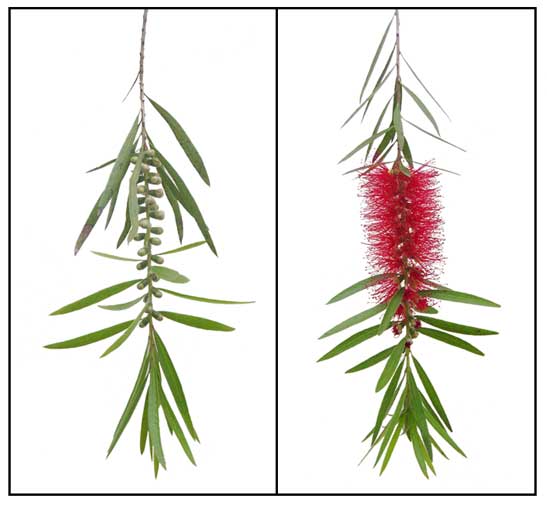
• Bottle brush is a shrub to a small tree, growing to a height of 5 meters, with numerous,
long, slender and drooping branches. Leaves are light green, narrow lanceolate,
up to 5 centimeters long. Spikes are 7- 8 centimeters long. Flowers are bright red in dense
cylindrical spikes.
• Growth form: A small tree, 6m-15m. Foliage: Leaves are 2-6 cm long, narrow lanceolate. Young flushes are slightly hairy. Flowers: Inflorescence 5-20cm x 3-6cm, terminal, bright red, comprising predominantly of showy stamens (see etymology). The stamens are fused together in a 'ring', are shed together as one unit. The leaves may continue to grow from the terminal apex of the inflorescence, so that the flowers appear as if "threaded" through the branches. Fruit: Dry, woody capsules; seeds are shed upon maturity. Special Note: Distinguishing characteristic - the seeds of this species are shed annually from the capsules and are not retained for many months as in most other species of Callistemon. (Flora & Fauna Web)
 • Melaleuca viminalis is a large shrub or small tree growing to 10 m (30 ft) tall with hard, fibrous, furrowed bark, a number of trunks and usually pendulous branches. Leaves are arranged alternately and are 25–138 mm (1–5 in) long, 3–27 mm (0.1–1 in) wide, more or less flat, very narrow elliptical to narrow egg-shaped with the narrower end towards the base and the other end tapering to a sharp point. Leaves have a mid-vein, 9-27 lateral veins and large number of conspicuous oil glands. Flowers are bright red and are arranged in spikes on and around the ends of branches that continue to grow after flowering. Spikes are 35–50 mm (1–2 in) in diameter and 40–100 mm (2–4 in) long with 15 to 50 individual flowers. The petals are 3.4–5.9 mm (0.1–0.2 in) long and fall off as the flower ages and the stamens are arranged in five bundles around the flower. The bundles are sometimes obscure but each contains 9 to 14 stamens. Flowering occurs from September to December and often sporadically throughout the year. Flowering is followed by fruit which are woody capsules, 3.8–4.8 mm (0.1–0.2 in) long and 5–6 mm (0.20–0.24 in) in diameter. (Wikipedia) • Melaleuca viminalis is a large shrub or small tree growing to 10 m (30 ft) tall with hard, fibrous, furrowed bark, a number of trunks and usually pendulous branches. Leaves are arranged alternately and are 25–138 mm (1–5 in) long, 3–27 mm (0.1–1 in) wide, more or less flat, very narrow elliptical to narrow egg-shaped with the narrower end towards the base and the other end tapering to a sharp point. Leaves have a mid-vein, 9-27 lateral veins and large number of conspicuous oil glands. Flowers are bright red and are arranged in spikes on and around the ends of branches that continue to grow after flowering. Spikes are 35–50 mm (1–2 in) in diameter and 40–100 mm (2–4 in) long with 15 to 50 individual flowers. The petals are 3.4–5.9 mm (0.1–0.2 in) long and fall off as the flower ages and the stamens are arranged in five bundles around the flower. The bundles are sometimes obscure but each contains 9 to 14 stamens. Flowering occurs from September to December and often sporadically throughout the year. Flowering is followed by fruit which are woody capsules, 3.8–4.8 mm (0.1–0.2 in) long and 5–6 mm (0.20–0.24 in) in diameter. (Wikipedia)
Distribution
- Widely cultivated in the Philippines.
- Grows well in Baguio City.
- Ornamental cultivation.
- Native to Australia.
 Constituents Constituents
- A study in India showed the leaves of
Callistemon viminalis yielded an oil: 1,8-Cineole (61.7%), -pinene (24.2%)
and methyl acetate (5.3%) were the major components.
- Study leaves for essential oil yielded 14 compounds, representing 98.94% of the total oil; the major components were 1,8-cineole (64.53%) and α-pinene (9.69%). (see study below) (11)
- GC-MS analysis of n-hexane extract
of Callistemon viminalis leaves yielded 40 compounds. Major compounds were 2,5,5,6,8a-pentamethyl-trans-4a,5,6,7,8,8a-hexahydro-gamma-chromene (27.60%), (10E,12E)-10,12-tetradecadienyl acetate (11.62%), Z-7-tetradecenal (4.98%), 1,3-cyclohexadiene (3.97%). (see study below) (9)
- Studies have the plant to be rich in phenolics, triterpenoids, flavonoids, saponins, steroids, alkaloids, tannin, carbohydrates, amino acids, and protein compounds. (26)
- Leaf essential oil yields 1,8-cineole (47.9% -82.0%) as the predominant constituent. (26)
- Methanolic extract of leaves isolated sic compounds for the first time, three are new flavonoids namely: 3-O-[α-L-arabinopyranosyl-(1->2)-α-L-arabinoyranosyl)]-3'-O-methylquercetin (1), 5,7,3',4' tetrahydroxy isoflavone-7-O-α-L-1C4-rhamnopyranosyl (1'''-6'')-O-ß-D-4C1-glucopyranoside (2) and 6-methyl-5,7-dihydroxy-4'-methoxyflavone (6) along with three known ones, hyperoside (3), rutin (4) and isoquercitrin (5). (see study below) (30)
- Study of fruits and bark isolated one new compound, 3,4-dihydro-2-(hydroxymethyl)4--methyl-2H-pyrrol-2-ol (5) along with known compounds lupeol (1),octacosanol (2), ß-sitosterol (3), betulin (4), betulinic acid (6), ursolic acid (7), corosolic acid (8), ß-sitosterol-3-O-ß-D-glucoside (9), methyl gallate (10), gallic acid (11), catechin (12), ellagic acid (13) and 3-O-acetylursolic acid. (14). (see study below) (31)
- Study for leave EO
from different sources yielded 1,8-cineol, α-pinene, α-terpineol, trans-geraniol, linalool, ß-pinene, pinocarveol, terpinen-4-ol, ß-myrcene, ∆-terpinene, and α-phellandrene. (35)
- GC/MS study of leaves for essential oil yielded 46 compounds with Eucalyptol (72.12) as main compound, followed by α-pinene (10.49), 3-cyclohexene-1-methanol, alpha-lapha,4-trimethyl-,(R)- (3.91), α-phellandrene (1.21), o-cymene (1.18) and n-hexadecanoic acid (1.18).
- Phytochemical screening of bottlebrush leaves collected in Nigeria yielded alkaloids, cardenolides, tannins, cardiac glycosiees, saponin and steroids, with absence of flavonoid, terpenoids, phenol, anthraquinones, and resins.
Mineral analysis showed massive amounts of calcium (4931.29 mg/kg), magnesium (4447.14 mg/kg), and potassium (1714.41 mg/kg). Zinc, iron, and manganese were detected in minimal amounts, 15.66, 287.70, and 51.90 mg/kg, respectively. (40)
Properties
• Considered antibacterial, antifungal, anthelmintic, hemostatic, diuretic.
• Studies have shown anthelmintic, anti-quorum sensing, insecticidal, anti-infective, antibacterial, molluscicidal, antioxidant, anti-sickling, anticancer, anti-inflammatory, antifeedant, antidiabetic, insecticidal, anti-leishmanial, cholinesterase inhibitory, antidiabetic, anti-platelet aggregation, wound healing, neuroprotective, synergism potential properties.
Parts utilized
Leaves, bark, essential oil.
 Uses Uses
Edibility
- Callistemon flowers were used as food source and traditional bush medicines by Australian aborigines. Flowers were sucked for nectar or used to make sweet drinks.
- Leaves used as tea substitute.
Folkloric
- No reported medicinal use in the Philippines.
- Used as diuretic and for relieving problems of the urinary tract. Used by women as douche to cleanse the genitourinary tract from excessive menstruation or mucosal discharge as leukorrhea. Used for urinary incontinence and bed-wetting in children. (10)
- In Jamaica, decoction used as "hot tea" treatment of gastroenteritis, diarrhea, and skin infections
(11)
- Used for treatment of cough and bronchitis.
- In China, used for making pills for treatment of hemorrhoids.
Others
- Insecticidal / Pesticidal: (see study below) (35) Fruit, bark, and leaves used as mollusicides against Biomphalria alexandria snails. (37) (41)
- Agroforestry: Used for windbreak plantings, degraded land reclamation. Used as bioindicator for environmental management. (37)
Studies
• Anti-quorum
sensing: Bacterial
intercellular communication or quorum sensing (QS) is believed to control
the pathogenesis of many bacterial organisms. C. viminalis is one of
several plants studied that showed to possess anti-QS activity, a potential
new direction for the treatment of bacterial infections. (3)Extracts of plants, including C viminalis, caused the inhibition of QS genes and QS-controlled factors with marginal effects on bacterial growth, suggesting the quorum-quenching mechanisms are unrelated to static or cidal effects. (7)
• Anthelmintic
activity: In veterinary studies: The anthelmintic
activity of the essential oils of Callistemon viminalis against earthworms
and tapeworms has revealed it to exhibit in vitro efficacy better than
piperazine phosphate. The activity of these oils against hookworms was
comparable to that of hexyl resorcinol (Garg & Kasera, 1982).
• Insecticidal:
Study yielded two novel epimeric compounds,
viminadione A and viminadione B, Viminadione A exhibited moderate insecticidal
activity. (5)
•
Anti-infective:
One of three plants screened for inhibition of opportunistic
human pathogen Pseudomonas aeruginosa that showed reduction in toxin
production and mortality and suggests a potential for anti-infective
development. (6)
•
Chemical
Composition / Antibacterial:
Study on chemical composition and antibacterial activity yielded
12 components from the leaves of CV. The major components were 1,8-cineole
and a-pinene. The oils exhibited inhibition against S faecalis, S aureus,
B cereus, S marcesens.
• Antioxidant / Hemolytic Effect / Essential Oil / Leaves: Study investigated the antioxidant potential and oil composition of leaves. A n-hexane extract yielded 40 compounds, with appreciable levels of total phenolic contents (0.27-0.85 GAE mg/g) and total flavonoid contents (2.25-7.96 CE mg/g). A methanolic extract exhibited higher TPC and TFC and scavenging power on DPPH assay. Hemolytic effect of the leaves was found in the range of 1.79-4.95%. (see constituents above) (9)
• Antibacterial / Leaves: Study evaluated water and alcoholic extracts of leaves of C. viminalis in vitro against ten pathogenic bacteria. Results showed antibacterial activity against both Gram positive (Staphylococcus aureus, S. epidermis, Streptococcus pneumonia) and Gram negative bacteria (Klebsiella pneumonia, K. oxytaci, Proteus vulgaris, Escherichia coli). (10)
• Essential Oil from Leaves / Antibacterial / Antioxidant: Study evaluated leaves for antibacterial and antioxidant activities. Essential oil of leaves yielded 14 compounds. Leaf essential oil exhibited the highest antioxidant activity comparable to gallic acid as standard. Essential oil also showed the highest zone of bacterial inhibition compared to standard tetracycline. Crude methanol extract and EA fraction showed significant antibacterial activity. (see constituents above) (11)
• Antimicrobial: Various extracts were tested against eight common bacteria and one fungus. All plant extracts sowed antimicrobial activities against the selected microorganisms; the methanol extract was most effective. The aqueous extract was effective as bactericidal agent against intestinal pathogens. (12)
• Molluscicidal: Methanol extracts of C. viminalis bark and leaves were tested for molluscicidal activity against the vector of schistosomiasis, B. alexandrina snails. C. viminalis fruit extract showed the highest effect against the tested snails. The site of action of all tested extracts was localized in the digestive system and hermaphrodite gland. (13)
• Betulinic Acid / Anti-Platelet Aggregation: Betulinic acid isolated from Callistemon viminalis in combination with oleanolic acid from Syzygium aromaticum showed significant platelet inhibitory activity on epinephrine-induced platelet aggregation. (14)
• Molluscicidal Activity
/ Fruit, Bark and Leaves: Study evaluated methanol extracts of C. viminalis fruits, bark and leaves for molluscicidal activity. Fruits, bark, and leaves showed LC50 of 6.2, 32, and 40 ppm, respectively. Fruit extract showed the highest effect against the tested snails. (16)
• Anti-Drepanocytosic Activity / Anti-Sickling: In a study of various plants for anti-drepanocytosic, ethyl acetate crude extracts of C. viminalis showed high antisickling activity. The anti-sickling activity of studied extracts was attributed to betulinic acid, betulinic acid acetate, oleanolic acid, and maslinic acid. (17)
• Antioxidant /
Anticancer Activity / Leaves: Study identified antioxidant and anticancer compounds in C. viminalis leaf extracts and its anticancer activity against liver cancer cell lines by inhibiting STAT3 protein. (18)
• Silver Dimer Nanoparticles
/ Antibacterial: Study reports on the use of aqueous extract of C. viminalis leaves as bioreductant for the synthesis of silver nanoparticles. The antibacterial activity of extract reduced nanoparticles showed antibacterial activity against four strains viz. E. coli, S. aureus, K. pneumonia and S. typhimurium. (19)
• Callistemenonone A / Antimicrobial / Leaves: Study isolated a new acyphloroglucinol including an unprecedented dearomatic dibenzofuran core, callistemenonone A, from the leaves of C. viminalis. The potent exerted potent bactericidal activity against a panel of methicillin resistance pathogenic microbes. (20)
• Anti-Inflammatory / Anticancer / DOR and FT Inhibitors: DOR (delta-opioid receptors) and FT (farnesyl transferase) inhibitors can obstruct various intracellular pathways affecting inflammation and cell proliferation. Study reports on the in-silico studies of anti-inflammatory and anti-cancerous properties of C. viminalis derived natural compounds viz. α-terpineol, catechin, methyl gallate and ellagic acid. These compounds have shown excellent binding energy and inhibitory constant for DOR and FT. (21)
• Inhibitory Effect on Non-Small Cell Lung Adenocarcinoma / Leaves: Study evaluated the inhibitory effect of C. viminalis crude leaf extract against A549 non-small cell lung adenocarcinoma. All concentrations of the leaf extract inhibited A549 non-small cell lung adenoCA with an IC50 of 23.21 µg/ml with percent inhibition proportional to extract concentration. (22)
• Bunsenite NiO Nanoparticles: Study reports on P-type Bunsenite NiO powders produced via biosynthesis and heat treatment using aqueous extracts from red flowers of C. viminalis. Results suggest a cost effective and environmentally friendly alternative to preparing Nickel oxide nanosized powders with potential for a variety of energy storage applications. (23)
• NiO Nanoparticles / Pseudocapacitor Applications / Flowers: Study reports on a cost-effective and environmentally friendly method of Nickel oxide nanoparticles synthesis using aqueous extracts of flowers from Callistemon viminalis, with potential for a variety of energy storage applications. (24)
• Larvicidal / Repellent / Essential Oil from Leaves: Study evaluated the insecticidal, larvicidal and repellent activity of essential oils from Callistemon viminalis, M. leucadendron, and H. suaveolenss against Chrysodeixis chalcitesss and compared it to neem oil. The essential oil from leaves showed higher biological activity than neem with 100% larval mortality at 2 µg/ml for 6 h. (25)
• Acylphloroglucinols / Callistenones / Leaves: Study of leaves isolated 11 acylphloroglucinols, including six new ones named callistenones F-K (1-6), along with five known congeners. All isolated compounds were evaluated for in vitro antimicrobial activity and growth inhibitory activity against four tumor cell lines (MCF-7, NCI-H460. SF-268, and HepG2. (27)
• Anti-Breast Cancer / Antiangiogenic / Antioxidant / Leaves: Study evaluated the anti-breast cancer. antiangiogenic, and antioxidant potential of of methanol extracts of leaves of Cassia occidentalis, Callistemon viminalis, Cleome viscosa, and Mimosa hamata. All the extracts exhibited cytotoxic activity against human breast cancer cell line MCF-7, with C. viminalis IC50 of 44 ± 0.19 µg/ml. In the CAM model, all extracts exhibited significant antiangiogenic activity by inhibiting blood vessel density, with most efficient activity exhibited by C. viminalis (67.76 ± 0.77%). All plants showed considerable antioxidant activity. (28)
• Hematite Iron Oxide Nanoparticles / Biologic Activities: Study reports on the use of aqueous floral extracts for the synthesis of Fe2O3 nanoparticles. The magnetic nature of the bio-inspired IONPs were revealed by superconducting quantum interference device. Antibacterial potential was evaluated against pathogenic gram positive and gram negative bacteria using disc diffusion method. The IONPs were highly effective against HepG3 cells (IC50=20 µg/mL). There was also moderate antileishmanial activity against promastigote and amastigote cultures. Moderate acetylcholinesterase (AchE), butyrylcholin-esterase (BchE) and α-glucosidase inhibition were reported. Results showed the biogenic and magnetic Fe2O3 can be used for diverse biomedical applications. (29)
• Cytotoxicity / Hepatocellular Carcinoma / Leaves: Study isolated new compounds from methanol extract of leaves and evaluated them for cytotoxic and hepatoprotective potentials. The methanolic extract showed strong cytotoxic activity against hepatocellular carcinoma cells (HepG2 cell line) and weak hepatoprotective effect. (see constituents above) (30)
• Antioxidant / Fruits and Bark: Study of fruits and bark isolated one new compound, 3,4-dihydro-2-(hydroxymethyl) 4-methyl-2H-pyrrol-2-ol (5) along with 13 known compounds. Total extracts, petroleum ether, CH2Cl2 and EtOAc fractions along with compounds 6, 7, 9, 10, 11, 12, and 13 showed antioxidant activity comparable with standard antioxidant, ascorbic acid. (see constituents above) (31)
• Antidiabetic / Sucrase Inhibitory Activity / Leaves: Study evaluated the antidiabetic activity of leaves extracts of five Callistemon bottle brush plants i.e. Callistemon lanceolatus, C. rigidus, C. viminalis, C. comboynensis, and C. viridiflorus using Sucrase enzyme inhibitory activity. C. rigidus decreased the activity of sucrase enzyme by 63.05 ±3.43 followed by C. viminalis at 61.21 ± 3.65. Both untreated and heat-treated aqueous bottlebrush extracts significantly inhibited sucrase enzyme. The activity was attributed several factors or mechanisms i.e., fiber or polyphenolic concentration.
The
sucrase inhibitory activity may be due to the presence of flavonoid diglycosides hydrolyzable tannins. (32)
• Antifeedant Activity / Flour Beetle Tribolium confusum: Study evaluated the antifeedant activity of Eucalyptus camaldulensis and Callistemon viminais plant essential oil against flour beetle, Tribolium confusum. Results showed the essential oil of E. camaldulensis and C. viminalis may potentially provide novel antifeedant activity to effectively control T. confusum along with minimum hazards for human. (33)
• Insecticidal / Essential Oil: Fumignat and contact toxicity of 'EO of leaves and its aromatized clay powder was tested against adults of Acanthoscelides obtectus and Callosobruchus maculatus. Cm was found more susceptible to vapors of th4 EO, while Ao was more susceptible to contact. Toxicity was attributed to viminadione A and viminadione B isolated from the aerial parts. Viminadione A exhibited more insecticidal property. (35)
• Antioxidant / Anti-Inflammatory / Anticancer / Aerial Parts: Study of 80% aqueous methanolic extract of aerial parts (AME) isolated 5 new compounds viz., kaempferol 3-O-(4″-galloyl)-β-d-glucopyranosyl-(1‴→6″)-O-β-d-glucopyranoside (1), kaempferol 3-O-β-d-mannuronopyranoside (2), kaempferol 3-O-β-d-mannopyranoside (3), quercetin 3-O-β-d-mannuronopyranoside (4), 2, 3 (S)- hexahydroxydiphenoyl]-d-glucose (5) along with 15 known compounds. The AMEand compounds exhibited similar or better antioxidant activities by DPPH and NO inhibition assays compared to vitamin C. Compounds 4, 7, and 16 showed cytotoxic activity against MCF-7 cell lines while 3, 7, and 16 showed strong activity against HepG2. In silico analysis using molecular docking for polyphenolic compounds 2, 3, 7, 16, and 17 occupied the 5-LOX active site with binding affinity greater than ascorbic acid or quercetin. Results suggest potential of the AME as source of polyphenols, which can be used against oxidative-stress-related disorders. (36)
• Wound Healing / Leaves: Study evaluated the wound healing activity of ointment formulations from extracts of branches, flowers, fruits, bark and leaves in excision wound models in rats. Results showed wound healing ability in measures of epithelization time, greater traction intensity, and tensile strength. (38)
• Neuroprotective in Alzheimer's Disease / Leaves: Amyloid beta plaques and neurofibrillary tangles are seen in the hippocampus and cerebral cortex region causing neurodegeneration in AD. C. viminalis possesses various chemicals such as ellagic acid, gallic acid, corosolic acid, ß-sitosterol, lupeol, betulin, and betulinic acid that acts on various pathways of AD, mainly on Aß generation in the brain. Studies confirming their presence along with preclinical studies on mice and conclusive results in the treatment of AD suggests its neuroprotective effect. (39) (Also see: 43)
• Phytochemical and Nutrient Content / Leaves: Phytochemical screening of bottlebrush leaves reveals a good source of antioxidants, nutritional, minerak and medicinal elements. (see constituents above) (40)
• Insecticidal / Antifunga / Essential Oils from Leaves and Flowers: Study evaluated the EO composition of leaves and flowers of C. viminalis and their insecticide and fungitoxic activities. Principal components of EO from leaves and flowers were eucalyptol (84.60% and 61.47%), α-pinene (1028% and 21.48%), and α-terpinol (2.59% and 2.79%), respectively. The 5% concentration of flower EO influenced the preference of aphids and their reproductions, while EO from leaves decreased the number of aphids within 48 hours. Both EOs showed no inhibition of A. alternate mycelial growth; while growth of F. oxysporum and B. cinerea was inhibited. Results presented insecticidal and antifungal potentials. (41)
• Antibacterial / Antibiotic Synergism / Urinary Pathogens / Leaves: Study evaluated the interaction effects of pharmaceutical and antibacterial activity of methanol extracts of dried leaves of C. viminalis on various bacteria that cause urinary tract infections. Per agar disc diffusion, highest zone of inhibition diameter was seen with 500 µg/ml to S. epidermis and minimum ZOI with E. coli. MIC results showed highest inhibitory effect with S. saprophyticus and S. epidermis. The extracts showed synergistic effects with vancomycin and ciprofloxacin on S. aureus and S. epidermis, P. vulgaris, and K. pneumonia. (42)
• Neuroprotective in Aluminum-Induced Alzheimer Dementia: Study evaluated the neuroprotective effect of methanol extract of C. viminalis in aluminium chloride induced dementia of Alzheimer-type in Swiss albino mice. TLC yielded betulinic acid, ursolic acid, ß-sitosterol, and lupeol, which have a potent role as antioxidant and known to improve blood flow and reduce plaque formation. Oral administration of ME (50 and 100 mg/kg) showed significant decrease (p<0.01) in AChE and nitrite level and significant (p<0.01) increase in GSH, catalase and SOD level in mice brain. Histopathology of hippocampus and cerebral cortex of mice brain showed markedly reduced toxicity changes induced by MECV. There was preservation of the normal histoarchitecture pattern of the cortex and hippocampus. Results showed neuroprotective effects. (43)
Availability
- Cultivated.
|