|
Botany
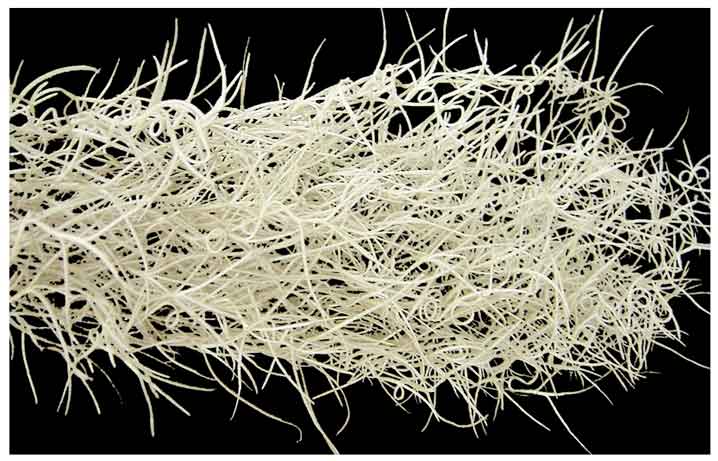
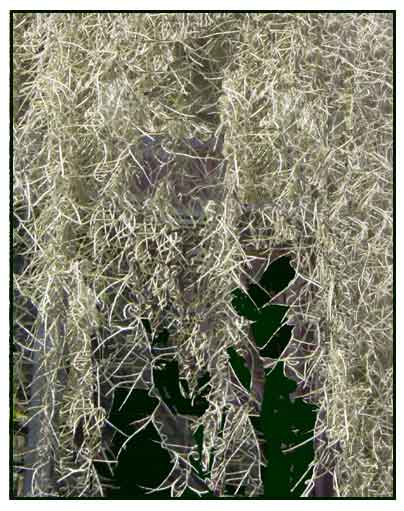
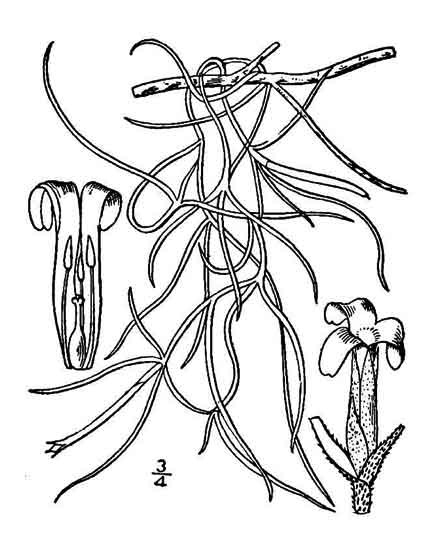
Buhok ni Ester is an epiphytic bromeliad with silvery gray,
threadlike and hanging festoons, growing 2 meters or longer, sometimes as longer than 20 meters, hanging on tree limbs, cliffs, and wires. Leaves are scattered,
narrow-linear, up to 7 centimeters long. Flowers are small, solitary in the leaf
axils.
 More botanical info More botanical info
From: A Study of Tillandsia Usneoides by Frederick H. Billings / Botanical Gazette, Vol. 38, No. 2, Aug., 1904: Tillandsia usneoides is the most widely distributed representative of the tropical and subtropical family Bromeliaceae. If provides a conspicuous and characteristic landscape feature. Its growth on ornamental trees is regarded with concern because of the common impression that it lives parastically. Exam reveals it is in no way connected to the tree but merely wraps its dead, wiry stems around the twigs in order to support itself. . . An indirect cause of the popular belief in its parasitism is its preference for sunny exposures. Many a cultivated tree in perfectly healthy condition possesses too dense foliage to serve as host for Tillandsia, but if the supply of leaves is reduced, the light conditions make the presence of the epiphyte possible, which might suggest to the owner that the moss is cause rather than the result of reduced foliage.
Distribution
- Ornamental cultivation,
preferring warm climates with high humidity.
Constituents
• Studies have yielded cyclopropane-containing
triterpenes and a flavone glycoside.
• Phytochemical testing yielded cycloarterenol, 4,5-dihydroxy-3',7-demthoxyflavanone and a mixture of steroids stigmasterol, ß-sitosterol and campesterol.
• Extract of Tillandsia usneoides yielded 26 cycloartane derivatives, including the following novel ones: (22E)-25,26,27-trisnor-3-oxocycloart-22-en-24-al, (24E)-3-oxocycloart-24-en-26-al, 24-hydroxycycloart-25-en-3-one, (23E)-25-methoxycycloart-23-en-3-one, (23E)-25-hydroperoxycycloart-23-en-3-one, 25,26,27-trisnor-24-hydroxycycloartan-3-one, methyl (24E)-26-carboxy-3,4-seco-cycloart-4(29),24-dien-3-oate, methyl (23E)-25-hydroxy-3,4-seco-cycloart-23-en-3-oate, methyl (23E)-25-methoxy-3,4-seco-cycloart-23-en-3-oate, and methyl 24-hydroxy-3,4-seco-cycloart-25-en-3-oate. (15)
 Properties Properties
• Air purifying, analgesic.
• Considered highly flammable, which makes it undesirable as a household plant or as outdoor plant in areas prone to wildfires. An additional risk is that when burned it generates methane which in itself if flammable.
Parts used
Roots and stems.
Uses
Folkloric
• No reported folkloric medicinal use in the Philippines.
• In south Louisiana,
has been reportedly used for the treatment of diabetes mellitus.
• In Bahia, Brazil, decoction of the whole plant, "Sambambaia," is used for sexual weakness.
• In the Guianas, whole plant used to strengthen and make the hair more attractive. Surinam Arawak steep the plant in hot water until decompossed, and use the liquid to wash their hair to achieve a glossy shine. In the French Guiana juice of a tillandsia used to treat rheumatism.(19)
Others
• Bioindicator: Studies have shown it is a particularly reliable indicator of metal pollutants in the air.
• Fiber: Yields a tough, elastic fiber from the non-living vascular tissues of the stem.
• Gardening: Also used as mulch, handicraft, and decorative handicraft.
• Stuffing: Entire plant use as packing material. Cured stems use as stuffing material for furniture, cushions, etc. (13)
- Others: Used as insulation. Mixed with clay to strengthen plaster. Used to skim scum off cooking liquids. Fiber woven into floor mats, to make string, rope and sacks. Makes an excellent mulch. (14)
Studies
• Anti-Diabetic:
Extracts of Tillandsia usneoides have been found to reduce blood
sugars in lab animals, an effect attributed to the compound HMG (3-hydroxy-3-methylglutaric
acid). (3) Study yielded four bioactive compounds, including HMG. HMG
elicited significant hypoglycemic responses in fasting normal mice.
Further evaluation of HMG and other potential HMGCoA lyase, for diabetes
treatment is suggested. (3)
• Biomonitor
/ Air Pollution: Neutron activation analysis applied
to the determination of elements in the epiphytic bromeliad T. usneoides
exposed in different polluted sites showed an accumulation of elements
and indicated a promising potential of the species to serve as a biomonitor
of air pollution.
• Analgesic:
Aqueous ethanol extracts of 17 medicinal plants in Brazil were studied
for analgesic properties in mice by the writhing and tail flick method.
Significant effects were noted in five plants, including Tillandsia
usneoides. (2)
• Antiedematogenic / Toxicity: Study showed an antiedematogenic effect and potent antioxidant activity.
No toxicity was reported. (5)
• Pharmacologic Activities / Antibacterial / Estrogenic: Old studies have
showed a weak antibacterial effect and estrogenic activities.
• Air Pollution Biological Monitor: Study results showed T. usneoides incorporates anthropogenic elements reaching max levels after 6 to 10 weeks. Results from biomonitors agree with those from aerosol filters, and suggests T. usneoides can be employed a first approximation for insights on atmospheric pollution levels prior to a detailed study using filters. (9)
• Flavonoid / Weak Antibacterial: Study isolated a flavonol type glycoside with weak antibacterial action against Staphylococcus aureus. (12)
• Monitoring of Strontium Environmental Pollution: Tillandsia species are known to be efficient biomonitors of air pollution. Study showed Tillandsia usneoides has considerable potential for monitoring Sr polluted environments through direct plant measurement for Sr contents or exploiting the leaf relative conductivity as indirect biomarker. (16)
• Trace Elements / Biomonitor Potential: Neutron activation analysis of epiphytic bromeliad Tillandsia usneoides for trace elements inn exposed polluted areas showed an accumulation of Al, As, Cr, Fe, Mo, Sb, Ti, V, and Zn. Results suggest promising potential as biomonitor of air pollution in Sao Paulo. (17)
• Antibacterial in Skin Infections and Wound Healing: Study evaluated the antimicrobial efficacy of various extracts of Tillandsia usneoides against skin infections in wound healing.
Antibacterial assay showed high zone of inhibition for both methanolic extract (>23mm, >22mm, and >20mm) and ethanolic extract (>22mm, >22mm, and >17mm) for P. aeruginosa, S. aureus, and S. epidermis, respectively. Results suggest the methanolic extract of T. usneoides has great potential for antimicrobial and wound healing activity. (18)
• Biomonitor for Vehicular Pollution: Study evaluated T. usneoides as biomonitor aimed at verifying the effects of highway construction and its effect of atmospheric contamination. Results showed increasing concentrations of Ba, Cr and Z in the biomonitor after the inauguration of highways indicating that these elements originated from vehicular emissions. (19)
• Radiation Contamination and Remediation: Study showed T. useneoides was tolerated to high radionuclide Cs stress. With enhancement of Cs solution concentration, Cs concentration significantly increased in the plants, suggesting that plants can accumulate Cs quickly and effectively. Results show T. useneoides has significant potential for monitoring Cs-polluted environments. (21) Availability
Wildcrafted. |