|   Gen info Gen info
- Corypha is a genus of palms in the family Arecaceae. All species are monocarpic and die after flowering.
-
Corypha elata (silag) is a palm that is the source of three kinds of fibers, namely: buri, raffia, and buntal.
- Like all Corypha, the tree is relatively slow growing, taking many years to form a trunk, and only flowers towards the end of its lifetime, at which time it sends up a massive inflorescence up to 5 meters high, with up to one million flowers.
- The production of buntal fiber in the Philippines started in Sariaya and Tayabas, Quezon, while the buntal hat weaving industry began in Baliuag, Bulacan during the pre-war years. The Philippines was considered a major exporter of the buntal fiber. The international market demand
resulted in supply shortage in the domestic market. To support and protect the then booming local hat weaving industry, Republic Act No. 4666, the Buntal Export Total Ban Law was passed in 1967. (20)
- Taxonomy and nomenclature conflicts: Some sites publish Corypha utan and C. umbraculifera as synonyms, while as many publish them as separate species. My search and study suggest they are separate species, and as such, are published separately as Buri and Talipot palm. (G.Stuart)
Botany
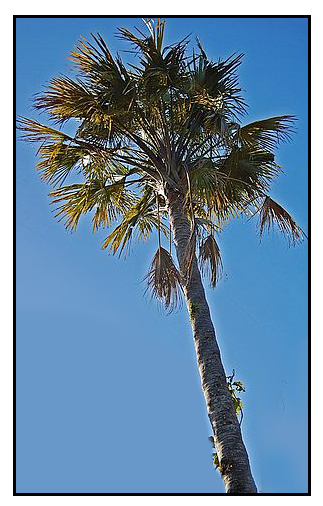
Buri palm is the most stately and largest of the Philippine palms. Trunk is
straight and erect, up to 1 meter in diameter and 20 meters in height.
Leaves are large and fan-shaped, rounded in outline, up to 3 meters
long, palmately split into about 100, lanceolate, 1.5 to 6 centimeters wide, segments extending one-half to two-thirds to the base; petioles are very stout, up to 3 meters long, 20 centimeters thick at the base, the margins armed with stout black spines. Inflorescence is pyramidal,
up to 7 meters high, the lower branches up to 3.5 meters long, the upper gradually shorter, the ultimate branches about 1 meter long. Flowers
are numerous, greenish-white, 5 to 6 millimeters in diameter. Fruits are globose,
fleshy, 2 to 2.5 centimeters in diameter. Seeds are hard, about 1.5 centimeters in diameter.
 Distribution Distribution
- Native to the Philippines.
-
Throughout the Philippines, in most islands and provinces, in some regions widely scattered, subgregarious in others and
abundant at low and
medium altitudes.
- Also native to Andaman Is., Assam, Borneo, Cambodia, Jawa, Laos, Lesser Sunda Is., Malaya, Maluku, Myanmar, New Guinea, Northern Territory, Queensland, Sulawesi, Sumatera, Thailand, and Vietnam. (7)
Constituents
- Sucrose is the produce of the sugar cane.
- Trunk yields large quantities of starch.
- Leaf extract yielded the presence of sterols, saponins, glycosides, and tannins. (see study below) (4)
- Phytochemical screening for secondary metabolites yielded alkaloids, unsaturated fats, sterols and terpenes, flavonoids,
and tannins, with absence of steroids, saponins, anthraquinone heterosides and cyanogenic glycosides. (11)
- Nutrient content of 100 g of gewang starch yields 11.005 g water, 0.518 g ash, 0.202 g fat, 0.691 g protein, 86.594 g carbohydrate, 32.726 g amylose, 51.11 g amylopectin, 12.278 g glucomannan, 100.52 mg calcium, 136,74 mg phosphorus.
(17)
- Nutraceutical study on fruit yielded ash 1.00g/100g, moisture 48.64g/100g,
crude protein 0.22g/100g, crude fat 1.37g/100g, sodium 16.25 mg/100g, potassium 58.39 mg/100g, iron 0.06 mg/100g. (20)
 Properties Properties
- Sugar is demulcent, antiseptic, cooling, laxative and diuretic.
- Roots are demulcent, emollient, diuretic and stimulant.
- It flowers once at the end of its lifetime, with a massive inflorescence up to 5 meters tall containing up to one million flowers. and when it does,
- The tree is ready for processing when the palms have fallen off the trunk; then felled, barked, sectioned, immediately consumed or stored. (14)
- Studies have suggested anticancer and antibacterial properties.
Parts utilized
Roots, leaves, stem.
 Uses Uses
Edibility
- Trunk yields a large quantity of starch.
- Buds (ubod) used for salads or eaten as vegetable.
- Kernels of young fruits are edible and made into
sweetmeats.
- Sap used to make a fermented drink (tuba), alcohol, vinegar, syrup and sugar.
- An average tree yields up to 8 - 10 cavans of fruit. Fruit is a good source of starch.
- Starch used for making desserts.
- In some areas of East Timor, considered main staple food. In other regions, food used during gap between harvests, or as famine food. (14)
- In Indornesia, starch cooked with shredded coconut (akarbilann or puta' laka). (17)
Folkloric
- In the Philippines, not medicinally as useful as the coconut.
- In Aurora, Zamboanga del Sur, sap from heated center portion of three palm-sized petioles of buri, saging, and bulungan
drunk for relapse, fever, headache, body pain, fever and migraines, once daily as needed. Leaf infusion or buri or decoction of buri, anonang, and nito drunk for the same purpose. (19)
- In Pangasinan, northern Philippines, leaf decoction used as bathing remedy for pasma. (11)
- Negritos used applications of hot compress of boiled leaves for pospartum relapse.
(15)
- Decoction of young plant used for febrile catarrh.
- Used to treat toothache.
- In Iloilo, reportedly used for musculoskeletal and dermatologic conditions.
- In Zamboanga del Sur, stems used for treatment of over fatigue.
- In Malaya, starch used for bowel complaints and the juice of roots used for diarrhea.
- In Celebes, roots chewed for coughs.
- In Ayurveda, used for hemorrhoids, peptic ulcer, gastritis, excessive sweating, skin disease.
- In Indonesia, the midrib sap juice is used as traditional medicine to immediately arrest wound bleeding. (16)
Others
- Ornaments: Mature seeds used for rosary beads and buttons.
- Fiber: Petiole yields the "buntal fiber," used in making the famous Baliuag and Lucban hats. Also, used for making rope. From the leaf is obtained a fiber, similar to raffia, used in making cloth, strings, and other fancy articles. Fiber from the ribs of unopened leaves used in making Calasiao or Pototan hats. Strips of unopened leaf used in making hats, mats, sails, baskets. (3)
- Leaf: Mature leaf used for covering tobacco bales; rarely, as thatch for houses; the ribs used for making brooms and weaving. Leaves also used for food wrapping.
- Trunk wood: Trunk can be used as firewood or made into wood frames for making nipa huts. (3) Wood also used as firewood. Also, as a temporary aqueduct for irrigation.
- Fencing: The large leaves armed with stout spines used as fencing against cattle. (14)
- Starch / Fruit: Fruit of the buri tree is a cheap source of food and good source of starch. An average tree can yield up to 8-10 cavans of fruits. (9)
Studies
• Antimicrobial Activity / Phytochemicals: Leaf extract analysis yielded the presence of sterols, saponins, glycosides, and tannins. Antimicrobial evaluated showed a zone of inhibition against Staphylococcus aureus, Pseudomonas aeruginosa, and Escherichia coli. (4)
• Antibacterial / Leaves: Study evaluated evaluated the minimum inhibitory concentration (MIC) of Corypha elata Roxb. leaf extract to three test organisms viz. E. coli, S. aureus, and P. aeruginosa. In all concentrations of 100%, 75%, 50%, and 25%, a complete inhibitory activity (+++) and mild reactivity (2) to the test organisms. Even at lowest 25%, there was compete inhibition of growth. (10)
• Gebang Palm Trunk as Enrichment Culture Medium for Bacterial Growth: Study evaluated the effectiveness of Gebang palm trunk as an enrichment culture medium using E. coli and S. aureus. Results showed the powderized trunk palm of buri is capable of growing both E. coli and S. aureus, with potential as enrichment medium for microbiological study. (12)
• Piceatannol / Anticancer / Seed: Piceantannol is a stilbene compound isolated from methanol seed extract of Corypha utan Lamk. MTT assay of the compound for cytotoxicity activity showed very strong cytotoxic activity against Murine leukemia P-388 cell lines with IC50 of 1.56 ppm. (13)
• Anticancer Activity against P388 Cell Lines / Bark: Study evaluated the natural constituents from bark of C. utan and their cytotoxicity on acute myeloid leukemia cell lines (P388) and their interaction with FLT3 as studied target. Study of bark yielded two triterpenoids, cycloartanol (1) and cycloartanone (2). Based on in vitro and in silico studies, both showed anticancer activity. Cycloartanol and cycloartanone could inhibit P388 cell growth with IC50s of 102.6 and 110.0 µg/mL, respectively. Both compounds demonstrated stable interaction by forming hydrogen bonds with FLT3. Results showed antiicancer potential by inhibition of P388 in vitro and FLT3 gene in silico. (18)
Availability
- Wild-crafted. |