|
Botany
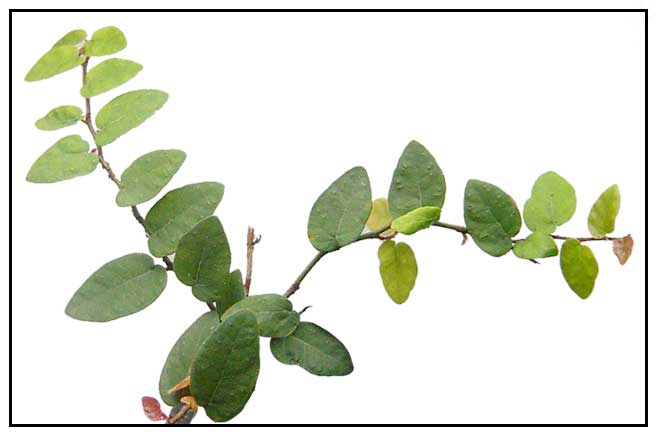
Creeping fig is a prostrate or climbing shrub; when young, flattened,
creeping and clinging close to adobe walls, woods, etc., and
ascending when old with ultimate branches 30 to 80 centimeters
long. Leaves are more or less two-ranked, on very short petioles,
ovate, 1.5 to 3 centimeters long with obtuse tip, round or heart-shaped
based and with entire or slightly wavy margins. Leaves on the
erect branches are very much larger, oblong, 5 to 10 centimeters long and
on long petioles. Pedicels are axillary, 2.5 to 4 centimeters in diameter. Flowers are minute, unisexual, arranged inside a fleshy
receptacle called syconium. Syconium are bell-shaped, 2.5 to 4 centimeters
in diameter. Fruits are achenes, borne in the axils of leaves, somewhat pear-shaped, 4 to 6 centimeters long, yellowish-green to pale red when mature.
 Distribution Distribution
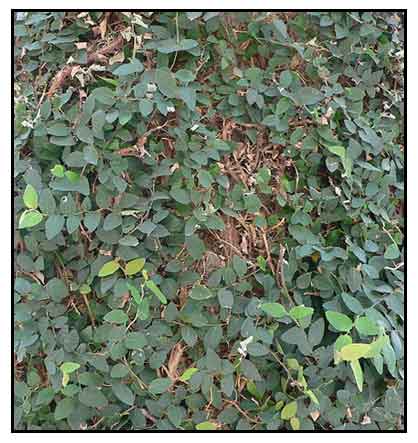
- Grown widely as an ornamental plant or creeper; vigorously growing on adobe
and concrete walls.
- Introduced.
Constituents
· Gum from the plant yields
glucose, fructose and arabinose.
· Fruit contains protein and latex.
· Latex yields the enzyme ficin responsible for the digestion of parasites in the human intestine.
· Study of leaves yielded four flavonoid glycosides, namely: rutin, apigenin 6-neohesperidose, kaempferol 3-robinobioside, and kaempferol 3-rutinoside. (see study below) (1)
· Studies have isolated 1,4-poIyisoprenes, amyrin acetate, mesoinositol, rutin, sitosterol and taraxenyl acetate and the flavonoids, bergapten and oxypeucedanin hydrate. (10)
· GC-MS analysis yielded alkaloids, terpenoids, flavonoids, cardiac glycoside, saponins, and tannins in the ethanolic extract. (see study below) (12)
· Phytochemical screening of methanol an d aqueous extracts of leaves yielded alkaloids, carbohydrate, tannins, flavonoids, saponin, glycosides, and steroid/triterpenoids. (13)
- Study of leaves yielded a new benzofuran derivative, pumiloside (1), together with seven known flavonoid glycosides, afzelin (2), astragalin (3), quercitrin (4), isoquercitrin (5), kaempferol 3-O-rutinoside (6), rutin (7), and kaempferol 3-O-sophoroside (8). (16)
- Study of methanolic extract of fresh leaves yielded
a new tocopherol-related compound, along with α-tocopherol. two known sterols, 15 known triterpenoids and five known flavonoid glycosides. (26)
Properties
· Latex reported to be proteolytic. The crude latex and its protein fractions digest certain species of parasites.
· Fruits are emmenagogue; sperm-invigorating,
and lactation-inducing.
· Stem and leaves are stomachic; invigorates the circulation;
refrigerant and anti-infectious.
- Studies have suggested antioxidant, antimicrobial, antimutagenic, analgesic, anti-inflammatory, antiproliferative, hypoglycemic, hypolipidemic, anti-hyperprolactinemic, anticholinesterase, nephroprotective properties.
Parts
utilized
· Stem, leaves and fruits.
· Stem and leaves: Collect year round, rinse, cut into
pieces; sun-dry.
· Fruits: Collect May to October; discard inside contents;
sun-dry.
Uses
Edibility
• In China, dried achenes are made into jelly.
Folkloric
• Fruits used for bed-wetting, impotency, orchitis; lack of milk
secretion and irregular menstruation.
• In China and Japan, leaves used as analgesic.
*
Decoction of fruits (9-24 g), stem and dried leaves (9-15 g)
for rheumatism, arthritis and pains due to sprains.
• Okinawans in Japan
use F. pumila as herbal medicine or beverage to treat diabetes and high
blood pressure.
• In China, leaves
used for painful and swollen piles. Leaves also used for dysentery,
hematuria and locally to carbuncles. Whole plant used for spermatorrhea
and as a galactagogue. Also used for impotence, menstrual disorders,
dysuria, dyschezia, rheumatism, lumbago, boils and impetigo. Juice of plant used for skin diseases.
• Plant ash rubbed on body in cases of dropsy.
• In New Guinea, used for malaise, fever, shaking, and vomiting. (25)
Studies
• Antioxidant / Flavonoid Glycosides / Rutin / Leaves:
Four flavonoid glycosides
were isolated from the leaves of Ficus pumila. Of these, rutin showed the strongest antioxidant activity in DPPH radical scavenging assay and superoxide radical inhibition assay. (see constituents above) (1)
• Sesquiterpenoid Glucosides:
Three new sesquiterpenoid glucosides,
pumilasides A, B and C were isolated from the fruit of F pumila. (2)
• Antimicrobial / Antimutagenic Activity / Furanocoumarin Derivatives: Study isolated 2 compounds – bergapten and oxypeucedanin hydrate. Bercapten inhibited the growth of S aureus, E coli, S typhi. Oxypeucedanin inhibited the growth of S typhi. On antimutagenic testing, both reduced the number of micronucleated polychromatic erythrocytes induced by mitocin C, bercapten by 44% and oxypeucedanin hydrate by 74%. (5)
• Analgesic / Anti-Inflammatory: Study evaluated a methanol extract for analgesic effects in two models: acetic acid-induced writhing response and formalin-induced paw licking. Results showed anti-inflammatory activity attributed to declined levels of NO and MDA in the edema paw through activities of SOD, GPx, and GRd in the liver. There was also reduction of inflammatory mediators such as IL-1ß, TNF-a, and COX-2. Study yielded three active ingredients: rutin, luteolin, and apigenin. (8)
• Achenes / Nutritive Composition: Study of nutritive composition showed the perianths to contain pectin 32.07%, protein 15.70%, crude fiber 26%, total flavonoids 15.14%. Seeds yield pectin 15.15%, protein 15.70%, crude fiber 20%, total flavonoids 2.08%. Seeds yield 30.13% oil with a polyunsaturated fatty acid: saturated fatty acid rate of 10.93 to 1. Results suggest potential for exploitation as a health food. (9)
• New Neophane Triterpene / Antimicrobial: Chloroform extract of leaves yielded a new neophane triterpene. It showed antimicrobial activity against E. coli, Pseudomonas aeruginosa, Bacillus subtilis, and Candida albicans. (10)
• Antiproliferative / Antioxidant: Study evaluated the heavy metal content of raw powder and extract of F. pumila, phytochemical constituents, and anti8oxidant effect using DPPH assay and total phenolic content, and cytotoxic effect using MTT assay of extract and fractions on liver cancer cells (HepG2). leukemic cells (jurkat) and normal liver cells (Cjhang). GC-MS analysis yielded alkaloids, terpenoids, flavonoids, cardiac glycoside, saponins, and tannins in the ethanolic extract. In DPPH assay, all fractions scavenged free radicals in a dose dependent manner, which positively correlated to phenolic contents. MTT assay showed the methanolic fraction was selective towards jurkat cell lines (selectivity index=2.822). Results suggest potential for the plant to contain compound/s as lead compounds for anticancer drugs. (12)
• Case of Photodermatitis: Leaves of ficus spp. are known to cause photodermatitis, a toxic reaction caused by direct skin exposure to certain plant compounds, followed by exposure to ultraviolet (UV) light. Although rare in this species of Ficus, this is the first account of phytodermatitis caused by trimming a wall covered with F. pumila. The UV index was high (6-7). The authors discuss treatment, mechanism, and likely involved constituents. (14)
• Hypoglycemic / Hypolipidemic / Leaves: Study evaluated the hypoglycemic and hypolipidemic activities of leaf extract of F. pumila in STZ-induced diabetic rats. Results showed decreased blood glucose level and decreased LDL, VLDL, TG, and TC, along with significantly increased HDL The effects were similar to effect of standard drug glibenclamide. (15)
• Anxiolytic / Leaves: Study evaluated the anxiolytic activity of ethanolic extract of leaves of Ficus pumila in experimental animals using three models viz., elevated plus maze (EPM), open field test, and Y-maze model. Diazepam was used as standard drug. Phytochemical screening yielded carbohydrate, glycosides, sterols, flavonoids, and triterpenes. Results showed significant dose-dependent anxiolytic activity. (17)
• Anti-Hyperprolactinemic Effect
/ Leaves: Study investigated the anti-hyperprolactinemic effect of F. pumila leaf extract in rats. Hyperprolactinemia was induced by subcutaneous injection of metoclopromide dihydrochloride.
Results showed a significant effect on measures of hyperprolactinemia. Extract treated hyperprolactinemic rats showed altered serum estradiol, progesterone, prolactin, FSH, and luteinizing hormone levels (p<0.05), as well as decreased pituitary prolactin-positive cell number (p<0.05) and mRNA expression (p<0.05). Results suggest potential use of the FPLE as anti-hyperprolactinemia treatment. (18)
• Anti-Proliferative / Human Leukemic Cell Lines: Study evaluated the anti-proliferative effect, antioxidant, and TPC of Ficus pumila. Hydroalcoholic extracts of leaves and stems were rich in tannins, general glycosides, saponins, terpenoids, alkaloids, flavonoids (leaves) and sterols (stems). Leaves and stems showed strong antioxidant activities with EC50s of 0.087 mg/ml and 0.089 mg/ml, respectively. All the crude extracts showed anti-proliferative effect towards the three human leukemic cell lines used (Jurkat, CEM, and HL-60), with the leaf extract showing strongest inhibition. The antioxidant property of the plant, along with its phenolic content, may be partly responsible for the anti-proliferative activity. (20)
• Adhesive Pad Formation / Stems from Clusters of Roots: Vines have different climbing strategies; one type, clinging vines developed a specialized structure, the adhesive pad that secretes a sticky substance that adheres to almost any substrate, Study reports on the developmental anatomy of clusters of adventitious roots. After emergence through cortex and epidermis, root hairs form, secreting a polysaccharide and protein substance. The adventitious roots and root hairs stick together forming the adhesive pad, which stick to almost any substrate. Study reports on experiments on shoot developmental behavior leading to adhesive pad formation and possible roles of auxin. (21)
•
Nephroprotective / Gentamicin Induced Damage / Leaves: Stud evaluated the nephroprotective effect of hydroethanolic extract of leaves of F. pumila on gentamicin induced kidney damage in female Wistar albino rats. Results showed significant reduction in abnormal biochemical and hematological markers induced by gentamicin. (22)
• Antioxidant / Fruit: Study evaluated the antioxidant activities of various extracts of F. pumila fruit by reducing power assay, APPH, TEAC assay, FRAP assay, and total phenolic contents. Results showed varying degrees of antioxidant efficacy in the four assays, with ethanol extracts showing the highest antioxidant activities. Results correlated with highest total phenolics content (2.50%) of 80% ethanol extract. (23)
• Butyrylcholinesterase Inhibitory Activity: Study evaluated the cholinesterase enzyme inhibitory activities of extracts and bioconstituents from F. pumila and F. thonningii. Three of the isolated compounds, viz., two isoflavones, alpinumisoflavon and lupiwighteonhydrate, and a furanocoumarin, aviprin, showed good inhibitory activities against butyrylcholinesterase but not against acetylcholinesterase. Results suggest a favorable pharmacological profile for treatment of Alzheimer's disease. (24)
Availability
Wild-crafted. |