|
 Botany Botany
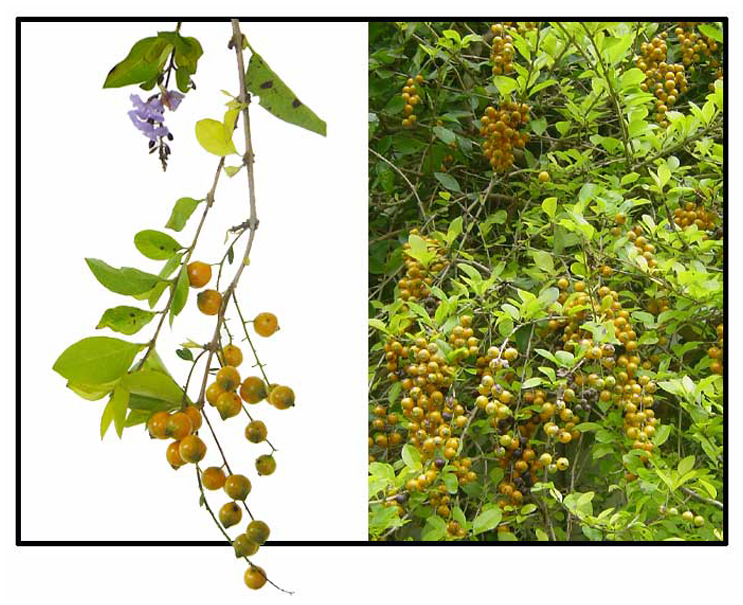
Duranta is a smooth, unarmed, scrambling shrub, growing
to a height of 1-3 meters, with straggling and drooping branches. Leaves
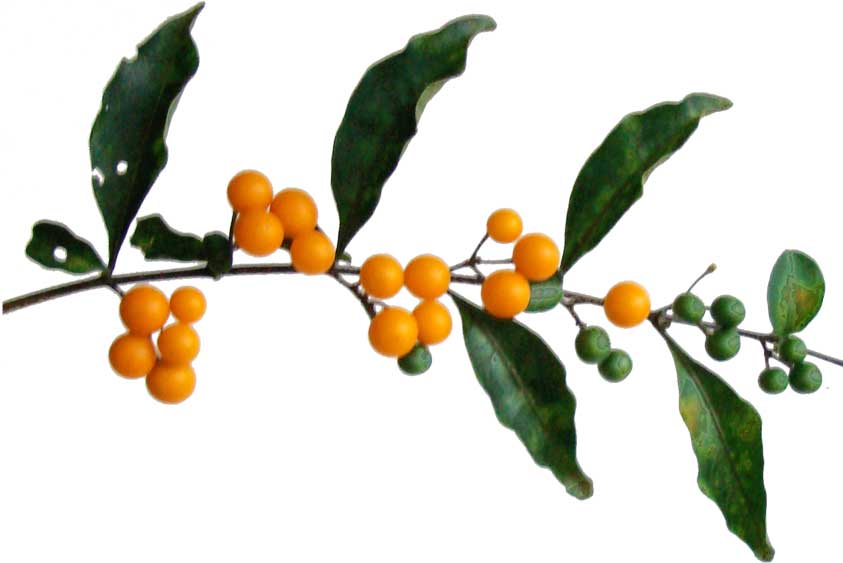
are small, obovate-elliptic, 3 to 6 centimeters long, with pointed or rounded tips
and pointed base; the margins, entire or slightly toothed. Racemes are
axillary with terminal panicles, spreading and slender, up to 12 centimeters
long. Flowers are scentless, borne on one side of the rachis, white
or lilac-blue with two violet stripes, about 1 centimeter long and 1 centimeter wide.
Fruit is fleshy, ovoid, orange-yellow and 7 to 8 millimeters long.
Distribution
- Native of tropical
America.
-
A common hedge and fence screen in Baguio.
Constituents
• The bark contains a glucosidal principal; the leaves yield a
saponin substance.
• Phytochemical studies report new compounds: cleomisconsin A,
hardwickiic acid, 3,13-clerodadien-16, oleic acid plus other known compounds.
• Study isolated 6 compounds: 24-ethylcholest-5-en-3-â-ol (â-sitoserol), naringenin, 3,4-dihydroxy-bphenethyl-O-á- rhamnopyranosyl-(1T3)-4-O-caffeoyl-â-D-glucopyranosid (acteoside), lamiide, á-glucopyranosyl (1T2) â-fructopyranoside (sucrose), á-galactopyranosyl(1T6) á-glucopyranosyl-(1T2) fructopyranoside (raffinose) from Duranta repens Linn. var. variegate. (See study below) (4)
- Leaves extracts yielded two new iridoids, durantoside IV and durantoside V together with several known compounds, oleanolic acid, ursolic acid, (E)-cinnamic acid, beta-sitosteryl-3-O-beta-D-glucopyranoside, (E)-p-methoxycinnamic acid, KNO-3, KCl, kusaginin, glucose, durantoside I, and durantoside II.
(15)
- Phytochemical screening of aqueous and methanolic leaf extracts yielded alkaloids, flavonoids, steroids, triterpenoids, tannins and phenols. (see study below)
(16)
- Phytochemical analysis of fruits yielded alkaloids, glycoside, saponins, and tannins. (see study below)
(17)
- A chloroform soluble fraction of an ethanolic extract of stem yield two triterpenes, ß-amyrin and 12-oleanene 3ß, 21ß-diol. (see study below)
(19)
- Analysis of seed and leaf oil yielded
anthocyanin (1.23% and 0.78%), oxalate (0.28 and 0.38), tannin (6.58 and 5.75), rutin (8.44 and 19.38), phenol (2.11 and 2.11), epicatechin (1.11 and 0.79), lunamarine (9.75 and 9.37), saponin, (18.95 and 14.21), sapogenin (5.94 and 3.50), ribalinidine (1.87 and 0.96), phytate (0.12 and 0.08), kaempferol (14.016 and 26.17) and catechin (29.32 and 16.50). Study for fatty acid yielded capric, lauric, myristic, myristoleic, palmitic, palmitoleic, steraric, oleic, and linoleic acids. (27)
- Study of leaves yielded four new iridoid glucosides, duranterectosides A, B, C, and D, along with durantosides I and II, lamiide, lamiidoside, and verbascoside. Stems yielded duranterectoside A, along with durantosides I, II, and III, and lamiidoside. (29)
-
A dichlormethane extract of flowers isolated oleanolic acid (1), a mixture of α-amyrin (2a) and ß-amyrin (2b) in a 3:1 ratio, phytyl fatty acid esters (3), and triacyllglycerls (4). (30)
- Study isolated Isoprenylated flavonoids 5,7-dihydroxy-3′-(2-hydroxy-3-methyl-3-butenyl)-3,6,4′-trimethoxyflavone (1), 3,7-dihydroxy-3′-(2-hydroxy-3-methyl-3-butenyl)-5,6,4′-trimethoxyflavone (2) and an isoprenylated acetophenone derivative (3), along with known compounds, 5-hydroxy-3,6,7,4′-tetramethoxyflavone (4), rosenonolactone (5), 6,7-dimethoxycoumarin (6), 5α,8α-epidioxyergosta-6,22-dien-3β-ol (7) and 5α,8α-epidioxyergosta-6,9(11),22-trien-3β-ol (8). (see study below) (31)
Properties
• Fruit is slightly poisonous with alkaloid type reactions. Deaths
have been reported from ingestion.
• Studies have suggest mosquitocidal, thrombin inhibitory, cytotoxic, antiviral, antimalarial, antioxidant, antifungal, antiurolithiatic properties.
Parts used
Leaves, flowers, fruits.
Uses
Folkloric
- Fruit has been used
as febrifuge.
- Fruits used for malaria and intestinal worms.
- Flowers are believed to be stimulant.
- Infusion of leaves and juice of fruit are diuretic.
- Leaves used for treatment of abscesses.
- In Bangladesh, tribal and mainstream use for malaria. Also used by mainstream Kavirajes as insect repellent, treatment of itches, infertility, fever, and pneumonia.
(13)
- In Andhra Pradesh, India, decoction of whole plant used for asthma, bronchitis, and fever. (34)
- In India, leaves and stems used for treatment of cataracts. (36)
- In the southeastern part of Nigeria, fruits used for treatment of malaria, abscesses, and parasitism. (35)
Toxicity
• Fruit is slightly poisonous with alkaloid type reactions.
Deaths have been reported from ingestion.
• Study of the chloroform soluble fraction of the stem of D. repens
showed toxicity with changes in biochemical parameters and abnormalities
in liver and renal functions, with degenerative changes on histopath
examination of the cellular destruction of the liver, heart and kidney. (8)
• Duranta erecta Poisoning in Nine Dogs and a Cat: Observed ingestion
of fruits and leaves resulted in drowsiness, hyperaesthesia and tetanic
seizures with GI manifestations of vomiting, diarrhea and bleeding. (9)
Studies
• Thrombin
Inhibitory: Study
isolated flavonoids with some compounds showing significant enzyme-inhibitory
activity against thrombin. (3)
• Mosquitocidal Triterpenes: Study
isolated two triterpenes, ß-amyrin and 12-oleanene 3ß,21ß-diol. The mixture of the two compounds was highly effective against the larvae of the mosquito, Culex quinquefasciatus, as a mosquitocide. (10)
• Phytochemical
Investigation / Antiviral: The
DR extract showed 76% reduction in the viral titer of Hepatitis A. The
activity may be attributed to the aceteoside or lamilide content which
showed high antioxidant activity. (4)
• Cardiac
Depressant: Estimation of Cardiac
Depressant Activity of Ten Medicinal Plant Extracts from Pakistan:
Cardiac depressant effect induced by D repens extract was not dose-dependent,
with a 50% negative inotropic effect, 50% negative chronotropic effect
and 80% reduction in coronary outflow. (5)
• Saponins
/ Cytotoxicity: Study isolated
two new triterpene saponins from the leaves of DRL durantanin IV and
V, together with 10 known compounds. The methanol extract and the 2
new compounds 1,2 and E/Z acteoside showed significant cytotoxic activity
against a HepG2 cell line.
• Antioxidant:
Study of the methanol extract of Duranta repens showed radical scavenging
activity. Study yielded three compounds: an acteoside, an iridoid lamilid and a saponin. (6)
• Radical Scavenging Activity: Phytochemical screening isolated four new coumarinolignoids,
Repenins A-D (1-4) with known coumarinolignoids, cleomiscosin A and
durantin A. The compounds showed potent radical scavenging activity.
(7)
• Iridoid Glycosides / Antioxidative: An ethanolic extract isolated six iridoid glycosides 1-6. Duranterectoside A (1) exhibited the strongest scavenging potential for DPPH radicals, -OH inhibitory activity, total ROS inhibitory activity, and OBNOO(-) scavenging activity tests. (12)
• Antiplasmodial Flavanoid Glycosides / Antimalarial: A CHCl3-soluble fraction of the whole plant of Duranta repens yielded two new flavonoid glycosides, along with five known flavonoids. Compounds 1-7 showed potent anti-plasmodial activity against the chloroquine-sensitive (D6) and chloroquine-resistant (W2) strains of Plasmodium falciparum. (14)
• Antifungal: Study evaluated aqueous and methanolic leaf extracts of D. repens against three fungi, viz., Aspergillus niger, Candida albicans and Microsporum gypseum. Results showed promising antifungal activity against the tested fungi with the methanolic extract showing more potent inhibitory effect. (see constituents above) (16)
• Cytotoxicity / Fruit: Study evaluated various extracts of fruit for cytotoxicity and antibacterial activity. On cytotoxic screening using brine shrimp (Artemia salina Leach) assay, the highest mortality was seen in the methanolic extract. No antibacterial activity was seen at various concentrations against human pathogenic bacteria tested. (17)
• Antioxidative Potential / H2O2 Induced Cell Death / Fruit: Study investigated the antioxidative potential of DR fruits on H2O2 induced oxidative cell death. In vitro analysis showed DPPH and H2O2 scavenging and reducing potential of the extracts. (18)
• Antishigellosis / Antimicrobial / Cytotoxic Potential / Stems and Fruits: Study of a chloroform soluble fraction of stem and ethanol extract of fruits exhibited potent antishigellosis activity and moderate activity against some pathogenic bacteria and fungi. Study also showed significant cytotoxicity against brine shrimp larvae. (19)
• Mosquito Larvicidal / Stem and Fruit: Study of crude extracts of stem and fruits, fractions and fresh fruit juice of D. repens against the larvae of Culex quinquefasciatus showed effective larvicidal activity. (20)
• Gastroprotective / Ethanol Induced Mucosal Damage: Study of an ethanol extract showed gastroprotective activity against ethanol-induced gastric mucosal injuries in rats. There was increased mucus production, decreased acidity, increased SOD level and decreased MDA level. (21)
• Antimicrobial / Antioxidant / Leaves: Study of various extracts of leaves showed antimicrobial activity. Gram positive bacteria showed more sensitivity than gram negative bacteria. It also showed antifungal activity against Candida albicans and Aspergillus niger and A. flavus. (22)
• Anti-Urolithiasis / Leaves: Study investigated the anti-urolithiatic activity of methanolic extract of D. erecta leaves by in-vitro and in-vivo analysis. A methanolic extract showed antioxidant potential with 93.51% inhibition of DPPH radical at 1000 µg/ml concentration, compared to 94.71% with ascorbic acid. In vitro, D. erecta inhibited formation of calcium oxalate and calcium oxalate monohydrate crystals, along with antimicrobial activity with zone of inhibition against a few bacteria. In vivo evaluation on a Wistar rat model confirmed the anti-urolithiatic activity. (25)
• Bioefficacy Against Dengue and Yellow Fever Vector, Ae. aegypti / Leaves: Study evaluated the bioefficacy of aqueous extract of leaves of D. erecta against yellow fever and dengue vector, Ae. aegypti. Results showed toxicity of the extracts at all concentrations tested against fourth instar larvae of Aedes aegypti. Study showed a concentration dependent increase in ovicidal, larvicidal, inhibition of adult emergence and fecundity. Results suggest a potential for botanicals to reduce the use of chemicals for mosquito control. (26)
• Leaf and Seed Oil: Seed oil contained higher Mg, K, Na, and vitamin K, while leaf oil contained higher Fe, vitamin A, and vitamin D. Fatty acid occurrence were as follows: palmitic > oleic > stearic > capric > linoleic > lauric >palmitoleic for seed oil, and linoleic > palmitoleic > oleic > stearic > palmitic > myristic > capric > lauric > myristoleic. Chemical analysis suggest the seed oil is more suitable for industrial and therapeutic purposes. (see constituents above) (27)
• Antithrombotic Effect / Fruit: Study evaluated the antithrombotic effect of D. repens fruit extract on male albino mice. Bleeding time of mice in the experimental group showed no significant difference with positive control (aspirin), while both were significantly different than negative control (distilled water).. Results suggest effectivity of D. repens as an antithrombotic agent. (28)
• Enzyme Inhibitory
Constituents: Study of D. repens isolated eight compounds. Compounds 1-5 showed inhibitory activity against prolyl endopeptidase; compounds 4 and 5 showed activity against thrombin. (31)
• Chitosan Nanoparticles / Antimalarial / Fruits: Study reported on the green synthesis of chitosan nanoparticles using Cassia fistula leaves and Durante repens fruit. The best IC50 against P. falcifarum were 0.004 and 0.08 µg/ml for C. fistula and D. repens, respectively. Results suggest encapsulation of the extracts with chitosan increase the P. falcifarum inhibitory power of both extracts, thus increasing their antimalarial potential. (32)
• Zinc Oxide Nanoparticles: Study reports on the green, environmentally non-hazardous biosynthesis of zinc nanoparticles using aqueous extracts of leaves, stem, root, flowers, and fruits of Duranta erecta as reducing agents. (33)
• No Anthelmintic Activity / Acute Toxicity Study: Study evaluated the anthelmintic potential of the plant using adult male albino mice experimentally infected with Heligmosomoides bakeri infective L3. Study failed to show anthelmintic activity in contrast to albendazole that significantly (p<0.05) reduced faecal egg counts and worm burdens by 71% and 92% in treated mice, respectively. On toxicity study, the extract had an LD50 greater than 5000 mg/kg bw. (35)
Availability
- Cultivated for ornamental
purposes. |