|
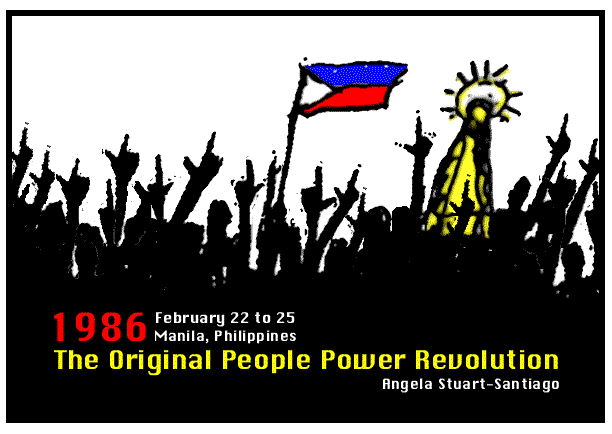
This book started out in the summer of 1986 as a draft sequence guide for a TV magazineseries which was to kick off with an EDSA feature (an Armageddon a la Star Wars: the forces of good vs. the forces of evil) under the direction of Marilou Diaz-Abaya. The series didn't push through but I pushed on with my research because I wanted to show that the EDSA revolt was neither a CIA plot nor a miracle made in heaven (as state and church analysts were making it out to be) but a purely Filipino and mundane, if mind-boggling, affair.
Besides, I was already elbow-deep in the newspapers and magazines of the time, sifting the historical from the hysterical and fashioning the details into a chronology of the four days' sychronous events. Not that it was easy. Mostly, accounts either failed to indicate or didn't agree on what time, clockwise, things happened. For instance, several reports placed Jaime Cardinal Sin's first call over Radio Veritas at around nine o'clock, but one said it was after Butz Aquino's first call, and another, that Butz called after ten.
I was constantly rearranging and refining my sequence of events, especially as I began taking in new data from the snapbooks. I'd find that I had placed one event too early, another too late; even, that I had mistaken three different Marcos press conferences for one, thanks to a lazy reporter. Different sources also tended to focus on different details of an event; rarely would a source furnish all pertinent data so that recounting an even meant patching details from several sources into some sequence.
Remember how we laughed at Marcos when he cried "Coup!" and cheered Enrile when he dismissed the allegation as a "bunch of bull"? As it turned out, Marcos had been telling the truth and Enrile had been engaged in psychological warfare. So what else was true and what else was false? The EDSA story was literally begging to be straightened out and told in full.
By the time my first draft was read, however, the market was crammed with EDSA books that weren't moving. My chronology gathered dust.
Four years later, in August 1990, a copy found its way to then defense secretary Fidel V. Ramos. I had received feelers about a Ramos biography, apparently in anticipation of the 1992 presidential campaign. Howie Severino of the Philippine Center for Investigative Journalism had alreay said sorry, he didn't do PR (public-relations/propaganda) jobs. I wasn't as pure. It was my chance to get to the military commander of EDSA who had yet to tell his story of the four days. With filmmaker Gerry Gerena, who brokered the deal, I proposed a biography back-to-back with a fully documented EDSA chronology annotated by Ramos. Eventually the biography was bumped off in favor of EDSA.
We had two interview sessions with Secretary Ramos, one in Camp Aguinaldo (November 1990), and another in his home in Ayala Alabang (January 1991) with family and friends, including General Rene Cruz; plus a session each with General Jose Almonte and Major Avelino "Sonny" Razon. All accounts are on videotape. Soon after, on the occasion of the fifth EDSA anniversary, Secretary Ramos and June Keithley recounted their stories on radio, live, transcripts of which were placed at my disposal.
By August 1991 I was done. By October, Nonoy Marcelo had submitted a dummy of the cover design and layout, and a few illustrations.
I never heard from Ramos's friends again. In mid-1995 I started cleaning up and updating the material, intending to publish it by the tenth EDSA anniversary. I dropped the Ramos propaganda, then took in new details and perspectives from several books published from 1987 to 1991 here and in the United States. Also I took in Freddie Aguilar's story from an interview with him soon after EDSA (my transcripts of which had been lost and found) as well as socialite Rose Marie Arenas's account (from a September 1995 interview arranged by Iskho Lopez and Mila Alora).
In November, Nita Umali Berthelsen, my mother's sister, urged me to send a copy of the manuscript to her long-time friend Eugenia Duran Apostol, founder of the Philippine Daily Inquirer and Mr. & Ms., which I did. Ms. Apostol phoned me the minute she finished reading it and said it was exactly what she had been looking for, a fully documented account of the four-day revolution. The best part of it was, Lorna Kalaw-Tirol managed to bag us a last-minute interview with former President Corazon C. Aquino (November 28).
We were not so lucky with either Senator Juan Ponce Enrile or the Marcoses. The senator's reaction to a simple request for an interview was a list of onerous conditions, including editing privileges. On the other hand, Irene Marcos-Araneta, who read an early draft of the manuscript, said the premise is wrong: "It was not a completely Filipino revoulution." Obviously she refers to the American aid that both rebel and government camps were offered. Records show, however, that the Americans were mostly on the sidelines and were as stunned as everyone else, including the Marcoses, at every unexpected turn of events.
My sequencing of events is tentative and styled for rearranging and ramifying by historians. Sources are cited at every point, the more clearly to show how slowly, and through which vehicles, information on EDSA trickled in. Materials have been edited only lightly, with certain inconsistencies and inaccuracies left in, to mirror more sharply the quality of Filipino journalism at the time, after fourteen years of censorship.
Angela Stuart-Santiago
December 1, 1995 |
PASASALAMAT
Kina Gerry Gerena, Nonoy Marcelo, Iskho Lopez, Jorge Arago at Louie Stuart, mga kaibigan at kapatid, sa mga payo't tulong. Kay Dorie Llabore, yaya't kaibigan, sa sampung taong alalay.
Kina Godofredo V. Stuart, MD (+) ng Imus, Cavite at Concepcion Herrera Umali ng Tiaong, Quezon, ama't ina kong aktibista. Kapwa Nacionalista noong panahon ni Ramon Magsaysay, naging Liberal noong panahon ni Diosdado Macapagal, at LABAN noong panahon ni Ferdinand Marcos. Hanggang Lucena'y nakarating kami upang makipag-rally kay Cory Aquino noong kampanyang snap election.
Kay Cholo, aking kabiyak, at kina Angelo at Katrina, aming martial law babies, sa pasensiya't alaga. Para sa inyo ito. |