|
Gen info
- Asteraceae is a large family of flowering plants consisting of over 32,000 known species in over 1,900 genera within the order Asterales. The number is rivaled only by Orchidaceae. (27)
- The family is commonly known as aster, daisy, composite, or sunflower family. Most species are herbaceous plants, which may be annual, biennial, or perennial, but also shrubs, vines, and trees. (27)
- Asteraceae was first described in 1740 under the name Compositae.
- Centipeda is a genus of flowering plants in the daily family, Asteraceae.
 Botany Botany
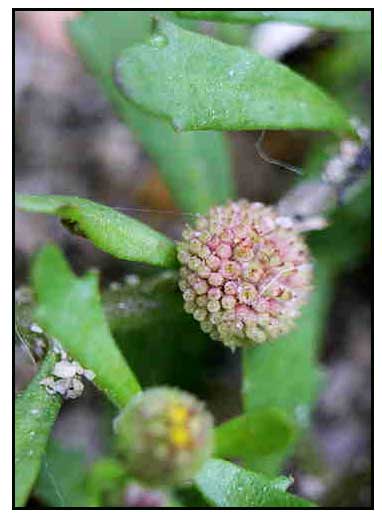
• Harañgan is a prostrate or ascending, slender, leafy herb, somewhat woolly or nearly smooth, with numerous branches spreading from the root, and 8 to 20 centimeters long. Leaves are oblong-obovate to oblanceolate,
1 centimeter long or less, and with few coarse teeth on the margins. Heads are stalkless, rounded, 3 to 4 millimeters in diameter, many
flowered, and borne singly in the axils of the leaves. Achenes are about 1 millimeter long, tipped with the persistent style, and bristly on the angles.
• Small annuals, stems decumbent, much branched, leafy. Leaves alternate, spatulate, entire or toothed. Heads sessile, axillary or in racemose inflorescences, heterogamous, disciform; involucre hemispheric, bracts in 2 series, spreading in fruit, equal, oblong, margins narrowly membranaceous; outer florets pistillate, many-seriate, fertile, corollas tubular, minute, obscurely lobed; central florets bisexual, fertile, few, corollas over twice as long as marginal florets, limb campanulate, deeply 4-lobed. Style arms of central florets truncate, anthers obtuse at base, without appendages. Achenes 5-angled, hairy, obtuse, narrowed at base. Pappus wanting. (Flora of Taiwan)
Distribution
- Native to the Philippines.
-
n open waste places, rice
paddies, etc. at low and medium altitudes.
- In Cagayan, Nueva Viscaya, Pampanga, Rizal and Laguna Provinces in Luzon; in Lanao, Mindanao.
-
Also native to Amur, Andaman Is., Borneo, Cambodia, China North-Central, China South-Central, China Southeast, East Himalaya, Fiji, Hainan, India, Inner Mongolia, Japan, Jawa, Khabarovsk, Korea, Laos, Lesser Sunda Is., Malaya, Manchuria, Myanmar, Nansei-shoto, Nepal, New Caledonia, New Guinea, New South Wales, Northern Territory, Pakistan, Primorye, Qinghai, Queensland, Samoa, Society Is., South Australia, Sri Lanka, Taiwan, Thailand, Tibet, Tonga, Vanuatu, Victoria, Vietnam, Western Australia, Xinjiang. (21)
Constituents
• Yields an amorphous volatile oil and a bitter principle, myriogynin.
• Contains an alkaloid, a glucoside and traces of saponin.
• Study yielded three antibacterial
sesquiterpene lactones, identified as 6-O-methylacrylylplenolin, 6-O-isobutyroylplenolin, and 6-O-angeloylplenolin. (see study below) (1)
• Study yielded two monoterpedoids together with five known
thymol derivatives. (Link)
• Study isolated ten compounds, (-)-cis-chrysanthenol-O-beta-D-glucopyranoside, methyl 3,5-dicaffeoylquinate, 3,5-di-O-caffeoyl quinicacid, tricin, 2-amino-4-methyl-pentanoicacid, 2-amino-3-phenyl-propionic acid, 4-amino-4-carboxychroman-2-one, brevilin-A, arnicolide C, arnicolide D. (10)
• Study for volatile constituents yielded forty-one compounds. Major constituents were: trans-chrysanthenyl acetate (42.18%), 4,4-trimethyl -bicyclo [3.2.0] hept-6-en-2-ol (6.85%), caryophyllene oxide (4.42%), 2-(2-furanylmethyl)-5 -methyl-furan (3.76%), hexadecanoic acid (3.55%), 2-methyl-5-(1-methylethyl)-phenol (3.53%), propanoic acid 2,3,7-trimethyl -2,6-octadienyl ester (2.97%), 3,7-dimethyl-2,6-octadien-1-ol (2.93%), thymol (2.88%) and α-humulene (2.29%).
• Study isolated four triterpenoid saponins from the whole plant: 1α,3β,19α, 23-tetrahydroxyurs-12-en-28-oic acid-28-O-β-d-xylopyranoside, 1β,2α,3β,19α,23-pentahydroxyurs-12-en-28-oic acid-28-O-β-d-xylopyranoside, 3α,21α,22α, 28-tetrahydroxyolean-12-en-28-O-β-d-xylopyranoside and 3α,16α,21α,22α,28-pentahydroxyolean-12-en-28-O-β-d-xylopyranoside. (23)
 Properties Properties
• Considered anodyne, antiphlogistic,
anticontusion, antitussive, diuretic, depurative, anti-infectious, antirheumatic.
• Pungent-warming, clears out nose, ear cavity, invigorates blood
circulation, relieves gastrointestinal disorders.
• Studies have shown antimicrobial, anti-proliferative, anti-inflammatory, anti-protozoal, anti-asthmatic, molluscicidal, antihistaminic, anti-ulcer, antioxidant, hair-growth stimulating, anti-psoriasis properties.
Concerns
• Plant has been reported to cause poisoning in livestock.
Parts
utilized
Entire plant.
 Uses Uses
Edibility
• No information on edibility.
Folkloric
• In the Philippines, squeezed between the fingers and inhaled, clearing the head by provoking sneezing.
• Used for rheumatic lumbar and leg pains.
• Powdered herb and minute seeds used as sternutatory.
• Infusion of plant used for purulent ophthalmia.
• Used as hot and dry medicine for paralysis, joint pains and worms.
• Ointment made dried
pulverized material with camphor or yerba buena (Mentha arvensis) to
make a 10% valenine ointment, applied to the nose for rhinitis.
• Sprains, bone fractures, poisonous snake bites, furuncle.
• Dosage: use 3 to 9 gms dried material or 9 to 15 gms fresh material
in decoction.
• Poultice used for sprains, contusions and snake bites.
• In India, used
as snuff for treatment of head colds.
• The Mundas of Chota Nagpur sniff the crushed plant for fevers and colds. In Punjab, herb is boiled to a pasted and applied to the cheeks for toothache.
• In Nepal, used
to treat sinus infections.
• In Chinese Materia Medica, herb is effective for expelling wind and clearing orifices, along with detoxifying, and reducing swellings. Per Materia Medica Hui Yan, it can unlock the nine passages in the human body, particularly the nasal pathways. (28)
• In China, used
for nasopharyngeal cancers. Also, the plant used as a kind of snuff for ophthalmia, causing the eyes to water. Plant decoction used for treatment of paralysis, malaria, joint pains.
Studies
•
Sesquiterpene Lactones / Antibacterial:
Study yielded three antibacterial sesquiterpene lactones, which showed
activity against Bacillus subtilis and Staphylococcus aureus. (see constituents above) (1)
• Antibacterial / Thymol: Study isolated two new monoterpenoids with five known thymol derivatives. All the agents tested exhibited antibacterial effects against all the bacteria investigated. Thymol, as a component of volatile oils, has been shown to possess antimicrobial activities. Results suggest C. minima could be a potential source for antibacterial substances for food preservation. (7)
• Antimicrobial / Chemical Composition:
Study showed the extract to have a broad spectrum of antimicrobial activity
against all tested strains, esp Enterobacter aerogenes, Klebsiella pneumonia,
Staph aureus and Yersinia enterocolitica. Twenty three compounds were
identified. Results show the extract to be a good antimicrobial agent
with a potential for public health applications.
•
Allergic Rhinitis: Treatment
with active extract in in an allergic-rhinitic animal model induced
by ragweed pollen showed significantly decreased pathologic changes,
with decreased infiltration of eosinophils and mast cells in the connective
tissue. Results conclude that Cm is effective in treating allergic rhinitis. (3)
•
Anti-Inflammatory / Induced Pleural Effusion:
Study showed the volatile oil of Centipeda
minima to have a protective effect on acute pleural effusion in rats
induced by an intrapleural injection of Car. (4)
•
Sesquiterpene Lactone: Brevilin A / Anti-Protozoal:
Study isolated a sesquiterpene lactone,
brevilin A, which was found to have antigiardial activity and similarly
active in vitro against Entamoeba histolytica and against Plasmodium
falcifarum. Three flavonoids were isolated: quercetin, quercetin 3-methyl
ether and kaempferol 7-glucosylrhamnoside. (5)
•
Antiproliferative / Florilenalin / Nasopharyngeal CA:
Study isolated a sesquiterpene lactone,
IF (2B-(isobutylryloxy)florilenalin that showed a significant dose-
and time-dependent inhibition on the growth of human nasophayngeal carcinoma
epithelial cells. Overall, Cm showed potent antiproliferative effect
on NPC cells and suggests further investigation of its medicinal potential. (6)
• Antiasthmatic: Study on the essential oil of Centipeda minima showed a good therapeutic effect with significant prolongation asthma latency and gasping on a guinea pig model of spray-induced asthma. (8)
• Molluscicidal Effect: Study of water and ethanol extracts against Oncomelania hupensis showed a molluscicidal effect, the aqueous extract higher than the ethanol extract. The main components were sesquiterpenes lactones and sterols. (9)
• Antiproliferative / Volatile Oils: Study showed that SFE oil induced CNE cell death via induction of apoptosis by regulating expression of the Bci-2 family of proteins, with consequent mitochondrial dysfunction. Results provided strong evidence for the anti-NPC potential of the SPE oil from C. minima. (12)
• Antiproliferative Effect: In this study, the n-hexane fraction showed broad spectrum of inhibitory effects on five human cancer cell lines, including breast CA MCF7 cells, prostate carcinoma PC-3 cells, hepatocellular carcinoma Hep G2 cells, nasopharyngeal CA CNE cells, and the acute promyelocytic leukemia HL-60 cells. Both extrinsic and intrinsic apoptotic pathways were activated. (15)
• Antihistaminic / Antiulcer: Hydroalcoholic extract of bark demonstrated antihistaminic activity with a concentration-dependent inhibition of histamine-induced contractile response on guinea pig ileum. Various fractions also showed significant ulcer protective effect with inhibition of ulcer index. (16)
• New Sesquiterpene Lactones / Minimolides G and H / Anti-Human Nasapharyngeal Cancer Cell Line: Study isolated two new sesquiterpene lactones, minimolides G and H. Both exhibited activity against human nasopharyngeal cancer cell line. (17)
• Antibacterial Sesquiterpenoids: Study yielded two new guiaiane-type sesquiterpene lactones, with three known guaianolide- or psedoguaianolides from C. minima whole plant. All the compounds were found active against eight different microbial pathogens. (18)
• Antioxidant / Anti-Inflammatory: An aqueous extract exhibited antioxidant in the TEAC and DPPH radical scavenging assays and anti-inflammatory activity with concentration dependent inhibition of paw edema after Carr treatment in mice. (19)
• 6-O-angeloylplenolin . Caspase-Dependent Apoptosis in Multiple Myeloma Cells: 6-OAP was previously showed to inhibit the growth of multiple myeloma cells through mitotic arrest. Study evaluated the level of apoptosis in dexamethasone-sensitive, dexamethasome-resistant, and chemotherapy sensitive myeloma cell lines. 6-OAP-induced apoptosis showed to be caspase-dependent. (20)
• Anti-Cancer / Nasopharyngeal Carcinoma: Study evaluated the anticancer activities of Centipeda minima ethanol extracts (CME) against nasopharyngeal carcinoma cell CNE-1. Results showed significant inhibition of proliferation of CNE-1 in a dose- and time-dependent manner and activation of the PI3K-AKT-mTOR signaling pathway. (22)
• Potential Use in Anaphylaxis: Several studies have suggested that medicinal plants traditionally used in Asia to prevent allergic reactions may help prevent anaphylaxis in animal studies. One such herbal medicinal plant is Centipeda minima, which contains flavonoids and used in Traditional Chinese Medicine for its anti-inflammatory and antihistamine effects. (24)
• Anti-Angiogenic / Sesquiterpene Lactones: Study evaluated an ethanol extract of Centipeda minima and its four fractions for anti-angiogenic activity in a wild-type zebrafish model. Fifteen sesquiterpene lactones were isolated from the SFE oil. Results showed C. minima possesses anti-angiogenic activity, and 6-O-angeloylenolin is a promising candidate for the development of an anti-angiogenic agent. (25)
• 6-O-Angeloylplenolin / Caspase-Dependent Apoptosis in Human Multiple Myeloma Cells: Study has previously demonstrated that sesquiterpene lactone 6-OAP inhibited the growth of multiple myeloma cells through mitotic arrest with accumulated cyclin B1. This study demonstrated that 6-OAP induces caspase-dependent apoptosis in myeloma cells. 6-OAP induces growth inhibition in human MM cells through various mechanisms, including the arrest of mitosis and the inhibition of certain signaling pathways, which lead to caspase-dependent apoptotic cell death. (26)
• NSCLC: NSCLC (Non-small cell lung caner) accounts for 80^ of all lung cancer diagnoses. Recent studies have shown ECM, the monomer compound arnica lactone C (ArnC) and DNA cross-linking agents together demonstrate promising effects of cancer cells line of NSCLC. In combination with DNA cross-linking agents, both have potential to enhance the therapeutic effects on NSCLC synergistically. (28)
• Components and Mechanisms in Lung Cancer: Study evaluated C. minima active compounds and molecular mechanisms in lung cancer using network pharmacology. Study identified a total of 21 bioactive compounds and 179 corresponding targets. Top three candidate ingredients identified were quercetin, nobiletin, and beta-sitosterol. The three combined well with TP53, AKT1, and MYC, respectively. In vitro testing verified quercetin induced non-small cell lung cancer (NSCLC) cell death in a dose dependent manner. In vivo results confirmed C. minima ethanol extract enhanced cisplatin-induced cell apoptosis in NSCLC xenografts. (29)
• Herbal Gel / Antimicrobial / Anti-Inflammatory / Leaves: Gel formulations of a herbal extract leaf powder was evaluated for antimicrobial and anti-inflammatory activities. Formulation F6 containing C. minima with xanthum gum as gelling agent showed best formulation for topical application, with measures of better spreadability (29.65%), maximum drug content (73.82%), faster drug release (78.4%), and promising antimicrobial and anti-inflammatory activity. (30)
• Anticancer Components and Cellular Targets in Human Cancers / Review: Review summarizes the various cellular targets and anticancer mechanisms of various bioactive components of C. minima. Studies have suggested the components reduce cell growth, arrest cell cycle at various stages, and induce apoptosis in different cancer cells via intrinsic and extrinsic apoptotic pathways. The molecules modulate different signaling pathways involved in tumorigenesis including STAT3, NF-kB,ERK1/2.MMPs and AKT. (31)
• Hair Growth Stimulating / Anagen-Activating Signaling Pathways: A previous study showed the effects of C. minima (CMX) standardized by brevilin A in inducing hair growth. Study evaluated the molecular basis underlying the effect of CMX on hair growth in human hair follicle dermal papilla cells (HFDPCs). Study showed CMX induced proliferation of HFDPCs, and transcript-level expression of Wnt5a, frizzled receptor (FZDR), and vascular endothelial growth factor (VEGF) was upregulated. CMX substantially induced expression of Wnt signaling-related
proteins, such as GSK phosphorylationn and ß-catenin. Computational predictions of drug-likeness, along with ADME property predictions, revealed satisfactory bioavailability score of CMX compounds, exhibiting high gastrointestinal absorption. Results suggest potential treatment for hair regeneration and minimization of hair loss. (32)
• Effect in Non-Small Cell Lung Cancer / Sesquiterpene Lactones: Study evaluated the therapeutic efficacy of ethanol extract of C. minima (ECM) and its active components in NSCLC and its underlying mechanisms. UPLC-MS revealed high levels of sesquiterpene lactones. ECM markedly induced cell cycle arrest and suppressed migration and invasion of NSCLC cells. Mechanistically, ECM promoted proteasone-dependent degradation of Skp2 overexpression of Skp2 protein and induced accumulation of its substrates p27. Results demonstrated the active components in CM possess potential anti-NSCLC activities by suppressing Skp2/p27 signaling pathway. The active sesquiterpene lactones can be developed as potent Skp2 inhibitor for treatment of NSCLC. (33)
• Anti-Inflammatory / Potential Treatment for Psoriasis: Psoriasis, a chronic inflammation-mediated skin disease, affects 2-3% of the global population. It is characterized by hyperproliferation and immune cell infiltration. Specific signaling pathways play an important role in the development of psoriasis when triggered by IL-6 and IFN-γ, which are produced by denritic cells and T-lymphocytes. Study evaluated the effects of CMX, enriched in Brevilin A, Arnicolide C and D, and Microhelenin C, on macrophages and keratinocytes. Results showed CMX inhibited JAK/STAT-mediated inflammatory responses and cell proliferation in macrophages and keratinocytes. Results suggest potential as therapeutic agent for treating psoriasis. (34)
• Anti-Liver Cancer Effects Via ER Stress/HMOX1/Fe2+/ROPS Pathway: Study evaluated the anticancer effects and molecular mechanism of CM against liver cancer. ECM significantly arrested the cell cycle at G2/M, induced apoptosis, and impeded invasion and cell migration in liver cancer. ECM might restrain liver cancer progression primarily via ER stress/HMOX1/Fe2+/ROS pathway, suggesting a potential therapeutic strategy for management of liver cancer. (35)
• Synergistic Effects of Combination Therapy for NSCLC: Study evaluated the combined anticancer effects of ethanol extract of C. minima (ECM) and DNA-crosslinking agents on non-small cell lung cancer (NSCLC) and underlying mechanisms. ECM can inhibit DNA-crosslinking agents-induced activation of FA pathway by attenuating both expression and monoubiquitination of FANCD2. Results showed combined treatments exhibited synergistic cytotoxic effects against A549 and H1299 cells, both in vitro and in vivo. Results suggest potential for ECM and its active components as novel anticancer drug in combination chemo-therapy. (36)
Availability
Wild-crafted.
Extracts and supplements in the cybermarket. |



.jpg)