Gen info Gen info
- Antiaris intoxicants is a tree in the mulberry and fig family, Moraceae. It is the only species in the genus Antiaris
- Etymology: The genus name Antiaris is derived directly from the Javanese name for it: ancar (obsolete Dutch-era spelling: antjar). The specific epithet toxicaria derives from Greek word toxicon meaning "arrow poison", referring to its toxic properties. In Javanese, it is known as upas, meaning "poison". The - Poison tree: The Chinese of Hainan Island refer to it as the "Poison Arrow Tree" (Jiandu Mu)0r Arrow Poison Wood because its latex was smeared on arrowheads in ancient times by the Li people for use in hunting and warfare. (37)
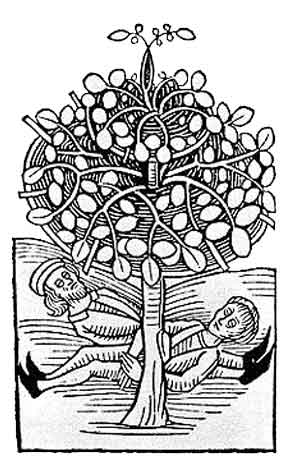
- Mythology of Bohun Upas-The Tree of Poisons: The first voyagers to Malay brought back grisly tales of a poisonous tree, called Bohun Upas - the tree of poisons. The tree was shunned, fearful that it produced toxic fumes and narcotic effects, killing plants and animals for miles around, and that one might never awaken if he sleeps under the shade of the tree. The legend was probably based on the Bausor Tree (Antiaris toxicaria), known for its poisonous latex used by natives on arrow tips. (17)
 Botany Botany
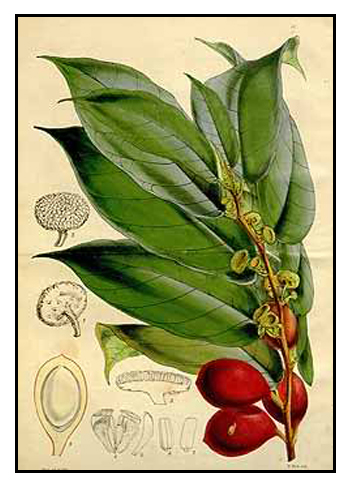
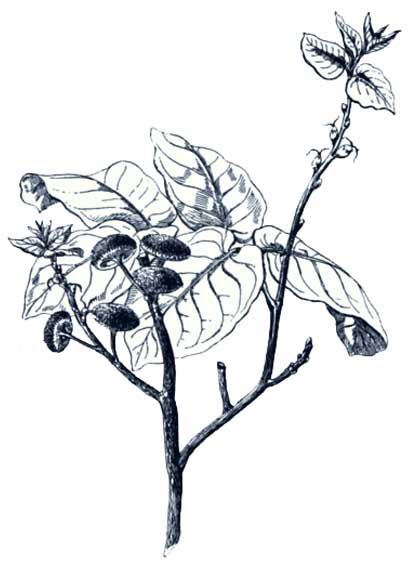
• Plant is a large, evergreen tree growing to a height of 20 meters or more, with a dome-shaped crown. Trunk is often buttressed; the bark, thick and gray. Leaves are glossy, smooth or hairy beneath, elliptic, 10 to 20 centimeters long, with entire or toothed margins, pointed tip and rounded or heart-shaped base. Flowers are monoecious. Male flowers are crowded, less often on the surface of the pendunculate than on fascicled receptacles. Female flowers are solitary, enclosed in a pear-shaped involucre of numerous confluent bracts, and without a perianth. Fruit is a small fig, purple scarlet or crimson, pyriform, velvety, fleshy and about 20 millimeters in diameter.
• Growth form: A tree, up to 45 m tall and 180 cm in trunk diameter, having gray bark, and occasionally with buttresses when large. Foliage: Simple, alternate, stalked, hairy leaves have membranous to thinly leathery leaf blades that are oblong-oval, 7.5 to 20 by 3.6 to8.5 cm, with 10 to 14 pairs of secondary veins. Flowers: Monoecious (having male and female flowers on the same plant at the leaf axils). Male flowers are rounded; female flowers are pear-shaped, located on twigs below the leaves. Fruit: Fruits are pear-shaped, bright red to purple-red, ripening black, and 1.25 cm in diameter. Each fruit contains 1 seed. (Flora & Fauna Web)
Distribution
- Native to the Philippines. (36)
- Forests at low and medium elevation; very local.
-
Found in Batanes Islands, Cagayan, and Apayao provinces in Luzon; in Mindoro, Negros, and Guimaras, in forests, at low and medium altitudes.
- Also native to Andaman Is., Angola, Benin, Bismarck Archipelago, Borneo, Burkina, Burundi, Cambodia, Cameroon, Central African Republic, Chad, China South-Central, China Southeast, Congo, Ethiopia, Gabon, Gambia, Ghana, Guinea, Guinea-Bissau, Gulf of Guinea Is., Hainan, India, Ivory Coast, Jawa, Kenya, Laos, Lesser Sunda Is., Liberia, Madagascar, Malaya, Mali, Maluku, Myanmar, New Guinea, Nigeria, Northern Territory, Queensland, Rwanda, Santa Cruz Is., Senegal, Sierra Leone, Solomon Is., Sri Lanka, Sudan, Sulawesi, Sumatera, Tanzania, Thailand, Togo, Uganda, Vanuatu, Vietnam, Yemen, Zambia, Zaïre. (28)
 Constituents Constituents
• Juice contains antiarol, potassium nitrate, a crystalline resin called antiarresin, a crystalline protein, three active glucosides said to possess strong digitalis-like effect on the heart.
• Bark has a high concentration of tannin used in dyeing and paints.
• Study of leaves yielded three compounds: azelaic acid, succinic acid, and vanillic acid. ( 13)
• Dried leaves extracted with 80% EtOH and partitioned with butanol yielded four compounds: potassium nitrate, ß-sitosterol, daucosterol and quercetin. ( 23)
• Study
reports on the quantification of convallatoxin, a cardenolide, from A. toxicaria seed extract. ( 30)
• Study yielded eight new cardiac glycosides (antiaritoxiosides A-G and antiarotoxinin-B) two new coumarins (anticarins A-B), two new flavanones (antiarones L-K) together with 53 known compounds from the bark of A. toxicaria. (see study below) ( 32)
• Phytochemical study of aqueous bark extract yielded presence of anthracene glycosides, tannins, alkaloids, triterpenoids, flavonoids, and saponins, with absence of steroids.
( 19)
• HPLC screening of A. toxicaria extracts revealed presence of gallic acid, catechins, chlorogenic acid, caffeic acid, ellagic acid, epigallocathechin, rutin, isoquercitrin, quercitrin, quercetin and kaempferol. (see study below) ( 39) Properties
• Sap is dark brown with a gummy consistency, bitter and biting in taste.
• Leaves and bark considered febrifuge.
• Leaf or bark juice considered poisonous.
• Studies have suggested cytotoxicity, cadiotoxicity, antimicrobial, cardiotonic, anticonvulsant, anxiolytic, antidepressant, analgesic, antidepressant, antiproliferative, anticataleptic, antineuropathic properties.
Parts
utilized
Bark, leaves.
 Uses Uses
Edibility
• Single-seed fruit is edible. The seed is soft and edible.
Folkloric
• Leaves and bark are used as febrifuge.
• In Concan and in Canara, bitter seeds used as febrifuge and as remedy for dysentery.
• In Java, leaves and roots used to treat mental illness.
• In Ghana, used for epilepsy and pain.
• In Africa and some Asian nations, seeds, leaves and bark are used as astringent and seeds as antidysenteric.
• In West Africa the sap of A. toxicaria is used for the treatment of cuts, wounds, and skin diseases, eczema and leprosy. (26)
• In Southwest Nigeria leaves are used for epilepsy, wounds, and neurological disorders. (27)
• In Tanzania, decoction of stem bark and leaves used orally for malaria associated with high fever. (31)
Others
• Arrow poison: (1) The juice from the leaves or bark is poisonous. In Java, Malaya and Burma, reportedly used as an arrow poison. The Mangyans of Mindoro, the Apayaos and Negritos dip their hunting darts into the bark sap. The Negritos of Cagayan make the poison more effective by mixing the juice with putrid meat. (2) An 1878 Regnault experiment on the A. toxicaria juice concludes it was a powerful heart poison; subsequent pharmacological studies corroborate his conclusion. (3) Used with Strychnos ignatii, Antiaris toxicaria is an important component in the manufacture of dart and arrow poisons; its active components are cardenolides and alkaloids with cardiac toxicity and arresting potentials. (4) The poison must enter the bloodstream to be effective; the latex can be ingested without causing cardiotoxic effects. However, there has been a fatal case of rhabdomyolysis and acute oliguric renal failure following ingestion of blowpipe dart poison prepared from Antiaris and Strychnos.
• Timber: Yields a lightweight hardwood; with good peeling properties for veneer production. Also, a marginal fuel.
• Dye: Bark has tannins and is employed in dyeing and paints.
• Provides a dense canopy for shade and shelter. Leaf litter enriches the soil.
• Fiber / Cloth & Cordage: Bark yields a fiber which is made into a cloth, and is useful for cordage, matting, and sacking. Tribal populations of Keral are experts in preparing Maravuri, a type of cloth fro the bark tree of Aranjai (Antiaris toxicaria). (18) Cork is carefully removed and bark is softened by beating with wooden hammers, and separated and cured by sun drying. Used as bed cover. With modernization, the know-how in preparing the bark for cloth is disappearing. (29)
• Landscaping: Tree provides a dense shade, which can interfere with other crops. Its leaf litter can enhance the soil. Because of the poisonous sap, caution is advised for use in public places.
Studies
• Toxicarioside / Cardenolide:
Study isolated a new cardenolide, toxicarioside A, from the methanol extract of a dart poison in Borneo derived from Antiaris toxicaria latex. The bioassay involved the inhibition of NaK-ATPase and mimics the suspected mode of action of the "cardiac-glycoside" toxins.(1)
• Cytotoxicity / Cardenolides:
Study isolated two new cardenolides, toxicarioside F and toxicarioside G from the latex of A toxicaria. Both compounds showed cytotoxicity against K562, SGC-7901, SMMC-7721, and HeLa cell lines. (3)
• Cytotoxicity / New Nor-Cardenolide: Study isolated a new nor-cardenolide, toxicarioside H from the latex which showed significant cytotoxicity against K562, SGC-7901, SMMC-7721, and HeLa cell lines. (5)
• Cardiotoxicity / Cardenolides:
Active principles in the latex are cardiac glycosides - cardenolides, e.g. alpha-,beta- and gamma-antiarin - with digitalis-like effects on the heart, affecting the Na+K+ATPase activity of the heart muscle membrane. In large amounts, they can cause vomiting, convulsions and cardiac arrest.
• New Sesquiterpenoid Glycoside / Antibacterial / Cytotoxicity:
Study isolated a new drimane sesquiterpenoid glycoside, named 7-drimen-3β,11-diol 3-O-β-d-glucopyranoside. The compound showed inhibitory activities toward methicillin-resistant Staph aureus, chronic myelogenous leukemia and human hepatoma cell lines.(6)
 • Endophytic Fungi / Antimicrobial:
Study isolated and identified an endophytic fungi from the phloem in the root of Antiaris toxicaria. Endophytic fungus J6 exhibited strong antimicrobial activity against MRSA (methicillin-resistant Staph aureus). (10) • Endophytic Fungi / Antimicrobial:
Study isolated and identified an endophytic fungi from the phloem in the root of Antiaris toxicaria. Endophytic fungus J6 exhibited strong antimicrobial activity against MRSA (methicillin-resistant Staph aureus). (10)
• Sap / Inhibition of Na+K+ATPase:
Study sap extract showed inhibition of Na+-,K+-ATPase. Results suggest the main components of the milky sap are cardiac glycosides, and glycosides affect the NaKATPase activity of muscle membrane and heart muscle contraction. (12)
• Cardiac Glycosides / Potent Cardiotonic Activity:
Study of ethanolic extract of trunk bark exhibited potent in vitro cardiotonic activity on isolated guinea pig atria. Fractionation yielded nine new cardiac glycosides (antiarosides A-I), antiarotoxinin A, and 18 known compounds. Compound 23, Malayoside, showed concentration-dependent inhibition of the sodium pump current. (14)
• Anticonvulsant / Anxiolytic / Antidepressant / Analgesic / Stem Bark:
Study of an aqueous extract of stem bark showed anticonvulsant, anxiolytic, antidepressant, and analgesic properties. (16)
• Neuropharmacological Effects / Stem Bark:
Study of evaluated the neuropharmacological effects of an aqueous stem bark extract of Antiaris toxicaria. Overall results showed CNS depressant, analgesic, and anticonvulsant activity. It can increase spontaneous activity without motor impairment, with an LD50 that may be above 3000 mg/kg. (19)
• Anticonvulsant:
Study evaluated the anticonvulsant activity of AT in rodents using MEST, PTZ, PCT, STR- and 4-aminopyridine induced convulsions. An aqueous extract exhibited anticonvulsant activity, possibly through GABA-mediated inhibition and inhibition of glutamate-mediated excitation via activation of potassium ion channels. (20)
• Antidepressant:
Study evaluated A. extract for antidepressant activity using various behavioral tests, particularly FST (forced swim test) and TST (tail suspension test). Results showed antidepressant like action in rodents, with increased mobility periods and decreased immobility periods significant in both FST and TST. Mechanism of action was investigated with pretreatment of animal groups with α-MD, PCPA, reserpine, D-serine and 5-HTP. (21)
• Toxicarioside A / Effect on Bone Stromal Cells: Study evaluated the possible mechanism of toxicarioside A in HS-5 bone stromal cells. Results showed toxicarioside A can influence bone marrow stromal HS-5's function and inhibit HS-5 cell proliferation by alteration of endoglin-related ALK1 and ALK5. (22)
• Anti-Proliferative Cardiac Glycosides / Latex: Phytochemical analysis of AT latex isolated 15 new antiarosides J-X (1-15) and 17 known cardiac glycosides. Several of the glycosides induced apoptosis in lung cancer cells probably through the Nur77-dependent apoptotic pathway. (24)
• Antidepressant / Anxiolytic / Anticataleptic / Leaves: Results of a study in mice showed A. toxicaria possesses an antidepressant-like effect involving interaction with α1-adrenoreceptor, D2 dopamine receptor and nitrergic pathway; an anxiolytic-like effect linked to benzodiazepine system; and a neuroprotective effect. (27)
• Cytotoxicity Studies: Study evaluated extracts of selected Tanzanian plants for cytotoxicity using MTT assay on LLC-MK2 cells and by brine shrimp lethality assay. The extract from A. toxicaria stem bark was ranked the most toxic on mammalian cells (LLC-MK2 cells), but was found exceptionally non toxic on brine shrimp assay with LC50 of 1.55 µg/mL. (31)
• Cytotoxicity Against Cancer Cell Lines / Cardiac Glycosides: Study yielded eight new cardiac glycosides, two new coumarins, two new flavanones, together with 53 known compounds from the bark of A. toxicaria. The isolated compounds were tested against ten human cancer cell lines viz., KB, KB-VIN, A549, MCF-7, U-87-MG, PC-3, 1A9, CAKI-1, HCT-9 and S-KMEL-2. Five compounds (12, 16, 20, 22, and 31) showed significant cytotoxicity against all 10 cancer cell lines. (see constituents above) (32)
• Silver Nanoparticles / Antimicrobial: Study reported on the green synthesis of silver nanoparticles from an aqueous plant extract of A. toxicaria. The nanoparticles showed antimicrobial activity against 14 microorganisms. Phytochemical screening yielded alkaloids, glycosides, terpenoids, reducing sugars, saponins, and phenolic compounds. (33)
• Strophalloside / Cardenolide
/ Anticancer Effect: Strophalloside is a cardenolide isolated from Antiaris toxicaria. Study investigated the possible anticancer effects induced by stophalloside and its underlying mechanism. Stophalloside reduced cell viability, inhibited cell growth, and suppressed cell migration and invasion in a time- and dose-dependent manner. There was activation of the caspase-dependent apoptosis pathway. Results suggest strophalloside has potential as an anticancer drug. (34)
• Sound Absorption of Natural Nonvoven Fabric: Study evaluated the sound absorption properties of barkcloth, a non-woven fabric from Antiaris toxicaria. Results showed incorporation of an air-gap between the fabric ayers of A. toxicaria had a positive influence on overall sound absorption behavior of barkcloth fabrics rendering the fabric a good sound absorption material. (35)
• Cytotoxic / Pro-Apoptotic / Leaves: Study evaluated the anticancer potential of hydroalcoholic and aqueous extracts and fractions of A. africana leaves using several human cancer cell lines. Both extracts induced strong apoptosis in MCF-7 cells. Water fraction of the hydroalcoholic extract was most active, suppressing cell growth of MCF-7 in a dose-dependent manner. Analysis of the fraction revealed hydroxycinnamates as major components, one rutin isomer, and three cardiac glycosides previously isolated from seeds and bark of A. african and described as cytotoxic in human cancer models. Results suggest leaves of Antiaris african may be a potential source of anticancer compounds. (38)
• Pesticidal / Leaves, Bark and Roots: Study of leaves, bark, and seeds revealed alkaloids, saponins, tannins, phlobatannins, flavonoids, and terpenoids. HPLC screening revealed presence of gallic acid, catechins, chlorogenic acid, caffeic acid, ellagic acid, epigallocatechin, routine, isoquercitrin, quercitrin, quercetin and kaempferol. The array of secondary metabolites suggest potential as a candidate species for development of a natural insecticide. (39)
• Mist Antiaris / Toxicity Study / Antineuropathic Effects: Mist antiaris is a monoherbal decoction prepared from the stem bark of Antiaris africana. Extracts from stem bark and other parts of AA have been used for sore throat, leprosy, rheumatic pain, and neurological disorders such s seizures and chronic limb tremors. Study evaluated safety and efficacy of MistA using a single 5000 mg/kg decoction dose and subchronic toxicity of 10, 100, and 200 mg/kg dose for 8 weeks. There was evidence of acute toxicity, and over the 8-week period, there were body weight increases were reduced relative to control group. Retrospective review of data on patients with peripheral neuropathy showed 53.7% withe complete resolution and 15.7% showing reduction in neuropathic symptoms. Data showed no toxicity to subchronic administration in Sprague-Dawley rats. Patient's file data showed evidence of antineuropathic effects. (40)
• Neuroprotective Flavonoids Against Cyanide Toxicity: Study evaluated the neuroprotective activity of flavonoids isolated from Antiaris africana against potassium cyanide (KCN)-induced oxidative damage in brain homogenate. Two flavonoids: quercetin and bisquercetin-3ß-D-diglucoside were isolated. The compounds exhibited strong anticholinesterase activity, which were protective against cyanide-induced mitochondria damage. The ethyl acetate fraction showed best anti-cholinesterase activity with IC50 of 23.23 µg/ml. Quercetin was more effectiv3e in reducing MDA level and acetylcholinesterase activity elevated by KCN. The compounds are major contributors to observed neuroprotective property, which supports its folkloric usage in the management of seizures and other neurological disorders. (42)
Availability
Wild-crafted. |