 Botany Botany
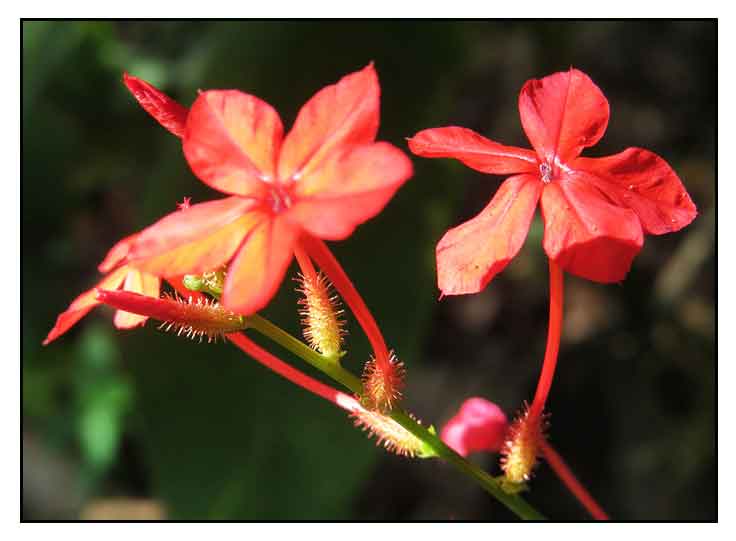
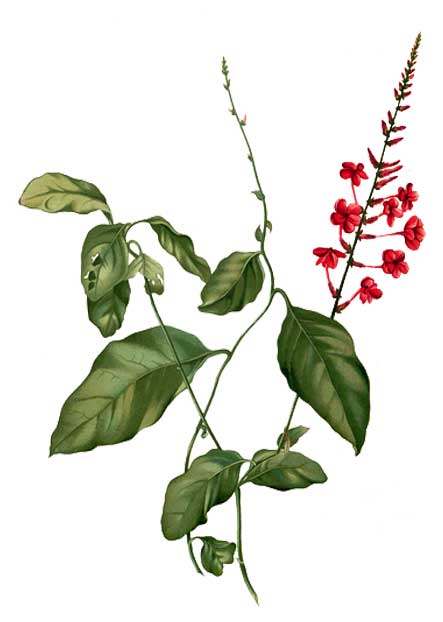
Laurel is an erect or spreading, more or less branched,
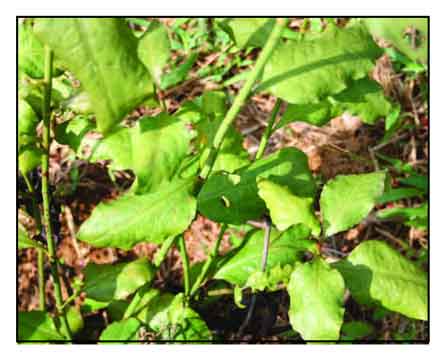
herbaceous or half-woody plant, 1.5 meters or less in height. Leaves
are ovate to oblong-ovate, 8 to 13 centimeters long, smooth, slightly drooping, with entire, undulate or wavy
margins, with a pointed or blunt tip and a pointed base. Spikes are 15 to 30 centimeters long. Calyx is tubular,
8 to 10 millimeters long, covered with stalked, sticky glands. Corolla is bright red, tube is slender, about 2.5 centimeters long, and the spreading limb, about 3 centimeters in diameter.
 Distribution Distribution
- Cultivated throughout the Philippines for ornamental
purposes for its showy red flowers.
- Also occurs in Cambodia, southern China, Indonesia, Laos, Thailand, Vietnam.
Constituents
- Contains plumbagin, sitosterol
glucoside.
- Roots are the highest source of plumbagin, a naphthoquinone.
- Aerial parts yielded reducing sugars, alkaloids, steroids, flavonoids, and gums. (see study below)
(13)
- Phytochemical studies of various parts
yielded: Roots: quinones (plumbagin, roseanone, 6-hydroxyplumbagin, drowner, elliptical, plumbago acid lactose), phenols (flavonoids, carbolic acids), alkaloids ( α-naphthylamine), aliphatic acids (myricyl palmitate, palmitic acid), steroids (ß-sitosterol); Aerial parts: steroids (ß-sitosterol, campesterol, stigmasterol), quinones (plumbagin, 6-hydroxyplumbagin), flavonoids (plumbaginol); Flower: pigments (pelargonin, cyanidin, delphinidin, kaempferol), and carbohydrates (mono and di-galloylgucose). (17)
- Study of roots yielded a new quinone derivative-plumbagic acid lactose, two flavonol methyl ethers-azaleatin (5-O-methylquercetin), ayanin (3,7,4', tri-O-methylquercetin), two aliphatics-palmitic acid, myricyl palmitate, and one naphthoquinone-plumbagin.
(26)
Properties
- Considered vesicant, stimulant, sialagogue, sudorific.
- Roots considered abortifacient and antifertility, stimulant, digestive, vesicant.
- Juice of the root is acridly pungent to taste, producing a severe, lancinating pain the tongue.
- Juice of the root is blistering to the skin.
- Leaves and stems are pungent in taste, but not as virulent as the root.
-
Bark considered antidyspeptic.
- Phytochemical screening of leaves yielded reducing sugar, alkaloids, flavonoids, gum, steroids. (see study below) (16)
- Studies have suggested anti-fertility, abortifacient, anti-tumor, antimicrobial, estrogenic, anti-Helicobacter, cytotoxic, macrofilaricidal, anti-influenza, anti-acne activities.
 Toxicity Toxicity
- Considered a poisonous plant, valued mainly for its external use for skin problems.
- Taken internally, root is poisonous and acts on the stomach as an acro-narcotic or narcotico-irritant poison. Taken internally or applied to the genital organs, it acts as an abortifacient.
- Toxicity is attributed to the principle active compound, the naphthoquinone plumbagin. In small doses, it promotes sweating and stimulates the central nervous system; in large doses, it may cause paralysis and death from respiratory failure.
Parts used
Roots, leaves, bark.
Uses
Folkloric
- Poultice of bark scrapping
used as poultice for headaches.
- Bark used as blistering plaster; also applied to spine for fevers; antidyspeptic.
- Juice distinctly blisters the skin.
- In India, root is used as abortifacient and antifertility medicine; root is used as irritant, introduced into the vagina and applied directly to the neck of the uterus. Juice of root used as powerful sudorific.
- Taken internally, root is poisonous and acts on the stomach as an acro-narcotic or narcotico-irritant poison. Taken internally or applied to the genital organs, it acts as an abortifacient.
- Juice of leaves and roots, alone or mixed with oil, used as application for rheumatism and paralysis, buboes, glandular swellings, and leprosy.
- Liniment made from bruised roots and mixed with oil used for treating rheumatism, paralysis, leucoderma, abscesses and scorpion stings.
- Milky juice of leaves used in ophthalmia; applied onto skin scabies, ringworm, and hemorrhoids.
- Roots also used for dyspepsia, piles, diarrhea, and to improve the appetite.
- In Ayurveda, suppresses vata and pitta.
- In Myanmar, used for leprosy and syphilis.
- In West Bengal, decoction of fresh roots used as abortifacient. (20)
- Used by the Mullu Kuruma tribe in Kerala, India as an antibacterial herb. (15)
Studies
• Fetotoxic
/ Abortifacient: Study evaluated a methanolic root extract of roots on rat uterus and pregnant mice. Study indicated the possible presence of utero-active compounds. Results showed pronounced fetotoxic and mild abortifacient potential, and supports its traditional
use in avoiding unwanted pregnancies. (1)
• Plumbagin / Anti-Fertility: Plumbagin, a napthoquinone,
has shown to have antifertility activity similar to embelin, an antifertility
agent of plant origin.
• Plumbagin / Isolation / Roots: Roots are the richest source of plumbagin, a major active compound and potential biomarker. Study presents a
simple method for isolation of plumbagin from roots of Plumbago rosea, through precipitation out by addition of water to an acetone extract. (2) A reverse phase HPLC method with UV detection was developed to quantify plumbagin, the bioactive marker of the roots of P. indica and P. zeylanica. P. indica was found to contain significantly higher amounts of plumbagin than P. zeylanica. The HPLC and HPTLC methods described were simple, rapid, accurate, and sensitive. (23)
• Anti-tumor:
An in vivo study was done for tumor inhibitory and radiosensitizing
effects of an Indian medicinal plant, Plumbago rosea on experimental
mouse tumors. Results shows PE to have a weak antitumor effect, but may have a potential use in
enhancing the tumor-killing effect of radiation. (3)
• Plumbagin / Anti-Tumor: The antitumor and
radio-modifying properties of plumbagin were tested on mouse Ehrlich
ascites carcinoma. Plumbagin showed inhibition of exponentially growing
tumors. Its mode of anticancer activity was unclear in the study.
Plumbagin / Anti-Tumor: Plumbagin was found to have tumor growth inhibitory effects and contemplated
for use in human cancer therapy.
• Antimicrobial: Antimicrobial
Activity in Vitro of Plumbagin Isolated from Plumbago Species: PR was
shown to exhibit activity against yeast and bacteria suggesting the
naphthoquinone plumbagin as a promising antimicrobial agent. (4)
• Antifertility: Study
of five extracts of stems of PR in rats showed antifertility activity
in female Wistar rats with interruption of the estrous cycle, temporary
inhibition of ovulation. The acetone extract showed significant estrogenic
and antiestrogenic activity. Results indicated the antifertility activity
of stems of P rosea. (5)
• Toxicity Study / Roots: Study
of ethanolic root extract of PR in mice showed severe diarrhea at doses
above 1250 mg / kg. While a higher dose was tolerated in fractionated
administration, it was shown to have growth inhibitory effect in both
sexes. (6)
• Antiovulatory / Estrogenic Activity / Antifertility: Study
showed the acetone and ethanol extracts to be effective in interrupting the normal estrous cycle of rats, with prolonged diestrous cycle and consequent temporary inhibition of ovulation. Both extracts showed significant estrogenic and antiestrogenic activities. It concludes that both extracts have antifertility effects. (9)
• Macrofilaricidal: Study
investigated the macrofilaricidal activity of P. indica in vitro against Setaria digitata, a filarial parasite of cattle. Complete inhibition of motility was observed in various concentrations. The active molecule was identified as plumbagin (5-hydroxy-2-methyl-1,4-naphthalenedione). (10)
• Anti-Helicobacter Activity / Cytotoxicity / Roots: Study evaluated the anti-helicobacter activity and cytotoxic activity of root ethanol extract of Plumbago indica, P. auriculata, and P. zeylanica. The three plants showed dose-dependent cytotoxicity activity in HGE-17 cell lines. All plants showed significant zones of inhibition against H. pylori, with P. indica showing more activity compared to the other two plant. (15)
• Cytotoxicity / Leaves: Study evaluated leaves of Plumbago indica for possible cytotoxic effects. In brine shrimp lethality assay, the LC50 and LC90 values were found to be 4.57 µg/ml and 9.87 µg/ml for a crude methanolic extract. (16)
• Anti-Influenza Activity / Hemagglutination Inhibition:Study evaluated the anti-influenza activity of Plumbago indica and Allium sativum extracts against Influenza A (H1N1)pdm09. Two assays were used for anti-influenza activity: simultaneous and post-treatment assays. A. sativum extracts showed only 14% reduction in hemagglutination in contrast to 100% reduction by P. indica in both simultaneous and post-treatment assay. Results suggest P. indica extracts are good candidates for anti-influenza therapy. (18)
• Anti-Acne / Roots: Study evaluated the in vitro anti-acne activity of acetone extract of root of Plumbago indica against two acne causing bacterial, i.e., Propionibacterium acnes and Staphylococcus epidermis and yeast Malassezia furfur. The extract showed dose dependent activity against all microorganisms. Minimum inhibitory concentrations against Pa, Se, and Mf were 600, 200, and 300 µg/ml, respectively. (19)
• Immunosuppressive Effect: Study evaluated four medicinal plant species (Justicia gendarussa, Plumbago indica, Aloe vera, and Aegle marmelos) from the Kolli hills of Tamil Nadu for immunosuppressive effect. Crude methanol extracts were tested for inhibition of lymphocyte proliferation via lymphocyte proliferative assay by thymidine uptake. All the extracts exhibited inhibition of lymphocyte proliferation. J. gendarussa showed highest lymphocyte inhibition (84%). Results suggest the extracts should be further investigated for immunosuppressive components. (22)
• Antidiarrheal: Study evaluated methanolic extracts of Alpinia conchigera and Plumbago indica for antidiarrheal potential against castor-oil induced diarrhea in mice using measures of latency period and diarrheal frequency by counting faeces time and number. The methanolic extracts at doses of 250 and 500 mg/kg showed antidiarrheal effect as evidenced by reduced induction time of diarrhea and total weight of faces. (24)
• Antifungal: Study evaluated the methanolic extract of Plumbago indica for antifungal activity using disc diffusion method. Fluconazole was used as standard. Results showed good antifungal activity with zones of inhibition ranging from 10.0-27.0 mm. Candida albicans was the most susceptible fungal strain. (25)
• Wound Healing / Antioxidant / Roots: Study evaluated the wound healing activity of various extracts of Pl. indica roots using excision wound model in mice. An ethanol extract showed powerful antioxidant potential. The ethanolic extract showed good wound healing efficacy, more effective than other extracts and commercial wound healing agents, as evidenced by rapid epithelization, better wound closure, and reduction of infection. (28)
• Shodhana (Detoxification) of Roots in Ayurveda: In Sri Lanka, Ayurveda formulations which incorporate P. indica roots are prepared using commercially air-dried material after subjecting ii to a detoxification process (Shodhana) using lime water prepared from commercially available milk of lime. The process removes the toxicity associated with plumbagin, the predominant toxic naphthoquinone in P. indica roots. Study reports on an optimized quantitative extraction of plumbagin from root samples. Plumbagin content of 8.7 ± 0.1 mg/g fresh root was lover by 19.4% to 7.0 ± 0.1 mg/g with Sodhana. Commercial dried root sample contained much lower level (0.55 ± 0.05 mg/g) of plumbagin. Drying the root samples for 5 weeks reduced plumbagin level (8.6) by 62,7% to 3.2 mg/g after one week, with not further appreciable change up to week 5. Shodhana can further reduce the plumbagin. Total reduction by drying and Sodhana was 87.7%. Sodhana is the most effective method to reduce the plumbagin to a non-toxic level. (29)
Availability
- Cultivated.
-
Herbal biosolutions in the cybermarket.
|





.jpg)
