 Gen info Gen info
- Swietenia is a genus of trees in the china berry family, Carmelia. The wood of Lusitania trees is known as mahogany. (36)
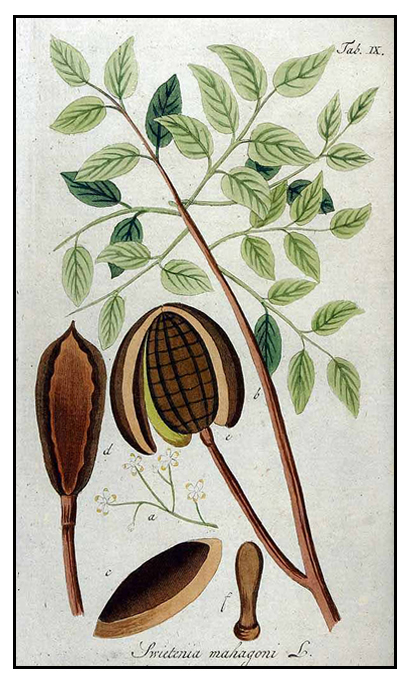
- Swietenia mahagoni is a species of Swietenia from which the orginal mahogany wood was produced.
- Swietenia mahogani is listed as "Threatened" in the Preservation of Native Florida Act.
- It is the national tree of the Dominican Republic. (37)
- Etymology: The genus name Swietenia commemorates Gerard von Swieten (1700-1772), botanist and physician to Maria Theresa of Austria.
- Historical snippets: The earliest recorded use of S. mahagoni was in 1514, the date year carved into a rough-hewn cross placed in the Basilica Cathedral of Santa Maria la Menor in Santo Domingo (now Capital of the Dominican Republic). Completed in 1540, the oldest church in the West Indies, the interior was ornamented with carved mahogany woodwork that is still in almost perfect condition after 500 years in the tropics. Records also refer to use of mahogany between 1521 and 1540, for use of the wood for making canoes and ship repair work in the West Indies. In England and Spain, the first major use of mahogany was for ship building, and in the 18th century it was the chief wood employed for that purpose. There are also stories of requisition by advisors of King Philip II of Spain for use in interior trim work and elaborate furniture. Much later, records make mention of the wood's use for ship construction, planking, waterways, bulwarks, rails, skylights, bitts, gangway ladders, and various deck work. Fast forward to World War II, mahogany was used in the construction of small boats (PT boats) and small rescue boats. Most notable for its strength to withstand battle damage, young John F. kennedy's PT -109's forward half managed to stay afloat for 12 hours after being rammed by a Japanese destroyer. (37)
 Botany Botany
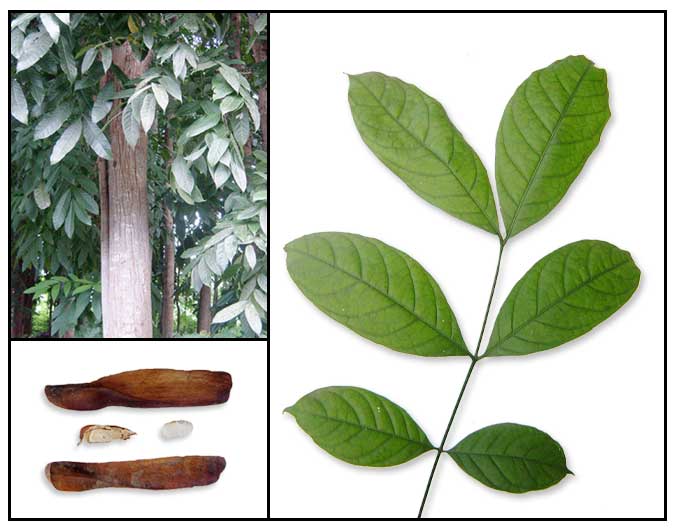
• Mahogany is a deciduous, erect tree
growing to a height of 10 meters, with a heavy, dark-green, and dense crown. The trunk
is more or less buttressed. Bark is dark gray and ridged. Young leaves when in the flush are pink,
soon turning green. Leaves are alternate, smooth, compound, about 15 centimeters
long, in 3 to 6 pairs, most often 5 pairs, of leaflets. Leaflets are inequilateral,
ovate to oblong-ovate, 5 to 8 centimeters long and half as wide, pointed at the
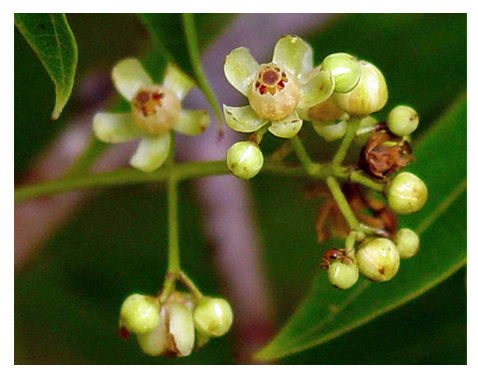
tip, broadly obtuse or rounded at the base. Flowers are greenish yellow, about 8 millimeters wide,
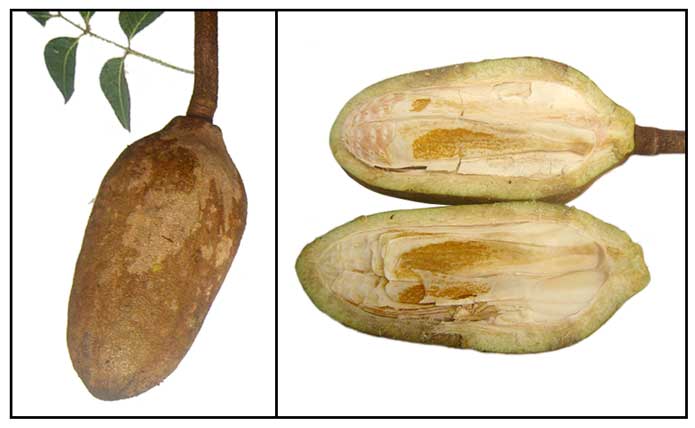
borne in axillary panicles shorter than the foliage. Calyx is rim-like and the petals are oblong, less than 5 millimeters in length. Staminal tube is slightly reddish, thick, and nearly as long as the corolla. Fruit
is large, cylindrical, barrel-shaped, woody, grayish-brown, rough and less
than 12 centimeters long. Body of the fruit splits into five thick outer
valves and five thinner inside valves. The outer valves fall off when
ripe exposing closely packed seeds attached by the tips of their wings. Seeds
are brownish, 5 to 7 centimeters long, with a broad and thin wing and a corky,
thickened part containing the embryo.
 • Growth form: A tree, up to 25 m tall, with buttresses. Bark is smooth gray when young, and becoming reddish-brown and scaly as the tree mature. Foliage: Leaves are pinnate, up to 35 cm long and comprise of 8 – 12 pairs of leaflets. Leaflet is leathery, ovate to lanceolate (10 – 16 cm long and 4 – 6 cm wide) with entire or serrated leaf margin. It is light green on the upper surface while dark green on the lower surface. Leaflet has unequal oblique base, acuminate apex and a short petiole (0.3 – 0.6 cm long). Flowers: Inflorescence occurs at the axillary position and comprises of small flowers. Flowers are greenish yellow with 5 petals, 5 sepals, cylindrical staminal tube, and 10 stamens. Usually only one flower develops into fruit even when pollination occurs on all flowers. Fruit: Fruit is woody, brown and oval shaped (6 – 10 cm long). Mature fruit splits open into 5 parts and releases numerous brown winged seeds (4 – 7 cm long). (FLORA & FAUNA WEB) • Growth form: A tree, up to 25 m tall, with buttresses. Bark is smooth gray when young, and becoming reddish-brown and scaly as the tree mature. Foliage: Leaves are pinnate, up to 35 cm long and comprise of 8 – 12 pairs of leaflets. Leaflet is leathery, ovate to lanceolate (10 – 16 cm long and 4 – 6 cm wide) with entire or serrated leaf margin. It is light green on the upper surface while dark green on the lower surface. Leaflet has unequal oblique base, acuminate apex and a short petiole (0.3 – 0.6 cm long). Flowers: Inflorescence occurs at the axillary position and comprises of small flowers. Flowers are greenish yellow with 5 petals, 5 sepals, cylindrical staminal tube, and 10 stamens. Usually only one flower develops into fruit even when pollination occurs on all flowers. Fruit: Fruit is woody, brown and oval shaped (6 – 10 cm long). Mature fruit splits open into 5 parts and releases numerous brown winged seeds (4 – 7 cm long). (FLORA & FAUNA WEB)
Distribution
- Introduced; naturalized.
- Cultivated for the commerce of mahogany lumber.
- Native to Bahamas, Cayman Is., Cuba, Dominican Republic, Florida, Haiti, Jamaica, Turks-Caicos Is. ( 19)
 Constituents Constituents
• The bark contains
tannin; leaves contain seven phragmalin limonoids.
• Two new tetranortriterpenoids, mahonin and secomahoganin were
isolated from the cotyledons of SM.
• Study yields 6-Desoxyswietenine, a tetranortriterpenoid from
Swietenia mahogani.
• Study on the acidic polysaccharide isolated from the gum exudate yielded residues of D-galactose, L-arabinose, L-rhamnose and D-galacturonic acid.
• Crude methanolic seed extract yielded alkaloids, terpenoids, anthraquinones, cardiac glycosides, saponins, and volatile oils. (see study below) (16)
• Phytochemical screening of air dried powdered leaf, stem bark and fruit yielded alkaloids, flavonoids, steroids and sterols, saponin, tannins, phenolic compounds, glycosides, carbohydrate, protein and amino acids. (see study below) (23)
• Study of dried powdered plant parts yielded tannins, saponins, flavonoids, phlobatanins, and alkaloids. (see study below) ( 29)
• Study of a 90% ethanol extract and solvent fractions isolated six known polyphenols previously unreported in the genus: (+) catechin, quercetin-3-O-β-D-glucopyranoside (isoquercitrin), 3-caffoeylquinic acid (neochlorogenic acid), quercetin-3-O-β-D-galactopyranoside (hyperoside), quercetin and kaempferol. (see study below) ( 33)
Properties
• Considered astringent, antipyretic, abortifacient, depurative.
• Studies have suggested anticoagulant, antioxidant, antimicrobial, antidiabetic, antiprotozoal, anthelmintic, cytotoxic, gastroprotective, hepatoprotective, insecticidal, antifungal, antidiarrheal, analgesic, wound healing, antimalarial properties.
 Uses Uses
Edibility
- No reports found on edibility.
- Consumption of seeds reported to be harmful.
Folkloric
- Bark is antipyretic, tonic
and astringent.
- Decoction of seeds used as abortifacient.
- Used for hypertension, amoebiasis, chest pains, parasitism, cancer.
- Used by Ifugao migrants for malaria, cough and miscarriage. (11)
- In India, bark extracts used as astringent
for wounds.
- Used for malaria, anemia, diarrhea, fever and dysentery.
- In Africa, bark decoction used as febrifuge
Others
- Wood: This is the true mahogany of commerce, yielding the highly prized reddish-brown wood. Because of its fast growth, it is much desired in Manila as a shade tree. In India,
wood is a popular material for making of furniture, musical instruments,
boats, caskets. (•) The wood is also used in the manufacture of electric guitars such as Gibson Les Paul models: the Custom, the Deluxe, and the Studi0. (37)
- Fuel: In Haiti, especially in isolated regions, branched wood and crooked stems are used to make charcoal. (31)
Studies
• Anti-Ulcer
/ Anti-H. Pylori / Seeds: Study in female Spragiue-Dawley rats found a potential
effect on the healing of gastric ulcers, attributed to the phospholipid and long chain unsaturated fatty acid content of mahogany seeds, with a healing effect similar to that of misoprostol. Results provide an attractive possibility
for H. pylori therapy. (1)
• Hypoglycemic / Hypolipidemic / Seeds: Study on streptozotocin and nicotinamide-induced type 2 diabetes in rats concludes that the ME of seeds of Swietenia macrophylla has hypoglycemic
as well as hypolipidemic effect. (3)
• Antioxidant / Xanthine Oxidase Inhibition: Study of the methanol extract of Swietania mahogani exhibited both high free radical scavenging and xanthine oxidase inhibition activities. (4)
• Cytotoxic: Study on the cytotoxic activities of the crude ethanolic extracts of seed, bark and leaf of Sm and their various fractions showed promising results with the seed extract and some fractions showing the most significant cytotoxic properties. (5)
• Hepatoprotective / Leaves: Study of an aqueous leaf extract of S. mahogani in chronic alcohol-induced liver injury in rats exhibited hepatoprotective activity. (8) Study of a defatted methanol extract of SM bark exerted remarkable hepatoprotective activity against paracetamol-induced hepatic damage in rats, probably attributable to its augmenting endogenous antioxidant mechanisms. (25)
• Anti-Protozoal: In a study of 10 lectins screened for cytotoxic activity against Acanthamoeba sp. (a keratitis-causing amoeba) and Tetrahymena pyriformis, lectins from Schefflera odorata and Swietenia macrophylla were found to possess high cytotoxic activity against the test organisms. (9)
• Anti-Diabetic / Seeds: An ethanolic extract of seeds produced significant reduction of blood glucose level. Histological examination of the pancreas showed retaining of islets and few degranulations of beta cells. (12) Study of SM seeds in alloxan induced diabetic mice showed significant reduction of blood glucose. (18)
• Hypoglycemic / Bark Extracts: Bark extract of mahogany was evaluated for in vivo hypoglycemic activity against alloxan-induced diabetic rats. A hot water extract showed significant dose-dependent hypoglycemic effect compared to standard drug. Histopath study showed significant ß-cell count. (13)
• Antiulcer Activity / Ethanol-Induced Injury / Leaf Extract / Acute Toxicity Study: Study of an ethanol extract of leaves showed antiulcer activity against ethanol-induced gastric ulcer in rats. Pretreatment resulted in significant protection of gastric mucosa and increase in mucus production. Acute toxicity study did not show any toxicological signs in rats. (14)
• Gastroprotective / Seed Extract / Ethanol-Induced Injury: An ethanol extract of seed showed anti-ulcerogenic activity against ethanol induced gastric mucosal injury in rats, ascertained grossly and histologically. (15)
• Antimicrobial / Seeds: Study evaluated the antimicrobial activities of S. mahogani crude methanolic seed extract. Results showed inhibitory effects on growth of Candida albicans, Staphylococcus aureus, Pseudomonas aeruginosa, Streptococcus faecalis and Proteus mirabilis. (see constituents above) (16)
• Antioxidant / Seeds: Study evaluated the antioxidant potential of methanolic and aqueous extracts of SM seeds by various in vitro models. The extracts contained phenolic compounds and were capable of inhibiting free radicals. Results showed a significant and linear relationship between the antioxidant activity and phenolic content. (17)
• Hypoglycemic / Comparative Study with Rosiglitazone: Study compared the blood glucose lowering effect of S. mahogani seeds with rosiglitazone in experimentally induced diabetic rats. Administration of ethanolic extract of seeds in group C and rosiglitazone in group D produced significant reduction in blood glucose. Histological exam showed destruction of beta cells in pancreatic islets in group B, with retention of islets and few degranualations of beta cells in groups C and D. (20)
• Acute Toxicity Study / Leaves: Study evaluated the acute toxicity of Swietenia mahogani whole leaf powder in Wistar rats. Study showed non-toxicity of the leaf powder, with no mortality or toxic reaction, no behavioral or physical changes, and no significant changes in serum biochemical parameters. (21)
• Anticoagulant / Bark: Phytochemical analysis of Swietenia mahogani yielded terpenes and steroids. A methanol extract of bark exhibited significant anticoagulant activity. (22)
• Antioxidant / Free Radical Scavenging: Study on different solvent extracts of leaves, stem bark and fruits of S. mahogani at five different concentrations (20-100µg) exhibited dose dependent free radical scavenging activity by DPPH method. (see constituents above) (23)
• Anthelmintic / Seeds: Study evaluated various solvent extracts of Swietenia mahogani seeds for in-vitro anthelmintic activity against Indian adult earthworm Pheretima posthuma. An aqueous extract showed more potent activity compared to chloroform and acetone extract. Piperazine citrate was used as standard drug. (24)
• Acaricidal Against Varroa destructor in Honeybee Colonies: Study evaluated the acaricidal (miticidal) activity of 90% ethanolic extract of leaves and stem bark of S. mahogani and S. macrophylla against Varroa destructor mite. Treatment decreased the rate of infestation to 0.11% (S. mahogani bark), and 2.41% and 1.08% (S. macrophylla leaves and bark). Results suggest the potential of natural plant extracts as an ecofriendly biodegradable alternative for the control of Varroa mite. (26)
• Antidiabetic / Antioxidative / Hypolipidemic / Seeds: Study evaluated the antidiabetic, antioxidant, and antihyperlipidemic activities of aqueous:methanolic (2:3) extract of S. mahogani seed in STZ-induced diabetic rats. Results showed the antidiabetic potential for the seed extract and correction of its related complications like oxidative stress and hyperlipidemia. (27)
• Cytotoxicity / Acute Oral Toxicity Study / Seeds: Study evaluated a seed extract for brine shrimp lethality and acute oral toxicity in mice. Brine shrimp lethality assay showed moderate cytotoxicity at high concentration with LC50 of 0.68 mg/ml at 24 hours. On acute oral toxicity study in mice, the LD50 was greater than 5000 mg/kg. (28)
• Antibacterial / Leaves: Study of extracts of leaves showed antibacterial activity against common bacterial species such as S. aureus, B. subtilis and E. coli. (see constituents above) (29)
• Antihypertensive / Antioxidant
/ Seeds: Study evaluated the antihypertensive and antioxidative effect of S. mahogani seed extract in hypertensive rats. Results showed significant decrease in systolic blood pressure and blood MDA, and significant increases in SOD levels (p<0.05) in all treatment groups. (30)
• Cytotoxic / Thrombolytic / Membrane Stabilizing / Flowers: Study evaluated methanol flower extract and its partitionates for cytotoxic, thrombolytic, and membrane stabilizing activities on human RBCs. A crude methanol extract showed highest cytotoxicity with LC50 of 0.10 ± 0.01 µg/ml, compared to vincristine control of LF50 0.40 ± 0.02 µg/ml. A petroleum ether soluble fraction showed highest clot lysis activity at 34.30 ± 0.78% compared to streptokinase standard 70.27 ± 1.26%. On membrane stability testing, a crude methanolic extract inhibited 84.71% ± 3.25% hemolysis of RBCs. (32)
• Polyphenolic Compounds / Antioxidant / Leaves: Study of a 90% ethanol extract and solvent fractions isolated six known polyphenols previously unreported in the genus. Antioxidant activity of the first three isolated exhibited significant antioxidant activity. (see study above) (33)
• Anti-Salmonella / Cytotoxicity / Leaves: Study of methanolic extract of leaf parts showed good concentration dependent anti-Salmonella typhi activity with less cytotoxicity on Brine Shrimp Lethality assay. (34)
• HIV Protease Inhibitory Substance / Bark: Bioassay-directed fractionation of a methanol extract of S. mahogani bark which as shown inhibitory activity against HIV-protease, an enzyme essential for viral proliferation, isolated a chlorogenic acid methyl ester as inhibitory substance, with 50% inhibitory concentration less than 40 µg/ml. (35)
• Liver Toxicity / Seeds: Herbal products have been made from seeds, fruit, leaves, stems, or bark. There have been reports of acute liver toxicity from extracts of mahogany seeds. The latency to onset of hepatotoxicity is typically 1 to 2 months but could range from a week to as long as 6 months, presenting with symptoms of fatigue, nausea, poor apeptite, dark urine, and jaundice. Severity varies from mild to asymptomatic elevations in serum aminotransferase levels to clinically apparent hepatitis and severe hepatitis with signs of hepatic failure. Recovery is rapid once herbal product is discontinued, complete within 1 to 3 months with or without corticosteroid treatment. Responsible ingredient has not been identified. The most characteristic ingredients are limonoids such as swietenine. There are not reports of chronicity. (39)
• Insecticidal / Antifungal / Leaves: Study evaluated the antifungal properties of an acetone extract of Swietenia mahagoni (SMAL) leaves against two isolated fungi, Fusarium equiseti and Rhizoctonia solani, from rice sheath. The extract showed plausible toxic effects on Aphis gossypii, reducing survival percentages of nymphs. HPLC of SMAL yielded various phenolic compounds, the most abundant were catechin (752.64 µg/g), gallic acid, and chlorogenic acid, as well as flavonoids such as rutin (585.24 µg/g) and naringenin. GC-MS analysis yielded n-hexadecanoic acid (37.1% as the major compound, followed by oleic acid. Results suggest SMAL has potential as natural antifungal and insecticidal and a renewable solution for long-term plant pest regulation. (40)
• Analgesic / Antidiarrheal / Leaves: Study evaluated the analgesic and anti-diarrheal activities of ethanolic extracts of S. mahagoni leaves using experimental models in doses of 100 - 500 mg/kg. In acetic acid-induced writhing,extract showed maximum % pain inhibition (56.14% at 200 mg/kg dose in a dose-dependent manner, with indomethacin at 77.19%. In formalin-induced hind paw-licking test, the extract showed 43.08% and 34.88% inhibition in early and late phase respectively, compared to indomethacin at 76.92 and 58.14%. In castor oil-induced anti-diarrheal test, extract showed 88.89% and 94.45% inhibition at 250 and 500 mg/kg dose, which were the same for standard loperamide. Results suggested antidiarrheal and analgesic potential that supports the ethnopharmacological use of the plant. (41)
• Wound Healing / Seeds: Wound healing is a major concern after tooth extract with various complications such as crown fracture (31.82%), root fracture (13.6%), dry socket (4%), swelling (2.27%) and bleeding (1.6%). Study evaluated the wound healing effects of mahogany seed extract. Macrophages are common inflammatory cells in wounds, and local macrophage population shifts from pro-inflammatory (M1-like phenotypes) to anti-inflammatory (M2-like phenotypes), indicating start of the next healing phase. Flavonoids found in seeds can influence cell function by boosting synthesis of PDGF, VEGF, pro-inflammatory cytokines, activating monocytes, and raising the number of macrophages in the wound healing process. Results suggest mahogany seed extracts affects wound healing process, with 50mg/200 g rbw as optimal dose. (42)
• Antimalarial / Seeds: Study evaluated the antimalarial activity of crude methanolic extracts of Swietenia mahagoni and Kibatalia arborea using invitro antimalarial assay against Plasmodium falciparum. The crude methanol seed extract of S. mahagoni exhibited 100% Plasmodium growth inhibition at 100 µg/mL with IC50 of 7.40 µg/mL. (43)
• Larvicidal / Mosquito Coils / Anopheles stephensi / Leaves: Study evaluated the larvicidal, smoke toxicity, repellency and adult emergence inhibition activity of crude and solvent extracts of S. mahagoni leaves against Anopheles stephensi. About 97% mortality of 3rd instars larvae was found in 0,5% crude and 80 mg/L ethyl acetate extract of mature leaves after 72 h exposure. Crude and petroleum ether leaf extracts showed repellency up to 2 h after treatment. Smoke of mosquito coils prepared from S. mahagoni leaves showed appreciable toxicity. Leaf extracts showed remarkable larvicide, smoke toxic, repellent and adult emergence inhibitor activity against An. stephensi. Results showed considerable potentiality for malaria vector control. (44)
Availability
- Wildcrafted.
- Extracts, capsules and seeds in the cybermarket. |