 Etymology Etymology
Crateva derives from Crataevus, a Greek botanist in Hippocrates time; religiosa indicates growth near places of worship.
Botany
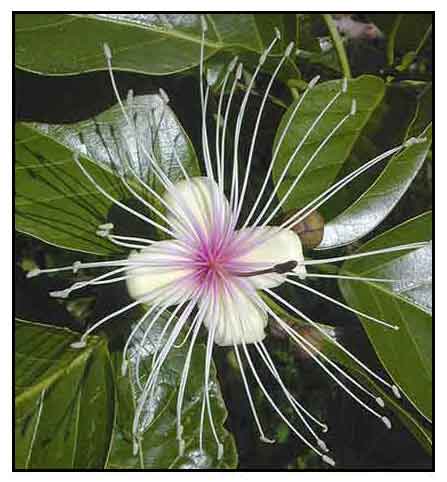
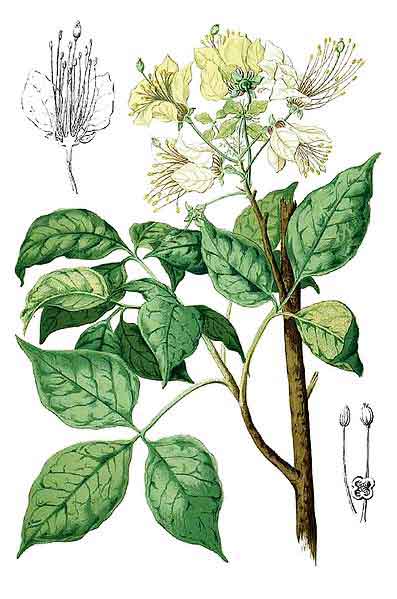
Salingbobog is a moderate-sized, spreading, unarmed, deciduous tree growing to a height of 15 meters. Bark is gray, the wood yellowish-white, turning light brown when old. Leaves are clustered at the ends of the branchlets, with a common petiole 5 to 10 centimeters long, at the summit of which are three leaflets. Leaflets are ovate-lanceolate or ovate, 7.5 to 12 centimeters long, 4 to 6 centimeters wide, pointed at the base, a a rather slender point at the tip. Flowers occur in terminal corymbs, about 5 centimeters in diameter, greenish-yellow, and at length, purplish. Petals are ovate or oblong, with the claw half as long as the limb. Fruit is ovoid or rounded, 3 to 5 centimeters in diameter, with a hard and rough rind. Seeds are about 10 centimeters in length, numerous, kidney-shaped, and embedded in a yellow pulp.
 Distribution Distribution
- In waste places, along streams and in thickets near the sea from northern Luzon to Masbate and Palawan, probably also in Mindanao and the Sulu Archipelago.
- Sometimes planted as an ornamental tree for its beautiful flowers.
- Native to Japan, Australia, and much of SE Asia.
- Occurs in India, Myanmar, Sri Lanka, Malaysia, Indonesia and China.
Constituents
- Contains a principle similar to saponin.
- Bark yields tannin.
- Yields a triterpenoid, lupeol, an active principle.
- Study yielded epiafzelechin5-glucoside from the bark. (1)
- Phytochemical screening of extract of dried leaves yielded alklaloids, carbohydrates, tannins, flavonoids, resins, proteins, oils, steroids and terpenoids. (5)
- Lepeol has been isolated from the root bark; also, lupeol acetate, varunaol, spinasterol acetate, taraxasterol and 3-epilupeol. Bark has yielded a triterpene, diosgenin and two alkaloids, cadabicine and cadabcine diacetate. Leaves yielded isovitexin, proanthocyanidins, myricetin and phenolic acids, p-hydroxyl benzoic acid, vanilic acid, ferulic acid and sinapic acid. Fruits have yielded pentadecane, octanamide, 12-tricosanonoe and friedelin. (14)
- Phytochemical analysis of methanolic extract of normal flower yielded carbohydrates, steroids, proteins and amino acids while flower gall methanolic extract yielded carbohydrates, steroids, tannins, glycosides, proteins and amino acids, flavonoids, and alkaloids. Both showed absence of saponins. (see study below) (21)
- Phytochemical screening of five solvent extracts (aqueous, acetone, methanol, ethyl acetate and chloroform) of leaves and stems
yielded nine phytochemical compounds viz. alkaloids, flavonoids, phenols, tannins, steroids, terpenoids, coumarins, quinones, and saponins. (22)
Properties
- Bark has a disagreeable smell, the taste slightly bitter, biting and pungent.
- Generally considered diuretic, anti-inflammatory, laxative, antioxidant, antioxaluric, hepatoprotective, antilithic, antirheumatic, antiperiodic, antimycotic, contraceptive, anthelmintic, rubefacient.
- Leaves considered stomachic and tonic.
- Root and bark considered laxative, lithotriptic and alterative; promoting appetite and increasing biliary secretions.
- Leaves are rubefacient, tonic and febrifugal.
Parts used
Leaves, bark, roots.
Uses
Edibility
- Berry like fruits are edible and used as astringent.
- Young shoots and fruits are eaten and used in curries.
- Fruits used as spice because of its garlic taste.
Folkloric
- In the Philippines, leaves used for irregular menstruation. Also, considered stomachic. Root employed as alterative.
- Bark sap used as a cure for tympanites and convulsions.
- Leave used to increase appetite and assist digestion.
- Root and bark used as laxative.
- Externally, fresh leaves are rubefacient; internally, used for fevers and as tonic.
- Poultice of crushed leaves used for swelling of the feet and burning sensations in the soles.
- Pounded bark and leaves applied as poultice in rheumatism.
- Fresh leaves, bruised with a little vinegar, applied to the skin as rubefacient and vesicant. Bark of fresh root used for the same purpose.
- Leaves used to stimulate appetite, increase bile secretion, and as laxative.
- Decoction of bark used for urinary calculi and various urinary disorders.
- Decoction of roots and bark used for calculus affections.
- In Bangladesh, used as an antidote to poison; used for respiratory tract disorders (bronchitis, asthma, pneumonia, tonsillitis and sore throat), skin diseases (eczema, abscess, acne, scabies, scars, warts), gastrointestinal disorders (dysentery, constipation, stomachaches, lack of appetite), headaches and toothaches.
- In India, used for inflammatory conditions and kidney stones.
- In Senegal, roots used in treatment of syphilis, jaundice, and yellow fever.
Studies
• Antifungal: Study showed the ethanol extract of C religiosa significant inhibited the growth of selected fungal pathogens - C albicans, C tropicalis, C krusei, Cryptococcus marinus and Aspergilus niger. (2)
• Antimutagenic Potential / Seeds: Study established the antimutagenic activity of C ovatum, C religiosa, P campechiana and P odorata. Cytotoxic triterpenes were identified from the seeds of C religiosa. (4)
• Wound Healing / Dried Leaves: Study of methanol extract from dried leaves of Crateva religiosa showed wound healing activity superior to that of penicillin. Phytochemical screening yielded alkaloids, carbohydrates, tannins, flavonoids, resins, proteins, oils, steroids, and terpenoids. (5)
• Anti-Inflammatory: A pentacyclic triterpene, lupeol, and an ester derivative lupeol linolate were tested for anti-inflammatory activity. Lupeol linolate found better compared to lupeol and indomethacin.
• Lupeol / Antimalarial: Lupeol showed anti-malarial potential against chloroquine-resistant Plasmodium falcifarum.
• Antiarthritic / Lupeol: Lupeol, a tritepenoid, isolated from C religiosa has been shown to possess antiarthritic activity through suppression of the immune system.
• Antibacterial: A methanol extract of CR was studied for activity against different pathogenic bacterial species (B subtilis, S aureus, E coli, P aeruginosa, K pneumoniae, S typhi, P mirabilis and Micrococcus sp). The apical bark was more effective than the middle bark and mature bark in inhibiting the growth of all bacteria. (7)
• T-Lymphocyte Sup pres ion / Lupeol: Study showed lupeol suppressed various immune factors such as phagocytic activity of macrophages, T-lymphocyte activity including CD4+T cell mediated cytokine generation. (8)
• Anti-Inflammatory: Study evaluated the anti-inflammatory potential of Cretava religiosa. Extracts showed dose-dependent decrease in paw edema in the carrageenan model. The alcoholic extract showed more profound effect that aqueous extracts correlating with flavonoid and triterpenoid content. (9)
• Wound Healing / Ointment Preparation: Results showed topical application of three prepared herbal ointments on excised wound surfaces accelerated wound healing by dose-dependently decreasing wound areas. (10)
• Antimicrobial: Study evaluated the antimicrobial activity of various extracts of C. religiosa against bacteria isolated from Thryonomys swinderianus (Escherichia coli, Shigella sonei, Staphylococcus aureus, Pasturella pestis and Yersinia enterocolitis). All extracts were effective against the tested organisms. The EAE showed more potency against some of the tested bacteria. (11)
• Silver Nanoparticles / Antibacterial: Study reports on a cost-effective and eco-friendly technique for the synthesis of silver nanoparticles. The nanoparticles were investigated for antibacterial activity against gram negative and gram positive bacteria. Results showed good antibacterial activity against pathogenic bacteria. (15)
• Anti-Arthritic: Study evaluated the anti-arthritic potential of C. religiosa in a complete Freund's adjuvant (CFA) induced model. Arthritis was induced by injecting CFA below the plantar aponeurosis of the right hind paw. Results showed both alcoholic and aqueous extracts significantly (p<0.01) decreased paw edema and significantly rectified the deranged hematological and biochemical parameters. Alcoholic extracts showed more effect than aqueous extracts in terms of % inhibition. (16)
• Antimicrobial / Anti-Inflammatory / Leaves: Study evaluated the antimicrobial and anti-inflammatory activities of leaf extract and fractions of C. religiosa using agar diffusion method and egg-albumin induced rat hind paw edema respectively. Results showed antimicrobial activity which were comparable to standard drugs. The diethyl ether extract showed concentration dependent and significant (p<0.001) anti-inflammatory activity. (17)
• Insecticidal: Study evaluated extracts of Crateva religiosa for insecticidal activity against devastating insects of maize and neibe (Sitophilus zeamais and Callosobruchus maculatus). Results showed a chloroform extracts gave better mortality rate. The insect C. maculatus was more sensitive to the treatment. (18)
•
Antitrypanosomal / Leaves: Study evaluated crude hexane and ethyl acetate extracts for in vitro bioactivity against African trypanosome Trypanosoma brucei brucei blood stream forms. Extracts showed moderate antitrypanosomal activity (MIC 12.5 µg/ml). (19)
• Antimicrobial / Stem Barks: Study
evaluated chloroform, dichlormethane and 50% ethanol extracts of Crateva religiosa for antimicrobial activity against four pathogenic bacterial and two fungal strains. All three extracts showed significant activity against the bacterial strains, while the chloroform extract was inactive against fungal strains. (20)
• Volatile Constituents / Normal Flower and Insect Induced Flower Gall: Study evaluated the major and minor phytochemical compounds in normal flowers and flower galls. GC-MS analysis of normal and galled flower of C. religiosa yielded 84 and 64 phytochemical compounds respectively. Stress conditions produced large number of fatty acids and secondary metabolites, with the flower gall showed higher unsaturated fatty acid content than normal flower extract. Fatty acids, oleic acid and palmitic acid, were higher in the flower gall than normal flower, and myristic acid was detected only in the gall extract. (see constituents above) (21)
• Anti-Inflammatory / Analgesic / Bark: Study evaluated various extracts of bark of Crataeva religiosa for analgesic and anti-inflammatory activities using acetic acid induced writhing and carrageenan induced paw edema in mice and rat respectively. Ethanolic and aqueous extracts showed significant analgesic and anti-inflammatory activity at 400 mg/kg dose. (23)
Availability
Wild-crafted.
|