 |

Family • Leguminosae / Fabaceae
Sapnit
Caesalpinia latisiliqua (Cav.) Hattink
| Scientific names | Common names |
| Bauhinia latisiliqua Cav. | Arayat (Ilk.) |
| Caesalpinia latisiliqua (Cav.) Hattink | Dauag (Tag.) |
| Caesalpinia torquata Blanco | Dauer (Ilk.) |
| Mezoneuron balansae Gagnep. | Kabit-kabag (Tag.) |
| Mezoneuron cabadbarense Elmer | Kamit-kabag (Tag.) |
| Mezoneuron glabrum "sensu Fern.-Vill., non Desf." | Kamot-pusa (Tag., Pamp.) |
| Mezoneuron keo Gagnep | Sabit (Ig.) |
| Mezoneuron latisiliquum (Cav.) Merr. | Sagnit (Tag.) |
| Mezoneuron oxyphyllum Gagnep | Sampinit (Tag., Mbo.) |
| Mezoneuron platycarpum Merr. | Sapinit (P. Bis.) |
| Mezoneuron rubrum Merr. | Sapnit (Tag., Pamp.) |
| Mezoneurum balansae Gagnep. [Spelling variant] | Siit (Bis.) |
| Mezoneurum latisiliquum (Cav.) Merr. [Spelling variant] | Sokit (Yak.) |
| Mezoneurum oxyphyllum Gagnep. [Spelling variant] | Tugabang (Bis.) |
| Mezoneurum procumbens Blanco | Ugabang (Bis.) |
| Caesalpinia latisiliqua (Cav.) Hattink is an accepted name The Plant List | |
| Other vernacular names |
| VIETNAMESE: Väu dieu, Vang qua rong, Keo rung. |
Botany
Constituents Properties Parts used Studies Availability |
 Distribution
 |
PHOTOS / ILLUSTRATIONS |
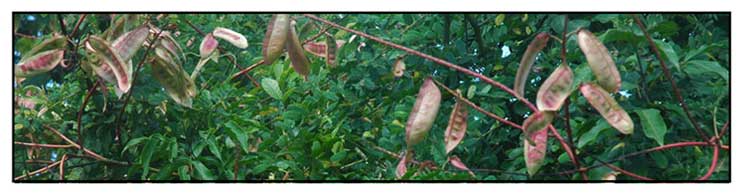
| IMAGE SOURCE: / Photo / Fabaceae: Caesalpinia latisiliqua / Fruiting plant / Copyright © 2011 by Leonardo L. Co. (contact: benctan@berkeley.edu) ref. DOL32322 / Non-Commercial Use / click on image to go to source page / Phytoimages.siu.edu |
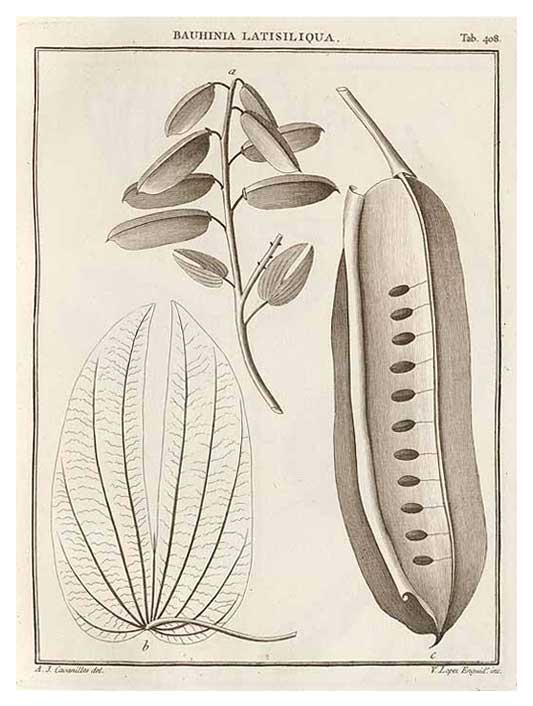
| OTHER IMAGE SOURCE: Drawing (Engraving): Caesalpinia latisiliqua (Cav.) Hattink / A.J. Cavanilles / Cavanilles, A.J., Icones et descriptiones plantarum, vol. 5: t. 408 (1799) [A.J. Cavanilles] / PlantIllustrations.org |
| Caesalpinia latisiliqua (Cav.) Hattink is an accepted name |
Additional
Sources and Suggested Readings |
l• |
DOI: It is not uncommon for links on studies/sources to change. Copying and pasting the information on the search window or using the DOI (if available) will often redirect to the new link page. (Citing and Using a (DOI) Digital Object Identifier) |
| List of Understudied Philippine Medicinal Plants |
• |
 |
|
