|
 Gen info Gen info
• Datura is a genus of nine species of highly poisonous, vespertine-flowering plants belong to the nightshade family, Solanaceae. They are known as thornapples, jimsonweeds, devil's trumpets or mad apple. Other English names include moonflower, devil's weed, and hell's bells. (41)
•
All Datura species are extremely poisonous and psychoactive, especially seeds and flowers, which can cause respiratory depression, heart irregularities, fever, delirium, hallucinations, anticholinergic toxidrome, psychosis, and death if taken internally. (41)
• Etymology: The genus name Datura originates from the Hindi dhatura meaning "thorn apple" and Sanskrit dhattura "white thorn-apple", with historical and cultural significance in Ayurveda and Hinduism. The English term "Jimsonweed" derives from its prevalence in Jamestown, Virginia, where it is called "Jamestown-Weed". (41)
• Historical mentions: Record of the name in English dates back to 1662. Nathaniel Hawthorne refers to one type in The Scarlet Letter as "apple-Peru". In Mexico, it is called toloache (tolguacha), derived from Nahuatl tolohuaxihuitl, meaning "the plant with nodding head", referring to nodding seed capsules of Datura species. (41)
• Datura species have long been used as poison and hallucinogen. Its psychoactive properties have found use in witchcraft and sorcery; some species used ritualistically as entheogens by some Native American groups. (41)
• Datura metel was first described by Carl Linnaeus in 1753. Originally, its origin was conjectured to be India, but now placed somewhere in the Americas, probably the Greater Antilles.
 Botany Botany
• Talong-punay is a coarse,
erect, branched, smooth or slightly hairy shrub or short-lived
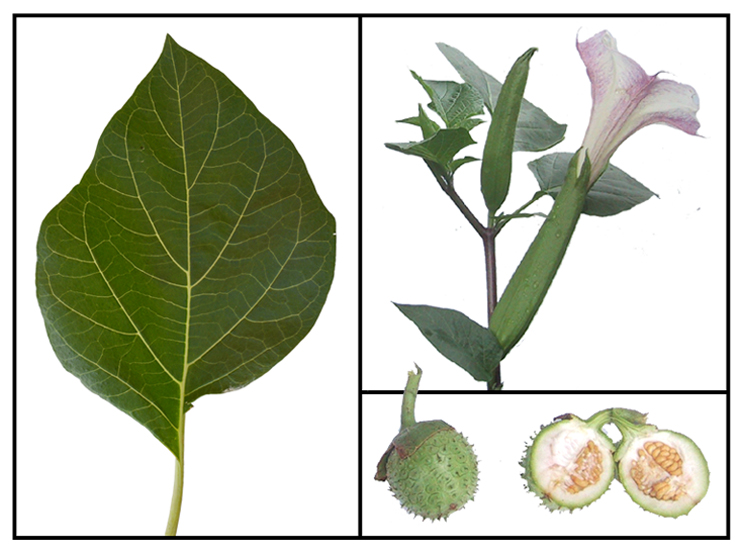
shrub, 0.5 to 2 meters high. Leaves are single, ovate to oblong-ovate, 9 to 18 centimeters long,
with inequilateral base, pointed tip and irregularly and shallowly
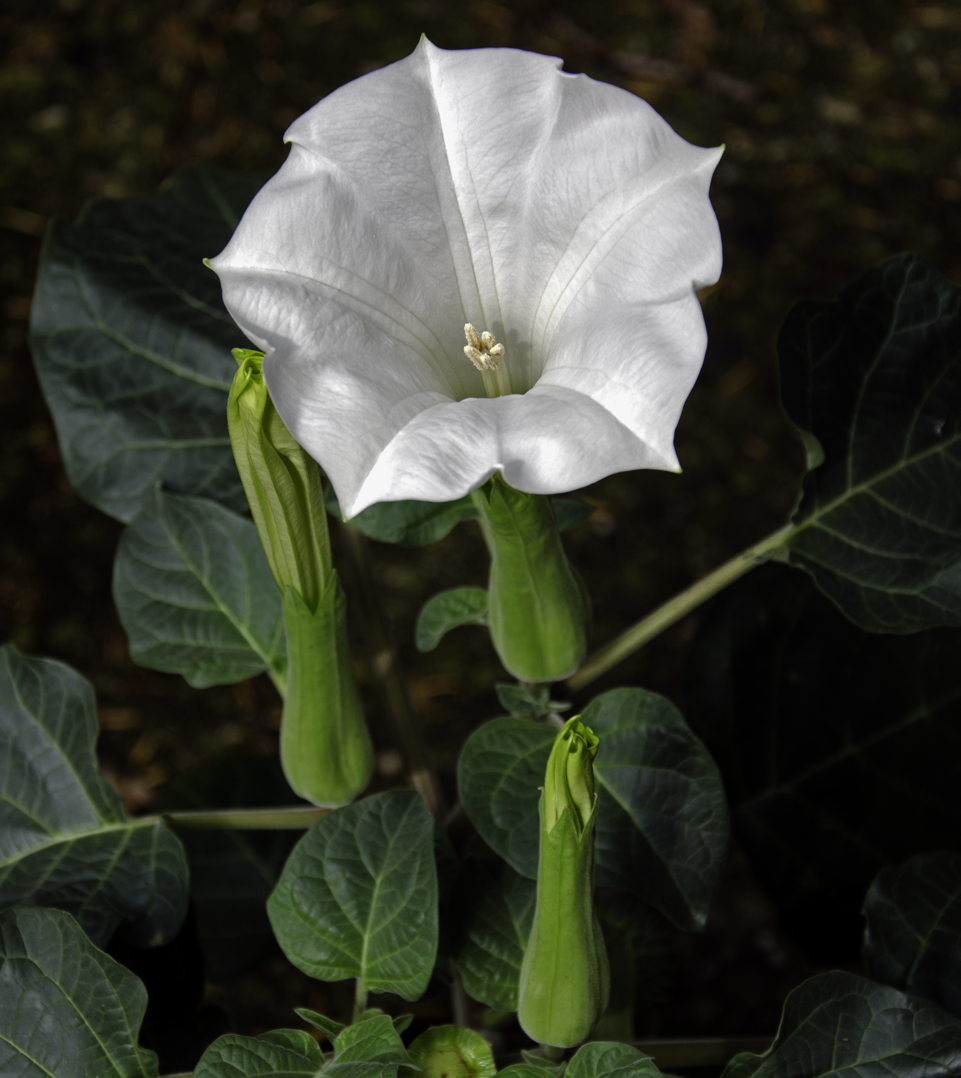
lobed margins. Flowers are white or nearly purple, axillary
and solitary, with a large ovary. Calyx is green, about 6 centimeters long, cleft at the apex, cylindric
and divided into linear teeth. Corolla is white, about
15 centimeters long and the mouth about 8 centimeters in diameter, trumpet-shaped
when fully opened. Stamens are 5, stigma 2-fid. Fruits are rounded capsules, green, about 3.5 centimeters in diameter
and covered with stout, short spines, dehiscing at the apex when
ripe forming an irregular suture. Seeds are numerous, closely packed, nearly smooth, and pale brown.
• Growth form: Medium-sized, evergreen woody shrub when grown in the subtropics or tropics.
Foliage: Leaves ovate (15 - 20 cm long) with undulate or serrate leaf margin. The leaves emit a disagreeable odor when bruised. Flowers: Flowers are single, trumpet-shaped and held vertically (20 - 25 cm long). Short projections occur between adjacent lobes and heart-shaped notches occur in the middle of each lobe apex. Those growing in the wild are typically whitish, but there are purple cultivars. Flowers are most fragrant at night to attract pollinating sphinx moths. Cool nights promote flowering. Fruit: Round to egg-shaped fruit is covered in tubercles (small, round bumps). It is classified as a capsule, a dry, dehiscent fruit. The fruit breaks open in an irregular manner, releasing 200 - 300 brownish yellow seeds. Seeds are approximately bean-shaped and have a large, whitish elaiosome. The elaiosome is a nutrient-rich tissue that attracts ants which disperse seeds. (FLORA & FAUNA WEB)
Distribution
- Introduced.
-
In open, waste places in and about settlements,
throughout the settled areas in the Philippines.
- Also cultivated also for ornamental purposes.
- Native to Mexico Central, Mexico Southeast, Mexico Southwest. (31)
- Now pantropic in distribution.
Parts
utilized
Leaves, seeds and
flowers.
Collect newly opened flowers and sun-dry.
 Constituents Constituents
• Yields tropane alkaloids such as hyoscyamine, scopolamine, anisodamine and anisodine.
• Flowers -
Scopolamine, 0.5%; hyoscyamine, 0.04%; atropine, 0.01%.
• Leaves: Total alkaloid content is 0.426%, mainly as atropine
and small amount of hyoscyamine.
• Seeds contain 0.426% alkaloid, mainly hyoscyamine.
• Roots: contain 0.35% hyoscyamine.
• Phytochemical screening of seeds yielded tannins, phlobatanins, cardiac glycosides, carbohydrates and flavonoids.
• A 50% ethanol eluate fraction of a macroporous resin of the flower isolated a new compound, yangjinhualin A and five known megastigmane sesquiterpenes. (14)
• Screening of leaves yielded alkaloids and steroids, with an absence of saponins and flavonoids. The concentration of Ca2+, Mg2+, Fe3+ and PO3- were found to be (4.28±0.05)×104, 4 (3.86±0.009) ×104, (2.33±0.007)×104 and (4.65±0.06)×104 ppm respectively. (see study below) (25)
• Methanol extract of whole plant isolated seven compounds viz., pterodontriol B (1), disciferitriol (2), scopolamine (3), adenosine (4), thymidine (5), ilekudinoside C (6), and dioscoroside D (7). (37)
• Study of methanol extract
of flowers isolated 10 new withanolides, withametelins I-P (1-8), 1,10-seco-withametelin B (9), and 12ß-hydroxy-1,10-seco-withametelin B (10), together with seven known withanolides. (see study below) (39)
 Properties Properties
- Bitter tasting.
- Considered anesthetic, antiasthmatic, antispasmodic,
antitussive, hallucinogenic, hypnotic.
- Leaves and seeds considered abortifacient.
- Plant as a whole has narcotic, anodyne, and antispasmodic properties analogous to those of belladonna.
- Dried seeds are considered a more powerful soporific than the leaves.
- Plant has long bee noted for it intoxicating and narcotic properties. An overdose causes a violent narcotic poisoning.
- Studies have suggested antiasthmatic, cytotoxic, antioxidant, antibacterial, antifungal, spasmogenic, anti-inflammatory, antigout, insecticidal, antifertility, hepatotoxic, nephrotoxic, hair-growth promoting properties.
Uses
Edibility
· In Brazil, seeds used for tea making. (32) (see toxicity below)
Folkloric
· Leaves used a lot in resolutive and mitigant poultices. Smoked like stramonium in cases of dyspnea produced by asthma. Seeds and roots have the same uses; some considered the seeds to be more potent.
· Asthma: get
dried leaves and stems, cut into small slices and mix with equal quantity of tobacco
and roll into a cigarette and smoke 2 to 3 times a day.
· Muscle pains and cramps due to rheumatism: get drug, boil and
obtain a concentrated decoction. Wash the painful parts with the warm
decoction.
· Gastric pain: use 0.3 gm of dried material in decoction.
· Sprains, contusions, snakebites, piles: use pounded fresh leaves
and apply over afflicted areas.
· Severe cold accompanied by excessive sneezing similar to hay
fever symptoms: use powdered seeds (0.1 gm) in pills or loose.
· Psoriasis: use the oil prepared by boiling Datura seeds with
sesame (linga) oil in an alkaline water made from ashes of gabi. For
the preparation of the alkaline water, simply dissolve the white ashes
of gabi in water.
· For rheumatic swelling of the joints, lumbago, painful tumors, nodes, etc., the plant is applied locally as poultice of leaves, epithem, fomentation or liniment.
· Leaves applied as anodyne poultice to inflamed breasts, or to check excessive secretion of milk. A paste made from turmeric and datura fruit is also useful for the same.
· Leaves boiled in oil, or the oil itself, is a useful application for hemorrhoids, anal fissures, and other rectal diseases associated with tenesmus.
· Juice of leaves administered internally for the prevention of gonorrhea.
· Leaves steeped in spirits used to stimulate hair growth.
· Heated leaves applied to the spleen for intermittent fever.
· Malays used the leaves for boils, leg sores, hemorrhoids, rheumatism, swollen joints, and fish bites. Heated leaves also used enlarged spleen and swollen testicles.
· Juice of ears dropped inside the ear for earaches.
· Ointment of seeds used for smallpox.
· Flowers digested in wine used as an anesthetic tincture.
· Lotion made from the flowers used for facial eruptions and feet swellings.
· In Cambodia, coconut oil is heated inside the fruit capsule, and the juice, with the oil, is squeezed into the ear.
· Plant used as an indigenous substitute for belladonna in the treatment of cataract and other eye diseases. Mydriatic potency has been reported - the watery extract of leaves is applied around the eyes causing dilatation for two days. Also, dilatation may be achieved through an alcoholic extract of the seeds in four ounces of spirits, the tincture evaporated to dryness in a water bath, and the residue dissolved in an ounce of water.
· Roasted leaves applied to the eyes for ophthalmia.
· Powdered roots are rubbed on the gums for toothache.
· Roots used for the bites of wild dogs.
· Pill made from pounded seeds placed on decayed teeth to relieve toothaches.
· Roots boiled in milk and administered with clarified butter and treacle for insanity.
· Seeds pounded in oil used as embrocation in rheumatism; also applied to syphilitic swellings and boils.
· In Ayurvedic medicinal system, used for treatment of various diseases i.e., inflammation, sciatica, gout, wounds, rheumatism, swelling, bruises, fever, asthma, and bronchitis. (51)
· In Konkan, plant juice is given with fresh curds for intermittent fevers.
· In India, used
for hysteria, insanity, diarrhea, asthma, skin diseases. For epilepsy,
seeds of ripe fruit are burned and the smoke inhaled. Seeds used in
small doses as analgesic.
· In China, used
for asthma; the dried leaves are rolled and smoked like a cigar. Dried flowers used for as anesthetic and prescribed for the treatment of asthma, cough, and convulsions.
· In Ayurvedic medicine, seeds used to treat skin rashes, ulcers, bronchitis, jaundice and diabetes (32)
· In Brazil, used
for making tea for its sedative effect. Flowers are dried and smoked as cigarettes. (32)
· In Vietnam, dried flowers and leaves cut into small chips and smoked as cigarettes for asthma. (32)
· In Bangladesh, leaves of D. metel, Zizyphus mauritiana, Calotropis gigantea, and bark of Terminalia arjuna are cut in pieces, boiled in water, then applied to paralyzed portions of the body 3-4 times a day, and daily till cure. (40)
Tincture preparation
· Tincture may be prepared by macerating two and a half ounces of bruised datura seeds in one pint of proof spirits, and left for seven days in a closed vessel, occasionally shaking it, and the mixture eventually pressed, filtered, and measured, and sufficient spirit proof added to make one pint. The tincture induces sedative and narcotic effects similar to opium.
Leaf extract preparation
· 100 grams of fresh leaves are crushed in a mortar to soften the leaves; add 5 liters of water to the crushed leaves; and sieve after 3 days. (see study below) (29)
Others
· Rituals: It features in rituals and prayers to Shiva; also in Ganesh Chaturthi, a festival devoted to the deity Ganesha. (41)
· Hallucinogenic: Used as a
ritualistic herb for its hallucinogenic effects. In Nigeria, decoction of leaves or fruits added to drinks to achieve a "high," as a substitute for marijuana. It has been reported that the Moros intoxicated themselves with the plant before committing their massacres. (•) Its psychoactive properties have also found use in witchcraft and sorcery.
· Poison: In India and Indo-China, reportedly used quite commonly with criminal intent. In China, often mixed with tea that hides the poison without raising suspicion. (•) In India,Thugs (gangs of professional robbers and merderers) would sometimes use preparations of Datura metel to stupefy merchants before stranggling or murdering them. (The English word thug derives its roots from Hindi thag, which means "swindler" or "deceiver".)
· Repellent: Extract of roots sprinkled in houses to repel snakes. Seeds, mixed with sorghum flour, used as poison bait for rats.
 Toxicity / Poisoning ! Toxicity / Poisoning !
• All plant parts are poisonous. It contains tropanic alkaloids
in varying concentrations; mostly parasympatholytic.
• Even a small dose is very poisonous because of the toxic tropane alkaloid or the presence of anticholinergic substances (scopolamine, hyoscyamine, and atropine), which can cause neural toxicity. (32)
•
In the Bicol area, reports of abuse by smoking an herbal cigarette of dried leaves and
lightly fried seeds resulted in permanent mental and behavioral problems.
• Common side effects: tachycardia (fast heart beat), slight increase
in blood pressure, dryness of the mouth and eyes, sedation.
• Early symptoms of poisoning are dilatation of the pupil, drowsiness, general weakness, with varying degrees of hallucinations.
• At toxic levels, tropanic alkaloids can cause hallucinations,
delirium, mental confusion, coma and death.
• Excessive doses can cause hallucinations, severe intoxication
and death. The window of toxic and medicinal dose is quite small.
• With medium doses, recovery can occur in 12 to 24 hours, however, with loss of memory and confusion that may last for days.
Studies
• Anti-asthmatic: Quisumbing's compilation describes a mechanism for the plant's anti-asthmatic effect. Asthma relief is attributed to depression or paralysis of the receptive mechanism of the parasympathetic nerves in the bronchi (a known action of solanaceous alkaloids), an effect confirmed by the relaxation produced by the alkaloidal extract from the smoke, on an isolated intercartilaginous portion of a bronchial ring previously contracted by pilocarpine. When smoke is inhaled, it is possible the sticky, resinous substance may help by coating the mucosa and thus lessening the bronchial irritation.
(•) Study evaluated the potential of Datura metel in controlling immune response and ameliorating the asthma in a mice model. Results showed potential of D. metel in ameliorating asthma symptoms by promoting naive T cell development and reducing activated T. cells. (35)
• Hypoglycemic
/ Antihyperglycemic: Study of seed powder of DM produced
significant dose-dependent reduction of blood glucose. (3)
• Cytotoxic Withanolides:
Study on methanol extract of flowers of DM isolated 10 new withanolides
with seven known withanolides. Compounds 1,3,4 and 6 exhibited cytotoxic
activities against lung, gastric and leukemia cancer cell lines. (4)
• Antimycotic: Study showed the chloroform fraction of Datura metel to be endowed with antifungal activity against all three species of Aspergillus, i.e., A fumigatus, A flavus and A niger. However, the cytotoxicity of the chloroform fraction was less than amphotericin B.
• Antifungal: Study of root and shoot extracts showed significant suppression of growth of the target fungal pathogen, Ascochyta rabiei, the cause of chickpea blight disease.
• Herbicidal / Roots and Shoots: Study showed the root and shoot extracts of Datura metel contain herbicidal constituents. The extracts exhibited activity against Phalaris minor Retz., one of the most problematic weeds of wheat in Pakistan. (7)
• Toxicity Studies: Suspensions of powdered leaf of Datura metel and D stramonium on virgin female albino mice showed dose dependent reversible and irreversible changes. Generally, D metel-treated mice showed less anatomical abnormalities than D stramonium-treated mice and suggests D metel could serve as a substitute for D stramonium in drug development. (8)
• Antibacterial / Alkaloid: A new antibacterial agent was isolated from Datura metel leaves with activity against S aureus, P aeruginosa, P mirabilis, S typhi, B subtilis and K pneumonia. Results support its use in phytomedicine for the treatment of asthma, cough, burns and wound healing in Nigeria. (9)
• Deleterious Frontal Cortex Effect: A study of aqueous leaf extract in adult Wistar rats caused deleterious effects on the frontal cortex of adult albino Wistar rats, with dose-depended vacuolations in the stroma of the brains of treatment group. (11)
• Sedation / Decreased Appetite: A study of seed extract for analgesic activity showed insignificant results. The study showed a behavioral pattern of sedation and decreased appetite on administration of the seed extract, attributed to action on u-type receptors in the CNS, which on stimulation have an intrinsic potential to reduce the distress or the effective component of pains without any significant change in the intensity of the actual sensation.
• Antimicrobial / Alkaloid: In a study screening 17 different coastal medicinal plants for antibacterial and antifungal activity , Datura metel showed a wide range of antimicrobial activity against many fish pathogens. Results suggested DM can be used as a putative antimicrobial drug in the aquaculture maintenance.
• Spasmogenic / Roots and Leaves: Study of D. metel leaf and root extracts, scopolamine and acetylcholine on isolated smooth muscle preparations. Leaf extract and scopolamine showed antispasmodic effects while the root extract and acetylcholine cause contracture in isolated rat uterus and rectum whole muscle. Results suggest a spasmogenic factor in the DM root extract.
• Antioxidant: Study the aqueous extract contained more phytochemical compounds than ethanol extracts. Antioxidant activities were higher in the plant leaf than the bark. Results suggest the plant as a natural source of antioxidants and phytochemical quality for antibacterial effectiveness. (15)
• Antimicrobial: Study evaluated aerial parts of Datura metel for antimicrobial activity against resistant pathogens of aquatic, human and plant origin. Results showed antimicrobial property and potential for use in the treatment of infectious diseases caused by resistant pathogenic organisms. (17)
• Anesthetic / Seeds: Study evaluated a methanolic extract of D. metel seeds as a potential oral anesthetic in dogs. Extract induced surgical anesthesia in dogs with recovery without complications. Results showed the seed extract to be relatively safe, inducing sleep similar to thiopentone sodium. (18)
• Flower Components / Antimicrobial: Study of methanol extracts of D. metel flowers yielded four compounds. Components identified as acetic acid, trifluoro-, 2,2-dimethylpropyl ester, 4- Trifluoroacetoxyoctane and 1,4-Cyclohexadiene, 1- methyl- have antimicrobial property. (19)
• Corrosion Inhibition of Mild Steel: Study evaluated the corrosion inhibition potential of D. metel in acid medium on mild steel. Results showed significant corrosion inhibitive effect, probably through adsorption of phytoconstituents. (20)
• Anti-Inflammatory / Antioxidant / Leaves: Study evaluated the in vitro anti-inflammatory and antioxidant potential of leaves of D. metel. Results suggest considerable activity and suggests in vivo studies. (21)
• Anti-Gout / Antiarthritis / Antioxidant / Leaves: Study of a methanolic extract of D. metel showed more than 50% xanthine oxidase inhibitory activity in vitro, comparable to standard anti-gout medicine, allopurinol. It also showed in vivo hypouricemic activity against potassium oxonate-induced hyperuricemia in mice. (22)
• Anti-Cancer / MCF-7 Cell Line: Study evaluated a methanolic extract of Datura metel for anticancer activity against MCF-7 cell line. Results showed a leaf extract to have remarkable anticancer activity. Isolation of the compound contributing to the activity has a potential for a novel and natural phytomedicine for the disease. (23)
• Bio-Pesticidal: Study evaluated solvent extracts of Datura metel against larvae of gram pod-borer Heicoverpa armigera. The most active was the ethyl acetate fraction of the leaf extract, with a significant potential for use as a bio-pesticide for the control of destructive polyphagous agricultural pest—H. armigera. (24)
• Insecticide / Leaves / Red Ants and Grasshoppers: Study evaluated the leaf of Datura metel for acute toxicity at varying concentrations on grasshoppers and red ants. Study showed a statistically significant dose dependent decrease in the survival rate and an increase in the percentage mortality of red ants and grasshoppers in the presence of Datura metel. (see constituents above) (25)
• Antifertility / Seeds: Study evaluated crude acetone extracts of seeds of Datura metel in female albino mouse for antifertility activity. A 2% seeds extract caused anti-implantation activity, and suggests a potential good source of antifertility compounds with minimal side effects after testing in human models. (26)
• Mineral Composition / Phytomonitor Potential: Study evaluated the mineral compositions of leaf, seed, and flower of D. metel. Results yielded 12 elements including Cu, Co, Ni, Mn, Zn, Fe, Na, K, Ca, Mg, P, and Al. Leaves were minerally richer than seed and flower counterparts. Datura metel was found tolerant for Co and Ni and may be used as phytomonitor for these elements in the soil. (27)
• Acetylcholinesterase Inhibitory Property / Withanolides: Study showed the acetylcholnesterase inhibitory properties of Datura metel is due to the presence of withanolides. The methanolic extracts showed more significant dose-dependent inhibition of acetylcholinesterase. (28)
• Anti-Termite / Datura: Study evaluated the efficacy of extracts from Datura metel, local soap and garlic in the management of Macrotermes belicosus. The synthetic insecticide, chlorpyrifos 0.1%, was used as control. In the laboratory, all the treatments had 75% - 100% repellence value with 100% mean insect mortality. On the field, only D. metel and chlorpyrifos were effective in preventing upsurge and rebuilding of termitaria. Results suggest an eco-friendly botanical potential for the management of termites in the field. (see leaf extract preparation above) (29)
• Hallucinogenic / Seeds: Study evaluated the hallucinogenic effect of aqueous seed extract of D. metel in male wistar rats. Treated groups exhibited some behavioral changes: restlessness, aggressiveness, agitation, and disorientation, with significant decrease in food and water intake. Results validate the action of D. metel on the central and peripheral nervous system. The hallucinogenic effect may be due to the presence of the alkaloid scopolamine. (30)
• Withametellins / Alkaloids / Cytotoxicity Against Cancer Cell Lines / Flowers: MTT analysis of methanol extract of flowers yielded withametelins I-P, 12-ß-hydroxy-1,10-seco-withametelin B, and 1,10-seco-withmetelin B. Withametelins I, K, L, and N exhibited cytotoxic activities against A549 (lung), BGC-823 (gastric), and K562 (leukemia) cancer cell lines, with IC50s ranging from 0.05 to 3.5 µM. Withamilin J exhibited moderate cytotoxicity against BGC-823 and K 562. (see constituents above) (32) (39)
• Neuro-Toxicological Effects / Leaves: Use of leaves have been reported to cause adverse alteration in behavior. Study evaluated the acute neuro-toxicological effects of aqueous-methanol extracts of D. metel on total locomotive activity, motor coordination and spatial memory in Y-maze in mice. The leaves extract caused neuro-toxicological effects in mice characterized by sedation and hypokinesia motor coordination impairment and disruption of short-term memory. The oral LD50 was greater than 2000 mg/kbw. (33)
• Bioefficacy
Against Colletotrichum gloeosporioides / Leaves: Study Anthracnose disease caused by Colletotrichum gloeosporioides is the most damaging disease causing reduction of flower set and yield losses in mango. Study evaluated the antifungal activity of various extracts Datura metel leaves against C. gloeosporioides. The chloroform fraction showed the best inhibition of the fungus. GC-MS analysis identified bioactive constituents i.e., n-hexadecanoic acid, phytol, octadecanoic acid, oleic acid, o-xylene, and cyclohexanol. (34)
• Anti-Rabies / Seed: Study evaluated soxhlet and cold extracts of Datura metel fruit and seed extract for anti-viral activity against the rabies virus. In vitro cytotoxicity assay was done using 3-(4,5-dimethyl- thiazolyl-2)-2,5-diphenyltetrazolium bromide assay. The Datura seed extract showed potential in vitro antirabies activity. Study suggests further screening for in vivo activity against rabies virus in a murine model. (36)
• Neurotoxicity / Exacerbation of Behavioral Deficits: Datura metel is abused by Nigerians for its psychostimulatory effects. Hallucinations, confusion, agitation, aggressiveness, anxiety, and restlessness are reported by users. Study evaluated the hypothesis that oral exposure exerts a neurotoxic effect by increasing oxidative stress in the mPFC (medial prefrontal cortex) and hippocampus that induces behavioral deficits in mice. Methanolic extract exposure significantly increased MDA and NO levels and reduced SOD, GSH, GPx, and CAT activities in mice brains. DM exposure also produced cognitive deficits, anxiety, and depressive-like behavior in mice after 28-days exposure. The mPFC and hippo-campus showed neurodegenerative features, loss of dendritic and axonal arborization, a dose-dependent decrease in neuronal cell bodies' length, width, area, and perimeter, and a dose-dependent increase in distance between neuronal cell bodies. Results suggest oral exposure in mice induces behavioral deficits, mPFC and hippocampus neuronal degenerations via redox imbalance in the brain of mice. Study raises concerns on safety and use by humans. (44)
• Hepatotoxicity / Seeds: Study evaluated the effects of methanol and aqueous extracts of Datura metel seeds on liver of Wistar rats. Extracts were administered at 400 mg/kbw for 14 days.
Results showed increased in ALP, AST, and ALT, total and direct bilirubin and reduced total protein and albumin, and inflammatory cellular infiltration in some regions of the liver in the test group. (45)
• Nephrotoxicity / Leaves: Study evaluated the histomorphological potentials and biochemical effects of Datura metel stramonium on kidneys of adult male Wistar rats. Leaves were air-dried, crushed into fine powder, and cold-macerated in 80% v/v methhanol in water. Doses of 200, 400, and 600 mg/kbw were used, orally for 28 days. Results showed hemorrhagic renal cortex, aggregation of inflammatory cells, and grossly dilated and degenerated convoluted tubules, which may lead to renal failure. There was also decreased level of bound siallic acid, which indicates increased sialidase activity that exposes the kidneys to damage. (46)
• Hair-Growth Effects / Leaf and Flower Formulations: Study evaluated and compared the properties of D. metel leaf and flower extracts for hair cosmetic formulations. Dried and pulverized leaves and flowers were extracted using n-hexane and methanol. The methanol leaf extract showed highest percentage recovery yield (23.5%). Both extracts yielded alkaloids, saponins, tannins, flavonoids, phenols, glycosides and reducing sugars, with terpenoids only in leaves, and steroids only in the flowers. In shaved animals, the methanol leaf extract initiated fastest hair growth in 5 days, with shaved areas completely filled with hair in 13 days. Hexane flower extracts produced the longest regrowth hairs (80.6%) after 30 days, Results suggest the leaves and flower extracts, mixed together in aliquots can provide improved hair growth formulations. (47)
• In Vitro Production of Atropine: Study evaluated the extraction of phytochemical compounds from both crude plant material and callus extracts. Phytochemical screening revealed presence of tannins, alkaloids, saponins, and flavonoids among plant parts and extracts. Callus extracts yielded higher atropine content than normal plant extracts, suggesting potential for in vitro culture to enhance atropine production. Atropine yield varied according to source: 1.25 mg/g in stem calli; 1.09 mg/g in leaf calli; 1.53 mg/g in fruit calli; 1.12 mg/g in flower calli. Highest concentration was found in calli produced from the fruit, followed by calli from stems, flowers, and leaves. Study provides info on its potential in pharmaceutical applications. (48)
• Anticancer / Triterpenoid: Study evaluated the anticancer properties of crude extract and triterpenoid compound isolated from Datura metel seeds against various cancer cell lines (HepG2, A498, NCI-H226, and MDR 2780AD). Compound 1 exhibited significant anticancer activity compared to crude extracts across various cell lines and potential as promising candidate for further investigation and pharmaceutical development. (49)
• Scopolamine Source: All parts of the plant contain tropane alkaloids, hyoscine (scopolamine), hyocyamiine, datumetine, and atropine. Of these, scopolamine is the main constituent, used worldwide in medicine as mydriatic, anticholinergic, and parasympatholytic agent. Widespread in Thailand, it presented as an attractive source of medicinally useful scopolamine. Study evaluated Datura metel var. metel and D. metel var. fastuosa for scopolamine contents from leaves, flowers, and fruits. TLC image and HPLC analysis showed good correlation between the two methods: scopolamine contents were high in the flower part of D. metel var. metel and the fruit part of D. metel var. fastuosa. Both have the potential as source of scopolamine production. (50)
Availability
- Wild-crafted.
- Seeds, powders, tinctures in the cybermarket. |