 Botany Botany
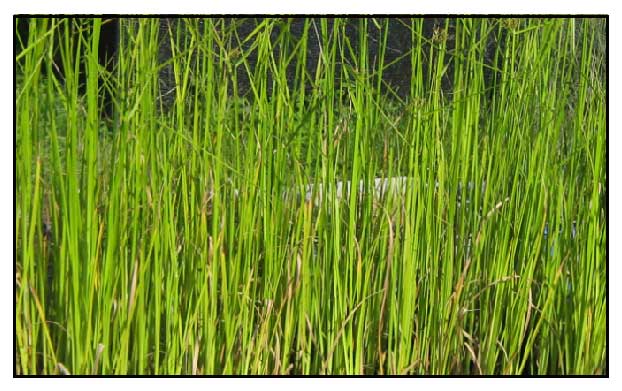
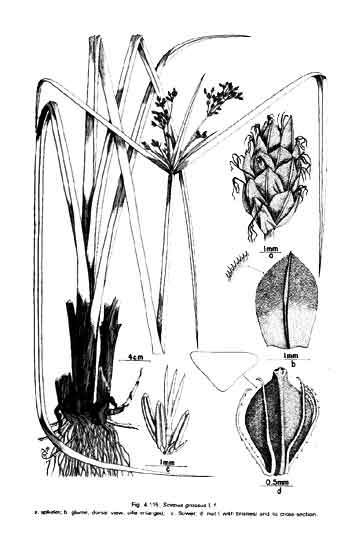
Tikiu is a very coarse, large, erect, glabrous, aquatic or marshy herb. Stems are triangular, 1.5 to 2 meters high or more. Leaves are few, basal, often half as long as the stem, 1 to 2 centimeters wide, the leaflike bracts subtending the inflorescence, spreading, broad, 30 to 60 centimeters long. Inflorescence is corymbose, and 10 to 18 centimeters long. Spikelets are very numerous, brown, ovoid, and 5 to 8 millimeters long. Nuts are obovoid, trigonous, dark brown or black, and shining.
 Distribution Distribution
- In fresh-water swamps, edges of ponds, and in newly opened rice lands at low altitudes from central Luzon to Mindanao in most provinces and islands.
- Native to Bangladesh, Nepal, India and other Southeast Asian countries.
- Naturalized in Australia, Borneo, Bhutan, Cambodia, China, Indochina, Indonesia, Laos, Malaysia, Myanmar, Pakistan, Sri Lanka, Thailand, and Vietnam.
Constituents
- Study on tubers for total starch, amylose and proximate analysis of starch (S), flour peeled (FP), and flour unpeeled (FU) (g/100 g dry sample) yielded: total starch 87.69 (S), 87.37 (FP), 80.43 (FU); amylose 32.33 (S), 30.44 (FP), 29.49 (FU); protein 0.17 (S), 0.32 (FP), 0.36 (FU); fat (0.06 (S), 0.12 (FP), ).10 (FU); crude fiber 0.08 (S), 1.43 (FP), 2.44 (FU); ash 0.09 (S), 0.34 (FP), 0.48 (FU). (see study below) (13)
- Ethanolic extract of coarse powder of tuber yielded carbohydrate, coumarins, flavonoids, steroid, tannin and terpenoid. (15)
- Phytochemical screening of methanolic extract of roots yielded flavonoids, alkaloids, and tannins. (see study below) (16)
Properties
- Root considered sweet, colling, laxative, tonic to the liver, astringent, antidiarrheal, antiemetic.
- Studies have shown antidiabetic, antipyretic, analgesic, antihyperlipidemic, phytoremediative properties.
Parts used
Roots, leaves, and stems.
Uses
Edibility
- Study suggests flours from tubers have potential for use as starchy foods. (see study below) (13)
Folkloric
- Root is astringent, and is given to check diarrhea and vomiting.
- Roots used against infection, burning sensation, fever and gonorrhea.
- Root of plant used
as diuretic.
- In Ayurveda, used for treatment of diarrhea, thirst, diarrhea, nausea, scanty micturition, jaundice, weakness of cardiac muscles, and low sperm count.
Others
• Veterinary: In India, sap extracted from leaves and stem of S. grossus is mixed with garlic (Allium sativum), and the paste applied topically for cattle wounds. (5)
• Basketry: Stems, dried and flattened, are used for making mats, baskets, etc.
• Paper: Study suggests a potential for production of moderate quality paper pulp. (see study below) (14)
Studies
• Indicator of Radioactive Pollution in Estuaries: Study evaluated sea weed (Scirpus grossus Linn.) as experimental plant to indicate radioactive pollution in estuaries by measuring accumulation of 137Cs, 65Zn, 60Co, 59Fe, and 54Mn. Study suggests radioactive pollution degrees of both sea water and soil can be deduced by means of conversion of the concentration factor's formula. (2)
• Domestic Wastewater Treatment: Study examined the ability of Scirpus grossus planted in a constructed wetland to treat domestic wastewater. Results showed S. grossus has great potential in removing pollutants in constructed wetlands in tropical regions. (3)
• Caloric Value Enhancement after Lead Phytotoxicity Test: Study showed the use of the plant as contaminant uptake in phytoremediation can enhance the caloric value of the plant. It presents a potential use as bioenergy alternative according to enhancement of its caloric value. (7)
• Phytotoxicity Test on Diesel-Contaminated Water: Study showed S. grossus and rhizobacteria in a subsurface flow system has potential in reclaiming hydrocarbon-contaminated water through enhancement of rhizobacteria by S. grossus in degrading hydrocarbon. (8)
• Phytoremediation of Wastewater / Lead: Study evaluated the effect of treatment of Pb contaminated wastewater by using phytoremediation technology. Fifty plants of S. grossus were grown in sand medium and spiked with various Pb concentration (10, 30, and 50 mg/ml). Results showed decrease in Pb concentration and suggest S. grossus is a hyperaccumulator. (11)
• Antidiabetic / Antihyperlipidemic / Leaves: Study evaluated the antidiabetic and antihyperlipidemic activities of aqueous and ethanol extracts of leaves of S. grossus in alloxan induced diabetic rats. Findings showed significant reduction in blood glucose and lipids when compared to the diabetic control group. (12)
• Potential As Starchy Food / Glycemic Index / Tubers: Study investigated the flour and starch isolated from tubers of Scirpus grossus for their physiochemical properties and starch digestibility using peeled and unpeeled processes. Proximate analysis showed the flours from both processes yield considerably high total starch (>80%) with a potential use as starchy food. In vitro starch digestion assay found all samples with estimated glycemic index of about 55 or less. (see constituents above) (13)
• Potential for Paper Pulp: Study suggests a potential for production of moderate quality paper pulp or mixing with conventional materials for pulp-making such as straw, wood, or used papers in recycling or reuse processes. (14)
• Analgesic / Antipyretic / Root: Study evaluated the analgesic and antipyretic activities of methanolic extract and fractions of root using acetic acid induced writhing and radiant heat tail flick method of pain models in mice and yeast induced pyrexia in rats. Results showed significant peripheral analgesic potential and antipyretic property. Central antinociceptive activity was absent. (16)
• Sulfide Phytoremediation: Phytoremediation study evaluated the removal of synthetic Spent Sulfidic Caustic (SSC). Results showed the phytoremediation process is possible for sulphide removal using Scirpus grossus plant. (17)
• Phytoremediation of Methylene Blue from Wastewater: Study demonstrated the ability of S. grossus to decolorize methylene blue (MB) dye at different concentrations in a subsurface batch system. Results suggest the phytoremediative ability of S. grossus to remove dye from wastewater.
(18)
• Potential as Natural Fiber: Study based on absorption and sinking speed values suggest that bundung grass has potential as a natural fiber for fishing gear material. (19)
• Nutritive Value / Potential Phytoaccumulator / Concern as Livestock Feed: Study reports that greater club rush as livestock feed as practiced by farmers is allowable in terms of nutritive value. However, as potential phytoaccumulator, free grazing can be of concern in localities likely to be contaminated with heavy metals. (20)
• Acute Oral Toxicity: Study evaluated the acute oral toxicity of Actinoscripus grossus by single-dose toxicity using OECD guidelines. Results showed not toxicity potential at dose of 2000 mg/kg in animals. The LD50 was more than 2000 mg/kbw. (21)
• Accumulation of Fe and Al in Scirpus grossus and Identification of Resistant Rhizobacteria: Phytotoxicity study evaluated the maximum accumulation of Fe and Al in Scirpus grossus in artificial bauxite mining wastewater containing Fe and Al.
Approximately 27 rhizobacteria were isolated from roots of all treatments; three isolates were identified as Bacillus cereus strain NII, Bacillus pumilus strain NII and Brevibacterium sp. strain NII, which showed high resistance and tolerance to highest Fe and Al concentrations in the medium. (22)
Availability
Wild-crafted. |