 Gen info Gen info
- Dolichandrone spathacea is a species of plant in the family Bignoniaceae.
-
Etymology: The scientific name derives from the Greek words dolichos meaning "long," and andron meaning "male" and referring to the long stamens of the flowers, and spathe meaning "broad leaf blade." (7) The species epithet spathacea derives from Latin meaning "spathe-bearing."
Botany
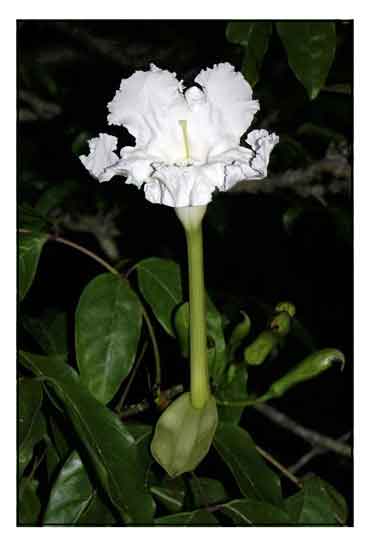
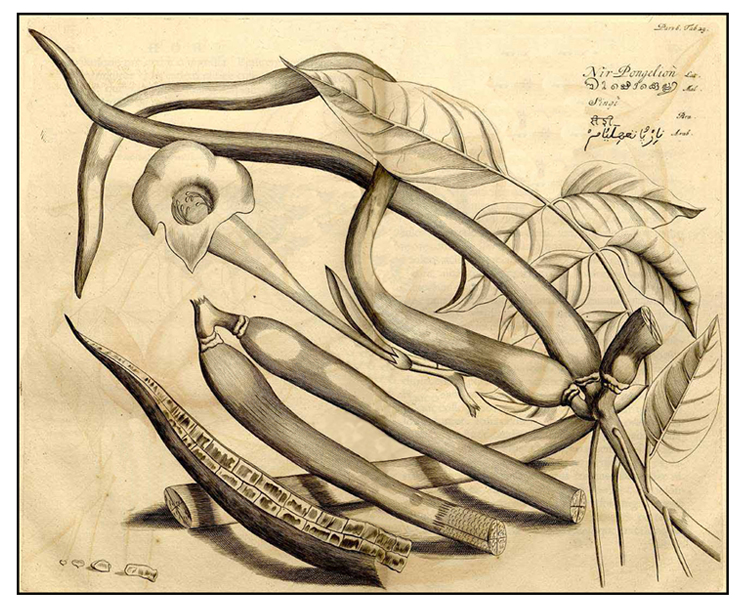
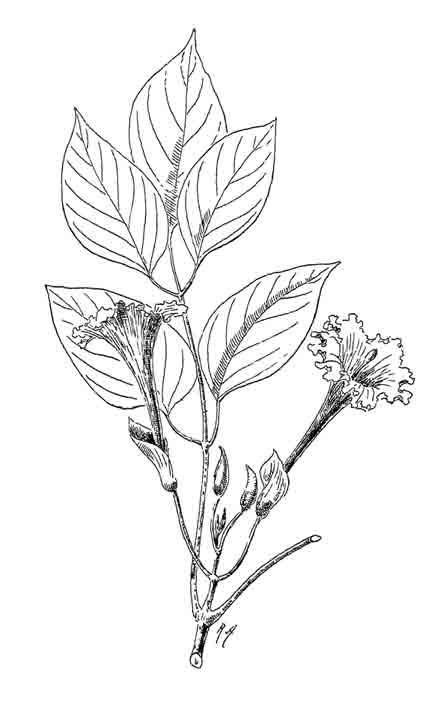
• Tiwi is a smooth tree, growing 5 to 15 meters high. Leaves are opposite, 30 to 40 centimeters long, pinnately compound with seven to nine leaflets. Leaflets are ovate to ovate-lanceolate or ovate-elliptic, 7 to 15 centimeters long, unequal at the base and pointed at the tip. Flowers are borne on short, terminal, few-flowered racemes. Calyx is 4 to 5 centimeters long, spathelike, and split down one side to the base. Corolla is white, with a rather slender, cylindrical tube 9 to 11 centimeters long, becoming funnel-shaped or bell-shaped above, 5 to 7 centimeters in diameter. Fruit is a capsule, somewhat cylindrical or slightly compressed, 30 to 40 centimeters long, 2 to 2.5 centimeters thick, with numerous, rectangular, winged seeds.
• Growth form: A tree that can grow up to 25 m tall. Trunk: Smooth, gray to dark brown colored bark. Foliage: Leaves are compound pinnate, often reddish when young, measuring 20 - 30 cm long, held on a reddish petiole of up to 6 cm. Leaflets are asymmetrical, broad egg-shaped to broad lance-shaped with smooth margins sometimes wavy. The terminal leaflet at the end of the leaf tends to be larger than rest of the lateral pairs. Each leaflet measures between 5.5–20 cm long by 2.5–7 cm wide. Flowers: Flowers are borne on an inflorescence, each shoot contains 2 - 6 flowers, each measures at 15 - 20 cm long. Flowers are large, white, trumpet-shaped, composed of a long thin tube that expands near the opening and spreads abruptly into 5 rounded lobes with frilly edges. They are fragrant, nocturnal, dropping off at about sunrise. Fruit: The fruit is a bean-like, splits upon maturity measuring 20–70 cm long by 1.5–3 cm wide. Seeds are buoyant, dark gray, rectangular with corky wings about 1.5cm long. (17)
 Distribution Distribution
- Native to the Philippines.
-
Along the seashore and tidal streams from La Union to Palawan, Mindanao and the Sulu Archipelago.
- Also native to Andaman Is., Bangladesh, Bismarck Archipelago, Borneo, Cambodia, Caroline Is., China Southeast, Hainan, India, Jawa, Laos, Lesser Sunda Is., Malaya, Maluku, Myanmar, New Caledonia, New Guinea, Nicobar Is., Queensland, Santa Cruz Is., Solomon Is., Sri Lanka, Sulawesi, Sumatera, Thailand, Vanuatu, Vietnam. (5)
Constituents
- Phytochemical screening yielded triterpene and saponin compounds.
- Study of methanolic extract of leaves yielded five new compounds three iridoid glycosides (1-3) and two triterpenoid saponins (4,5), along with 32 known compounds. The new iridoids were esterified derivatives of 6-ajugol and 6-catalpol, and the new saponins were glucosides of two polyhydroxy triterpenes with ursan skeleton. (see study below) (6)
- Study of methanol extract of leaves yielded 16 iridoids, 3 saponins, 3 phenylethanoid glycosides, 4 flavonoid glycosides, 3 monoterpenic acids, 5 phenolic acids and 1 megastigman glucoside. (see study below) (8)
- Study of leaves and bark isolated two new cycloartanes, named dolichandrone A (1) and dolichandrone B (2), as well as two new iridoids, named [6-O-[(E)-4-methoxycinnamoyl]-1β-hydroxy-dihydrocatalpolgenin (3) and 6-O-[(E)-4-methoxy-cinnamoyl]-1α-hydroxy-dihydrocatalpolgenin (4), together with four known iridoids (5-8). (see study below) (12)
- Phytochemical screening of flower extracts yielded alkaloids, amino-acids, carbohydrates, starch, reducing sugars, glycosides, phenolic compounds, saponins, tannins, and flavonoids. (see study below) (14)
Properties
- Studies have suggested antibacterial, antioxidant, xanthine oxidase inhibitory, cytotoxicity, antidiabetic, α-glucosidase inhibitory, anti-inflammatory properties.
Parts
utilized
Bark, leaves, seeds.
 Uses Uses
Edibility
• The flower is edible; used in Thai cuisine, known as Dok Khae Thale or Dok Khae Pa. (10)
Folkloric
• In the Philippines, poultice of fresh leaves and bark is applied against flatulence to women after childbirth.
• Seeds are powdered, and taken for nervous complaints.
• In Java, leaves are used for making mouthwash for thrush.
• Leaves and bark used for bronchitis and gastrointestinal diseases.
• Leaf decoction used for various infections of the mouth.
• Also, has a reputation as abortifacient.
• In Palau, for yaws (frambesia), bark is squeezed together with young stem and flower stalk of Croton sp., and the sap is poured in heated coconut oil; when cooled, applied to affected part of the body.
• Leaves and roots used for liver detoxification. In India, seeds mixed with ginger used to treat pain caused by muscle spasms. Leaves used for asthma. Root bark used for body detoxification. (15)
Others
• Fish poison: The bark used as fish poison. Some reports that a decoction of bark in dogs have no ill effects.
• Betel substitute: Leaves and fruits can be used as betel leaf substitutes. (7)
• Wood: Used for making wooden shoes, toys, matchsticks, fishing net floats. (7)
• Fuel: Wood used as fuelwood.
Studies
• Antibacterial / Methicillin-Resistant Staphylococcus aureus / Stems and Leaves: Study of methanol extracts of stems and leaf showed inhibitory activity against MRSA clinical isolates. Stem extracts showed better inhibitory activity which was attributed to triterpene and saponin compounds. (2)
• Antioxidant: In a study of 52 traditionally used Thai medicinal plants, Dolichandrone spathacea leaves was one of six plant species that showed effective DPPH radical scavenging activity. (4)
 • Antibacterial / Leaves: Study of methanolic extract of leaves yielded five new compounds three iridoid glycosides (1-3) and two triterpenoid saponins (4,5), along with 32 known compounds. In this study, th major compounds, verbascoside and p-methoxycinnamic acid, showed strong antibacterial activity; the 6-O-esterified iridoids showed weaker antibacterial activity. (see constituents above) (6) • Antibacterial / Leaves: Study of methanolic extract of leaves yielded five new compounds three iridoid glycosides (1-3) and two triterpenoid saponins (4,5), along with 32 known compounds. In this study, th major compounds, verbascoside and p-methoxycinnamic acid, showed strong antibacterial activity; the 6-O-esterified iridoids showed weaker antibacterial activity. (see constituents above) (6)
• Antimicrobial / Leaves: Study evaluated the antimicrobial activity of extracts and isolated compounds against 22 microorganisms. Results showed several new natural compounds with interesting level of antimicrobial activity with lowest MIC of 31.2 µg/ml, and mixtures of compounds showing synergy. (see constituents above) (8)
• Dolichandrone B / Cytotoxicity Against Cancer Cell Line / Leave and Bark: Study of leaves and bark yielded two new cycloartanes, dolichandrone A (1) and B (2), along with two new iridoids, [6-O-[(E)-4methoxycinnamoyl]-1ß-hydroxy-dihydrocatapolgenin (3) and 6-O-[(E)-4-methoxycinnamoyl]-1a-hydroxy-dihydrocatapogenin (4), together with four known iridoids (5-8). Compounds 1, 2, 5, and 7 were tested for in vivo cytotoxic activity against four human cancer cell lines. Compound 2, dolichandrone B, showed in vitro cytotoxic activity against KB cell line with IC50 of 18.77 µM. (9)
• Xanthine Oxidase Enzyme Inhibition / Leaves: Xanthine oxidase is pivotal in the development of hyperuricemia, contributing to excessive production of uric acid during purine metabolism in the liver. Study showed the leaf extract of D. spathacea inhibited XO in ethyl acetate and butanol fractions at concentration of 100 µg/mL, at 78.57% (IC50 55.93 µg/ml) and 69.43% (IC50 70.17 µg/ml), respectively. Of the main leaf extract constituents, six compounds, namely trans-4-methoxycinnamic acid (3), trans-3,4-dimethoxycinnamic acid (4), p-coumaric acid (5), martynoside (6), 6-O-(p-methoxy-E-cinnamoyl)-ajugol (7), and scolymoside (17), were identified as potent XO inhibitors with IC50s ranging from 19.34 µM to 64.50 µM. Compounds 3-5, 7, and 17 exhibited competitive inhibition like allopurinol, while compound 6 showed mixed-type inhibition. Study suggests D. spathaceae possess potential for modulation of xanthine oxidase enzyme. (11)
• Cycloartanes and Iridoids / Cytotoxicity / Leaves and Bark: Study of leaves and bark isolated two new cycloartanes, named dolichandrone A (1) and dolichandrone B (2), as well as two new iridoids, named [6-O-[(E)-4-methoxycinnamoyl]-1β-hydroxy-dihydrocatalpolgenin (3) and 6-O-[(E)-4-methoxy-cinnamoyl]-1α-hydroxy-dihydrocatalpolgenin (4), together with four known iridoids (5–8). Compounds 1, 2, 5, and 7 were evaluated for in-vitro cytotoxicity against four human cancer cell lines KBm Ku, HepG2, and MCF7. Only compound 2 exhibited good cytotoxicity against KB cell line with IC50 18.77 µM. (12)
• Catapol Iridoids as Glucosidase Inhibitor / Antidiabetic Potential: D. spathacea iridoids are promising antidiabetic inhibitors towards α-glucosidase protein and oligo-1,6-glucosidase protein (PDB-3AJ7). Study isolated five catalpol iridoids (1,2,10,13,14) were isolated from the mangrove plant and derivatives 3-9, 11,12,15) were obtained by reduction, acetylation, O-alkylation, acetonisation or hydrolysation from naturally isolated compounds. In-vitro bioassay revealed compound 10 to be the most effective inhibitor of α-glucosidase with IC50 of 0.05 µM, in the order of 10>2>14>13>1. Results suggest an alternative approach for diabetes treatment based on inhibitability of the catalpol iridoid derivatives towards carbohydrate-hydrolases. (13)
• Antimicrobial / Flowers: Flower extracts prepared by seven solvents (pet ether, chloroform, methanol, acetone, ethyl acetate and ethanol and distilled water) were tested from antimicrobial activity against six types of organisms by agar-well diffusion method invitro. Distilled water extract show effective activity against Bacillus subtilis, Staphylococcus aureus, Pseudomonas aeruginosa, and Candida albicans. (14)
• Zinc Oxide Microparticles / Protection of V. radiata Against Cr(VI) Stress: Study reports on a green and simple synthesis of ZnO microparticles (ZnO MPs) from Zn solution and aqueous leaf extract of D. spathacea for protecting the legume plant (Vigna radiata) against Cr(VI) stress. The Zn MPs successfully exhibited potential protective effects on seed germination and seedling vigor. Results suggest potential for a new and green zinc-micronutrient fertilizer to mitigate adverse effects of heavy metal contamination on crop cultivation. (15)
• Anti-Inflammatory Iridoids / Leaves, Barks, Flowers: Study of leaves and barks of D. spathacea isolated three iridoids 6-O-[(E)-4-methoxy cinnamoyl]catalpol (1), 6-O-[(E)-3,4-dimethoxy cinnamoyl]catalpol (2), nemoroside (3); and study of fruits isolated three ursane-type triterpenoids ursolic acid (4), pomolic acid (5), uncaric acid (6), along with sucrose octaacetate (7), daucosterol tetraacetate (8) and 1-hentriacontanol (9). Compounds 1 and 2 showed inhibitory effect on LPS-induced IL-6 and TNF-α on RAW 264.7 cells at concentration of 25 µg/ml. (16)
Availability
Wild-crafted. |





_(20780320826).jpg)