
HOME    •    SEARCH      •      EMAIL    •     ABOUT  •     DONATE


Family • Asteraceae
Green knob bush
Blumea virens DC.
Lu ai na xiang

Scientific names Common names
Blumea laevis var. minor (Hook.f.) Karthik & Moorthy Green knob bush (Engl.)
Blumea lapsanoides DC.  
Blumea virens DC.  
Blumea virens var. minor Hook.f.  
Conyza virens Wall.  
Erigeron virens Russ. ex DC.  
Placus virens (DC.) Kuntze  
Blumea virens DC. is an accepted species. KEW: Plants of the World Online

Other vernacular names
CHINESE: Lu ai na xiang.
INDIA: Bareek bhambooradi (Marathi), Pokasunga (Odia).
THAILAND: Nat noi.

Gen info
- Asteraceae is a large family of flowering plants consisting of over 32,000 known species in over 1,900 genera within the order Asterales. The number is rivaled only by Orchidaceae. The family is commonly known as aster, daisy, composite, or sunflower family. Most species are herbaceous plants, which may be annual, biennial, or perennial, but also shrubs, vines, and trees. (3)
- Blumea is a genus of flowering plants in the daisy and sunflower family, Asteraceae. It is a genus of mostly relatively small weeds. Some are ruderal species (plants first to colonize disturbed lands
- Blumea virens is an annual flowering plant in the family Asteraceae. It was first published in 1834 by Augustin Pyramus de Candolle.
- Etymology: The genus name Blumea is named in honor of the German-Dutch botanist Carl Ludwig Blume (1796-1862). The surname Blume is appendaged with the Translingual/Latin suffix -a to Blumea, a common nomenclatural practice in feminizing a genus name. The specific epithet virens is the present particile of the Latin verb virere, meaning "to be green" or "to flourish or be verdant."

Botany
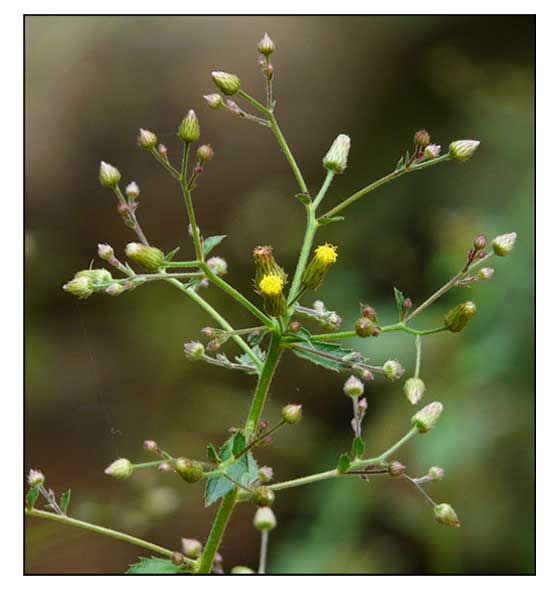
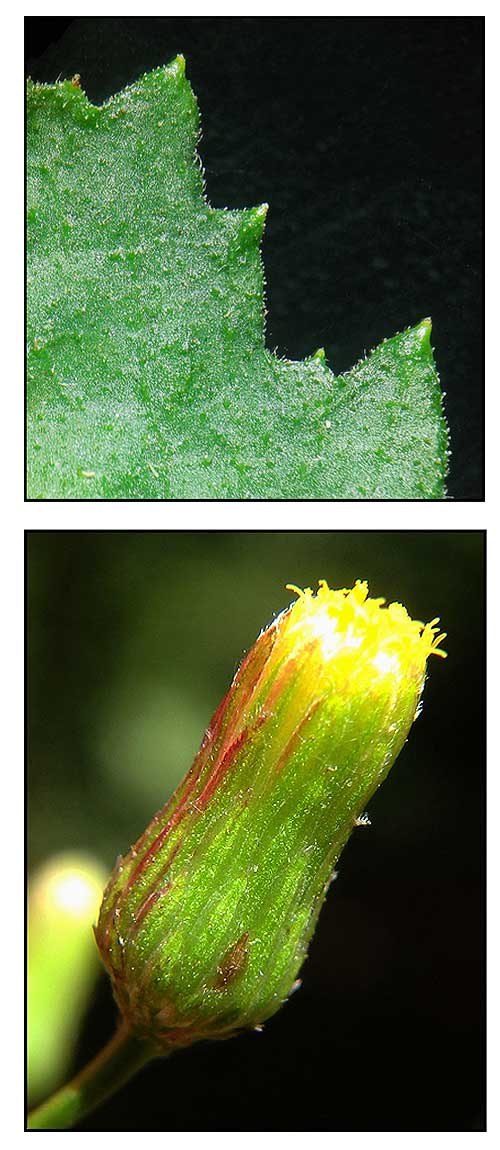
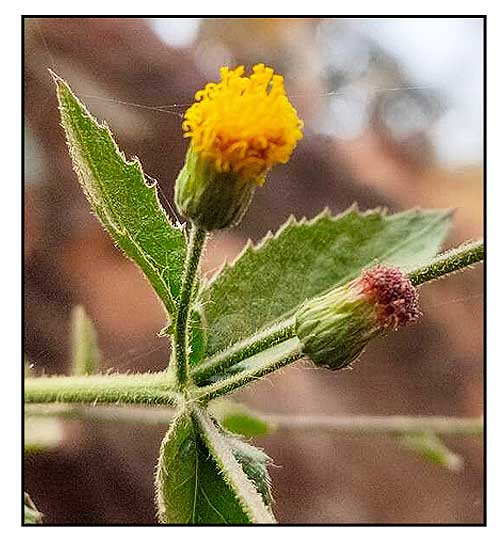
• Green Knob-Bush us a herb, 10-180 cm tall. Stems are simple or branched, quite hairless or rarely sparingly hairy. Leaves are stalkless, 3-22 x 0.7-10 cm; lower ones inverted-lanceshaped, lyrately lobed with end-lobe obovate and lateral lobes broadly triangular to oblong, margin saw-toothed with fine-pointed teeth, tip fine-pointed; upper ones obovate to inverted-lanceshaped, lobed or not, fine-pointed-saw-toothed with minute teeth, both surfaces hairless or sparingly hairy. Flower-heads are usually borne in large, spreading, lax, branch-end leafy panicles. Flower-heads are 5-7 mm in diameter, carried on hairless stalks about 3 cm long. Involucre is columnar, 6-7 mm; phyllaries in 5 or 6 series, herbaceous, entirely reflexed at maturity, linear, 1-7.5 mm. Receptacle is 2-2.5 mm in diameter, convex, hairless. Florets are yellow, tubular; marginal florets thread-like, 4-4.5 mm, 2- or 3-lobed, hairless; central florets 4.5-5 mm, with 5 triangular, papillate lobes. Achenes are oblong-columnar, ribbed, sparsely hairy. Pappus is white, up to 4 mm. (Flowers of India)

• Herbs, 10-180 cm tall. Rhizome fibrous. Stems simple or branched, quite glabrous or rarely sparingly pilose. Leaves ignesrightsile, 3-22 × 0.7-10 cm; lower ones oblanceolate, lyrately lobed with terminal lobe obovate and lateral lobes broadly triangular to oblong, margin serrate with apiculate teeth, apex apiculate; upper ones obovate to oblanceolate, lobed or not, apiculate-serrate with minute teeth, both surfaces glabrate or sparingly pilose. Capitula usually in large, spreading, lax, terminal, leafy panicles, pedunculate, 5-7 mm in diam.; ultimate peduncles ca. 3 cm, bracteate, glabrous. Involucre columnar, 6-7 mm; phyllaries in 5 or 6 series, herbaceous, entirely reflexed at maturity, linear, 1-7.5 mm, sparsely pilose on abaxial surface with white, spreading hairs and colleters, apex mucronate, inner series with prominent scarious margins. Receptacle 2-2.5 mm in diam., convex, alveolate, glabrous. Corollas yellow, tubular; marginal florets filiform, 4-4.5 mm, 2- or 3-lobed, glabrous; central florets 4.5-5 mm, with 5 triangular, papillate lobes. Achenes oblong-columnar, ribbed, sparsely hairy. Pappus white, up to 4 mm. (Flora of China)

Distribution
- Native to the Philippines. (1) (2)
- In Cuulion, Guimaras; in Luzon: Abra, Bataan, Batangas, Benguet, Bulacan, Ilocos Norte, Pampanga, Pangasinan, Rizal, Zambales; in Mindanao: Zamboanga del Norte. (2)
- In thickets and open forewts along small streams, at low and medium elevation, 0-1400 m.
- Also native to Andaman Is., Assam, Bangladesh, Cambodia, China South-Central, East Himalaya, India, Jawa, Laos, Myanmar, Nepal, Sri Lanka, Thailand, Vietnam.
(1)

Constituents
- Phytochemical screening of methanolic extract revealed presence of steroids, alkaloids, flavonoids, tannins, diterpenes, triterpenes, and glycosides, while the aqueous extract yielded steroids, alkaloids, flavonoids, diterpenes, and glycosides. (see study below) (4)
- Study of roots for essential oil yielded 52 compounds, comprising 97.8% of total oil. Major constituents were α-pinene (6.9%), hexadecanoic acid (4.3%), α-muurolol (3.8 %), γ-muurolene (3.4%), 5-cedranone (2.9%), cubebik (2.7%), and bicyclogermacrene (2.5%). Oil was rich in oxygenated sesquiterpenes (34.3%), followed by phenyl derivatives (29.4%), sesquiterpene hydrocarbons (20.7%, monoterpene hydrocarbons (8.4%), oxygenated long-chain hydrocarbon (4.3%), and oxygenated monoterpenes (0.7%). (5)
- GC-MS analysis of ethanoli extract of leaves revealed presence of 4,4,5,8 tetramethylchroman-2-ol, hexadeconic acid, isolongifolene, and 1-Heptatriacotanol. (see study below) (6)

Properties
- Studies have suggested toxicity, mosquito larvicidal properties.

Parts used
Roots, leaves.

Uses

Edibility
- No information on edibility.
Folkloric
- No reported folkloric medicinal use in the Philippines.
- In various traditional systems, whole plant used for treatment of bronchitis, fevers, internal burning sensations, blood diseases, skin boils, throat ailments, and worm infestations.


Studies
• Acute Oral Toxicity:
Study evaluated the in vivo acute oral toxicity of aqueous and methanolic extracts of B. virens in Sprague Dawley rats per OECD 425 guidelines. Limit dose was 2000 mg/kg. No signs of toxicity or mortality was seen in the 14-day observation period. Histopathological studies done at end of the study showed the ME revealed hepatotoxicity and pulmonary toxicity to animals, whereas no abnormalities were detected with the aqueous extract. (4)
• Mosquito Larvicidal against Aedes aegypti / Leaves: Study evaluated the leaves of ten aromatic plants for larvicidal efficacy against fourth instar larvae of Aedes aegypti. Of the ten, three solvent extracts i.e., Acalypha fruticosa, Blumea virens, Cymbopogon citratus showed larvicidal efficacy. Ethanolic extracts of B. virens showed 99% mortality at 24 hours. Petroleum ether extract of B. virens showed zero % mortality. In aqueous solution, B. virens also showed higher activity compared to other plant extracts. (see constituents above) (6)

Availability
- Wild-crafted.

November 2026

                                               PHOTOS / ILLUSTRATIONS
IMAGE SOURCE: Blumea virens DC / © Bhikkhu Nyanatusita / Non-commercial use / Image modified / Click on image or link to go to source page / Flora of Sri Lanka
OTHER IMAGE SOURCE: Blumea virens - Close-up of flower / © Bhikkhu Nyanatusita / Non-commercial use / Image modified / Click on image or link to go to source page / Flora of Sri Lanka
OTHER IMAGE SOURCE: Blumea virens - Close-up of leaf margin: saw-toothed with fine pointed teeth / © Groups / Non-commercial use / Image modified / Click on image or link to go to source page / Groups
OTHER IMAGE SOURCE: Blumea virens / © Dinesh Valke / Non-commercial use / Image modified / Click on image or link to go to source page / flickr
OTHER IMAGE SOURCE: Blumea virens / © plantnet / Observed by sonu kumar / Non-commercial use / Image modified / Click on image or link to go to source page / plantnet

Additional Sources and Suggested Readings
(1)
Blumea virens DC.
/ KEW: Plants of the World Online
(2)
Asteraceae: Blumea virens / Co's Digital Flora Database
(3)
Asteraceae / Wikipedia
(4)
ACUTE ORAL TOXICITY STUDY OF AQUEOUS AND METHANOLIC EXTRACT OF BLUMEA VIRENS IN SPRAGUE DAWLEY RATS / Reni John, Krishnaprasad G Koorse, Surya S, Bibu John K, Dhanush KB, Usha PTA / Exploratory Animal and Medical Research, 2026; 7(2): pp 154-158
(5)
Chemical Compositionof Blumea virens Roots from India / R K Joshi / Chemistry of Natural Compounds, 2018; 54(3) / DOI: 10.1007/s10600-018-2415-y
(6)
STUDY ON LARVICIDAL EFFICACY OF A FEW AROMATIC PLANTS AGAINST AEDES AEGYPTI, L., A POTENTIAL DENGUE VECTOR, AND CHARACTERIZATION OF POSSIBLE ACTIVE PRINCIPLES / Steffy Rapheal, Steffy Francis, Neesh EM, AV Asha et al / Conference: Biodiversity & Evaluation: Perspectives and Paradigm Shifts, 2015

•

DOI: It is not uncommon for links on studies/sources to change. Copying and pasting the information on the search window or using the DOI (if available) will often redirect to the new link page. (Citing and Using a (DOI) Digital Object Identifier)

                                                            List of Understudied Philippine Medicinal Plants
                                          New plant names needed
The compilation now numbers over 1,830 medicinal plants. While I believe there are hundreds more that can be added to the collection, they are becoming more difficult to find. If you have a plant to suggest for inclusion, native or introduced, please email the info: scientific name (most helpful), local plant name (if known), any known folkloric medicinal use, and, if possible, a photo. Your help will be greatly appreciated.
•

•
HOME      •      SEARCH      •      EMAIL    •     ABOUT