
HOME    •    SEARCH      •      EMAIL    •     ABOUT  •     DONATE


Family Rutaceae
Kamal
Melicope bonwickii (F.Muell.) T.G.Hartley
YELLOW CORKWOOD / YELLOW EVODiA

Scientific names Common names
Euodia bonwickii F.Muell. Kamal (Tagalog)
Euodia speciosa Rchb.f. & Zoll. ex Teijsm. Yellow corkwood (Engl.)
Euodia villamilii Merr. Yellow evodia (Engl.)
Melicope bonwickii (F.Muell.) T.G.Hartley  
Melicope bonwickii is an acceptd species. KEW: Plants of the World Online

Other vernacular names
INDONESIA: Abal (Madurese), Awal (Javanese).

Gen inf
- Melicope is a genus of about 240 species of shrubs and trees in the family Rutaceae.
- Melicope bonwickii, commonly known as yellow evodia or yellow corkwood, is a species of tree in the family Rutaceae.
- Taxonomy: The genus Melicope was first formally described in 1775 by Johann Reinhold Forster and his son Georg Forster in their book Characteres Generum Plantatum. Species was first formally described in 1865 by Ferdinand von Mueller, who gave it the name Euodia bonwickii and published the description in Fragmenta Phytographiae Australiae. In 1994, Thomas Gordon Hartley changed the name to Melicope bonwickii in the journal Sandaknia. (4)
- Etymology: The genus name Melicope derives from Greek words meli, meaning "honey," and kope, meaning "a division," referring to the glands at the base of the ovary. The specific epithet bonwickii honors James Bonwick.

Botany
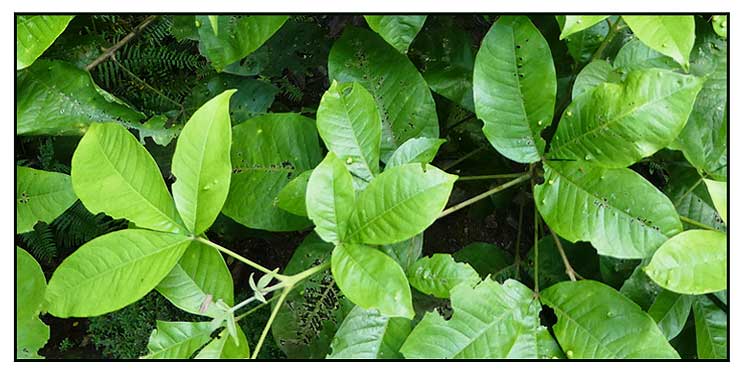
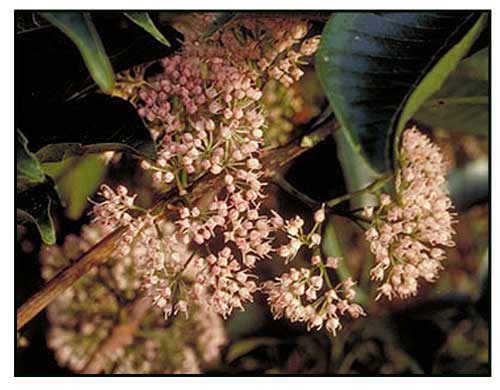
Melicope bonwickii grows up to 40 meters (130 ft) tall. Leaves are trifoliate on a petiole  30–95 mm (1.2–3.7 in) long, the end leaflet egg-shaped with the narrower end towards the base, sessile, 100–300 mm (3.9–11.8 in) long and 50–150 mm (2.0–5.9 in) wide. Flowers are bisexual, borne in panicles  35–100 mm (1.4–3.9 in) long, in leaf axils. Sepals are more or less round, 1.5–2 mm (0.059–0.079 in)long and joined at the base. Petals are pink, rarely white, about 4.5 mm (0.18 in) and are hairy with a ridge on the back. There are four  stamens. Fruit consists of up to four follicles, 4–6 mm (0.16–0.24 in)long. (4)

• A tree up to 40 m tall, young branchlets glabrous to rarely sparsely hairy, terminal bud appressed hairy. Leaves opposite, 3-foliolate, 14-40 cm long, leaflets elliptical to obovate, 10-30 cm × 5-15 cm, glabrous or sparsely hairy on veins below. Inflorescence on branchlets below the leaves, rarely axillary, glabrous to sparsely hairy, 3.5-10 cm long. Flowers bisexual, stamens 4, filaments glabrous. Fruit sparsely hairy to almost glabrous, follicles nearly round to obovoid, 4-6 mm long, exocarp dry. Seeds nearly round to ellipsoid or hemispherical, 3-4.5 mm long. (PROSEA)

Distribution
- Native to the Philippines. (1)
- Also native to
Borneo, Lesser Sunda Is., Maluku, New Guinea, Queensland, Sulawesi, Vanuatu. (1)

Constituents
- Study of leaves isolated furoquinoline alkaloids: a new 7-(2'-hydroxy-3'-chloroprenyloxy)-4-methoxyfuroquinoline (1) together with the known 7-(2',3'-epoxyprenyloxy)-4-methoxyfuroquinoline (2), evellerine (3) kokusaginine (4) and an amide aurantiamide acetate (5). (see study below) (3)

Properties
- Studies have suggested cytotoxicity, anticancer properties.

Parts used
Bark, leaves.

Uses

Edibility
- No recorded information on fruits, leaves, and flowers.
Folkloric
- No reported medicinal use in the Philippines.
- In Indonesia, bark used as leech repellent or for treatment of leech bites.
- In the Tanimbar Islands of the Moluccas, plant used for treatment of dysentery.
Others

- Nectar: Flowers are popular with nectar or pollen feeding birds, especially parrots. (2)
- Agroforestry: Potential as pioneer species in restoring native woodland. (2)
- Wood: A useful general purpose timber.

Studies
• Anticancer / Furoquinoline Alkaloids / Cytotoxicity Against Cervical Cell Lines / Leaves
:
Study of leaves isolated furoquinoline alkaloids: a new 7-(2'-hydroxy-3'-chloroprenyloxy)-4-methoxyfuro-quinoline (1) together with the known 7-(2',3'-epoxyprenyloxy)-4-methoxyfuroquinoline (2), evellerine (3) kokusaginine (4) and an amide aurantiamide acetate (5). Compounds 1 and 2 showed significant activity against cervical cell lines (HeLa). (3)

Availability
- Wild-crafted.

September 2026

                                                 PHOTOS / ILLUSTRATIONS
IMAGE SOURCE: Flowers of Melicope bonwickii / by Bruce Gray / CC BY 3.0 au / Image modified / Click on image or link to go to source page / Wikipedia
OTHER IMAGE SOURCE: Yellow evodia (Melicope bonwi kii / © Steve Fitzgerald / Some rights reserved / CC BY-SA 4.0 International / Image modified / Click on image or link to go to source page / iNaturalist

Additional Sources and Suggested Readings
(1)

Melicope bonwickii / KEW: Plants of the World Online
(2)
Melicope bonwickii / Tropical Plants Database: Ken Fern / Useful Tropical Plants
(3)
Furoquinoline alkaloids from Melicope bonwickii (F.Muell.) T.Hartley / Ismiarni Komala, Mawardi Rahmani, Mohd Aspollah Sukari, Asmah Rahmat et al / Natural Product Research, 2006; 20(4): pp 355-360 /
DOI: 10.1080/14786410500462983

(4)
Melicope bonwickii / Wikipedia
(5)
Melicope bonwickii / Juliasri Djamal, JLCH van Valkenburg / PROSEA

DOI: It is not uncommon for links on studies/sources to change. Copying and pasting the information on the search window or using the DOI (if available) will often redirect to the new link page. (Citing and Using a (DOI) Digital Object Identifier)

                                                            List of Understudied Philippine Medicinal Plants
                                          New plant names needed
The compilation now numbers over 1,750 medicinal plants. While I believe there are hundreds more that can be added to the collection, they are becoming more difficult to find. If you have a plant to suggest for inclusion, native or introduced, please email the info: scientific name (most helpful), local plant name (if known), any known folkloric medicinal use, and, if possible, a photo. Your help will be greatly appreciated.

HOME      •      SEARCH      •      EMAIL    •     ABOUT