|
Gen info
- Lycopodiaceae is an old family of vascular plants, including all of the core clubmossses and fir mosses, with about 17 accepted genera and about 500 known species. The family originated about 380 million years ago in the early Devonian. (26)
- Lycopodium is a genus of clubmosses in the family Lycopodiaceae, also known as ground pipes or creeping cedars.
- Lycopodium is one of nine genera in the subfamily Lycopodioideae, comprising 9 to 15 species. In other classifications, the genus is equivalent to the whole of the subfamily, including all other genera, and with more than 40 accepted species. (25)
- The genus Lycopodium was first published by Carl Linnaeus in 1753.
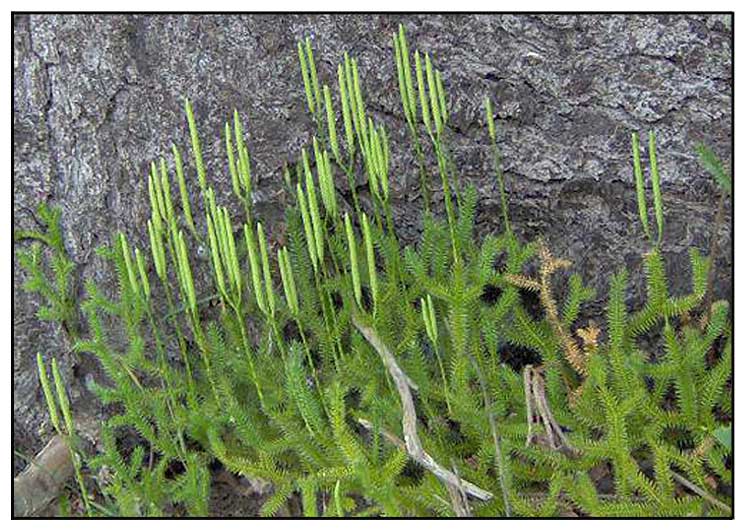
- Lycopodium clavatum is the most widespread species in the genus Lycopodium in the clubmoss family.
- Etymology: Lycopodium is Greek-derived, lykos (wolf) and podion (foot); called "wolf's foot" from its resemblance of the branch tips to a wolf's paw. clavatum, from Latin, means "club shaped."
 Botany Botany
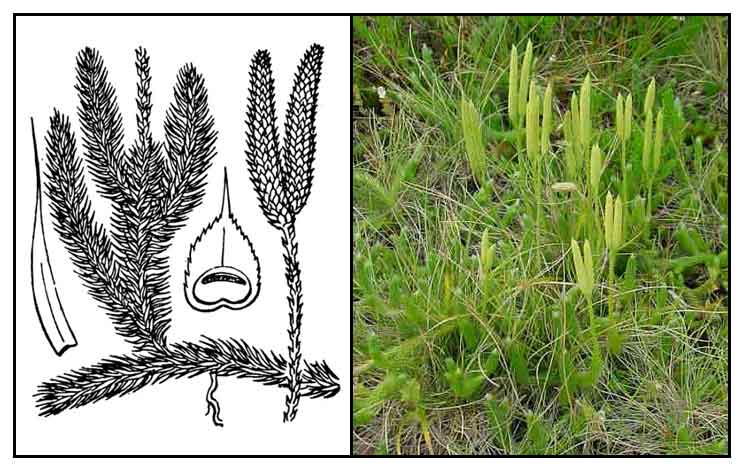
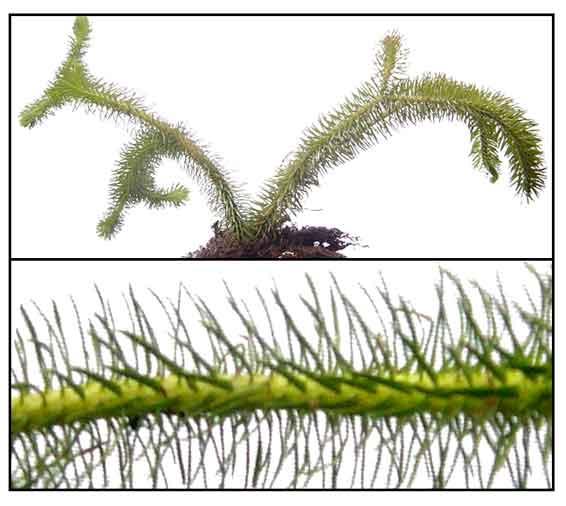
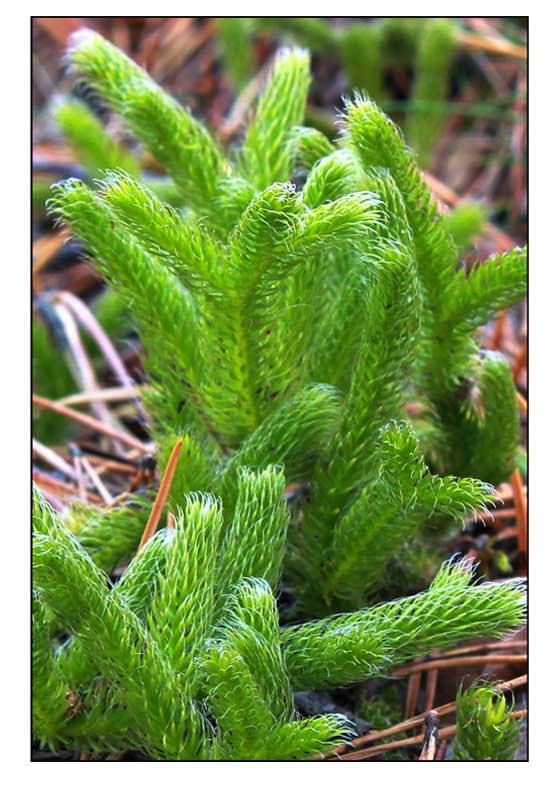
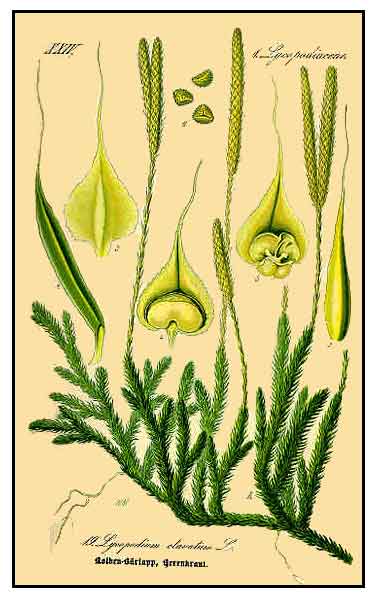
• Licopodio is a perennial with prostrate,
creeping, tough and flexible woody stem, growing to a length up to 5
meters or more, dichotomously branched, with short and ascending branches. Leaves
are very numerous, small and persistent, 5 to 8 millimeters long, closely placed
and densely imbricated on the stem, points all turned somewhat upwards, sessile, linear-oblong, the apex
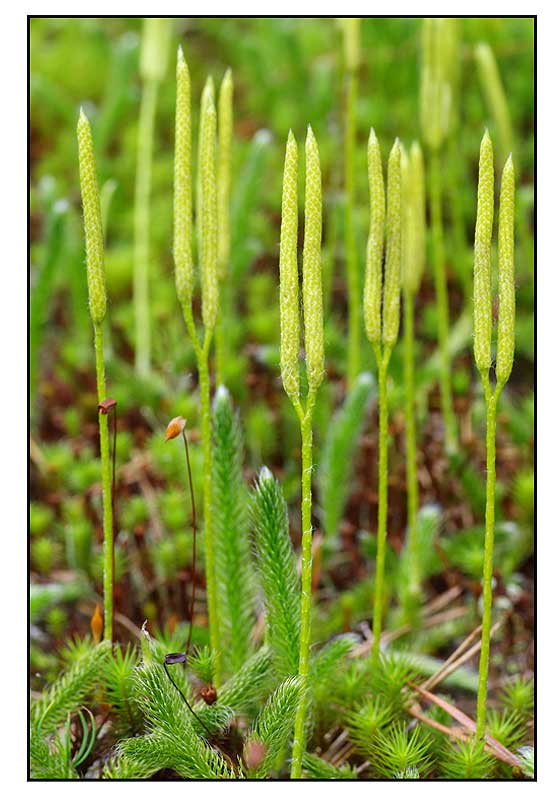
terminating in a hairlike process as long as the leaf. Spikes are borne
singly or in pairs, at the end of the erect and slender stiff branches,
2.5 to 6 centimeters long, cylindric, linear, blunt and composed of short-stalked
imbricated bracts, terminating to a long filiform point. Spores are
pale yellow, very minute, tetrahedral, and finely reticulated.
Distribution
- Native to the Philippines. (16)
-
In the Philippines, limited to the high mountainous
areas of Luzon.
- Extensively distributed globally, found in the temperate and colder regions of both hemispheres and in the Old and New Worlds.
 Constituents Constituents
- Principal constituent
is a fixed oil, 47 %, described as a bland and maintaining liquidity even at low temperatures of 5º Fahrenheit.
- Study yielded three serratene triterpenoids.
- Study yielded alkaloids lycopodine (major alkaloid), clavatine and clavatoxine; polyphenolic acids including dihydrocaffeic; flavonoids including apigenin, and triterpenes.
- Study has yielded active principles viz., clavatin, annotin, lycopodine, nicotine triterpene, flavonoids, and minerals. GC-MS analysis of ethanolic extract
yielded lycopodine (58.26%) as one of the most abundant alkaloids. (see study below) (21)
Properties
Considered analgesic, anti-inflammatory, antirheumatic, antioxidant, antipruritic, antispasmodic,
carminative, decongestant, demulcent, diuretic, emmenagogue, tonic.
- Studies have suggested anti-inflammatory, antiviral, antimicrobial, anticancer, hepatoprotective, analgesic, CNS depressant, anti-protozoal, antioxidant, nootropic, acetylcholinesterase inhibitory, anti-urolithiatic, monosodium urate crystallization inhibitory properties.
Parts utilized
Entire plant, spores.
Uses
Edibility
- Caution: While there are reports from long ago for the leaves being steeped into tea for treatment of fever and bloating, L. clavatum is not considered edible. The green vegetative stems, leaves, and roots contain poisonous alkaloids.(see toxicity below: Licopidine)
-
While green plant parts are toxic, the dry, powdery yellow spores are non-toxic, and are used in traditional remedies and homeopathic prep-rations. However, raw or bulk spores are not used as food source, and can cause asthma, respiratory irritation or allergic reactions (itching of skin and nose, conjunctivitis among others).
 Folkloric Folkloric
- Polvo de licopodio is
used as a dusting powder for excoriated skin problems, as in the intertrigo of infants, and in eczema and erysipelas.
- Used for gout and rheumatism.
- Used to stimulate the appetite.
- Used to relieve spasmodic retention of urine in children.
- Used for urinary and kidney stones.
- Used for constipation, piles, flatulence, enteritis, bronchitis and pneumonia.
- In the Visayas, the material is crushed
or finely chopped, heated with salt, for application to insect and centipede
bites.
- In China, decoction of the plant used for
beriberi and nervous conditions.
- In India, used for the treatment of inflammation-related
diseases.
- In the Pyrenees region, plant is used as a diuretic.
- Used for healing of bed sores – finely powdered club moss is spread over the open sores.
- infusion used for liver cirrhosis and malignant liver conditions.
- Spores inhaled to stop bleeding noses; applied to wounds and various skin diseases.
- The Obo community of South Cotobato use plant preparations for body pains and as anti-aging facial wipes. (18)
- In Finnish traditional medicine, used as diuretic and as remedy for rickets.
- In Ayurveda, spores used topically for treatment of weeping eczema, diaper rash, and wounds. Whole plant decoction used for liver disorders and urinary tract infections. Powdered spores dusted over moist skin to prevent chafing and infection. In low doses, used for gas, bloating and indigestion. Paste used for relieving pain in sciatica and lumbago. (29)
Others
- Pharmacy: Used to envelop
pills to prevent in from sticking; also to alter the taste.
- Mordant: Used as mordant in dyeing.
- Repellent: Used as insect repellent.
- Weaving: Stems made into matting.
- Lighting / Fireworks: Used as flash powder in early photography and magic acts. Used in fireworks and artificial lighting.
- Homeopathy: Lycopodium is one of the most commonly used plant in homeopathy. Used for premature ejaculation and erectile dysfunction. (see below for homeopathic studies)
- Jet lag: It is an active ingredient in a homeopathic over-the-counter product (No-Jet-Lag) designed to relieve tiredness and jet lag symptoms associated with flying.
Preparations
• Infusion: An infusion is made with 1/4 liter of boiling water poured over a level teaspoon of Club Moss. 1 cup is taken in small sips, half an hour before breakfast. For malignant diseases of the liver and cirrhosis, 2 cups daily.
• Club Moss Pillow: 100 to 300 gm depending on the size of the area affected by cramp. Stuff the material into a pillow and apply to the aching area overnight. (Pillow retains can be used for a year.)
Toxicity & Allergy concerns
• Constituents: Contains lycopodine which may be paralyzing to the motor nerves. Contains clavatine which is toxic to many mammals. Spores are not known to be toxic.
• Asthma: Report of occupational asthma in two women employed in the manufacture of condoms. The spores of LC, used as a rubber dusting agent, were identified as the causative agent. (9)
 Studies Studies
• Anti-Inflammatory: Study of extracts showed anti-inflammatory activity probably from the
alkaloid compounds and supports its folkloric use. (1)
• Antimicrobial / Antifungal / Antiviral: All extracts showed activity against test strains of S aureus. LC extracts showed antifungal activity. Only the chloroform extract showed activity against HSV. All extracts showed insignificant antiradical effect on DPPH. Lycopodine was identified as the major alkaloid. (2)
• Hepatoprotective / Antitumor: Study evaluate the protective effect of a plant extract in mice chronically fed hepato-carcinogens. Treatment
with spore extract of Lycopodium clavatum had a significant reduction
of tumor incidence in the liver of carcinogen intoxicated mice. Results
validate the extract use in complementary and alternative use against
hepatotoxicity. (4)
• Lycopodine / Anti-Cancer Property / Chemotherapeutic Potential: Crude ethanolic extract of LC is a mixture of about 200 alkaloids. Results showed that lycopodine considerably inhibited growth of HeLa cells indicating its potential use in chemotherapy. (8)
• Hepatoprotective / CCl4-Induced Damage: Study evaluated the hepatoprotective action of L. clavatum against carbon tetrachloride-induced damage in rats. Results showed control of biochemical parameters. The protective action was confirmed by microanatomical studies of hepatic tissues. (10)
• Chemical Marker Powder / Forensic Use: Study showed a powder, based on L. clavatum spores, to have potential for use as a chemical marker for forensic evidence of persons having handled objects. The rate of loss in the decay curve (decrease in spores) was highest in the first two hours. (11)
• Analgesic and CNS Depressant Effects / Forensic Use: Study investigated the possible analgesic and behavioral effects of homeopathic formulations of L. clavatum in animal models using hot plate, ice place, Randall-Selitto tests and behavioral effects using rota rod and open field tests. Results showed homeopathic formulations possess central nervous system depressant activity. (12)
• Antiprotozoal Activity: Study investigated the antiprotozoal activity of extracts of L. clavatum and L. camplanatum L. subsp. chamaecyparissus against Trypanosoma brucei rhodesiense, T. cruzi, Leishmania donovani and Plasmodium falciparum. Results showed both fern species contain antiprotozoal activity with no cytotoxicity. (13)
• Antioxidant: Study evaluated the efficacy of club moss (L. clavatum) and blessed thistle (Cnicus benedictus) hydroalcoholic extracts in preventing oxidative stress damage in liver tissue of mice. Results showed treatment of mice with plant phenophenols resulted in marked improvement in most of the studied parameters. (14)
• Anti-Cancer / Homeopathically Potentized Dilutions: Study of homeopathically potentized ultrahigh dilutions of L. clavatum (LC-5C and LC-15C) demonstrated an ability to induce apoptosis in cancer cells. (15)
• Effect on Memory and Cerebral Blood Flow: Study has shown acetylcholinesterasee (AchE) inhibitory effect in Lyc alkaloid extract. Study evaluated the effect of Lyc on learning and memory function and cerebral blood flow (CBF) in intracerebrovascularly STZ induced memory impairment in rats. Results showed improvement in learning and memory and increased in CBF in rats at all potencies of Lyc studied. (17)
• Antioxidant: Study evaluated the secondary metabolites and antioxidant property of decoction and ethanolic extracts of L. clavatum. Results showed antioxidant activity on DPPH assay which may be attributed to the presence of flavonoids, steroids, and flavanoids. (18)
• Effect of Potentized Homeophathic Lycopodium clavatum in the Treatment of Polycystic Ovarian Syndrome (PCOS): Study reports of the relative efficacy of two potentized homeopathic remedies — Calcarea carbonica and Lycopodium clavatum—for the removal of ovarian cysts in a study of 40 patients. Results showed both plants showed removal of cysts in 21 patients, with amelioration of relevant symptoms and no reported side effects. (19)
• Effect on Aging-Induced Testicular Function: Study evaluated the effects of ethanolic extract of Lygopodium clavatum on aging induced alteration in testicular function. Depleted testosterone level improved in all treated rats with improvement in sperm parameters. Effects seemed to be dose-dependent. (20)
• Bacteriostatic / Hepatoprotective: Study evaluated the hepatoprotective and antimicrobial effects of Lycopodium clavatum and Equisetum arvense against xenobiotic intoxication or microbial infection. Liver injury was induced by acetaminophen in a mice model. Results showed the hydroalcoholic extract had only moderate hepatoprotective and antimicrobial effects. The extracts induced a moderate bacteriostatic effect on growth of most of the tested bacteria, but no against fungi. The principle hepatoprotective compound was lycopodine. (see constituents above) (21)
• Antiurolithiatic / Clinical Trial: A multicentric, randomized, double-blind, placebo controlled trial evaluated the efficacy of Lycopodium clavatum in the management of urolithiasis. Patients were prescribed the homeopathic medicines or conventional medicines. Study showed there was not statistical significance between the groups (p=0.31) in reference to number of cases where stones were expelled during the trial. A statistical difference was found between between groups (p=0.039) for pain and positive trend for homeopathy was noted for dysuria. Further studies with pragmatic study design and individualistic Homeopathy can be undertaken to assess the effectiveness of treatment in urolithiasis. (22) No efficacy was found for L. clavatum for urolithiasis in a double-blind, randomized trial However, there was a positive trend seen for pain relief. (23)
• Apoptotic Effect on MCF-7 Human Breast Cancer Cells / Clinical Trial: Study evaluated the cytotoxic and apoptotic effects of LC water extract (LC-WE) and ethanol extract (LC-EE) plants extracts on MCF-7 human breast cancer cells. LC treatment showed dose- and time-dependent cytotoxic effect on MCF-7 cells, indicating potential as anticancer agent against human breast cancer. LC treatment activated apoptosis-related proteins, including BAX, Caspase-3, and Caspase-9. Results suggest LC may induce apoptosis as mechanism of its cytotoxic effect. Study suggests potential of LC as a promising natural compounds for breast cancer treatment. (27)
• Hepatoprotective / Paracetamol-Induced Liver Damage: Study evaluated the hepatoprotective efficacy of L. clavatum 30C (Lyc) against liver damage experimentally induced by paracetam0ol (Pct) in Wistar rats. Results showed Lyc 30c exerted a moderate hepatoprotective effect on acute Pct-induced hepatitis, evidenced by histological decrease in necrosis and inflammatory foci, preserved glycogen and other 1,2-glycols in zone 3 and reduced serum levels of ALT and AST.
(28)
• Mitigation of Oxidative Stress and Inflammation in Acetic Acid-Induced Colitis: Study evaluated the effect of Lycodium (LYCO) in acetic acid (AA)-induced colitis model in Wistar rats. LYCO was given at dose of 50 mg/kg/day 3 days before or 30 min after induction of IBD (inflammatory bowel disease) and continued for 7 days. Treatment with LYVO significantly improved IBD-induced reduction of body weight, improved histology, inhibited MDA formation, and restored antioxidants and reduced MPO activity. LYCO significantly reduced release of calprotectin and proinflammatory cytokines. LYCO treatment exhibited potential to improve disease activity by inhibiting oxidative stress, lipid peroxidation, and inflammation along with histological preservation of colonic tissues. (30)
• Inhibition of Monosodium Urate Crystallisation: Lycopodium clavatum is the most widely used drug in homeopathy for treating hyperuricemia and gout. Study evaluated the potential role of a homeopathic preparation of L. clavatum in different potencies on monosodium crystallisation in vitro. Spectrophoto-
metric analysis showed all potencies inhibited aggregation of monosodium urate crystals with maximum inhibition at 200C and 1M potency. Results suggest L. clavatum could be effective in inhibiting mono-
sodium urate crystals in vitro and causes dissolution of crystals, especially in high potency. Further studies suggest for mechanism of action. (31)
• Antihyperuricemic / Case Series: Study evaluated the effects of homeopathic medicine L. clavatum in the management of hyperuricemia in five cases. Results showed significant alleviation of hyperuricemia symptoms along with decrease in serum uric acid levels, enabling reduction in use of conventional medicine. (33) In the News
• Oil-filled Plant Spores for Age-Bitumen Cracks: Road fractures are the result of traffic loads that lead to water entering the pavement, which may eventually lead into potholes. Researchers have developed a self-healing road material that repairs small cracks before they develop into potholes. The material is made of porous plant spores filled with recycled oils, which are released under pressure from passing traffic. It softens the bitumen, letting it flow into cracks and sealing them without need of human intervention. The approach builds on earlier research (ACS Applied Materials & Interfaces, 2022) on microcapsules made from Lycopodium clavatum, a plant whose spores can serve as protective containers for rejuvinating oils (ex: sunflower oil). (Times of India)
Availability
- Wildcrafted.
- Cultivated.
- Pellets, powders, extracts in the cybermarket. |