| General
info
• Euphorbiaceae, the spurge family, is a large family of flowering plants. It is the 5th-largest flowering plant family, with about 7,500 species in 300 genera, 37 tribes, and three subfamilies: Acalyphoideae, Crotonoideae, and Euphorbioideae. A significant number are succulent, all contain latex and
have a unique flower structure. Although it is present in many traditional
medicinal systems, nearly all possess poison or toxicity.
• Euphorbia is a large and diverse genus
of flowering plants, commonly called spurge, in the family Euphorbiaceae.
• Euphorbia antiquorum, known as antique spurge and "Euphorbia of the Ancients", is a species of succulent plant in the family Euphobiaceae. It is the type species of the genus Euphorbia. It was first described by Carl Linnaeus in 1753 in Species Plantarum.
- Etymology: The common name "spurge" derives from Middle English/Old French espurge ("to purge"), referring to the plant's sap as purgative. The genus name Euphorbia derives from Euphorbos, the Greek physician of King Juba II of Numidia and Mauretania (52-50 BCE to23 CE), who married the daughter of Anthony and Cleopatra. Juba, a prolific writer on various subjects, including natural history, named the plant after his physician, Euphobos, as Augustus Caesar had dedicated a statue to the brother of Euphorbos, Antonius Musa, the personal physician of Augustus. In 1753, botanist and taxonomist Carl Linnaeus assigned the Euphorbia name to the entire genus in the physician's honor. (32)
 Botany Botany
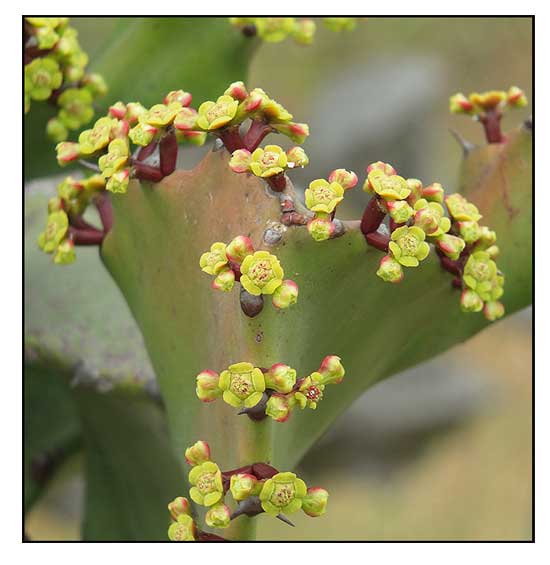
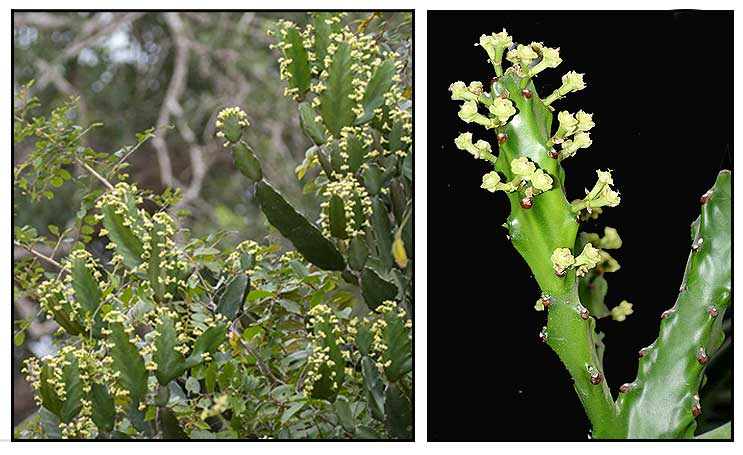
• Euphorbia antiquorum is a succulent woody shrub growing 1 to 3 meters high with
milky sap. Mature stem is cylindrical in shape with 3 to 6 ridges; younger
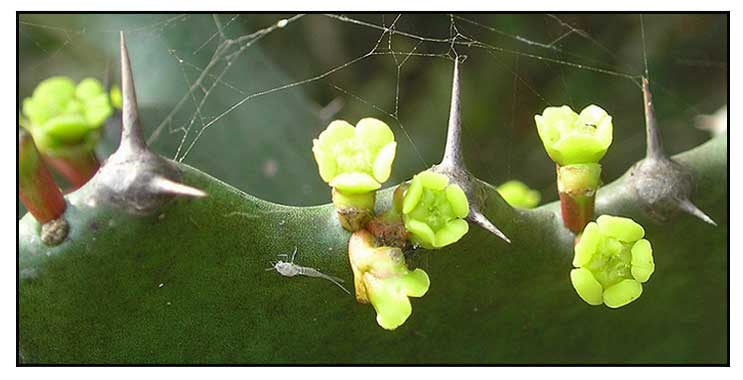
branches green with 3 to 5 ridges; the projection of the ridges are armed
with a pair of 2- to 3-millimeter long spines. Leaves are few, borne on the ridges, succulent, obovate to oblanceolate
to spathulate in shape. Apex is obtuse with a small pointed projection,
base gradually narrowing downward, sessile. Male flower possess only 1 stamen, filament short; female
flower situated alone at the center of the cyathium, protruding beyond
the involucre. Styles are 3, not joined to each other, each style forking
towards the tip. Inflorescence is yellowish-green, monoecious, composed
of several staminate (male) flowers and one pistillate (female) flower
borne on a green, hemispherical involucre. Whole cuplike cymose
inflorescence is called cyathium. Fruits are glabrous, smooth, about 1 centimeter in diameter.
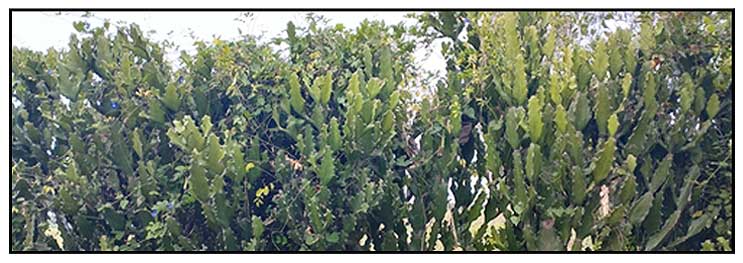
• It is one of the largest armed Euphorbia tree with an average height of 5-7 m, stems 5-7 cm thick, green, glabrous, branching from upper parts; upward curving, segmented.
Distribution
- Native to the Philippines. (29)
- Elsewhere, listed as naturalized.
-
Widely cultivated throughout
the Philippines as an ornamental but may occasionally be found
as an escape from cultivation.
- Native to Assam, Bangladesh, Cambodia, East Himalaya, India, Jawa, Malaya, Myanmar, Pakistan, Sri Lanka, Thailand, Vietnam. (8)
Constituents
- From the latex, study isolated three new triterpenes, euphol-3-O-cinnamate, antiquol A and antiquol B, with known triterpenes, euphol, 24-methylenecycloartanol and cycloeucalenol; together with a nonacosene, sitosterol and p-acetoxyphnol. (7)
- Study isolated ten compounds viz.
glutinol (1), taraxerol (2), friedelanol (3), stigmasterol (4), 23-cycloarten-3β,25-diol (5), ent-13S-Hydroxy-16-atisene-3,14-dione (6), 6,7,8-trimethoxylcoumarin (7), 3,3′,4′-tri-O-methylellagic acid (8), ent-kaurane-3-oxo-16β,17-diol (9) and daucosterol (10). (15)
- Phytochemical screening of roots yielded flavonoids carbohydrates, phytosterols, fixed oils and fats, phenolic compounds, gums, and mucilage. (23)
- Study of aerial parts isolated 18 new ingol-type diterpenes, euphorantins A-R (1-18), along with four known analogues (19-22). (see study below) (25)
- Study isolated three highly modified cembranoids, quorumolides A-C. It is noteworthy, biosynthetically, that the stereochemistries of C2 and C12 in the pyran ring of 1-3 were opposite to those of marine-derived rare cembranoids. (26)
- Study of whole plant isolated 16 diterpenoids, including 5 new compounds, euphiquorins A-E (1, 5-8), together with 11 known analogues (2-4, 9-16). (Compounds showed no significant cytotoxicity against MCF-7 cells).
(40)
- Bioassay-guided study isolated five ent-atisanes, one seco-ent-atisane, and one lathyrane (ingol-type), elucidated as: elucidated as ent-1α,3α,16β,17-tetrahydroxyatisane (1), ethyl ent-3,4-seco-4,16β,17-trihydroxyatisane-3-carboxylate (2), ent-atisane-3-oxo-16β,17-acetonide (3), ent-3α-acetoxy-16β,17-dihydroxyatisane (4), ent-16β,17-dihydroxyatisane-3-one (5), calliterpenone (6), and ingol 12-acetate (7). (see study below) (43)
 Propertie Propertie
· Bitter tasting, cooling effect.
· Stomachic, antifebrile, antiphlogistic, anti-infectious, antidermatosis.
· Studies have shown hepatoprotective, antioxidant, insecticidal, antibacterial, antifungal, analgesic, anti-inflammatory, mosquitocidal, larvicidal, anti-hyperglycemic, anticancer, wound healing, renal protective, piscicidal, alpha-glucosidase inhibitory, hepatoprotective properties.
Parts
utilized
· Stem, latex.
· Collected the whole year round.
· Remove cortex after harvest, cut into sections, roast
in frying pan till brownish-yellow.
Uses
Edibility
· Despite reports on the whole plant being poisonous, young shoots that have been properly boiled for detoxification, soaked in water and covered with sugar, have been eaten as sweetmeats. (42)
Folkloric
· No reported medicinal use in the Philippines.
· Acute gastroenteritis: use 3 to 6 gms dried materials in decoction.
· Malignant furuncle and carbuncle infections: use pounded fresh
stem (quantity sufficient) and apply as poultice.
· Scabies, various dermatoses: apply sap over afflicted areas.
· In India, Juice of plant used for chest pains and constipation. Latex applied to boils for early suppuration and healing. Bark is used as purgative. Latex used for killing wound maggots. Saline extract used as antibiotic.
· In Andhra Pradesh, India, latex from stem applied on spots of burn injury. Stem is heated on fire, and juice expressed is topically applied on wounds to facilitate healing. (22)
· Used as traditional folk medicine for treatment of inflammation, arthritis, wounds, stomachache, cutaneous infections, deafness, bronchitis, asthma, diabetes, and as purgative. Fresh milky juice or gum used as aphrodisiac, for treatment of conjunctivitis, cough, dropsy, fistula wounds, toothache, gonorrhea, joint swelling, inveterate ulcer, splenic enlargement, snake bites, among others. Stems used for treatment of worms, ulcers, wound healing, gout, joint pains, cancer, phthisis, skin sores, and scabies. Whole plant used as antitussive and anticancer. (33)
· In Myanmar, dried, powdered sliced branches used for profuse lochial discharge. Latex applied to warts. Root bark used as purgative. In India, whole plant used for skin infections; latex, for dropsy, bronchitis, and as nerve tonic; pith used for syphilis, dropsy, anasarca; bark, in combination with bark of other species, used on venereal sores. In China, whole plant decoction used for bladder inflammation; raw plant tissues used internally for cholera; stem latex used for warts; and stem compressed onto large boils. (35)
· In Ayurveda, the Charaka Samhita (ca 1st-2nd century CE) mentions it as a counter-irritant remedy for piles and skin lesions. In Sushruta Samhita, its use is highlighted in wound dressings and as ingredient in traditinal rakta stambhana (bleeding-staunching) formulations. (38)
- In medieval times, around 10th century CE, local Indian and Sri Lankan healers used Snuhi latex mixed with ghee or honey as poultice for arthritic joints, relieving inflammation and stiffness. (38)
- Indian folk practitioners use root decoction for dyspepsia and as gentle purgative. (38)
- Dried heartwood used as antipyretic; used in treatment of dysentery and dropsy, and used in applications to treat toothache.
Livestock
• Milk of E. antiquorum is applied near to eyes for cattle to
treat conjunctivitis and corneal opacities.
• Milk is applied to the neck and joints of cattle to treat black
quarter.
Others
• Ritual / Superstition: In Northeast India, one of the Euphorbia species used to ward off evil spirits.
• Ancient construction: Juice of plant used as potent ingredient in mixture of wall plaster, according to the Samarangana Sutradhara, a Sanskrit treatise on Silpasastra (Hindu science of art and construction).
• Fish poison: Toxic milky-white sap used as fish poison (piscicide). Effect attributed to caustic toxic compounds and dieterpenoids such as 3-O-angeloylingenol and euphorbin. (see study below) (38)
• Agroforestry: Used as barrier or ornamental hedge. In the northwestern Himalayas, grown as living fence to mark land boundaries and to exclude livestock and other animals. (42)
• Crafts: Wood used for making bowls. (42)
• Insecticidal: Reported insecticidal use.
Caution
!
• This drug is toxic. Frying neutralizes
the toxin, after which it can be taken orally. However, excessive dosage
may still cause diarrhea.
• The milky sap or latex, which is also poisonous, must not come
in contact with the eyes; skin contact with this sap may cause skin
inflammation. Take caution too that this is not administered to pregnant
patients.
Studies
• Anti-Epstein
Barr Virus Activation: Study yielded three triterpene
alcohols from the latex. Some compounds showed potent inhibitory effects
on Epstein-Barr virus early antigen activation. (3)
• Hepatoprotective
/ Antioxidant / Aerial Parts: Study of aqueous extract of the aerial
parts of Euphorbia antiquorum showed significant antioxidant activity
and also significant dose-dependent hepatoprotection, effects comparable
to Silymarin and Sodium metabisulphite. The results helps justify its
traditional use for treating jaundice. (4)
• Insecticidal / Latex:
Study of the insecticidal properties of EA showed the
components were best extracted by xylene. The xylene-latex extract was
highly toxic to soft bodied insects / spiders. On storage, both the xylene-latex extract and the n-hexane fraction were still highly stable with only a 3 % decline of activity after one year. (6)
• Flavonoids / Antibacterial / Latex: Study evaluated the latex and flavonoids from roots of Euphorbia antiquorum for antibacterial activity against Pseudomonas aeruginosa, Klebsiella pneumonia, Proteus vulgaris, Escherichia coli, Streptococcus anginosus and Bacillus subtilis. Results showed the flavonoids from E. antiquorum latex were effective against gram positive and gram negative bacterial species, with 30 µg/ml extract concentration sufficient to constrain bacterial growth. The pure latex of E. antiquorum yielded 7.54 mg/g total flavonoid. (9) E. antiquorum latex has been used as classical binding agent for the kshara sutra in the management of anal fistula. This study for the antimicrobial properties of a methanol extract latex showed minimum inhibition to E. coli and S. aureus. (28)
• Anti-Hyperglycemic / Roots: Study evaluated the anti-hyperglycemic effect of E. antiquorum root in streptozotocin-nicotinamide-induced type 2 diabetes mellitus and fructose induced insulin resistance models. Treatment with alcohol and aqueous extracts of EA roots resulted in significant (p<0.001) lowering of serum blood glucose and GHb levels in both models. (10)
• Mosquitocidal / Aedes aegypti / Latex: Ae. aegypti is the primary vector of chikungunya, yellow fever, and dengue. A methanolic latex extract f E. antiquorum tested for larvicidal activity against 4th instar larvae of Ae. aegypti showed high toxicity to the mosquito larvae with LC50 of 10.70 ml/dl at 48 hr. exposure. (11)
• Analgesic / Anti-Inflammatory: Study evaluated aqueous ethanolic extract of whole plant for analgesic activity (hot plate, acetic acid induced writhing and formalin induced writhing methods) in Swiss albino mice and anti-inflammatory effect (carrageenan induced rat paw edema method) in Long Evans rats. Results showed significant dose dependent analgesic effect (p<0.01) and significant anti-inflammatory (p<0.001) effect. Chemical constituents tannins, flavanoids, terpenoids, and alkaloids may be responsible for the observed analgesic and anti-inflammatory effects. (12)
• Silver Nanoparticles / Latex / Antibacterial, Larvicidal and Anticancer: Study reports on the rapid biosynthesis of silver nanoparticles (EAAgNPs) using aqueous latex extract of E. antiquorum as potential bioreductant. Phyto-fabricated EAAgNOs exhibited significant antimicrobial and larvicidal activity against bacterial human pathogens as well as Cx quinquefasciatus and Ae. aegypti. In vitro cytotoxicity assessment showed potential anticancer activity against human cervical carcinoma cells (HeLa). The EAAgNPs can be considered environmentally benign and non-toxic nanobiomaterial for medical applications. (13)
• Aldose Reductase Inhibitory Effect / Terpenoids / Antidiabetic: Study evaluated the ethanol, petroleum ether, and aqueous extracts of E. antiquorum for anti-hyperglycemic and aldose inhibitory effect in Alloxan-induced diabetic rats. All extracts demonstrated hypoglycemic effect, but the ethanol extract (69%) showed more effect which was comparable to standard drug Glibenclamide. Results showed EA has antidiabetic and aldose reductase inhibitory effect. Molecular docking study showed Antiquol A to be one of the best aldose reductase inhibitor. (14)
• Anticancer / Human Cervical Cancer Cells Via Apoptotic Pathways / Latex: The latex of EA has shown inhibitory effects on several cancer cell lines. Study supported the hypothesis that Euphorbia antiquorum causes cell death via apoptotic pathways in human cervical adenocarcinoma HeLa cells. (16)
• Invention / Anticancer Herbal Extract: Invention claims an herbal extract from E. antiquorum to inhibit tumor growth of five different human cell lines, including human hepatoma cell line, human colorectal adenocarcinoma cells, human monocyte-like lymphoma and human leukemia T cells. The extract from EA induces morphological changes of colorectal adenocarcinoma cells. Furthermore, the etract has very low toxicity. (17)
• Antifungal / Latex: Study evaluated the antifungal effect of methanolic latex extract on some human pathogenic fungi viz., Candida albicans, C. cruzi, C. tropicalis, C. parapolisis, and Aspergillus sps. The latex showed significant zone of inhibition in a dose dependent manner. (18)
• Anticancer / S-Phase Arrest in Human Cervical Cancer Cells / Latex: Study evaluated the influence of EA in human cervical cancer cells. Study showed EA could downregulate topoisomerase, and activate ATM kinase, which then induce parallel Chk 1/2 and MAPK signaling pathways to promote degradation of Cdc25A to induce S-phase arrest in human cervical cancer HeLa cells. (19)
• Adsorption / Activated Carbon for Dye Removal: Study reports on the use of E. antiquorum wood for the convenient and economically preparation of activated carbon with high absorptive capacity. The adsorbent was used for the adsorptive removal of four categories of dyes. (20) Study evaluated the mechanism of adsorption of Basic Red 29 from aqueous solutions using activated carbon prepared from E. antiquorum wood. (21)
• Cytotoxicity Studies / Latex: Study evaluated the cytotoxicity of methanolic extract of latex of Euphorbia antiquorum using in vitro models. Cytotoxicity assays using S. cerevisiae and Brine shrimps showed the latex was safe at lower concentrations compared to higher doses. Latex effectively counteracted etoposide mediated cytotoxicity, suggesting the extracts has potential to protect non-cancerous cells in the body against etoposide induced ill-effects during cancer treatment. (23)
• Antioxidant / Free Radical Scavenging: Study evaluated the free radical scavenging activity of various extracts of E. antiquorum. Ethanol and acetone extracts showed significant free radical scavenging with high levels of phenolic compounds. (24)
• Ingol-Type Diterpenes / 11ß-Hydroxysteroid Dehydrogenase Type 1 Inhibitory Activity / Aerial Parts: Study of aerial parts yielded 18 new ingol-type diterpenes, euphorantins A-R (1-18) along with four known analogues (19-22). Diterpenes 1, 14, and 22 exhibited inhibitory activity against mouse 11ß-HSD1 with IC50s of 12.0, 6.4, and 0.41 µM, respectively. (25)
• Latex Biofuel: Study reports on the potential of latex yielding species Euphorbia antiquorum for liquid biofuel production due to its abundant availability. The plant has capacity to grow on marginal lands with high water use efficiency and good percentage of extractable biocrude (21.8%). The study highlighted the use of dried phylloclade biomass for extraction with A5/A10 blending of the biocrude with neat diesel. Study also revealed the antibacterial properties of the extracted flavonoids from pure latex. (27)
• Silver and Copper Nanoparticles / Anti-Breast Cancer / Antioxidant: Study reports on the synthesis of silver and copper nanoparticles using aqueous extract of E. antiquorum. Antioxidant activity by H2O2 scavenging activity and ascorbic acid as standard showed effective scavenging activity and potential of the plant as source of natural antioxidant. Cytotoxicity study of AgNPs at 1000 µg/ml showed 73.22% inhibition against breast cancer cell line, compared to 68.85% ihibition by copper nanoparticles. (34)
• Wound Healing / Stem: Study evaluated the wound healing activity of Euphorbia antiquorum ethanol stem extract formulation on an excision wound model using wistar rats. Extracts were formulated into ointment using hydrophilic base of 2.5 and 5% strengths, and applied on wounds twice daily. Parameters measured were wound contraction period, % inhibition, along with biochemical parameters. Significant wound contraction was observed with 5% strength compared to control and standard. (36)
• Renal Protective / Stem: Study evaluated the renal protective effect of E. antiquorum alcoholic extracts of stems on alloxan-induced diabetic Wistar rats. Results showed significant reduction of elevated blood glucose level, urinary albumin, urine and serum creatinine. (37)
• Piscicidal / Latex: Study evaluated the piscicidal activity of methanolic latex extracts of E. antiquorum against Poecilia reticulata in laboratory conditions. LC50 of the latex extract at 72 hr exposure was 1.62 ml/dl. Fish larvae showed various pathologic changes such as erratic swimming, moribund behavior, depigmentation and death. No pathologic changes and mortality were observed in the control group. (39)
• Hepatoprotective against CCl4-Toxicity / Aerial Parts: Study evaluated an aqueous extract of aerial parts of E. antiquorum for in vitro antioxidant efficacy and in vivo hepatoprotective and antioxidant activity in albino rats. Both extracts exhibited marked hepatoprotection against the toxic dose of CCl4. Results suggest EA could be a potential source of natural antioxidant and hepatoprotection. (40).
• Alpha-Glucosidase Inhibitory Diterpenes: Bioassay-guided study isolated five ent-atisanes, one seco-ent-atisane, and one lathyrane (ingol-type). Compound 3, ent-atisane-3-oxo-16β,17-acetonide, showed most significant inhibitory activity against alpha-glucosidase with IC50 of 69.62 µM, possibly via competitive retardation of enzyme function. (see constituents above) (41)
• Amelioration of Induced Diabetes Via GLUT-4 Modulation / Stem Powder: In a study of 4 solvent fractions of ethanolic stem extract, the ethyl acetate fraction exhibited highest antioxidant and glucose utilization activity. Of the subfractions. Fraction 2 (CEA2) showed strong antioxidant activity and significantly enhanced glucose utilization and GLUT4 translocation (p<0.01). In a high-fat high-fructose diet and low-dose STZ-induced diabetic rat model, CEA2 (200 and 400 mg/kg) markedly reduced FBS, improved body weight, restored biochemical parameters, and decreased TNF-α and IL-6 levels, while improving pancreatic and hepatic histopathology. Study establishes CEA2 as a potent modulator of insulin signaling and GLUT4 mobilization, suggesting potential for type 2 diabetes management. (44)
• Gold Nanoparticles / Anticancer / Antimicrobial / Stem and Flower: Study reports on the synthesis of gold nanoparticles using EA extract. The EA-AuNPs were tested against MCF-7 breast cancer cell line. Main components of the plant included antiquol, camelliol, euphol, euphorbol, ingenol, isohelianol, and taraxerol. Optimized molecules were docked against VGEFR-2, ERK-2, and TNFR-1. The study demonstrated cytotoxic effectsof the stabilized EA-AuNPs on MCF-7 cell lines. Results suggest that euphol and euphorbol could be among the most potent macromolecule inhibitors. (45)
Availability
Wild-crafted.
Cultivated. |





_-_Botanischer_Garten_-_Heidelberg,_Germany_-_DSC01386.jpg)